
Body length
InferredConditional reference reconstruction:25–28 m.
Assumes proportions comparable to better-preserved titanosaurs; not a measured complete body or population range. [D2]
EXHIBIT 279
Notocolossus gonzalezparejasi
Dinosaur
An enormous Argentine titanosaur that supplied rare evidence about the short, sturdy hind feet of giant sauropods. [2]
TWO WAYS TO PICTURE THE PAST
Compare the evidence with the familiar movie image. The illustrations are not to a shared scale.
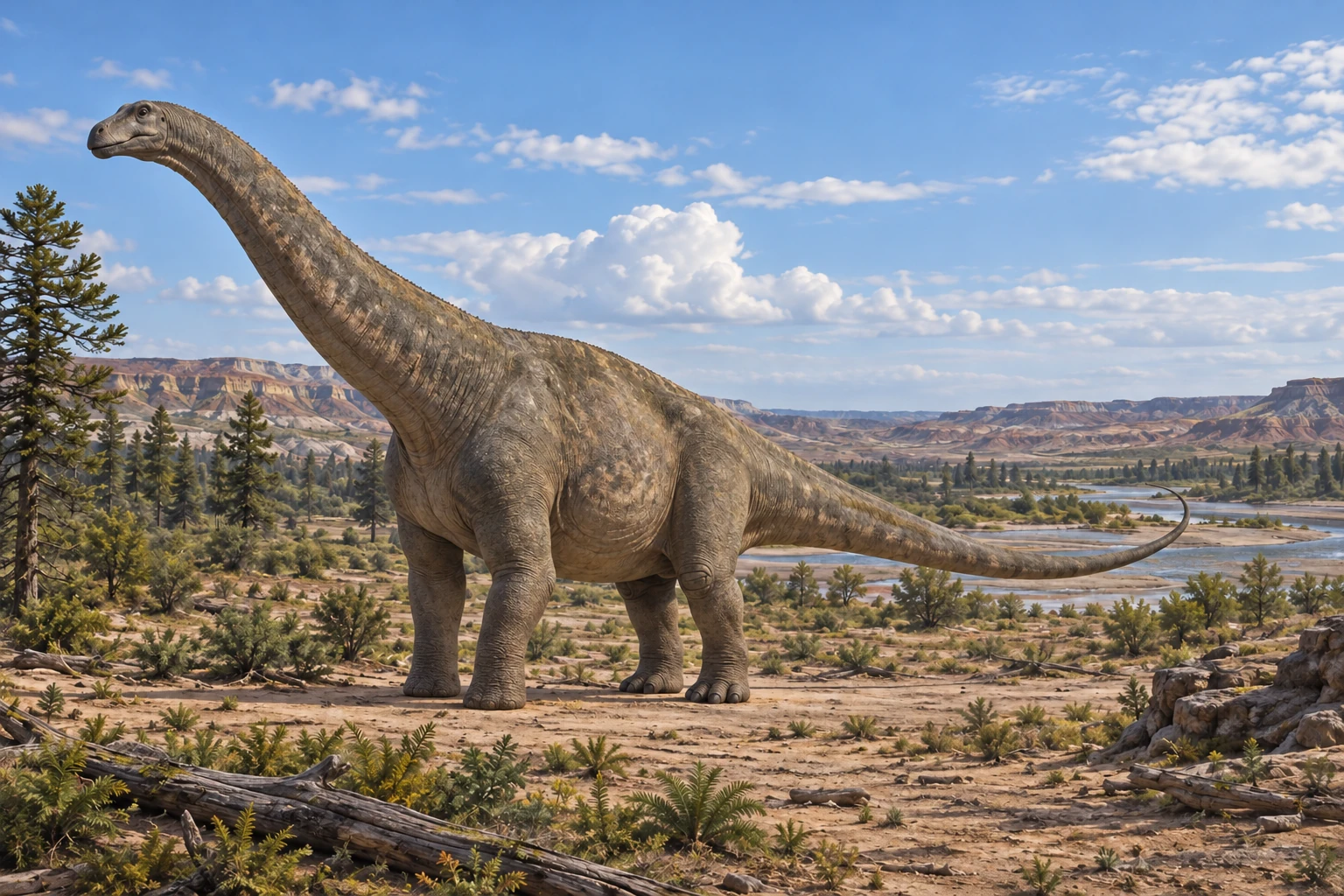
An illustrative reconstruction. Compare its anatomy with the evidence and limitations in the dossier. [1]
Source-informed reconstruction. Appearance evidence [1]. Original illustration; missing anatomy, coloration and scenery include interpretation.
Fossils constrain this life reconstruction. Missing anatomy, coloration and the environmental scene include interpretation; the dossier explains the evidence limits.
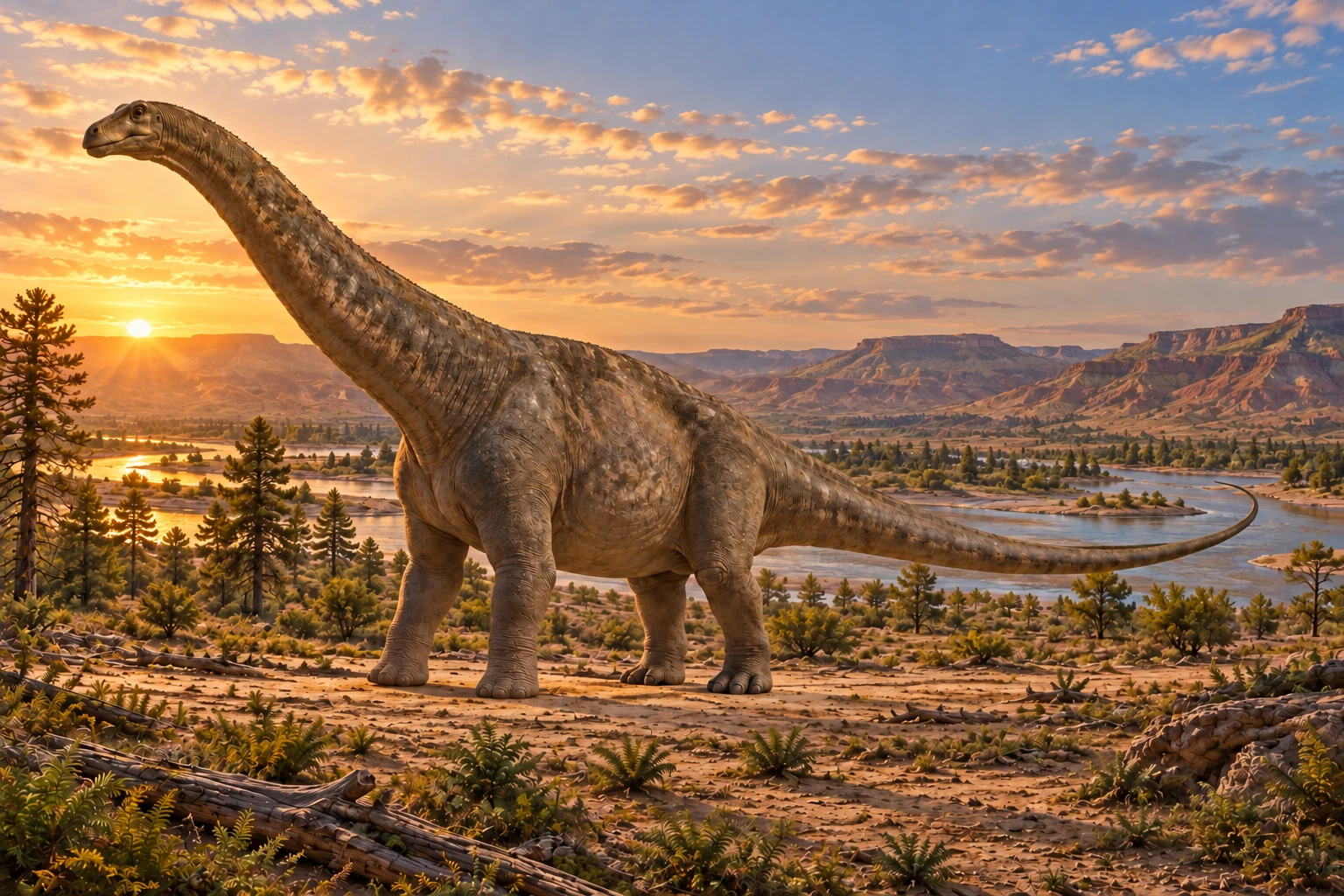
An illustrative reconstruction. Compare its anatomy with the evidence and limitations in the dossier. Lighting, coloration and scenery are artistic choices. This image does not document a fossil locality or behavior.
Original artwork · artistic interpretation.
Scientific view: source-informed reconstruction, credited paleoart or specimen-based imagery. Movie-style view: Original artistic interpretation. Reconstructions involve uncertainty.
MEET THE ANIMAL
Notocolossus was an enormous plant-eating dinosaur from Argentina. It belonged to the titanosaurs, the long-necked sauropod group that included many giants. The discovery came from southern Mendoza Province and brought together researchers from Argentina and abroad. Despite its impressive size, the known fossils are incomplete, so a whole-body drawing must include parts restored by comparison. [D3]
One individual supplied a huge upper-arm bone measuring 1.76 meters. Another, smaller individual preserved a complete articulated hind foot. Keeping those animals separate matters: the foot was not discovered attached to the giant arm. Its short, sturdy bones and reduced toes help researchers investigate the support structures that carried a titanosaur’s weight across the ground. [D1]
How big was the complete animal? The research-team announcement suggested about 25–28 meters and 40–60 tonnes if its proportions resembled better-preserved titanosaurs. Those are conditional estimates, rather than measurements of a complete skeleton or limits for every adult. The uncertainty does not make the foot less useful. Often a rare, well-preserved body part teaches us more than a dramatic claim about being the largest dinosaur. [D2]
PREHISTORIC ANIMAL DOSSIER
The animal, the evidence, and the questions still open.
A gigantic upper-arm bone and a complete hind foot do not belong to the same described individual. [D1]
Profile scope: This exhibit concerns Notocolossus gonzalezparejasi from Argentina’s Plottier Formation; two partial individuals supply different anatomical evidence. [D1]
Source supported identifies a description documented by the cited source. Inferred marks a reconstruction or functional estimate. Debated marks competing interpretations. Not established means the sources reviewed for this dossier do not support a firm conclusion; it does not mean a behavior never occurred.
A size reference is an estimate, not a population range. Nesting evidence does not by itself establish courtship, mate choice, or lifelong pairing.
Conditional reference reconstruction:25–28 m.
Assumes proportions comparable to better-preserved titanosaurs; not a measured complete body or population range. [D2]
Conditional reference estimate:40–60 tonnes.
Comparative proportions and missing anatomy create uncertainty; this is not a measured adult range. [D2]
Plant-eating sauropod inferred.
No skull or stomach contents establish its preferred foods. [D2]
Continental Plottier Formation setting.
The locality establishes geographic and geological occurrence, not an exclusive microhabitat. [D3]
Four-legged terrestrial support inferred.
The compact hind foot helps investigate weight support; speed is unresolved. [D1]
Gigantic humerus and short, robust hind-foot bones.
The articulated foot belongs to smaller LD 302, not giant holotype LD 301. [D1]
Not established here
Neither described partial skeleton establishes assigned eggs, embryos or nests. [D1]
Not established here
The inspected specimen description establishes no mating display or sexual dimorphism. [D1]
Not established here
Two separate partial individuals do not establish a herd or family group. [D3]
Sources and inspection notes for the claims in this profile.
THE STORY IN THE FOSSILS
A complete foot is especially useful when investigating how giant sauropods supported themselves. Its reduced toe bones challenge assumptions drawn from incomplete relatives. [2]
The discovery came from southern Mendoza and involved Argentine and international researchers. Separate fossil inventories remain essential when reconstructing an enormous animal. [3]
The dossier identifies the scope of each reference estimate. A mount, an individual fossil and a species-wide adult range are different measurements. Comparison metrics remain unavailable where adult scope has not been established. Unknown does not mean zero.
Sources support the stated claims and scopes. Refer to the evidence notes for uncertainty.
KEEP EXPLORING
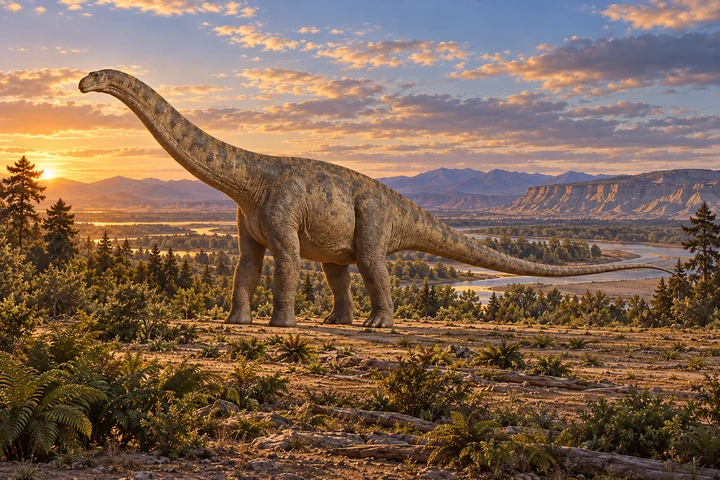
Futalognkosaurus dukei
Dinosaur
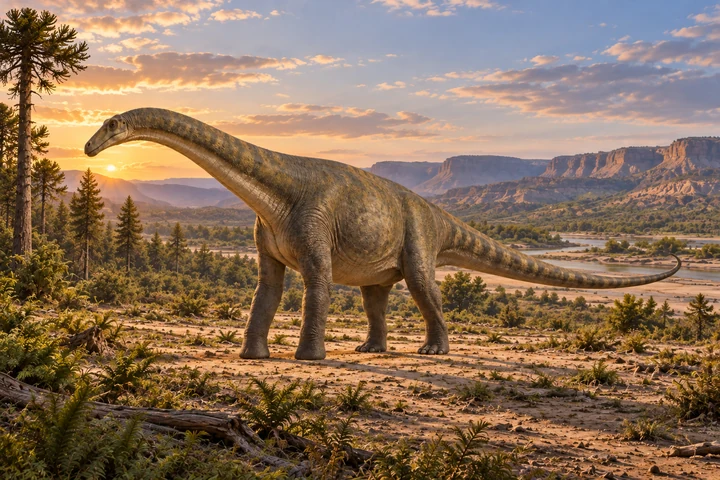
A Patagonian titanosaur with a robust neck and preserved neck, trunk and pelvis skeleton.
Sarmientosaurus musacchioi
Dinosaur
A Patagonian plant-eating titanosaur whose unusually complete skull allowed researchers to investigate its head and senses.
Tyrannosaurus rex
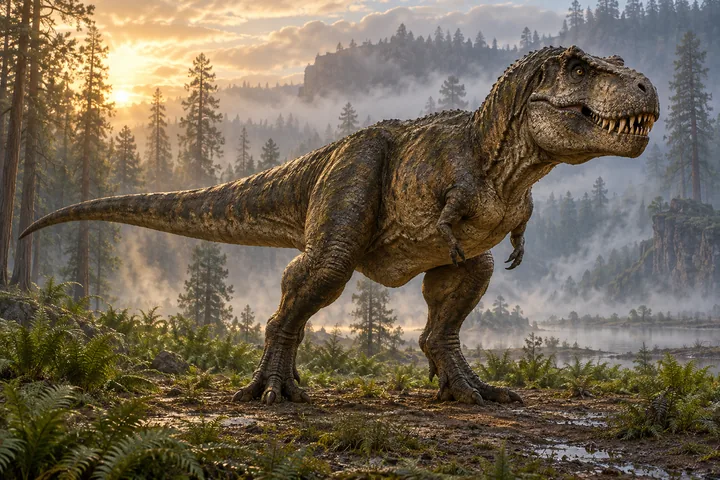
Tyrannosaurus rex was a large meat-eating dinosaur from the final part of the Cretaceous in western North America. Fossil teeth, bite marks and skeletons reveal a powerful animal whose behaviour still invites questions.