EXPLORE PREHISTORY 220 prehistoric animal profiles · Scientific & movie-style image galleries

EXHIBIT 01

Tyrannosaurus

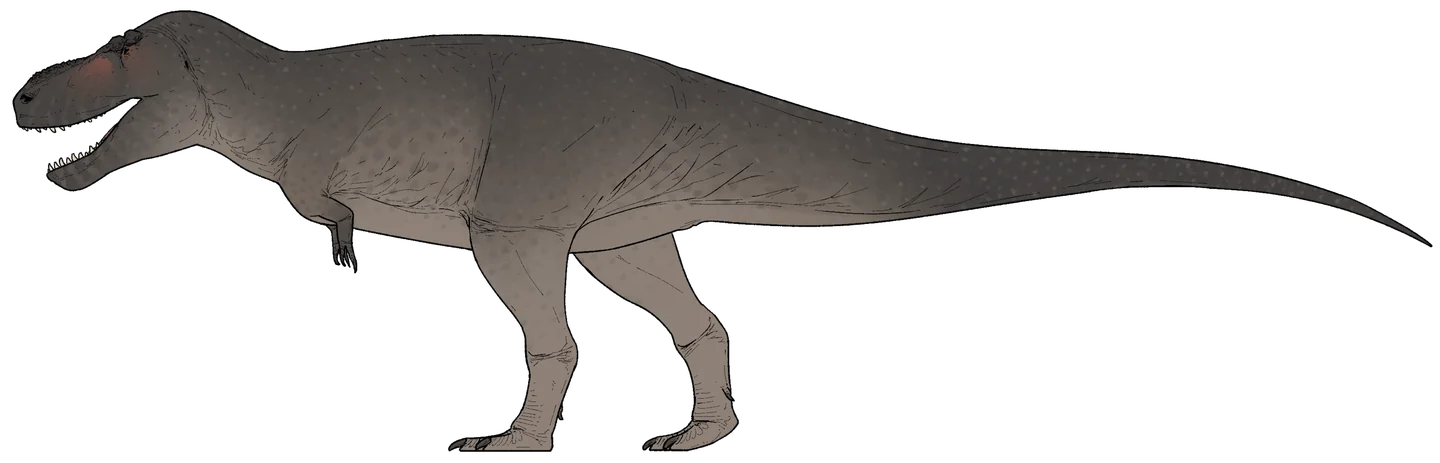
Tyrannosaurus rex

Bone-crushing jaws left traces of meals in the fossil record.

Evidence profile
PERIODLate Cretaceous[1]
DIETCarnivoreInferred from related anatomy [1]
TOTAL LENGTH12–13 mApproximate adult reference estimate [4][2]
FOSSILS FOUNDWestern North America, USA, Canada[1]
CompareRead the dossierView the sources

MEET THE ANIMAL

Meet Tyrannosaurus

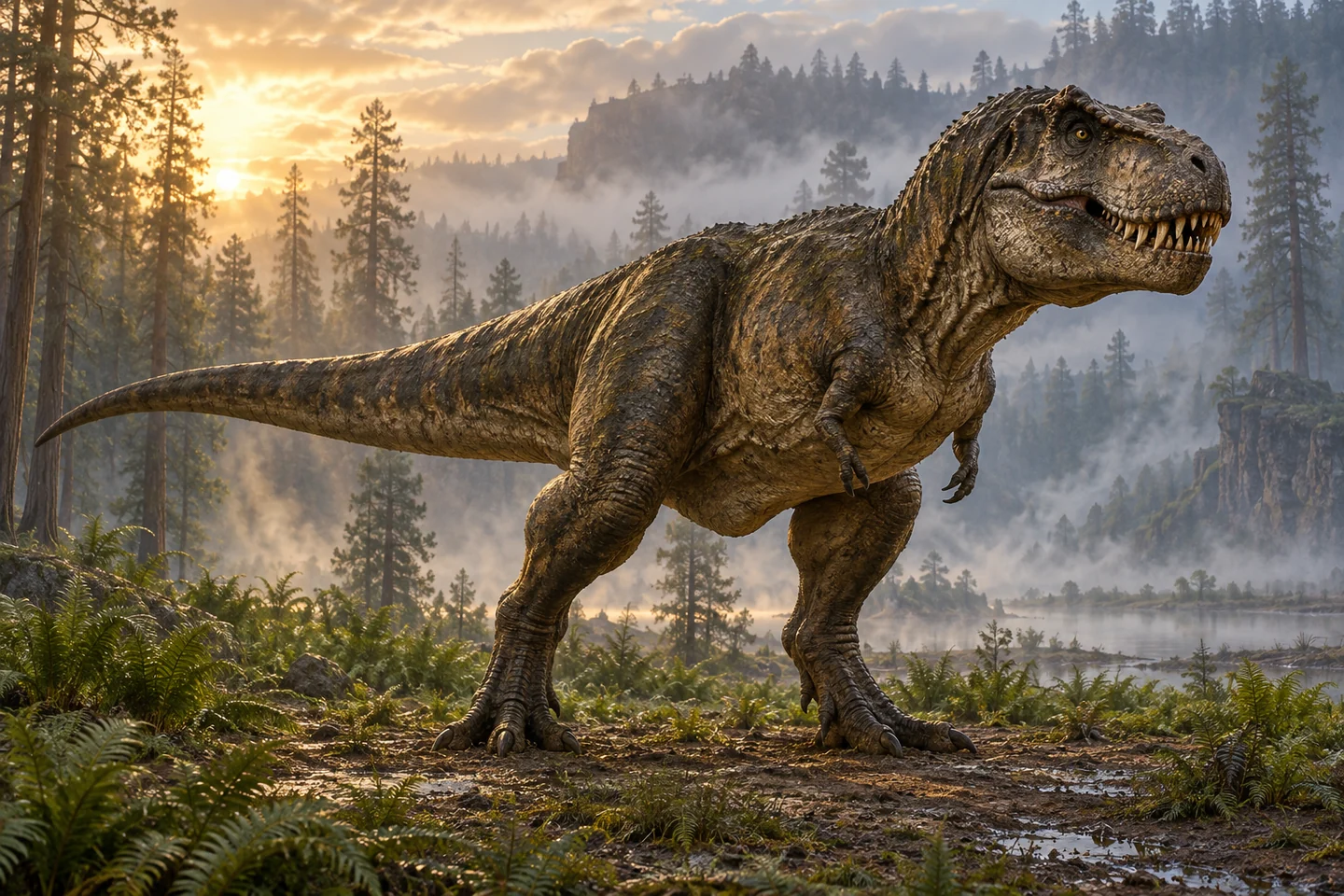
Tyrannosaurus rex lived near the end of the Cretaceous Period in western North America. Fossils from the United States and Canada reveal a large animal that moved on two legs. Its huge skull and strong teeth give it a very different outline from the small arms beneath its shoulders. Those arms are familiar, but their exact jobs remain uncertain. [S1]

Tyrannosaurus was equipped for powerful feeding. Strong jaws and large teeth could tear flesh and crush bone, supporting its role as a meat eater. The museum account also allows scavenging an animal that was already dead. Feeding capability does not establish how every meal was obtained: an animal can hunt and scavenge, and an imposing jaw alone does not preserve the details of a particular kill. [S1]

One individual provides an especially unusual clue about reproduction. Researchers identified bone tissue associated with producing eggs in the specimen called MOR 1125. This gives us information about that animal, rather than a complete picture of every Tyrannosaurus. It does not reveal the number of eggs in a nest or how parents cared for young. Fossils can answer a narrow question while leaving much of an animal's life open. [D3]

Overview sources
  1. Dinosaur - Tyrannosaurus rexAustralian Museum · Accessed 2026-10-04Inspected: page

PREHISTORIC ANIMAL DOSSIER

A life in profile.

The animal, the evidence, and the questions still open.

Tyrannosaurus rex was a large predator from the closing Cretaceous of western North America. Its teeth and feeding traces support bone consumption; reproductive tissue offers a rare window into an individual's biology.

Profile scope: Species — Tyrannosaurus rex

Time
Late Cretaceous
Fossil locations in this exhibit
Western North America, USA, Canada
How to read the evidence

Source supported identifies a description documented by the cited source. Inferred marks a reconstruction or functional estimate. Debated marks competing interpretations. Not established means the sources reviewed for this dossier do not support a firm conclusion; it does not mean a behavior never occurred.

A size reference is an estimate, not a population range. Nesting evidence does not by itself establish courtship, mate choice, or lifelong pairing.

Body length

Inferred

About 12–13 m (museum reference)

The museum gives about 12 m, with large specimens nearing 13 m. These are reconstruction references rather than a complete growth or population range; maturity is not assessed for each estimate. [D1]

Body mass

Inferred

About 7 tonnes (museum reference)

The museum's rounded reference is 7,000 kg; larger specimens receive estimates above 8,000 kg. Fossil body mass requires reconstruction rather than weighing. [D1]

Diet and feeding

Source supported

Meat; hunting and scavenging

Teeth, bite marks on herbivores and bone fragments in attributed dung support meat and bone consumption. Feeding marks alone do not identify a kill. [D1]

Habitat and setting

Source supported

Western North America

Fossils occur in Montana, South Dakota and Alberta. This establishes regional occurrence rather than a single preferred microhabitat. [D2]

Movement

Source supported

Two-legged terrestrial movement

Its hindlimbs supported a bipedal animal. Published maximum-speed estimates depend on biomechanical assumptions. [D1]

Distinctive anatomy

Source supported

Large skull, strong teeth, small arms

Its large skull and bone-crushing teeth contrast with short forelimbs. The forelimbs' precise functions remain uncertain. [D1]

Reproduction & life together

Reproduction and nesting

Source supported

Egg production supported in MOR 1125

Chemical and histological tests identify medullary tissue associated with egg production in this individual. This does not reveal clutch size, nests or parental care. [D3]

Mating and courtship

Not established

Not established here

Reviewed sources do not establish a T. rex courtship sequence or mating posture.

Social behaviour

Source supported

Biting interactions; pack hunting unconfirmed

Marks on tyrannosaur bones document interactions involving bites. Their motives and coordinated hunting are unresolved. [D1]

Dossier research & sources

Sources and inspection notes for the claims in this profile.

  1. TyrannosaurusNatural History Museum, London · Accessed 2026-10-02T. rex profile; museum size references, feeding and interactions · Inspected: page
  2. 7 Questions About Tyrannosaurus rexAmerican Museum of Natural History · Accessed 2026-10-02Western North American fossil occurrence and skeletal context · Inspected: page
  3. Pregnant T. Rex Could Aid in Dino Sex-TypingNorth Carolina State University · Accessed 2026-10-02Research team's account of medullary tissue in MOR 1125 · Inspected: page

THE STORY IN THE FOSSILS

Meet Tyrannosaurus.

Tyrannosaurus rex lived about 68–66 million years ago. Its fossils come from western North America, including Montana and South Dakota in the United States and Alberta in Canada. The Natural History Museum gives about 12 metres as a reference length and describes large specimens such as Sue and Scotty as nearly 13 metres long. [3] [1] [2]

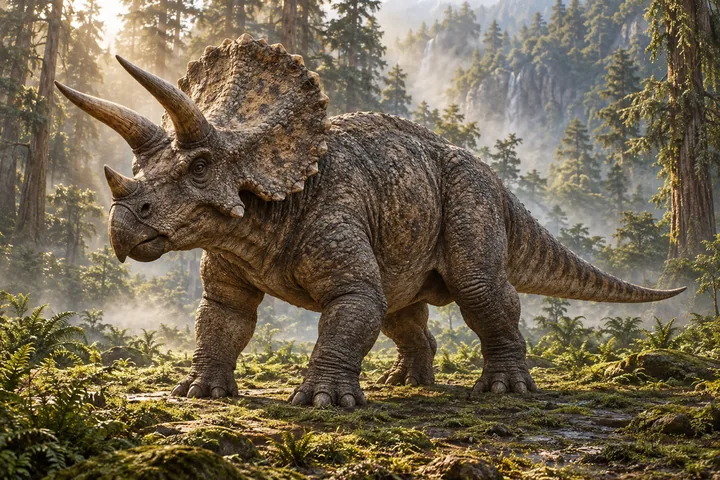
Its jaws and teeth could break bone. Bite marks attributed to Tyrannosaurus occur on Triceratops and Edmontosaurus fossils, providing evidence of feeding. A bite mark alone does not tell us whether the animal was killed or scavenged. The Natural History Museum describes T. rex as both a hunter and a scavenger. [7] [2]

Barnum Brown recovered the partial skeleton that became the species' name-bearing specimen in Montana's Hell Creek Formation in 1902. Henry Fairfield Osborn named Tyrannosaurus rex in 1905. Even this familiar dinosaur is reconstructed from incomplete evidence: many recovered skeletons lack substantial parts. [1]

A note on scale and time

Approximate museum reference for adult-sized T. rex, including large known specimens; total body length, not height. This published 12–13 m reference is not a complete biological size range or a population confidence interval. The cited dates are approximately 68–66 million years ago. Unknown does not mean zero.

About 7,000 kg: the Australian Museum's T. rex reference estimate at the same educational scope as its 12–13 m length. A single rounded estimate, not a fixed mass or species-wide mass interval. Life stage and estimation method are not specified by the museum. [4]

Sources & editorial notes

Sources and evidence notes for this exhibit.

  1. 7 Questions About Tyrannosaurus rexAmerican Museum of Natural History · Accessed 2026-10-02Introduction; Where did T. rex live?; How fast was T. rex?; When was T. rex discovered? Species-specific page. Opened and read.
  2. TyrannosaurusNatural History Museum, London · Accessed 2026-10-02What did Tyrannosaurus eat?; How big was Tyrannosaurus?; What were Tyrannosaurus' arms used for? Header is genus-level; used numerical and feeding statements explicitly naming T. rex. Opened and read.
  3. What Do You Know About T. rex?American Museum of Natural History · Accessed 2026-10-02Question 6 explanation explicitly distinguishes Tyrannosaurus rex (about 68–66 Ma) from the wider tyrannosaur group. Opened and read.
  4. Dinosaur lifecycles: from go to woeAustralian Museum · Accessed 2026-10-02Smallest and largest, largest meat-eater list: explicitly gives Tyrannosaurus rex 12–13 m and 7 tonnes. Species-named educational reference, life stage and method unspecified; not a biological size interval.
  5. Tyrannosauroid integument reveals conflicting patterns of gigantism and feather evolutionBell et al., Biology Letters / University of New England author repository · Accessed 2026-10-02Abstract; full-text PMC search extract identifies the T. rex specimen Wyrex
  6. Read Their Lips?Auburn University, reporting Cullen's own research · Accessed 2026-10-02Researcher's account of tooth wear, skull proportions and oral tissues
  7. The Biomechanics Behind Extreme Osteophagy in Tyrannosaurus rexGignac & Erickson, Scientific Reports · Accessed 2026-10-02Abstract and indexed original-paper text on trace evidence, tooth–bone contacts and Triceratops/Edmontosaurus feeding damage. DOI 10.1038/s41598-017-02161-w. Publisher opening returned an error; inspected indexed publisher excerpts, not full text.
  8. Tyrannosauroid integument reveals conflicting patterns of gigantism and feather evolutionBell et al., Biology Letters / author-posted full paper · Accessed 2026-10-02pp. 2–3, Methods, Results (a) Description and Discussion; DOI 10.1098/rsbl.2017.0092. Original paper read, including Wyrex HMNS 2006.1743.01 skin patches. This is not direct Black Beauty integument.
  9. Theropod dinosaur facial reconstruction and the importance of soft tissues in paleobiologyCullen et al., Science / author-posted full text · Accessed 2026-10-02Abstract; main text pp. 1348–1351; figures 1–4. DOI 10.1126/science.abo7877. Original author-posted text read. Tooth/skull proportions and comparative histology support closed-mouth soft-tissue coverage; not preserved T. rex lips.

FOLLOW YOUR CURIOSITY

Who will you meet next?

KEEP EXPLORING

More from the collection