EXPLORE PREHISTORY 220 prehistoric animal profiles · Scientific & movie-style image galleries

EXHIBIT 04

Brachiosaurus

Brachiosaurus altithorax

Air-filled ribs, towering shoulders, and a fossil record with big gaps.

Evidence profile
PERIODLate Jurassic[2]
DIETHerbivoreInferred from related anatomy [4]
TOTAL LENGTHNot established hereComparable estimate unavailable
FOSSILS FOUNDNorth America, USA, Colorado[2]
CompareRead the dossierView the sources

MEET THE ANIMAL

Meet Brachiosaurus

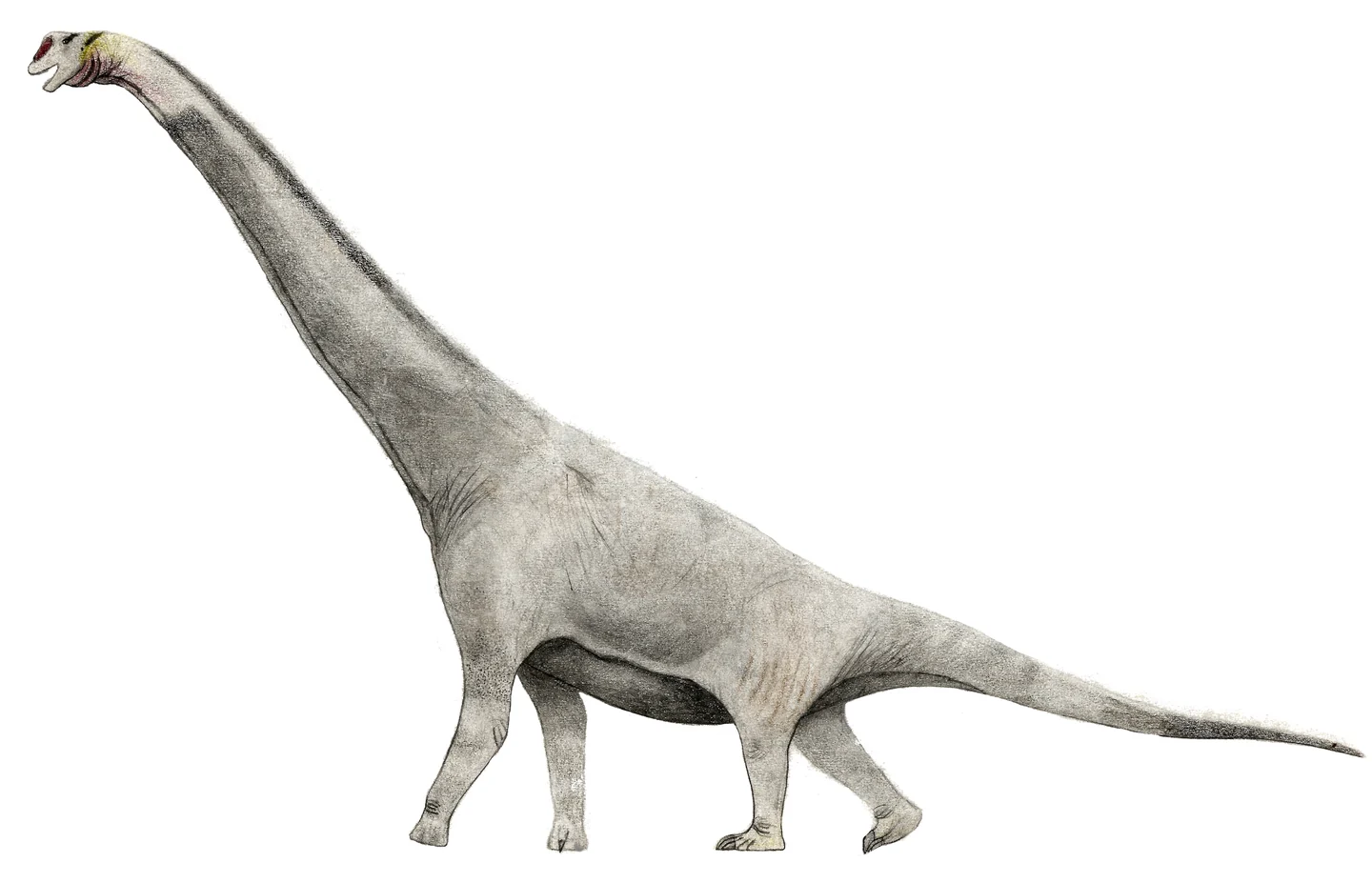
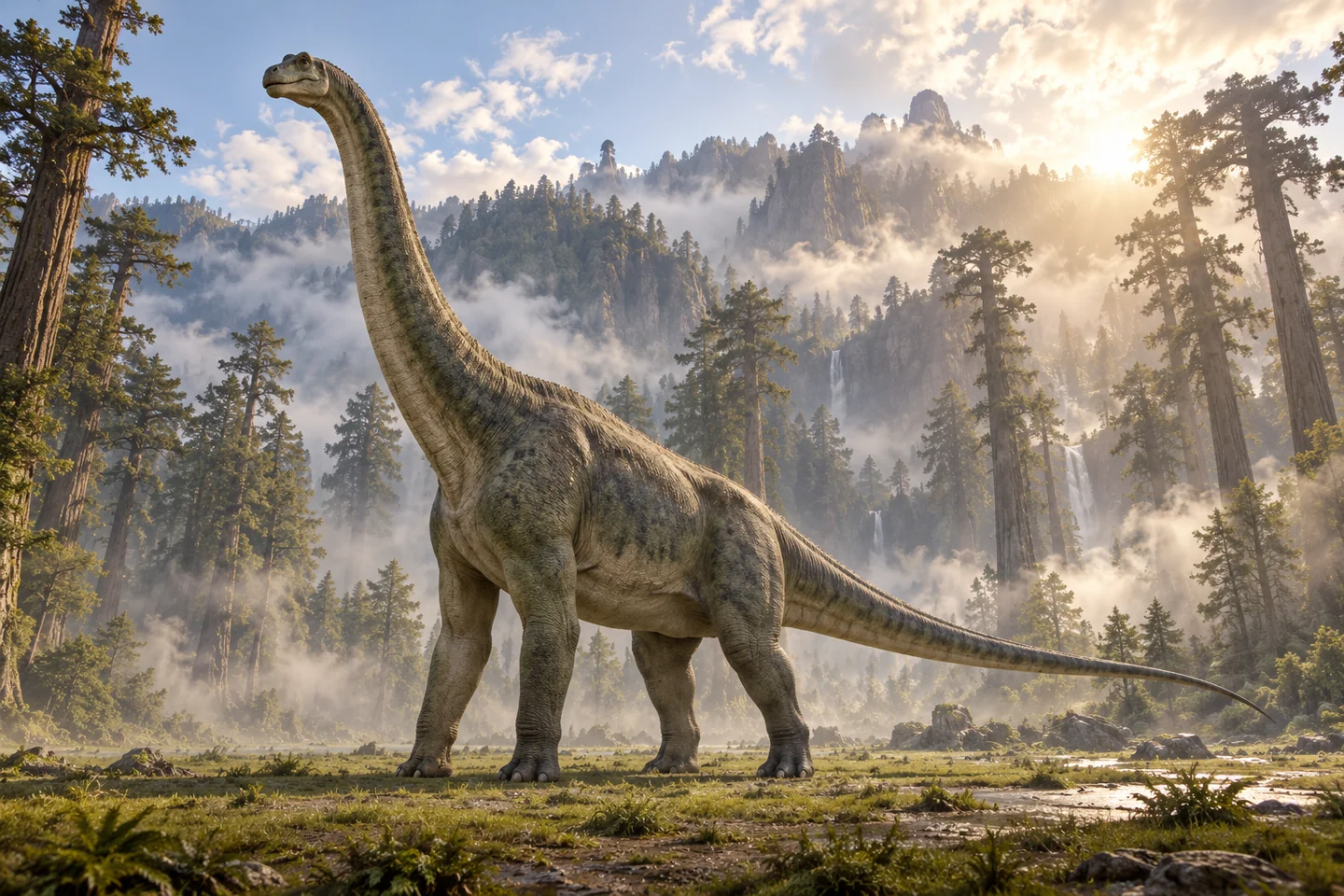
Brachiosaurus altithorax was a large plant-eating dinosaur from the Late Jurassic of North America. It belonged to the sauropods, the group that includes many long-necked dinosaurs. Long front limbs contributed to its high shoulders, giving it a different body shape from sauropods with much shorter front legs. Fossils place this American dinosaur in the Late Jurassic. [S1]

The American animal should be distinguished from Giraffatitan, an African dinosaur once placed in the same genus. The original Brachiosaurus skeleton lacks important parts, so a complete body outline depends partly on comparisons with relatives. Published length and weight reconstructions are estimates built around particular remains and assumptions. The original individual had not finished growing, which makes it especially important to avoid treating its estimate as a species-wide adult maximum. [S1]

Even a small detail inside a bone can matter. Openings in ribs show that parts of the respiratory system extended into the skeleton. These air spaces help researchers investigate anatomy that would otherwise be lost. Other aspects of its life remain less clear: the reviewed evidence does not identify its nests, mating displays or herd structure. A towering reconstruction should not hide those gaps in the fossil record. [D3]

Overview sources
  1. BrachiosaurusNatural History Museum, London · Accessed 2026-10-04Inspected: page

PREHISTORIC ANIMAL DOSSIER

A life in profile.

The animal, the evidence, and the questions still open.

Brachiosaurus altithorax is the American brachiosaur from the Late Jurassic Morrison Formation. Its incomplete fossils differ from African Giraffatitan, so complete body reconstructions require explicitly stated comparisons.

Profile scope: Species — Brachiosaurus altithorax

Time
Late Jurassic
Fossil locations in this exhibit
North America, USA, Colorado
How to read the evidence

Source supported identifies a description documented by the cited source. Inferred marks a reconstruction or functional estimate. Debated marks competing interpretations. Not established means the sources reviewed for this dossier do not support a firm conclusion; it does not mean a behavior never occurred.

A size reference is an estimate, not a population range. Nesting evidence does not by itself establish courtship, mate choice, or lifelong pairing.

Body length

Inferred

Maybe about 25 m (subadult reconstruction)

Taylor's tentative reconstruction concerns the holotype-sized animal. Missing head, neck and tail geometry uses comparisons with Giraffatitan; this is not a directly measured complete skeleton or adult maximum. [D2]

Body mass

Inferred

About 28.7 tonnes (2009 model)

Taylor's holotype-based model gives 28,688 kg with assumed density and reconstructed missing parts. The holotype was subadult; this is not a species-wide adult mass. [D1]

Diet and feeding

Inferred

Plant eater

Sauropod relationships support herbivory, and the museum includes this species among plant-eating sauropods. Exact plant selection is unreviewed. [D4]

Habitat and setting

Source supported

Morrison Formation, North America

The study identifies Late Jurassic fossils from Colorado, Utah and Oklahoma, with some referrals uncertain. Precise microhabitat preference is unreviewed. [D1]

Movement

Inferred

Four-legged terrestrial movement

Limb anatomy and sauropod comparisons support quadrupedal movement. A precise gait or maximum speed is not established here. [D1] [D4]

Distinctive anatomy

Source supported

High shoulders; air spaces in ribs

Long forelimbs contributed to high shoulders. Pneumatic rib openings record respiratory-system extensions into bone. [D1] [D3]

Reproduction & life together

Reproduction and nesting

Not established

Not established here

Reviewed sources do not identify B. altithorax eggs, clutch size or nest behaviour.

Mating and courtship

Not established

Not established here

Reviewed sources do not establish B. altithorax mating displays or mating posture.

Social behaviour

Not established

Not established here

Reviewed sources do not establish a B. altithorax herd structure or group size.

Dossier research & sources

Sources and inspection notes for the claims in this profile.

  1. A re-evaluation of Brachiosaurus altithorax and its generic separation from Giraffatitan brancaiJournal of Vertebrate Paleontology; Michael P. Taylor (2009) · Accessed 2026-10-02B. altithorax anatomy, holotype-based mass model and subadult status · Inspected: page
  2. How big was Brachiosaurus altithorax? I mean, really?Michael P. Taylor, Sauropod Vertebra Picture of the Week · Accessed 2026-10-02Researcher's explicitly tentative whole-body length reconstruction · Inspected: page
  3. Novel pneumatic features in the ribs of Brachiosaurus altithoraxActa Palaeontologica Polonica; Taylor and Wedel (2023) · Accessed 2026-10-02Pneumatic openings in holotype ribs · Inspected: page
  4. Herbivorous heavyweightsAustralian Museum · Accessed 2026-10-02B. altithorax listed within plant-eating, quadrupedal sauropods · Inspected: page

THE STORY IN THE FOSSILS

Meet Brachiosaurus.

The type skeleton of Brachiosaurus altithorax was collected in western Colorado in 1900 and named by Elmer Riggs in 1903. It includes vertebrae, ribs, girdle material, a right humerus and a right femur, but lacks a skull and neck. The humerus helped establish its distinctive high-shouldered proportions. [1]

A 2023 study found openings into air spaces in two ribs. This skeletal pneumaticity records extensions of the respiratory system entering bones. Herbivory is inferred from its sauropod identity; the Australian Museum explicitly lists B. altithorax among a group introduced as plant-eating sauropods. [2] [4] [1]

B. altithorax differs from Giraffatitan brancai, an African dinosaur once assigned to Brachiosaurus. A detailed comparison supports separate genera and a longer, deeper trunk in the American animal. Complete-looking reconstructions contain substantial inference because the American fossils leave much of the body unknown. [1]

A note on scale and time

We have not established a comparable adult total-length estimate for this taxon in this draft. Specimen measurements in the text describe those individuals. A numerical age interval has not been reviewed here. Unknown does not mean zero.

Sources & editorial notes

Sources and evidence notes for this exhibit.

  1. A re-evaluation of Brachiosaurus altithorax Riggs 1903 (Dinosauria, Sauropoda) and its generic separation from Giraffatitan brancai (Janensch 1914)Journal of Vertebrate Paleontology / Society of Vertebrate Paleontology; author-hosted full paper · Accessed 2026-10-02pp. 787–788: abstract, initial finds and missing type-skeleton regions; p. 798: systematic palaeontology; discussion of bodily proportions
  2. Novel pneumatic features in the ribs of the sauropod dinosaur Brachiosaurus altithoraxActa Palaeontologica Polonica · Accessed 2026-10-02p. 709: abstract; pp. 711–712: specimen and referral history; pp. 712–714: rib pneumaticity, figures 2–3 and descriptions
  3. When did dinosaurs live?Natural History Museum, London · Accessed 2026-10-02Jurassic Period section: identifies Brachiosaurus among plant-eating sauropods; genus-level context
  4. Herbivorous heavyweightsAustralian Museum · Accessed 2026-10-02Introduction identifies sauropods as plant-eaters; Sauropod diversity explicitly lists Brachiosaurus altithorax. Diet assignment is an inference from this species’ inclusion in that group, not preserved food. Opened and read.
  5. File:Brachiosaurus althi.jpgLevi bernardo / Wikimedia Commons · Accessed 2026-10-02Creator-supplied Summary names B. altithorax and Scott Hartman skeletal reference; colours inspired by living birds and elephants. Art provenance only.
  6. How big was Brachiosaurus altithorax? I mean, really?Michael P. Taylor / Sauropod Vertebra Picture of the Week · Accessed 2026-10-02Author calculation following 2009 study: uncertain total length about 25 m; immediately identifies compared Brachiosaurus and Giraffatitan specimens as subadult. Do not extrapolate an adult range.

FOLLOW YOUR CURIOSITY

Who will you meet next?

KEEP EXPLORING

More from the collection