
Body length
InferredAbout 2.39 m (femur-based reconstruction)
IGM 100/20; 2007 regression from 273 mm femur. Maturity unverified here. [D4]
EXHIBIT 139
Adasaurus mongoliensis
Adasaurus is distinguished by a reduced claw on its second toe. [1]
TWO WAYS TO PICTURE THE PAST
Compare the evidence with the familiar movie image. The illustrations are not to a shared scale.
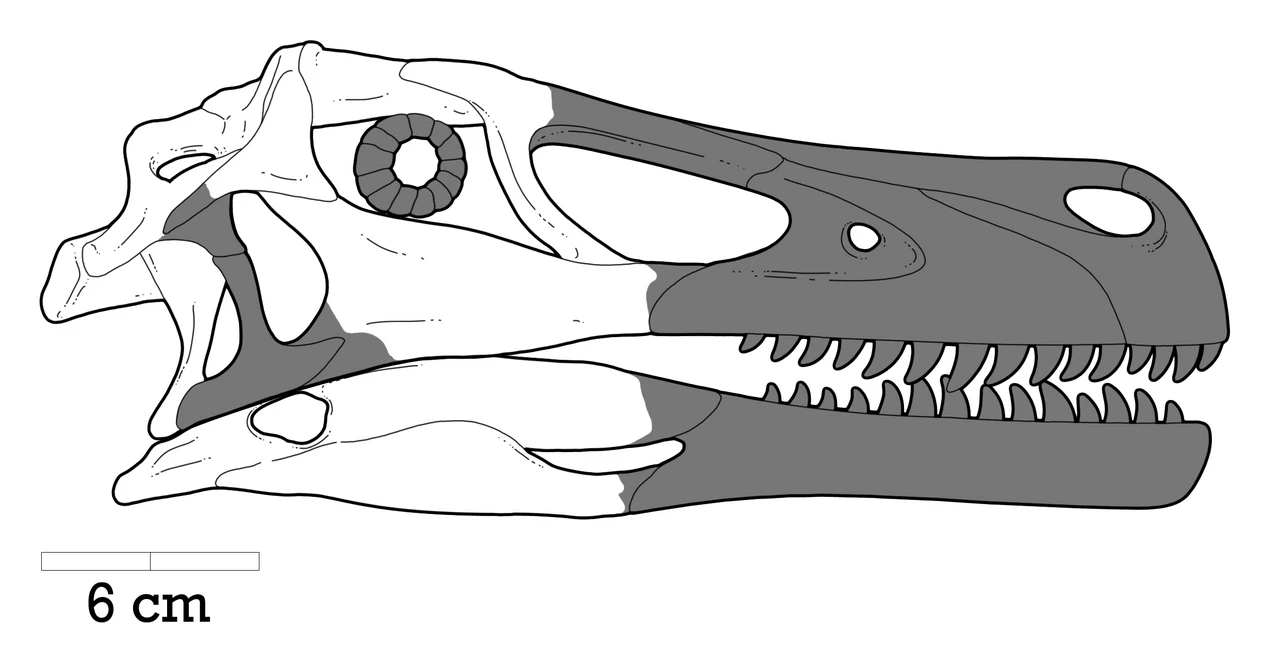
Adasaurus mongoliensis skull restoration by PaleoNeolitic, based on the incomplete IGM 100/20 skull reviewed by Turner and colleagues. White regions represent preserved material; grey regions restore missing anatomy, notably much of the snout. The full outline and teeth in restored regions are comparative reconstruction, not a complete fossil skull. [1]
Adasaurus Skull.png · PaleoNeolitic. CC BY-SA 4.0. Current Commons 1280 px preview converted to WebP and proportionally reduced for thumbnail use. No cropping, mirroring, anatomical edits or compositing; diagram annotations retained. Derivatives retain CC BY-SA 4.0.
Skeletal mounts and drawings may restore missing parts; the caption identifies the displayed material.
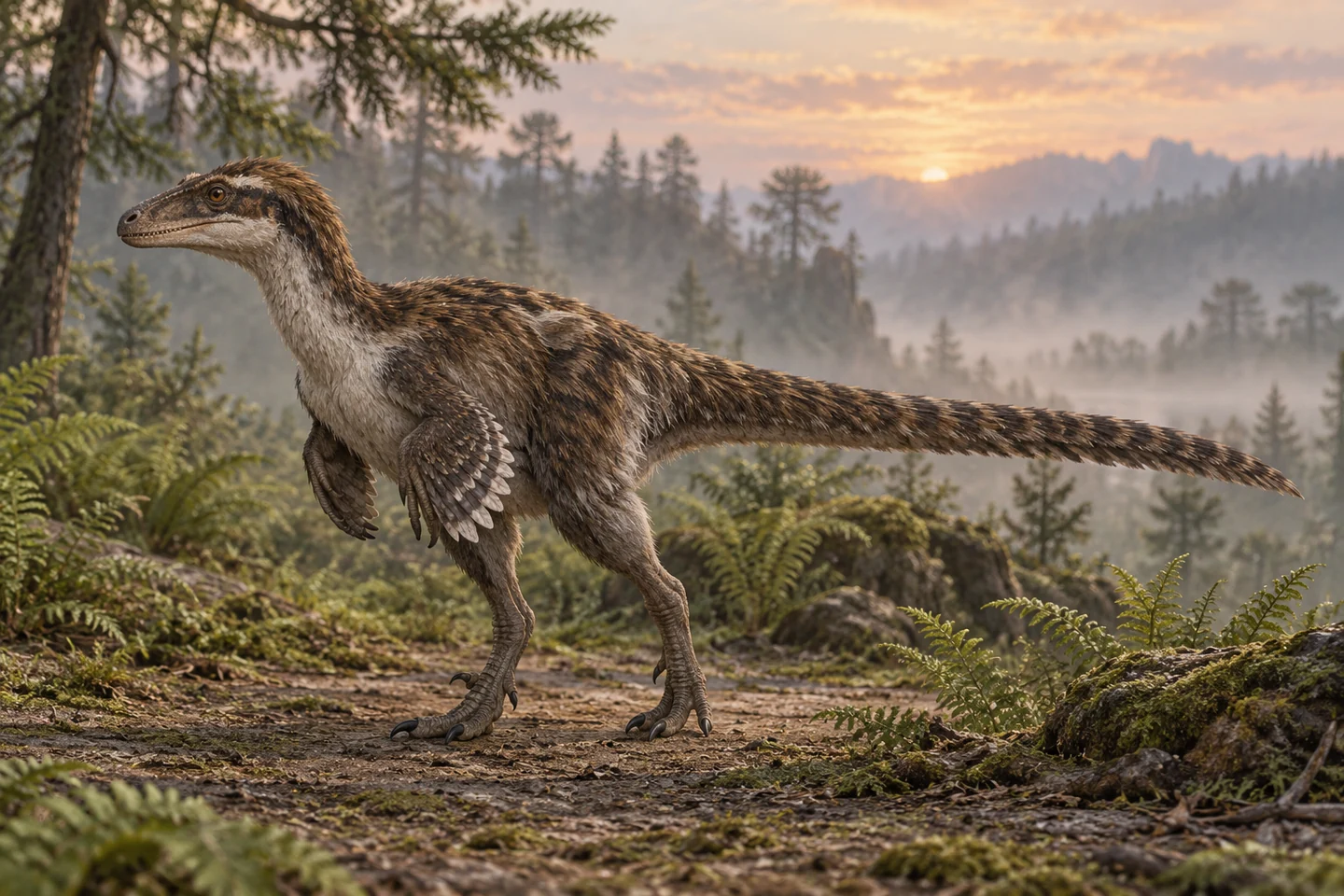
Original cinematic interpretation of Adasaurus. Colors, soft tissues, scenery and missing anatomy are reconstructed artistic choices; this is not a directly observed individual or behavior. The reduced second-toe claw is distinguished from the enlarged sickle claws of many other dromaeosaurs; complete plumage and missing contours remain inferred. Lighting, coloration and scenery are artistic choices. This image does not document a fossil locality or behavior.
Original artwork · artistic interpretation.
Scientific view: source-informed reconstruction, credited paleoart or specimen-based imagery. Movie-style view: Original artistic interpretation. Reconstructions involve uncertainty.
MEET THE ANIMAL
Adasaurus was a dromaeosaurid dinosaur from Late Cretaceous Mongolia. Dromaeosaurids are the group often called raptors. Its fossils come from Bugin Tsav in the Nemegt Formation. The main specimen preserves part of the rear of the skull and an incomplete skeleton; a separate specimen includes tail bones and a foot. Together, they leave substantial gaps in its appearance. [S1]
Its second toe carried an unusually reduced claw, rather than the strongly enlarged claw familiar from many other raptors. Researchers also compare details of its cheek, skull roof and pelvis to distinguish it from related dinosaurs. The claw's shape suggests that its use may have differed, but does not preserve an observed attack or identify a particular prey animal. [S1]
One published size calculation estimated a body length of about 2.39 metres from its thighbone. This method compares a bone's length with body proportions in other dinosaurs to reconstruct missing anatomy. It is an estimate for the fossil used in that calculation, not a complete skeleton measured from nose to tail or a confirmed maximum for the species. [D4]
PREHISTORIC ANIMAL DOSSIER
The animal, the evidence, and the questions still open.
The unusual claw is preserved anatomy; its exact use during hunting remains uncertain. [D1] [D2]
Profile scope: Genus — Adasaurus; A. mongoliensis from Nemegt material. [D1]
Source supported identifies a description documented by the cited source. Inferred marks a reconstruction or functional estimate. Debated marks competing interpretations. Not established means the sources reviewed for this dossier do not support a firm conclusion; it does not mean a behavior never occurred.
A size reference is an estimate, not a population range. Nesting evidence does not by itself establish courtship, mate choice, or lifelong pairing.
About 2.39 m (femur-based reconstruction)
IGM 100/20; 2007 regression from 273 mm femur. Maturity unverified here. [D4]
About 44 kg (limb model)
IGM 100/20; measured femoral circumference; maturity unverified. [D3]
Animal prey inferred
Carnivory is inferred comparatively from dromaeosaurid relationships; the preserved skull is largely posterior, and restored teeth are not evidence of a specific meal. [D1]
Nemegt Formation, Bugin Tsav
Late Cretaceous Mongolia; locality alone does not define complete habitat preference. [D1]
Two-legged movement inferred
Hindlimb and foot material support bipedal reconstruction; the reduced claw does not measure running speed. [D2]
Reduced second-toe claw
The original description and revised diagnosis retain a small ungual on digit II. [D1] [D2]
Not established here
Reviewed descriptions establish no assigned eggs or parental-care record. A fusion observation alone does not diagnose reproductive maturity. [D1] [D2]
Not established here
The original description does not identify sex-specific ornaments or a directly supported mating sequence. [D1]
Not established here
Type and referred material do not establish a social group or coordinated hunting. [D1]
Sources and inspection notes for the claims in this profile.
THE STORY IN THE FOSSILS
A smaller second-toe ungual changes the familiar raptor silhouette. It cannot identify exactly how this dinosaur caught prey. [1]
The skull is incomplete; restorations distinguish the preserved rear skull from the reconstructed snout. [2]
The dossier identifies the scope of each reference estimate. A mount, an individual fossil and a species-wide adult range are different measurements. Comparison metrics remain unavailable where adult scope has not been established. Unknown does not mean zero.
Sources support the stated claims and scopes. Refer to the evidence notes for uncertainty.
KEEP EXPLORING
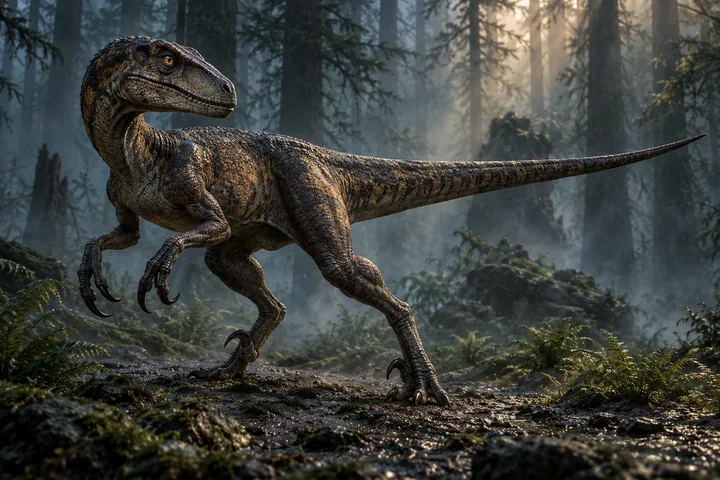
Velociraptor mongoliensis
Velociraptor mongoliensis was a lightly built meat-eater from Late Cretaceous Mongolia. Its long limbs, teeth and enlarged foot claws made it distinctive, while the Fighting Dinosaurs specimen records a remarkable interaction with a horned dinosaur.
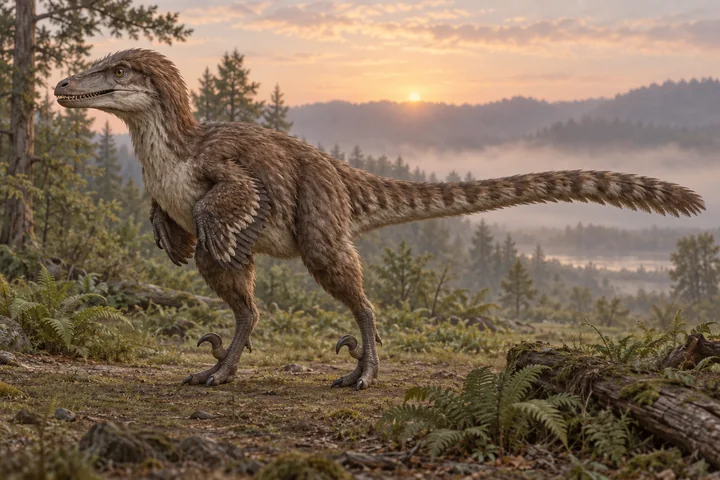
Achillobator giganticus
Achillobator had distinctive limb and pelvic proportions.
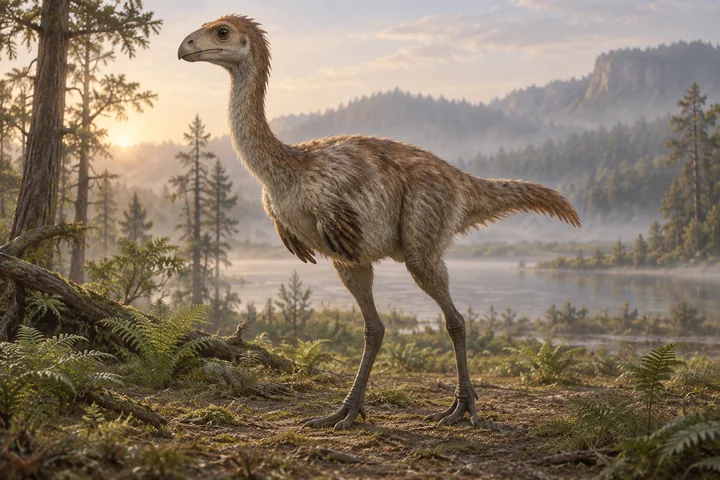
Avimimus portentosus
Avimimus has a compact head and an unusually informative bonebed.