
Body length
InferredAbout 1.8 m (museum reference)
The museum card gives this approximate species reference. It does not identify a measured specimen, maturity assessment or population range. [D1]
EXHIBIT 06
Velociraptor mongoliensis
A small predator whose famous fossil preserves an encounter with Protoceratops.
TWO WAYS TO PICTURE THE PAST
Compare the evidence with the familiar movie image. The illustrations are not to a shared scale.
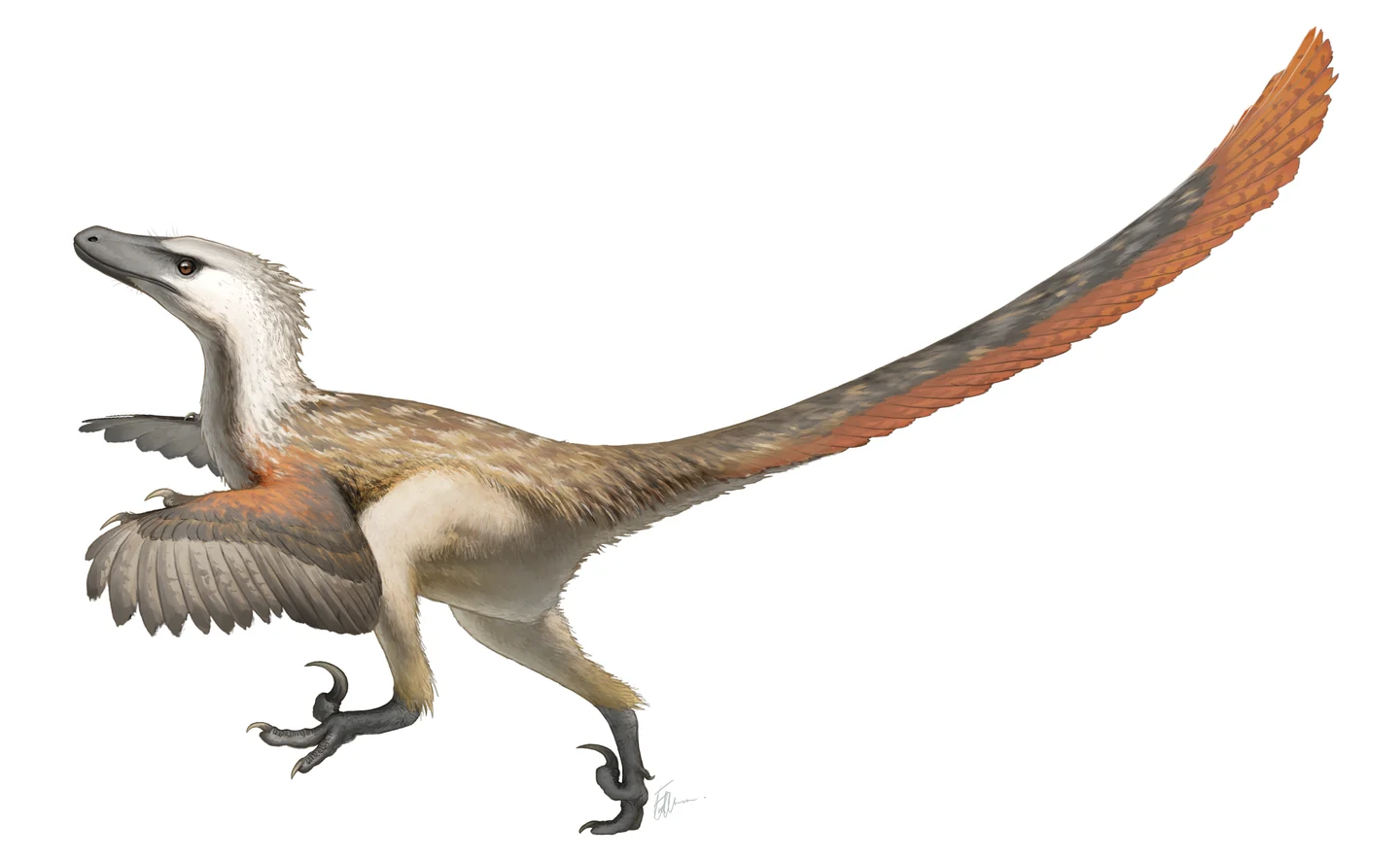
A feathered reconstruction with wing-like arm feathers and enlarged second-toe claws. Feathered relatives support this interpretation for V. mongoliensis. The quill-knob fossil often cited as direct evidence has a questioned species assignment; a 2023 proposal that it represents another species remains preliminary. The exact plumage, colors and pose are interpretations. [2] [7] [8] [6]
Velociraptor Restoration — Fred Wierum. CC BY-SA 4.0. Resized and converted to WebP; complete composition retained.
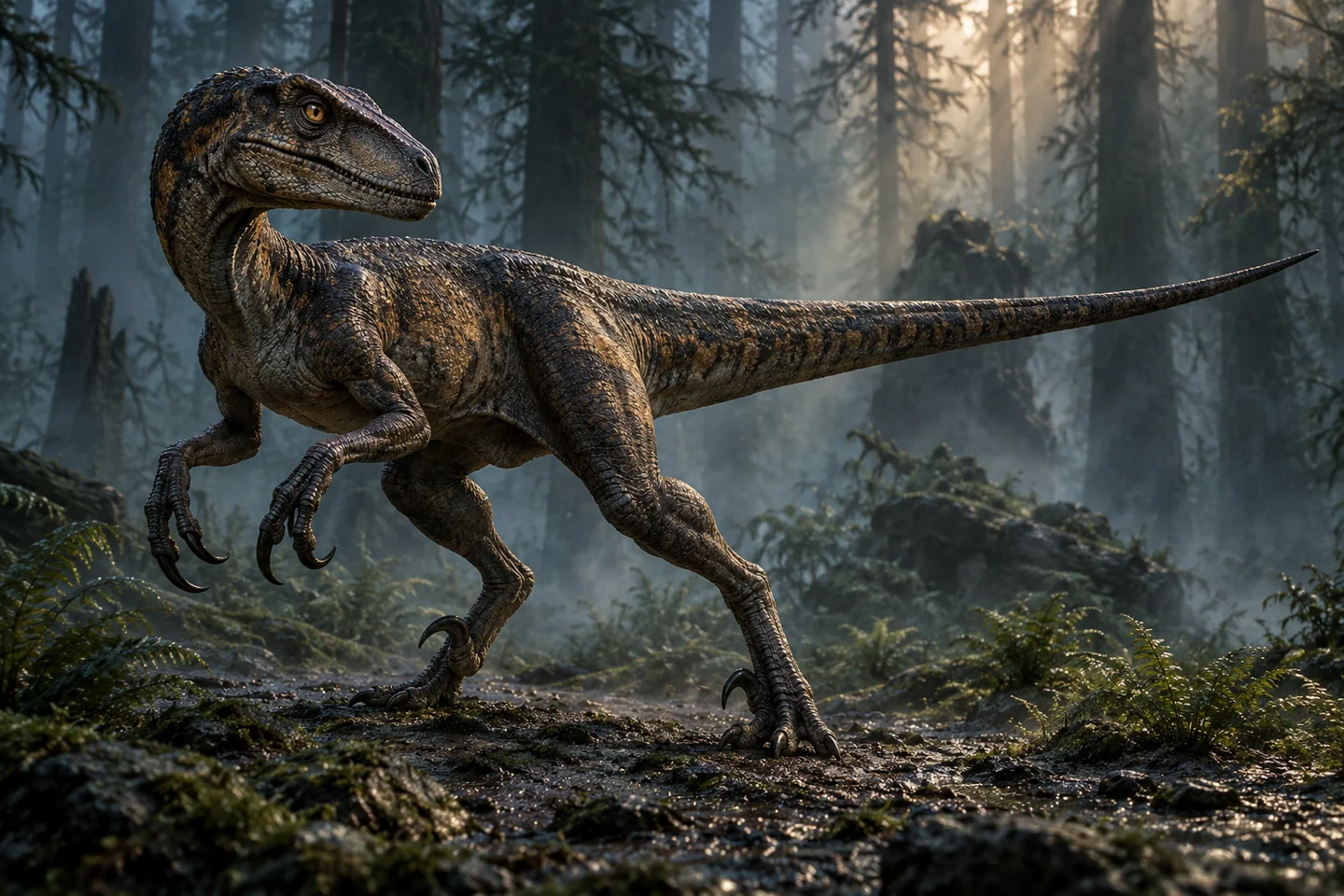
An original screen-style raptor with scaly skin and no visible feathers. Feathered relatives support a feathered reconstruction of V. mongoliensis, while the exact plumage remains inferred. The palms-down hands, colors, forest setting and pose are artistic choices. Neither picture establishes the animal's size, and they are not shown to the same scale. [2] [7] [8]
Original artwork · artistic interpretation.
Scientific view: credited paleoart interpreting fossil evidence. Movie-style view: Original artwork. Colors and many soft tissues are uncertain.
MEET THE ANIMAL
Velociraptor mongoliensis was a small Late Cretaceous meat eater from Mongolia. Its enlarged curved foot claws, sharp teeth and bird-like proportions made it a very different animal from a huge tyrannosaur. Claw function needs testing rather than a movie-style explanation of every attack. The first species was named from Mongolian material, and evidence from another Velociraptor species should not automatically be assigned to this one. [S1]
Researchers reported bumps on a forearm bone where large feathers attach. These bumps are called quill knobs. The study provided evidence of feathered forelimbs in an animal historically identified as Velociraptor. A preserved attachment mark is a specific anatomical clue, rather than permission to invent any feather color or courtship display. [D3]
Later work corrected that fossil's specimen number to IGM 100/3503 and noted that its species identification was being studied again. [D4]
That distinction matters because the feature and the specimen's identity are separate questions. A small, feathered predator can be recognizable while individual fossils continue to be reassessed. Skeletal shape supports possible movements and feeding abilities, but a detailed hunting routine requires other evidence. Keeping the known bones, their proposed functions and the animal's taxonomic identity separate creates a more useful picture than assigning it a complete fictional daily life. [S1]
PREHISTORIC ANIMAL DOSSIER
The animal, the evidence, and the questions still open.
Velociraptor mongoliensis was a small, bird-like carnivore from Late Cretaceous Asia. It had grasping hands and enlarged foot claws; evidence historically attributed to Velociraptor also supports feathered forelimbs.
Profile scope: Species — Velociraptor mongoliensis
Source supported identifies a description documented by the cited source. Inferred marks a reconstruction or functional estimate. Debated marks competing interpretations. Not established means the sources reviewed for this dossier do not support a firm conclusion; it does not mean a behavior never occurred.
A size reference is an estimate, not a population range. Nesting evidence does not by itself establish courtship, mate choice, or lifelong pairing.
About 1.8 m (museum reference)
The museum card gives this approximate species reference. It does not identify a measured specimen, maturity assessment or population range. [D1]
About 18 kg (museum reference)
The museum card gives a rounded reconstruction estimate. The life stage and method are not specified. [D1]
Meat eater
Sharp teeth and grasping anatomy support carnivory. Specific feeding tactics are interpretations of anatomy and fossils. [D2]
Late Cretaceous Mongolia and China
These are the museum's listed fossil localities. Geographic occurrence is better established here than a uniform preferred habitat. [D1] [D2]
Two-legged terrestrial movement
Long hindlimbs and non-volant proportions support terrestrial bipedal movement. Exact running speed is not established by these sources. [D2] [D3]
Enlarged foot claws and bird-like forelimbs
Quill knobs were reported in a referred specimen later correctly numbered IGM 100/3503; its assignment was under renewed study in 2021. This does not establish whole-body plumage colors. [D1] [D3] [D4]
Not established here
The inspected sources do not demonstrate a nest, clutch size or brooding event specifically for V. mongoliensis; proposed feather uses do not establish these behaviours.
Not established here
Reviewed sources do not establish V. mongoliensis courtship; possible feather display remains a functional suggestion.
Not established here
Reviewed sources do not demonstrate coordinated pack hunting or a typical V. mongoliensis group size.
Sources and inspection notes for the claims in this profile.
THE STORY IN THE FOSSILS
Velociraptor mongoliensis had a lightly built body, long legs and fingers, sharp teeth and a large curved claw on each foot. AMNH gives about 1.8 metres as a species reference length. This is an approximate museum estimate, not a measured size range or an explicitly age-verified adult. Its name-bearing fossil is catalogued from Mongolia's Djadokhta rocks. [2] [1] [3]
The Fighting Dinosaurs specimen preserves V. mongoliensis and Protoceratops andrewsi together. Found in Mongolia in 1971, it shows the animals entangled, with a Velociraptor foot claw near the Protoceratops neck. This is direct evidence of interaction; a complete account of the encounter and the animals' burial is an interpretation. [4]
Feathers are supported by the animal's dromaeosaurid relationships, but direct evidence needs careful attribution. A 2007 study reported quill knobs on a fossil assigned to V. mongoliensis. A 2021 paper corrected its catalog number to IGM 100/3503 and noted that its assignment was under study. A 2023 conference abstract proposed that it may represent another species; this is a preliminary reassessment, not a formal revision. [7] [8] [6]
We have not established a comparable adult total-length estimate for this taxon in this draft. Specimen measurements in the text describe those individuals. A numerical age interval has not been reviewed here. Unknown does not mean zero.
Sources and evidence notes for this exhibit.
KEEP EXPLORING
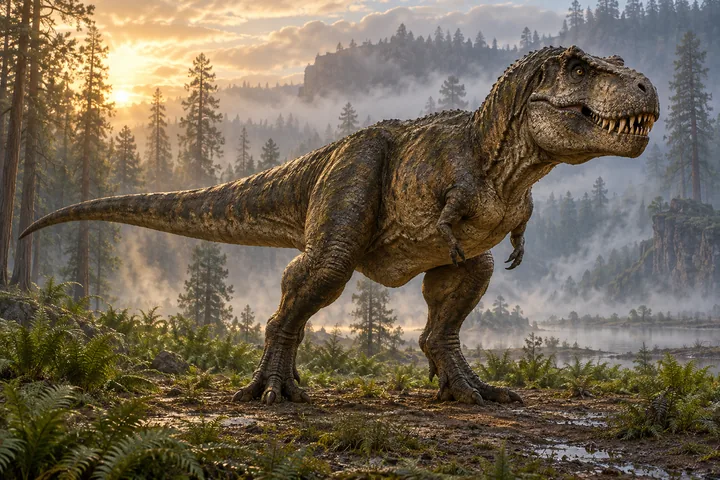
Tyrannosaurus rex
Bone-crushing jaws left traces of meals in the fossil record.
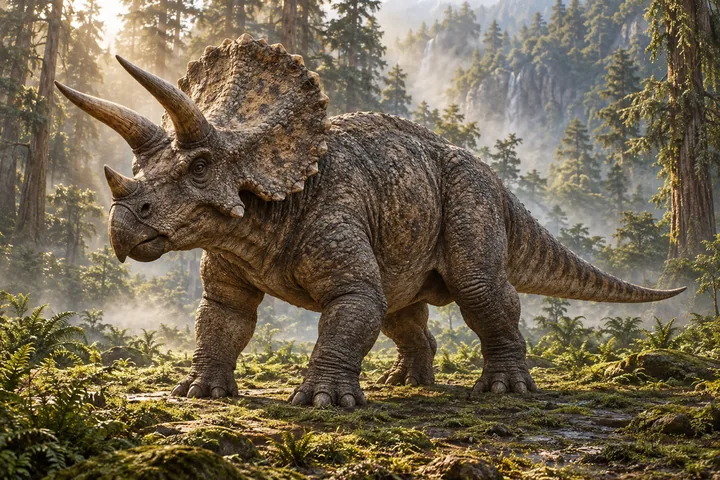
Triceratops horridus
Three horns, a broad frill, and a plant-eater beneath the formidable silhouette.
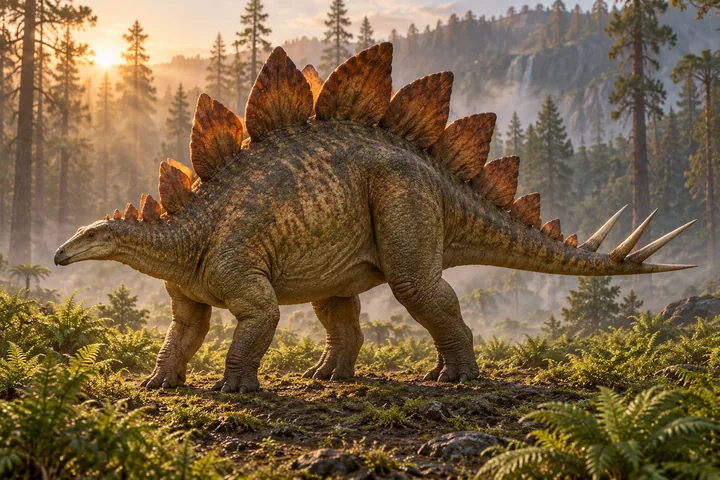
Stegosaurus stenops
A small head, a skyline of plates, and four spikes at the tail.