
Body length
Not establishedNot established here
NHM lists 21 m without specimen, maturity or method. The 2025 revision questions historical referrals; this is not a secure type-based length. [D2] [D8]
EXHIBIT 87
Alamosaurus sanjuanensis
Alamosaurus is a New Mexican titanosaur with fossil assignments reconsidered in 2025.
TWO WAYS TO PICTURE THE PAST
Compare the evidence with the familiar movie image. The illustrations are not to a shared scale.
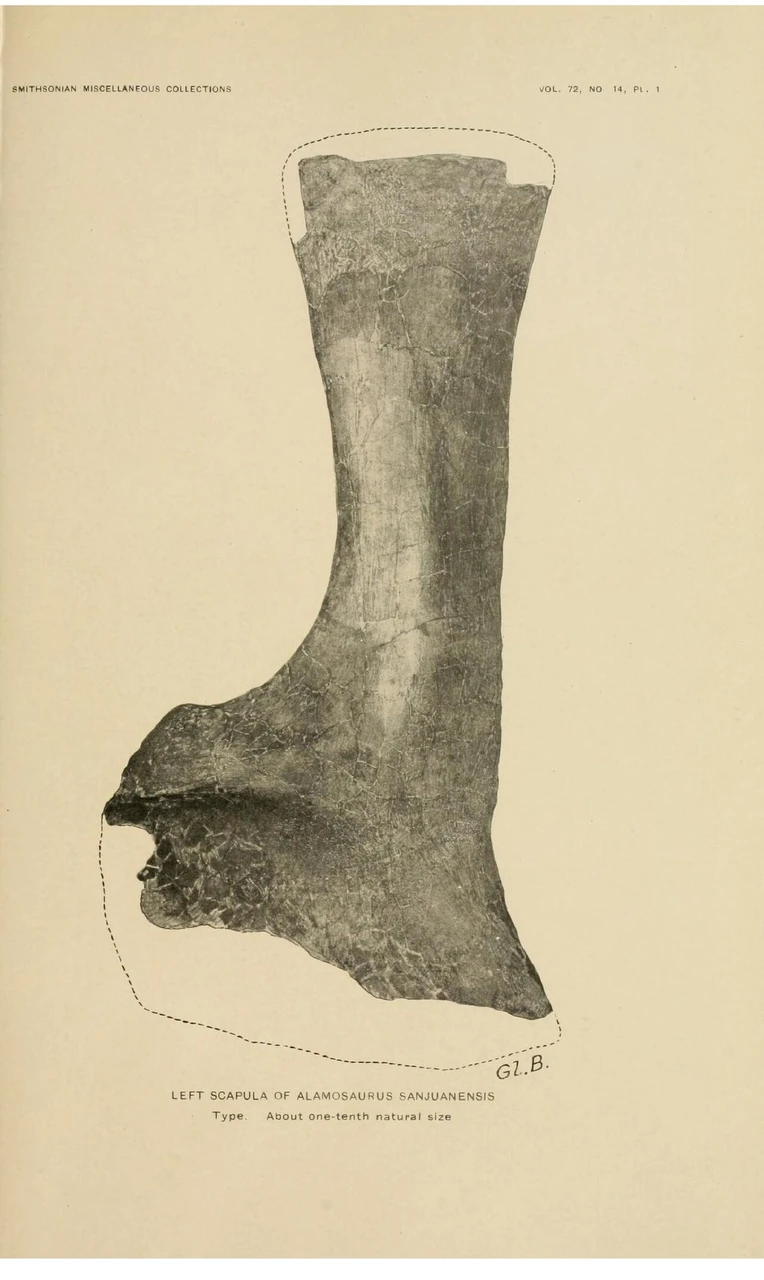
Gilmore’s 1922 Plate 1 records the Alamosaurus holotype scapula, USNM 10486. Dashed outlines reconstruct missing portions. The printed one-tenth scale no longer applies after digital resizing; this is a shoulder bone, not a complete skeleton. [7]
A new sauropod dinosaur from the Ojo Alamo Formation of New Mexico.pdf, Plate 1 · Charles W. Gilmore (publication); Smithsonian Institution / Biodiversity Heritage Library (scan). Public domain (United States). Plate 1 page preview resized proportionally and converted to WebP. No cropping, anatomical edits or upscaling.
The photograph or figure shows the credited fossil material; displayed mounts and labels can include interpretation.
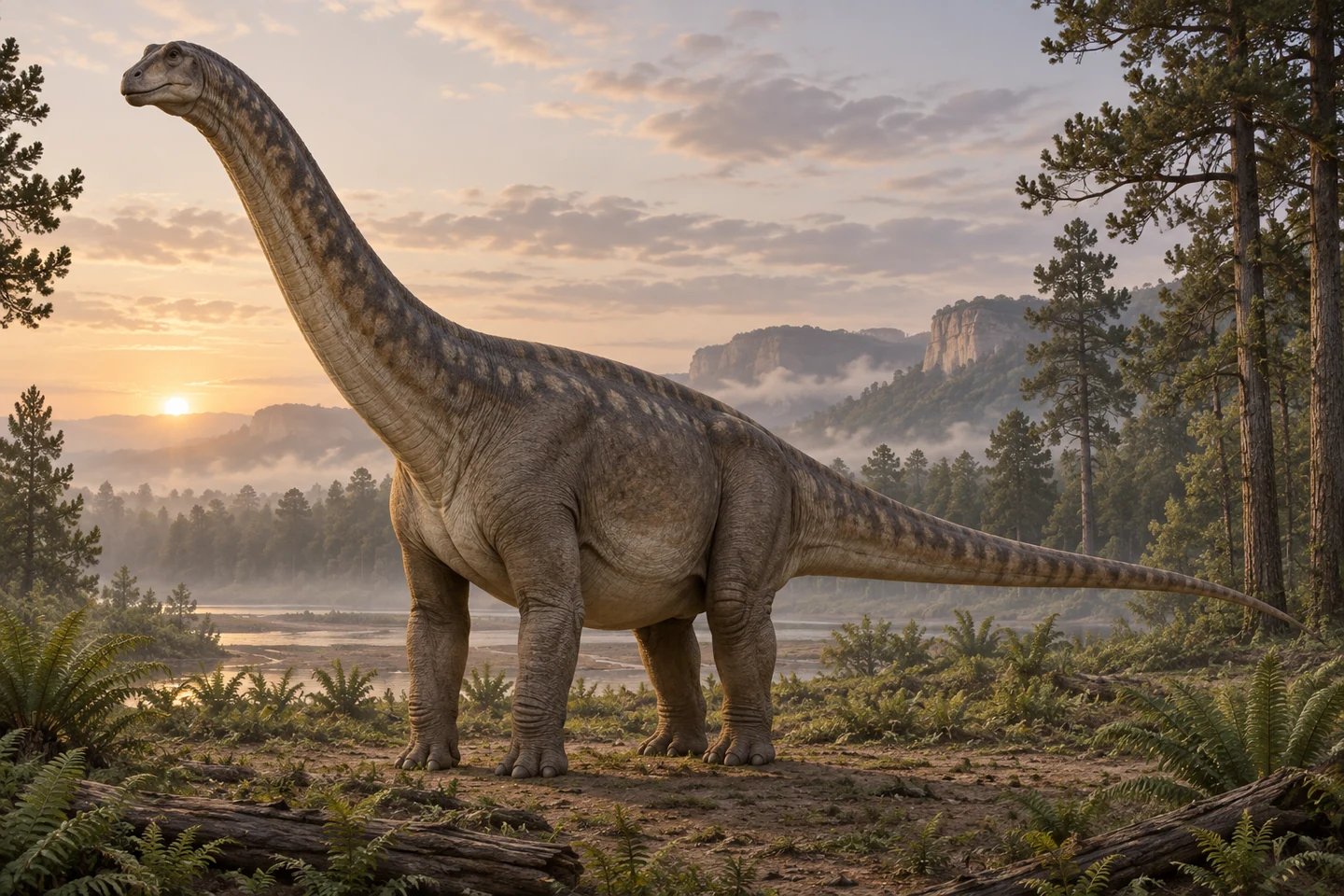
Original cinematic interpretation of Alamosaurus sanjuanensis. Full-body proportions remain uncertain because the type fossil is fragmentary. Coloration, soft tissues and scenery are artistic choices; this is not a measured individual. Lighting, coloration and scenery are artistic choices. This image does not document a fossil locality or behavior.
Original artwork · artistic interpretation.
Scientific view: source-informed reconstruction, credited paleoart or specimen-based imagery. Movie-style view: Original artistic interpretation. Reconstructions involve uncertainty.
MEET THE ANIMAL
Alamosaurus was named from Late Cretaceous fossils discovered in New Mexico. Its original shoulder blade is an important anchor for identifying the dinosaur. That bone was incomplete, and a pelvic bone found nearby could not confidently be assigned to the same individual. The earliest material therefore does not amount to one complete skeleton. [D7]
It is classified as a plant-eating sauropod. Familiar museum body-length figures should be treated carefully when they do not name a specimen, growth stage, or estimation method. A reference figure is useful for orientation, but it cannot turn a partial fossil into a measured animal or establish how large all members of a species grew. [D2]
Institutional descriptions reconstruct sauropods such as Alamosaurus walking on four supporting limbs. That broader body plan does not provide a measured speed or one exact stride for this dinosaur. The long-necked body in a restoration combines the preserved pieces with reconstructed proportions. Its silhouette is more complete than the original fossil, leaving some movement details and proportions uncertain. [D1]
PREHISTORIC ANIMAL DOSSIER
The animal, the evidence, and the questions still open.
The type scapula anchors this profile; body reconstructions remain uncertain.
Profile scope: Species focus: A. sanjuanensis; disputed referrals remain separate.
Source supported identifies a description documented by the cited source. Inferred marks a reconstruction or functional estimate. Debated marks competing interpretations. Not established means the sources reviewed for this dossier do not support a firm conclusion; it does not mean a behavior never occurred.
A size reference is an estimate, not a population range. Nesting evidence does not by itself establish courtship, mate choice, or lifelong pairing.
Not established here
NHM lists 21 m without specimen, maturity or method. The 2025 revision questions historical referrals; this is not a secure type-based length. [D2] [D8]
About 20 tonnes; type-scaled composite model
Paul’s 2025 model scales an approximate, incomplete regional-titanosaur composite to the holotype scapula. Type maturity and whole-body proportions remain unresolved; this is not an adult maximum. [D8]
Plant-eater
The museum identifies herbivory. Precise foods and feeding height remain uncertain for the restricted genus. [D2]
Early Maastrichtian, New Mexico
The revision anchors Alamosaurus in the lower Ojo Alamo type occurrence. Historical terminal-Cretaceous Texas and Utah referrals require reassessment. [D8]
Four-legged terrestrial walker
The institutional reconstruction follows the sauropod supporting-limb plan. Precise Alamosaurus gait, limb spacing and speed remain unresolved. [D1]
Type shoulder blade
USNM 10486 preserves a gradually broadening left scapula, 155 cm long as preserved; Gilmore estimated 170 cm if complete. Bone length is not body length. [D7]
Not established here
Focused nesting searches and reviewed specimens do not identify Alamosaurus eggs or clutches. Generic titanosaur nests cannot establish its parental care.
Not established here
Reviewed anatomical and behavioral research does not establish courtship, mate choice or mating posture.
Not established here
The historical Big Bend juvenile-herd interpretation concerns Texas referrals. A 2025 revision questions such assignments; securely applying that behavior to Alamosaurus requires reassessment. [D6] [D8]
Sources and inspection notes for the claims in this profile.
THE STORY IN THE FOSSILS
Paul’s 2025 revision names Utetitan from Utah skeleton USNM 15560 and treats key Texas specimens as indeterminate. These proposals change which fossils can inform Alamosaurus biology. [8]
Gilmore’s original shoulder blade and pelvic bone were found roughly 200 feet apart. Whether they belonged to one individual was uncertain even in 1922; a complete skeleton cannot be assumed. [7]
The dossier identifies the scope of each reference estimate. A mount, an individual fossil and a species-wide adult range are different measurements. Comparison metrics remain unavailable where adult scope has not been established. Unknown does not mean zero.
Sources support the stated claims and scopes. Refer to the evidence notes for uncertainty.
KEEP EXPLORING
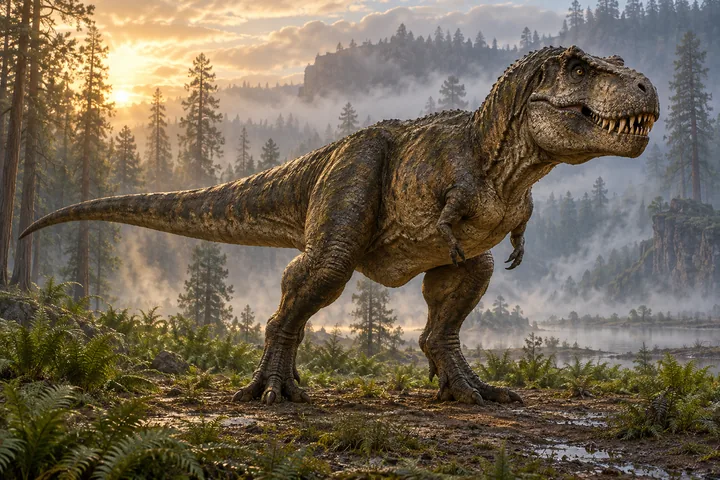
Tyrannosaurus rex
Tyrannosaurus rex was a large meat-eating dinosaur from the final part of the Cretaceous in western North America. Fossil teeth, bite marks and skeletons reveal a powerful animal whose behaviour still invites questions.
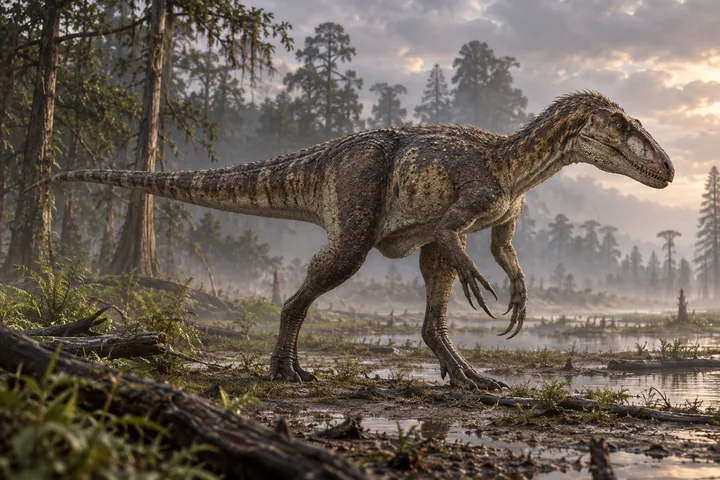
Dryptosaurus aquilunguis
Dryptosaurus was an eastern North American tyrannosauroid with a short upper arm and unusually large hand. Its partial skeleton and changing restorations reveal how evidence and imagination interact.
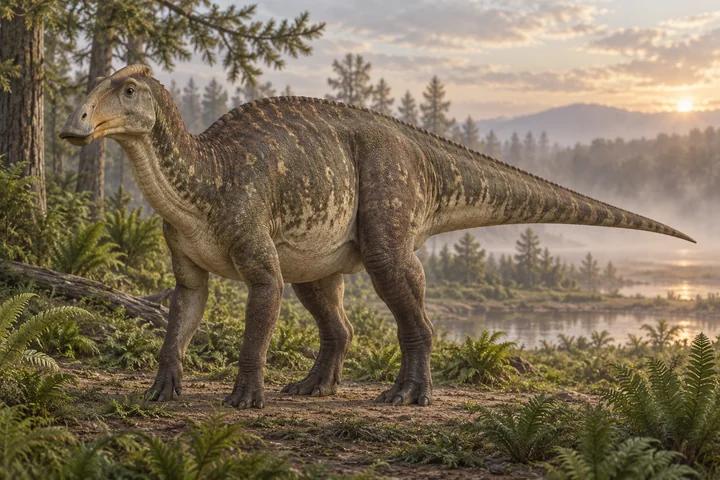
Maiasaura peeblesorum
Maiasaura preserves detailed evidence of growth, nesting and possible care.