
Body length
InferredAbout 9 m (museum reference)
A rounded reconstruction value with no stated specimen or maturity assessment; it is not an adult maximum. [D1]
EXHIBIT 77
Maiasaura peeblesorum
Maiasaura preserves detailed evidence of growth, nesting and possible care.
TWO WAYS TO PICTURE THE PAST
Compare the evidence with the familiar movie image. The illustrations are not to a shared scale.
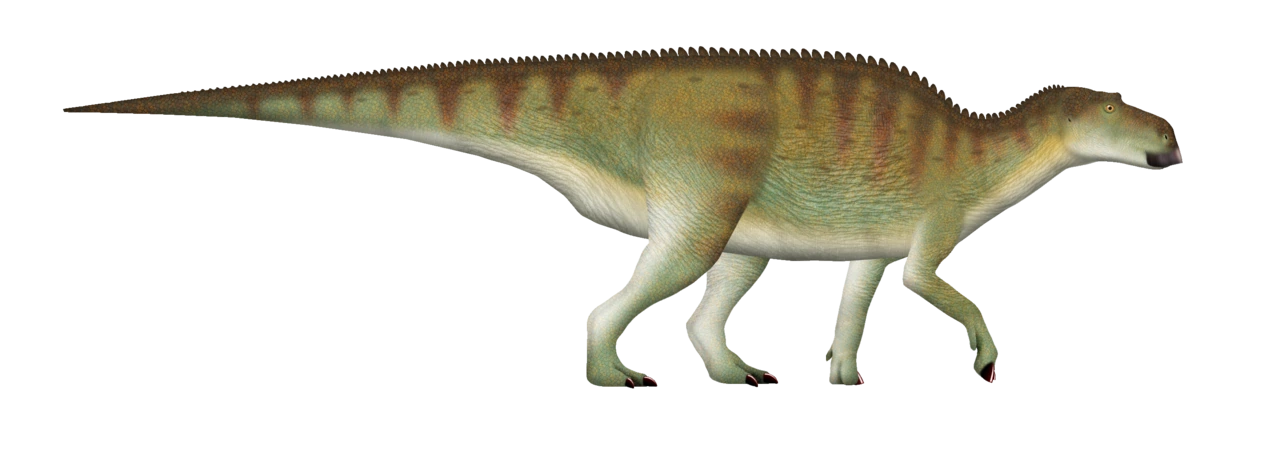
Life reconstruction of Maiasaura peeblesorum by TotalDino, using the current revised artwork. Preserved anatomy informs the skeleton; missing parts, soft tissues, colors and markings remain interpretations. [1]
Maiasaura TD.png · TotalDino. CC BY 4.0. Commons-listed 1280px current preview resized proportionally for the thumbnail and converted to WebP; no anatomical edits. Same source license applies.
Scientific reconstruction is an interpretation; source credit does not certify every anatomical detail.
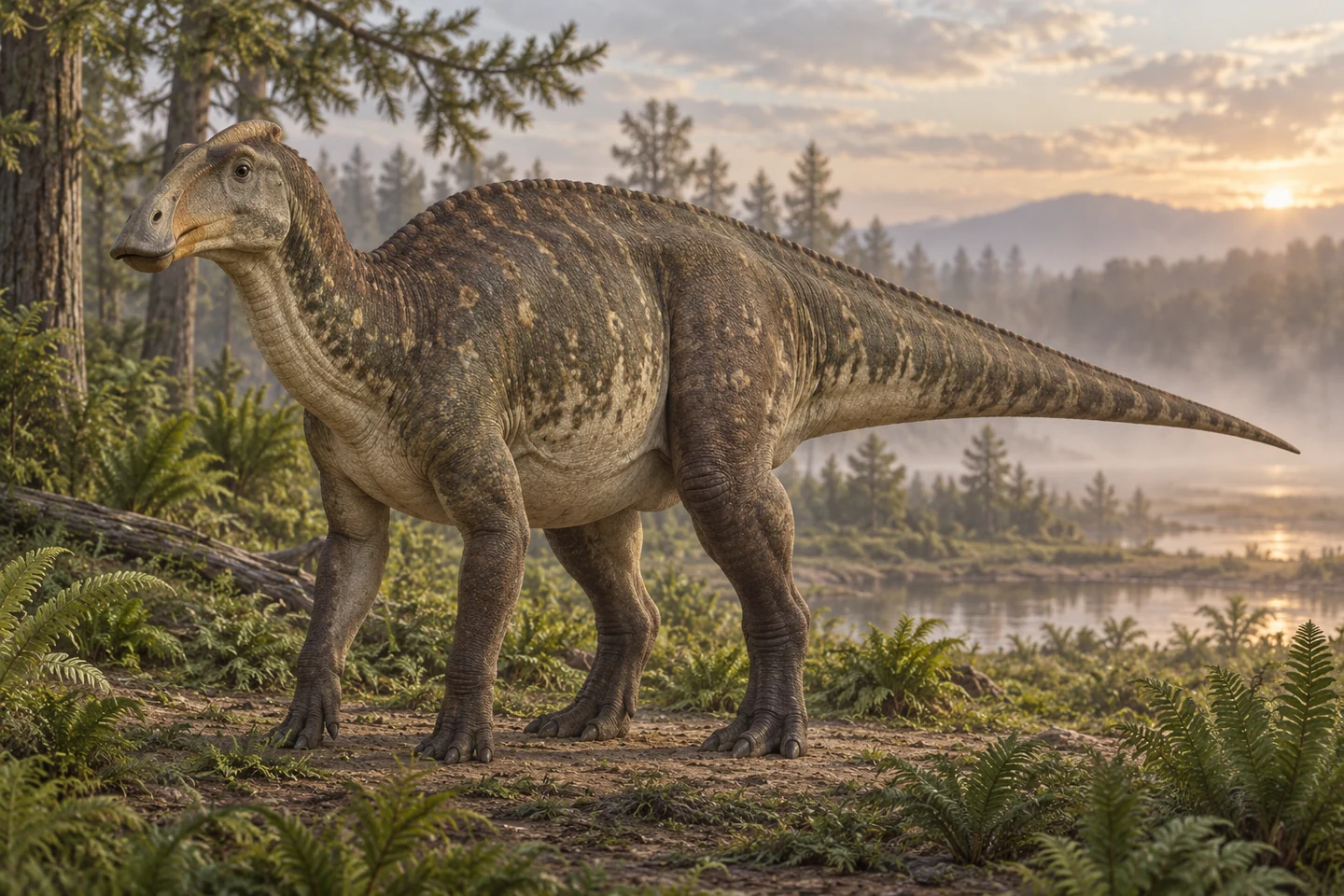
Original cinematic interpretation of Maiasaura peeblesorum. Coloration, soft tissues and scenery are artistic choices; reconstructed proportions do not establish a measured individual. Lighting, coloration and scenery are artistic choices. This image does not document a fossil locality or behavior.
Original artwork · artistic interpretation.
Scientific view: source-informed reconstruction, credited paleoart or specimen-based imagery. Movie-style view: Original artistic interpretation. Reconstructions involve uncertainty.
MEET THE ANIMAL
Maiasaura was a plant-eating dinosaur from Late Cretaceous Montana. A beak and many food-processing teeth suited it to eating vegetation. Its fossils offer more than a body outline: nesting sites, young animals, and extensive bonebeds make it possible to investigate growth and reproduction. These different clues answer different questions about its life. [D1] [D2]
Thin sections of leg bones reveal how the animal grew. Some rings in a young Maiasaura formed within one year, so counting every ring as a birthday would give the wrong age. Researchers have to distinguish yearly pauses from other growth marks before turning a fossil bone into a life-history record. [D3]
Recent studies compare bone-related clues to metabolism and tooth wear in young and adults. Their results support ideas that hatchlings were dependent and may have received selected food. That does not preserve a parent feeding a chick or identify which parent provided care. Maiasaura's reputation for parenting rests on evidence that can be tested and revised, not a complete recording of family life. [D4] [D5]
PREHISTORIC ANIMAL DOSSIER
The animal, the evidence, and the questions still open.
Care remains inferred.
Profile scope: Species — Maiasaura peeblesorum.
Source supported identifies a description documented by the cited source. Inferred marks a reconstruction or functional estimate. Debated marks competing interpretations. Not established means the sources reviewed for this dossier do not support a firm conclusion; it does not mean a behavior never occurred.
A size reference is an estimate, not a population range. Nesting evidence does not by itself establish courtship, mate choice, or lifelong pairing.
About 9 m (museum reference)
A rounded reconstruction value with no stated specimen or maturity assessment; it is not an adult maximum. [D1]
About 3,660 kg for ROM 44770
Limb-circumference estimate for an individual labeled mature; not a species-wide average or maximum. [D6]
Plant-eating, with juvenile/adult differences
A 2026 study finds different wear patterns in young and adults. Selective provision of better-quality food is an interpretation, not preserved meals. [D5]
Two Medicine Formation, Montana
Nesting localities and extensive bonebeds place this species in a Late Cretaceous continental setting. Depositional occurrence does not identify one exclusive habitat. [D2]
Juveniles and adults probably moved differently
The growth study discusses a proposed transition from bipedal juveniles toward quadrupedal adults. These postures are skeletal interpretations, not a directly observed life sequence. [D2]
Beak and rows of food-processing teeth
The horny beak and many chewing teeth fit a hadrosaur adapted to processing vegetation. Individual soft tissues and colors remain reconstructed. [D1]
Nests and young; dependent hatchlings proposed
Nesting evidence supports reproduction. Earlier incapacity-based care arguments were challenged by mineralized neonatal pelvis and missing adult nest remains. A 2025 bone-derived metabolic comparison favors dependence. Provisioning, nest attendance and nest residence remain interpretations; feeding acts and incubation duration are not directly recorded. [D4]
Not established here
The reviewed nesting, growth and metabolic studies do not establish mate choice, pairing or courtship displays.
Aggregations are supported by bonebed evidence
A largely single-species bonebed preserves many growth stages. Association supports animals gathering; transport and accumulation require interpretation, and do not establish permanent herd composition. [D2]
Sources and inspection notes for the claims in this profile.
THE STORY IN THE FOSSILS
A young Maiasaura tibia can contain vascular rings that formed within one year. Reading every ring as an annual birthday would produce the wrong age. Histology must distinguish rapid growth from yearly pauses. [3]
Its reputation for care continues to be tested. Recent metabolic proxies and tooth wear favor dependence and possible food provisioning. Neither reveals which parent fed the young or how food was delivered. [4] [5]
The dossier identifies the scope of each reference estimate. A mount, an individual fossil and a species-wide adult range are different measurements. Comparison metrics remain unavailable where adult scope has not been established. Unknown does not mean zero.
Sources support the stated claims and scopes. Refer to the evidence notes for uncertainty.
KEEP EXPLORING
Gryposaurus monumentensis
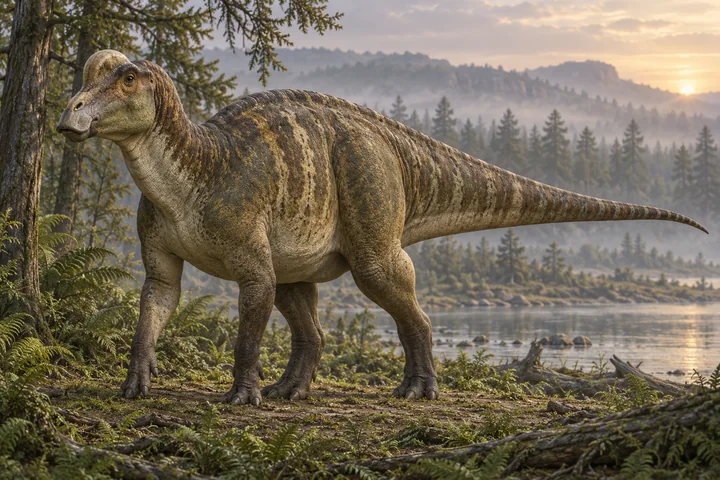
Gryposaurus was a duck-billed dinosaur with an arched nose; its species differ in skull construction.
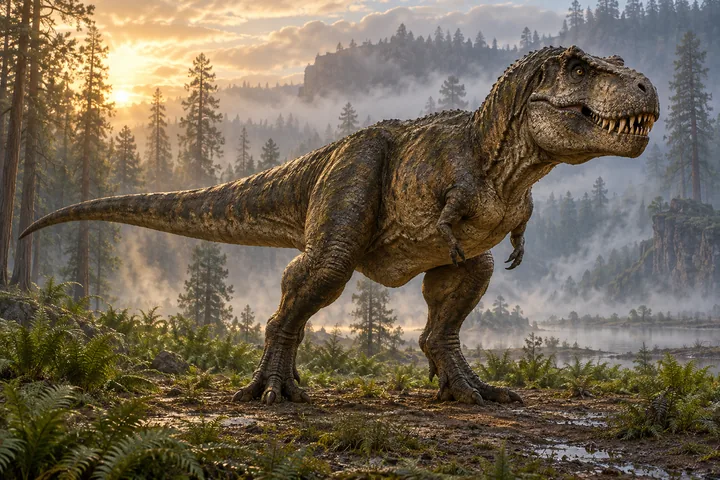
Tyrannosaurus rex
Tyrannosaurus rex was a large meat-eating dinosaur from the final part of the Cretaceous in western North America. Fossil teeth, bite marks and skeletons reveal a powerful animal whose behaviour still invites questions.
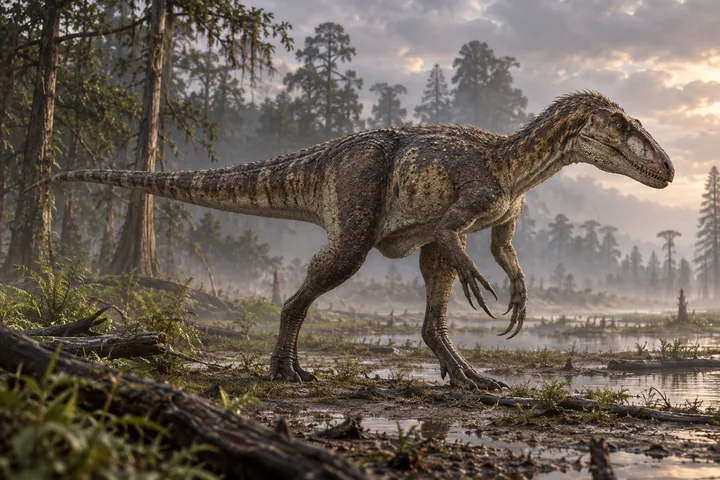
Dryptosaurus aquilunguis
Dryptosaurus was an eastern North American tyrannosauroid with a short upper arm and unusually large hand. Its partial skeleton and changing restorations reveal how evidence and imagination interact.