
Body length
InferredAbout 6.4 m (museum reference)
The directory's rounded length is not a documented biological range or a measured complete skeleton. [D1]
EXHIBIT 58
Dryptosaurus aquilunguis
Dryptosaurus was an eastern North American tyrannosauroid with a short upper arm and unusually large hand. Its partial skeleton and changing restorations reveal how evidence and imagination interact.
TWO WAYS TO PICTURE THE PAST
Compare the evidence with the familiar movie image. The illustrations are not to a shared scale.
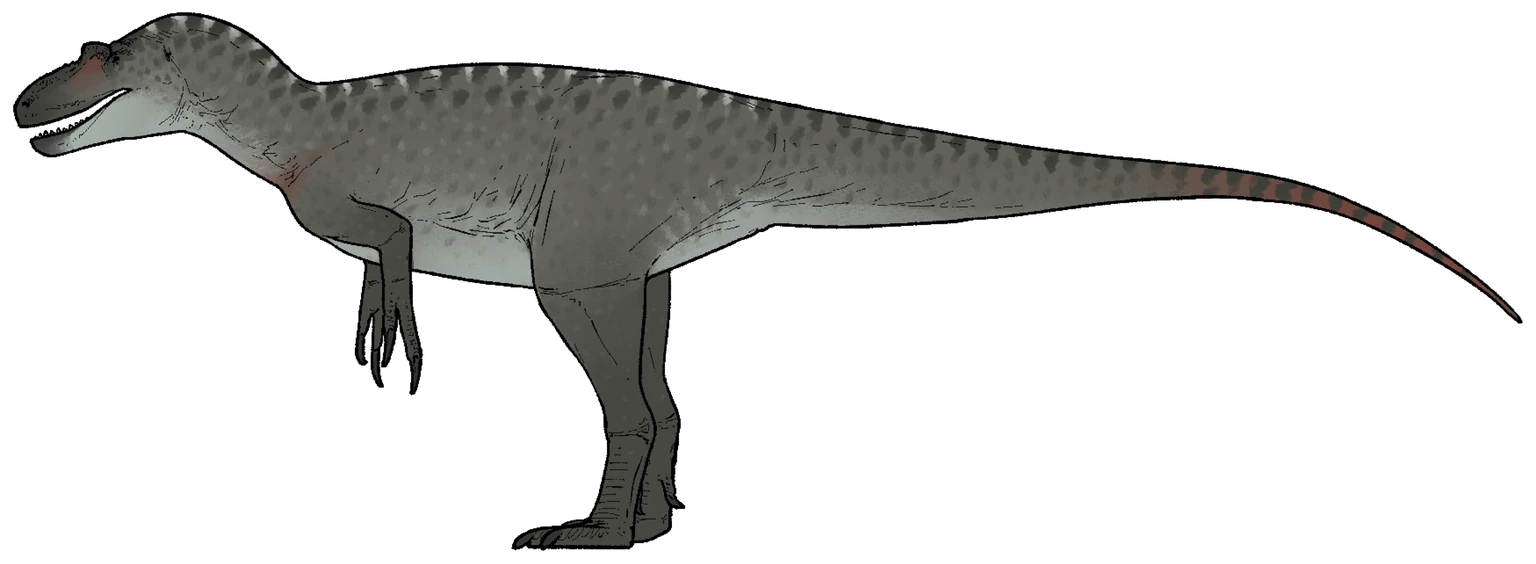
Life reconstruction of Dryptosaurus aquilunguis by Connor Ashbridge. Its incomplete skeleton requires reconstruction of missing anatomy; the skin, colors and markings are artistic choices. [2]
Dryptosaurus aquilunguis.png · Connor Ashbridge (Ddinodan). CC BY 4.0. Current original resized to 1536px and converted to WebP; 640px thumbnail generated. Composition and colors unchanged.
Scientific reconstruction is an interpretation; source credit does not certify every anatomical detail.
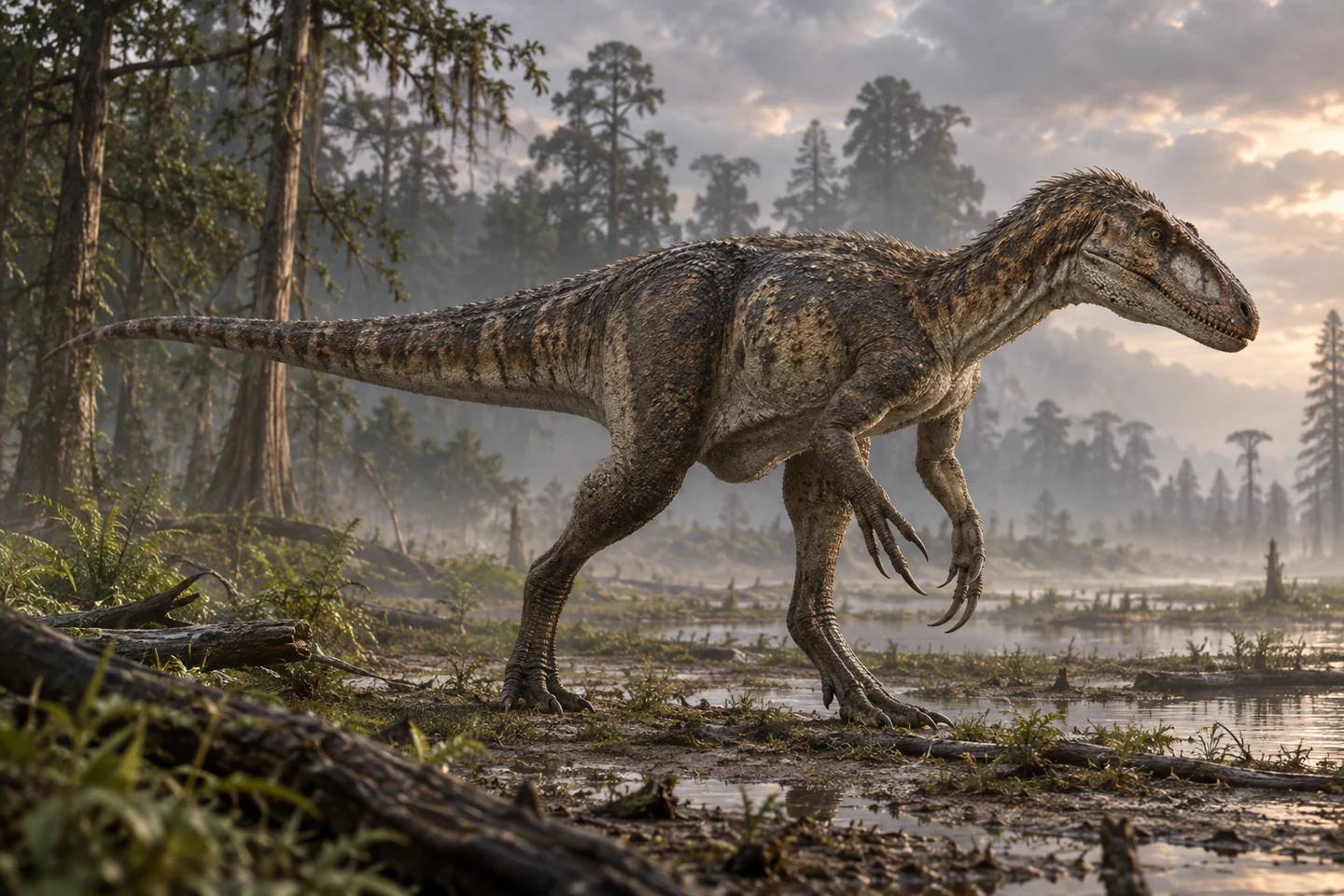
Original cinematic interpretation of Dryptosaurus. Anatomy, soft tissues and colors are reconstructed choices. Lighting, coloration and scenery are artistic choices. This image does not document a fossil locality or behavior.
Original artwork · artistic interpretation.
Scientific view: source-informed reconstruction, credited paleoart or specimen-based imagery. Movie-style view: Original artistic interpretation. Reconstructions involve uncertainty.
MEET THE ANIMAL
Dryptosaurus was a meat-eating dinosaur from Late Cretaceous North America. Its name means tearing lizard, but it was originally called Laelaps. That name was already being used for a mite, so the dinosaur was renamed in 1877. Such naming rules prevent different animals from sharing the same scientific label, even when the first name becomes familiar. [D1]
The incomplete New Jersey skeleton has unusual proportions: a short upper arm paired with a large hand. Researchers suggest both jaws and hands could assist feeding, while their exact use remains uncertain. [D2]
Charles Knight’s 1897 painting made Dryptosaurus memorable by showing two active animals together. Originally titled Leaping Laelaps, it presented a lively dinosaur image that contrasted with older, sluggish restorations. Yet a painting records an artist’s reconstruction, informed by the scientific opinions of the time. The two painted dinosaurs do not demonstrate real fighting, play or cooperative hunting. Their poses are part of the artwork, rather than a fossil record of an encounter between living animals. [D3]
PREHISTORIC ANIMAL DOSSIER
The animal, the evidence, and the questions still open.
Dryptosaurus combined tyrannosauroid ancestry with unusual forelimb proportions. Its fossil record is much thinner than that of the better-known western tyrannosaurs.
Profile scope: Species — Dryptosaurus aquilunguis; most anatomical evidence comes from the incomplete holotype ANSP 9995.
Source supported identifies a description documented by the cited source. Inferred marks a reconstruction or functional estimate. Debated marks competing interpretations. Not established means the sources reviewed for this dossier do not support a firm conclusion; it does not mean a behavior never occurred.
A size reference is an estimate, not a population range. Nesting evidence does not by itself establish courtship, mate choice, or lifelong pairing.
About 6.4 m (museum reference)
The directory's rounded length is not a documented biological range or a measured complete skeleton. [D1]
Not established here
A suitably scoped mass estimate was not established from the inspected sources.
Carnivore; grasping role proposed
The skeleton suggests both jaws and hands could assist feeding; their exact use remains uncertain. [D2]
Late Cretaceous New Jersey
The holotype came from the marine New Egypt Formation. Marine burial does not demonstrate an aquatic lifestyle. [D2]
Bipedal terrestrial reconstruction
The preserved hindlimb and theropod anatomy support two-legged movement; no running speed is established here. [D2]
Short upper arm, enlarged hand
This combination distinguishes Dryptosaurus from tyrannosaurids with uniformly reduced forelimbs. [D2]
Not established here
The reviewed holotype description does not establish eggs, nests, clutch sizes or parental behavior.
Not established here
No species-specific courtship or mating behavior is established in the reviewed sources.
Not established here
The famous paired reconstruction is artwork. The reviewed fossils do not establish fighting, play or group hunting. [D3]
Sources and inspection notes for the claims in this profile.
THE STORY IN THE FOSSILS
Originally called Laelaps, this dinosaur received the name Dryptosaurus in 1877 because Laelaps already named a mite. Its discovery forms part of the early history of American dinosaur science. [1]
Charles Knight's 1897 Leaping Laelaps portrayed dynamic animals. That influential scene remains a reconstruction, while the fossil evidence reveals an unusual tyrannosauroid with proportionally large hands. [3] [2]
The dossier identifies the scope of each reference estimate. A mount, an individual fossil and a species-wide adult range are different measurements. Comparison metrics remain unavailable where adult scope has not been established. Unknown does not mean zero.
Sources support the stated claims and scopes. Refer to the evidence notes for uncertainty.
KEEP EXPLORING
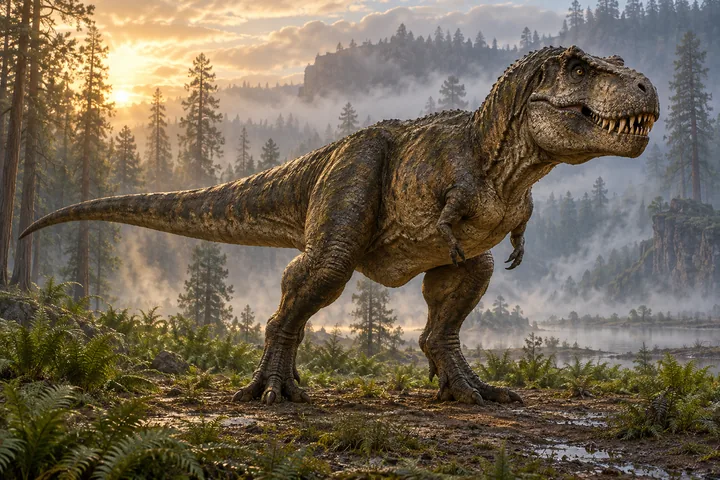
Tyrannosaurus rex
Tyrannosaurus rex was a large meat-eating dinosaur from the final part of the Cretaceous in western North America. Fossil teeth, bite marks and skeletons reveal a powerful animal whose behaviour still invites questions.
Maiasaura peeblesorum
Maiasaura preserves detailed evidence of growth, nesting and possible care.
Gryposaurus monumentensis
Gryposaurus was a duck-billed dinosaur with an arched nose; its species differ in skull construction.