
Body length
InferredApproximately 3.5 m reconstructed length.
Reference reconstruction, not a measured complete skeleton or an adult species range. [D1]
EXHIBIT 254
Anzu wyliei
Dinosaur
A long-necked, crested caenagnathid from the Hell Creek Formation; its diet and feather colors remain uncertain. [4]
TWO WAYS TO PICTURE THE PAST
Compare the evidence with the familiar movie image. The illustrations are not to a shared scale.
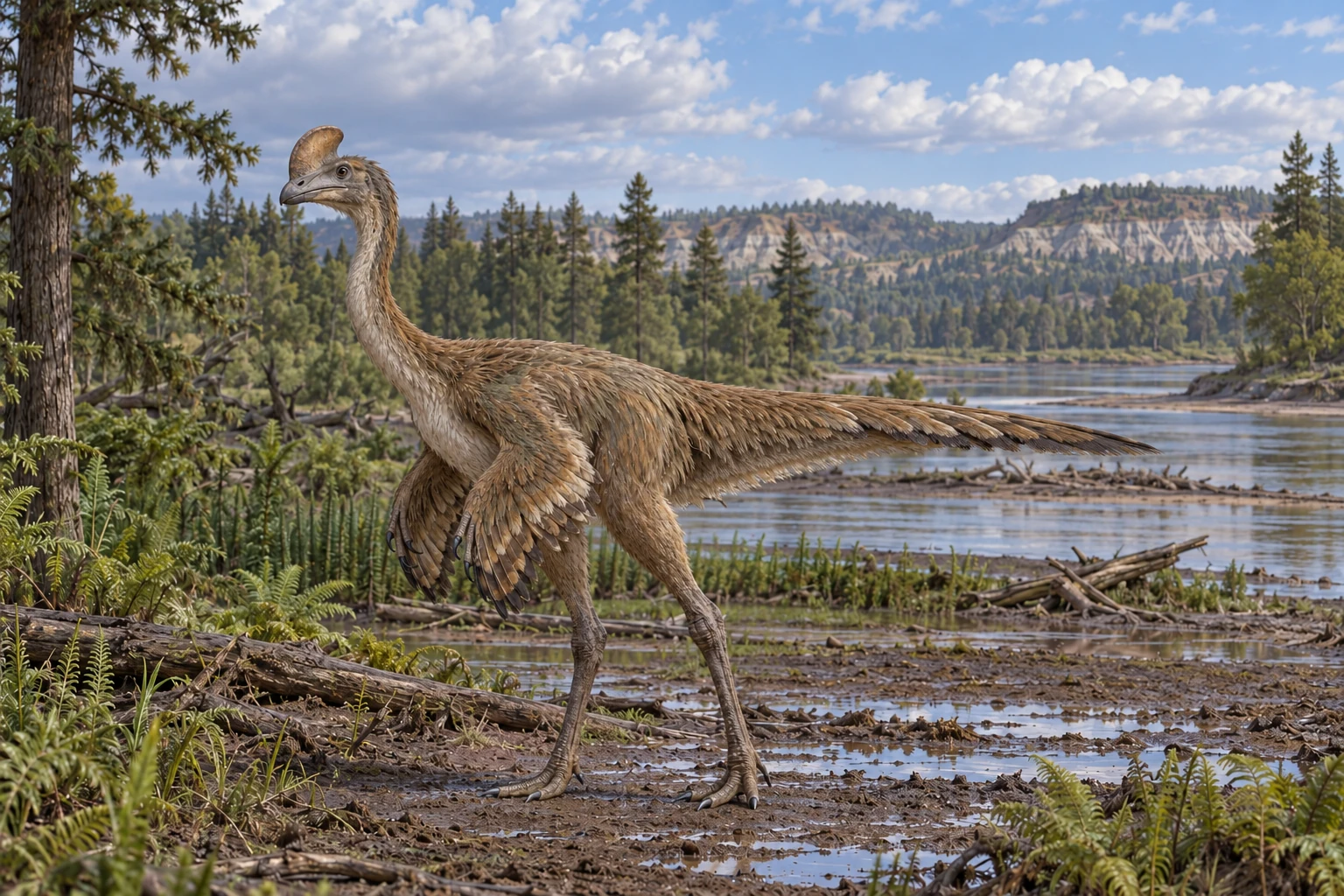
An illustrative reconstruction. Compare its anatomy with the evidence and limitations in the dossier. [1]
Source-informed reconstruction. Appearance evidence [1]. Original illustration; missing anatomy, coloration and scenery include interpretation.
Fossils constrain this life reconstruction. Missing anatomy, coloration and the environmental scene include interpretation; the dossier explains the evidence limits.
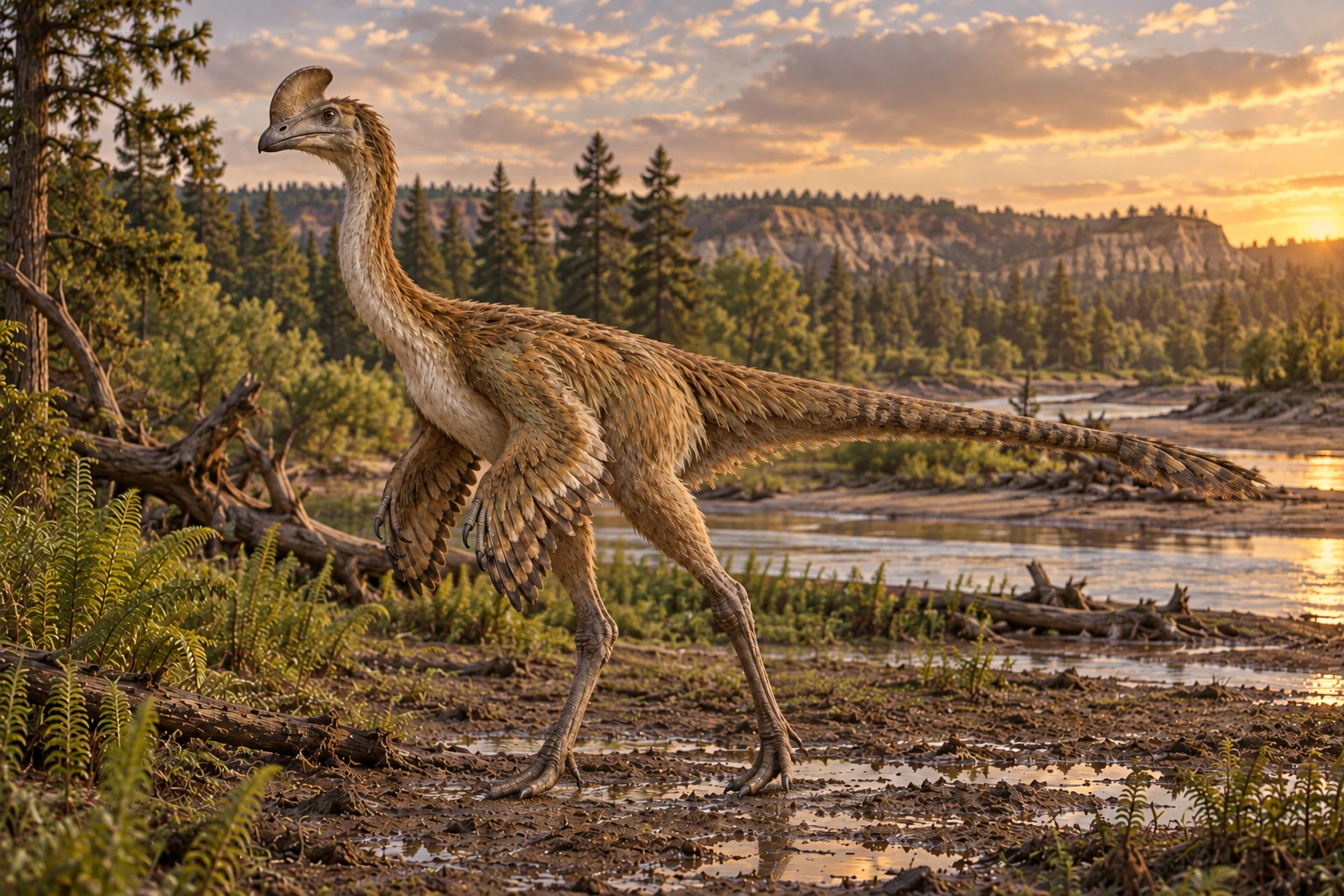
An illustrative reconstruction. Compare its anatomy with the evidence and limitations in the dossier. Lighting, coloration and scenery are artistic choices. This image does not document a fossil locality or behavior.
Original artwork · artistic interpretation.
Scientific view: source-informed reconstruction, credited paleoart or specimen-based imagery. Movie-style view: Original artistic interpretation. Reconstructions involve uncertainty.
MEET THE ANIMAL
Anzu lived near the end of the Cretaceous in what is now North and South Dakota. Its long neck and long legs made it look surprisingly bird-like, but its hands ended in large claws. A toothless beak and tall skull crest are especially recognizable. Researchers think its jaws could handle several kinds of food, although its favorite meals remain a mystery. [D4]
Knowing what an animal looked like does not tell us exactly how much it weighed. A later study built a digital body around the fossil skeletons and compared different estimating methods. One method produced a heavier result than another. The difference shows why a reconstruction needs uncertainty: a fossil contains bones, while a living body also included muscles, organs and other tissues. [D2]
Anzu also lived alongside smaller relatives. Researchers studying a different Hell Creek caenagnathid used anatomy and evidence of maturity to distinguish it from a young Anzu. This is an important lesson when studying growth. A small fossil can represent a youngster, but it can also belong to a separate small-bodied species. [D3]
PREHISTORIC ANIMAL DOSSIER
The animal, the evidence, and the questions still open.
Later comparisons distinguish Anzu from smaller Hell Creek caenagnathids; small bones alone need not belong to young Anzu. [D3]
Profile scope: This exhibit concerns Anzu wyliei, represented by overlapping partial skeletons rather than one complete individual. [D1]
Source supported identifies a description documented by the cited source. Inferred marks a reconstruction or functional estimate. Debated marks competing interpretations. Not established means the sources reviewed for this dossier do not support a firm conclusion; it does not mean a behavior never occurred.
A size reference is an estimate, not a population range. Nesting evidence does not by itself establish courtship, mate choice, or lifelong pairing.
Approximately 3.5 m reconstructed length.
Reference reconstruction, not a measured complete skeleton or an adult species range. [D1]
Model-dependent estimates: 216–280 kg.
The 2021 volumetric reconstruction differs from its 159–199 kg minimum-convex-hull result; neither interval is an observed population range. [D2]
Possible omnivorous generalist.
Jaw form permits plant and animal foods; an identified preferred meal is unavailable. [D4]
Humid Hell Creek floodplain deposits.
Burial settings suggest well-watered surroundings; they do not establish an exclusive habitat preference. [D4]
Bipedal terrestrial movement.
Long hindlimbs support two-legged locomotion, without an established running speed. [D1]
Toothless beak, tall crest, long neck and clawed hands.
Feather covering is inferred from relatives, rather than directly preserved Anzu plumage. [D1]
Not established here
No assigned nest established in the reviewed evidence. Brooding in other oviraptorosaurs does not identify Anzu eggs or parental behavior. [D1]
Not established here
No established courtship sequence. Neither sex-specific anatomy nor a mating ritual is demonstrated in the reviewed description. [D1]
Not established here
Everyday grouping remains unresolved. Healed injuries do not identify their cause or prove flocking, cooperative hunting or social rank. [D4]
Sources and inspection notes for the claims in this profile.
THE STORY IN THE FOSSILS
The three major skeletons supply complementary evidence. Combining their overlapping anatomy gives a fuller reconstruction without turning several fossil individuals into a single complete specimen. [1]
Body mass depends on how missing soft tissues are restored. Comparing volumetric models with scaling methods tests an estimate rather than weighing a fossil animal directly. [2]
The dossier identifies the scope of each reference estimate. A mount, an individual fossil and a species-wide adult range are different measurements. Comparison metrics remain unavailable where adult scope has not been established. Unknown does not mean zero.
Sources support the stated claims and scopes. Refer to the evidence notes for uncertainty.
KEEP EXPLORING
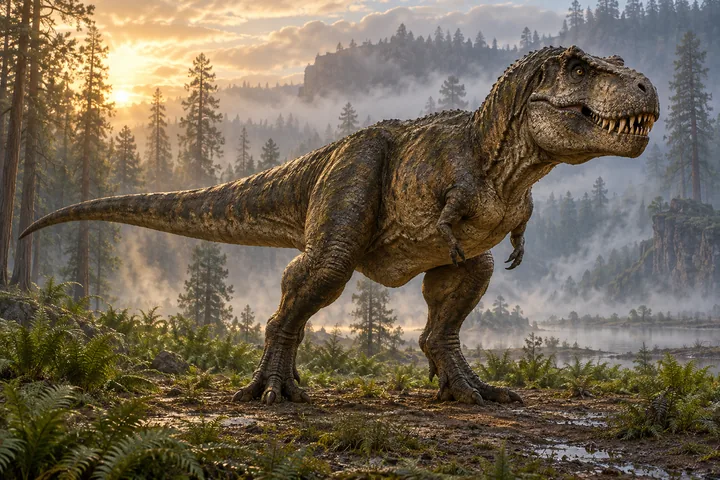
Tyrannosaurus rex
Tyrannosaurus rex was a large meat-eating dinosaur from the final part of the Cretaceous in western North America. Fossil teeth, bite marks and skeletons reveal a powerful animal whose behaviour still invites questions.
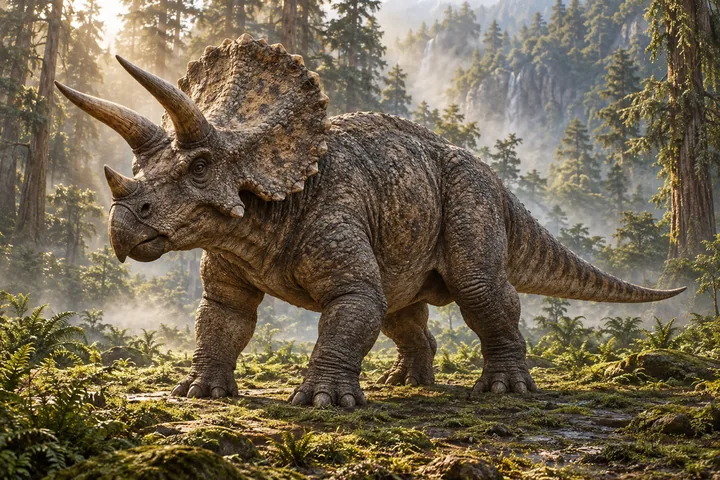
Triceratops horridus
Triceratops horridus was a horned dinosaur of the Late Cretaceous. Skin impressions attributed to this species reveal scales, while skulls and their positions in rock layers help researchers distinguish it from the later Triceratops prorsus.
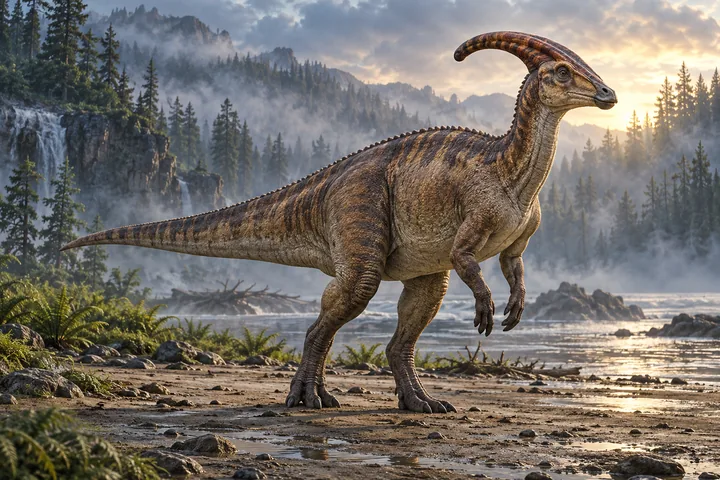
Parasaurolophus walkeri
Parasaurolophus walkeri was a crested duck-billed dinosaur from Late Cretaceous Alberta. Its famous Royal Ontario Museum skeleton preserves both an elongated tubular crest and healed injuries.