
Length
InferredAbout 5 m (holotype reconstruction)
The original description reconstructs MML-195 from incomplete remains. Its maturity and an adult species length interval are not established. [D1]
EXHIBIT 96
Austroraptor cabazai
Austroraptor was a large Patagonian theropod with a long low skull, small teeth and unusually short arms.
TWO WAYS TO PICTURE THE PAST
Compare the evidence with the familiar movie image. The illustrations are not to a shared scale.
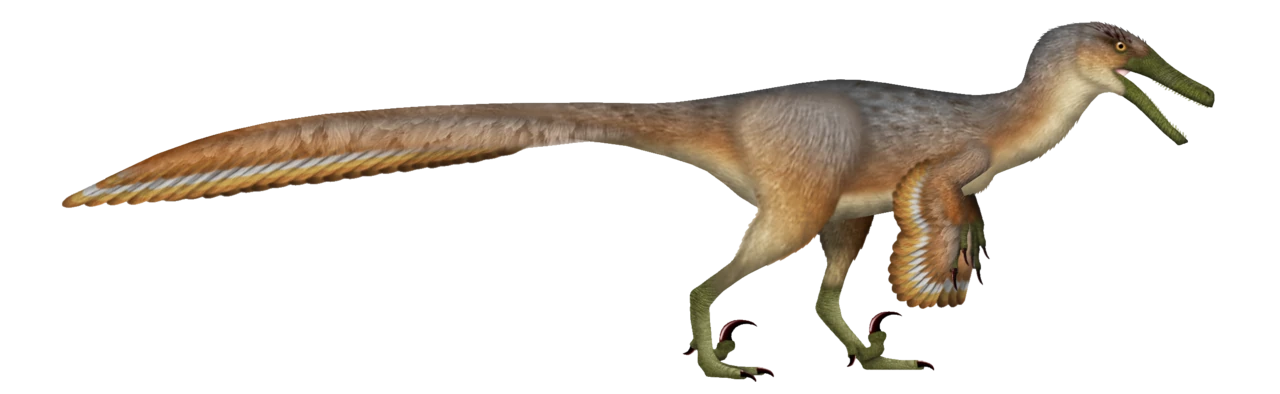
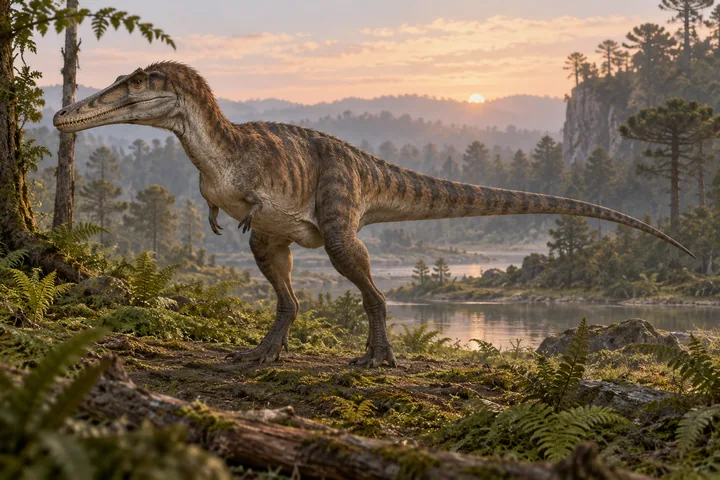
Life reconstruction of Austroraptor cabazai by TotalDino. The long low snout and reduced arms have fossil support; color, feather coverage and other soft tissues are comparative interpretations, not preserved features of these specimens. [1]
Austroraptor TD · TotalDino. CC BY-SA 4.0. Commons-listed 1280 px preview converted to WebP; smaller responsive copy proportionally resized. Artwork preserved. These copies remain CC BY-SA 4.0.
Scientific reconstruction is an interpretation; source credit does not certify every anatomical detail.
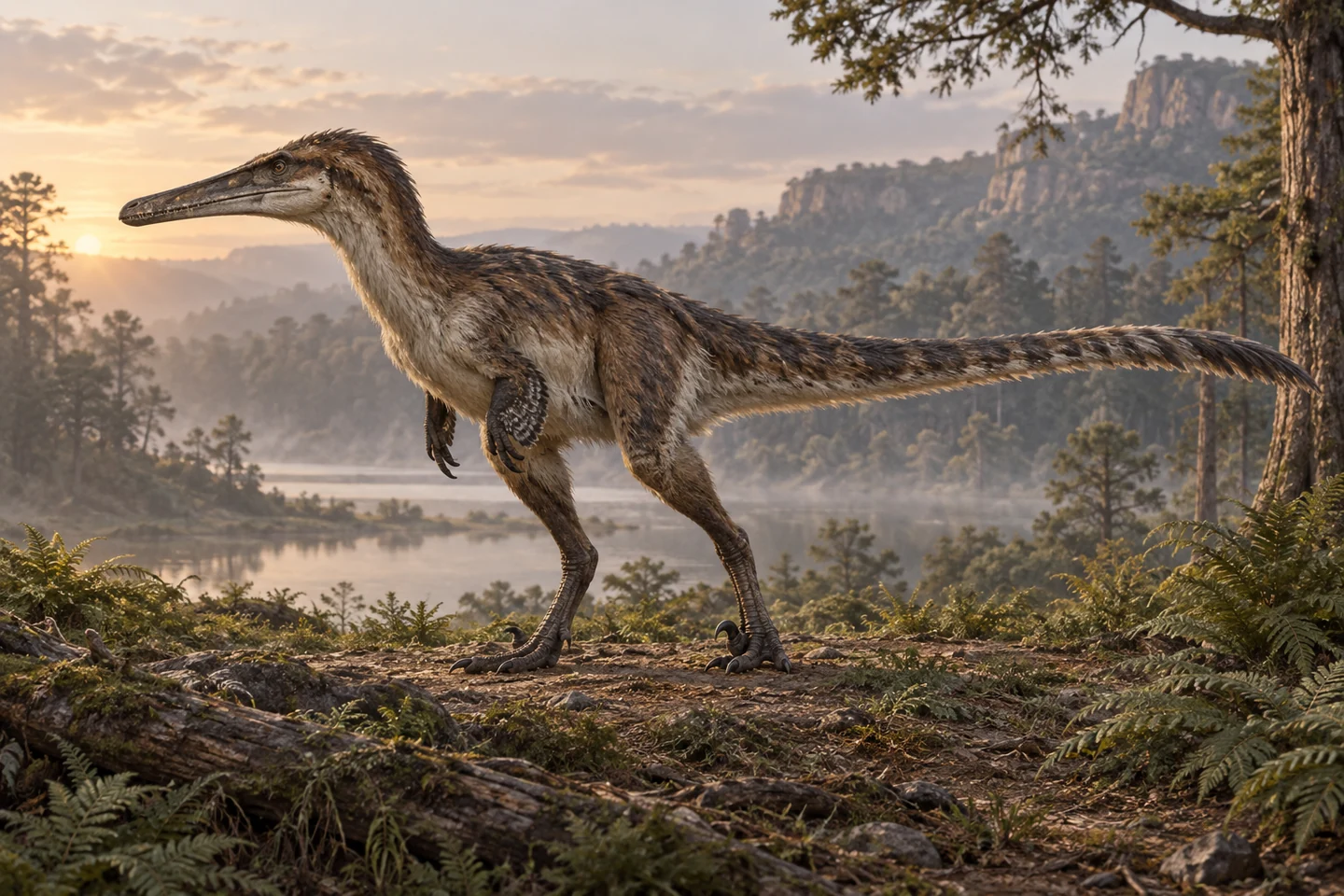
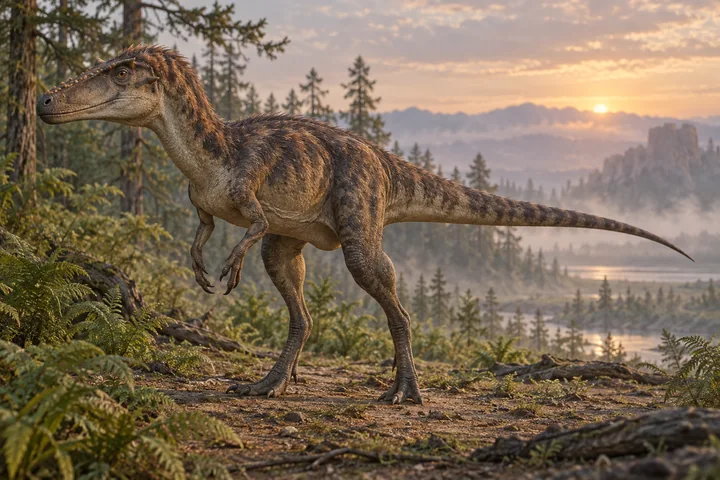
Original cinematic interpretation of Austroraptor cabazai. Coloration, soft tissues and scenery are artistic choices; reconstructed proportions do not establish a measured individual. Lighting, coloration and scenery are artistic choices. This image does not document a fossil locality or behavior.
Original artwork · artistic interpretation.
Scientific view: source-informed reconstruction, credited paleoart or specimen-based imagery. Movie-style view: Original artistic interpretation. Reconstructions involve uncertainty.
MEET THE ANIMAL
Austroraptor was a Late Cretaceous dinosaur from Río Negro in Argentina. Its incomplete original skeleton was reconstructed as an animal about five metres long. A long, low skull and reduced upper arms distinguished it from many familiar raptor outlines, without establishing a complete adult size range. [D1]
A second partial individual added details of the forearm, hand, and foot. These bones support a reconstruction moving on its hind legs. Short whole arms do not mean that the forearm bones were unusually short in every comparison; the proportions of separate limb sections need to be considered. [D2]
Skull and tooth comparisons have suggested feeding on fish as well as land animals. Fish scales at the quarry are not a preserved meal inside Austroraptor, so the evidence does not make it an exclusive fish eater. The feeding proposal remains an interpretation of anatomy and setting. [D3]
The original upper-jaw bone is documented in the region's paleontological collections. That identified specimen provides a firm reference for future comparisons. A reconstruction built around it still includes less directly known details, especially living color, feathers, and particular hunting behavior. [D4]
PREHISTORIC ANIMAL DOSSIER
The animal, the evidence, and the questions still open.
Its anatomy supports predatory feeding, with fish consumption remaining a hypothesis.
Profile scope: Species: A. cabazai. MML-195 anchors the length reconstruction; the 2025 mass calculation uses a reconstructed femur, not a measured living animal.
Source supported identifies a description documented by the cited source. Inferred marks a reconstruction or functional estimate. Debated marks competing interpretations. Not established means the sources reviewed for this dossier do not support a firm conclusion; it does not mean a behavior never occurred.
A size reference is an estimate, not a population range. Nesting evidence does not by itself establish courtship, mate choice, or lifelong pairing.
About 5 m (holotype reconstruction)
The original description reconstructs MML-195 from incomplete remains. Its maturity and an adult species length interval are not established. [D1]
About 460 kg (2025 reconstruction)
The calculation uses a conservatively reconstructed 60 cm femur and a published mass regression. It is an estimate, without a demonstrated adult population range. [D3]
Predator; fish consumption proposed
Skull and tooth comparisons suggest fish plus terrestrial prey. Conical teeth and quarry fish scales do not prove a preserved meal or exclusive piscivory. [D3]
Río Negro; Allen Formation
Bajo de Santa Rosa fossils are Late Cretaceous. The reviewed sedimentary interpretation includes river and lake settings. [D1] [D3]
Hindlimb-supported walking inferred
Preserved hindlimb and foot anatomy support bipedal reconstruction; no specific speed or pursuit behavior is established. [D2]
Long low snout; reduced arms
The humerus is short relative to the hindlimb. The second specimen clarifies hand and forearm anatomy; short whole arms do not mean unusually short forearms. [D1] [D2]
Not established here
Regional dinosaur eggs are not securely assigned to Austroraptor; its nesting, incubation and care remain unestablished.
Not established here
Focused review found no supported mating display, sexual dimorphism or courtship sequence.
Not established here
Two known partial individuals do not demonstrate pack hunting or a lasting social organization.
Sources and inspection notes for the claims in this profile.
THE STORY IN THE FOSSILS
Austroraptor’s unusually long skull and short arms distinguish it from familiar raptor reconstructions. A second partial skeleton supplied limb details that were missing from the original description. [2]
Its holotype maxilla is documented in Río Negro’s paleontological collections. These identified bones anchor the reconstruction; feathers, living color and exact hunting behavior remain less directly constrained. [4]
The dossier identifies the scope of each reference estimate. A mount, an individual fossil and a species-wide adult range are different measurements. Comparison metrics remain unavailable where adult scope has not been established. Unknown does not mean zero.
Sources support the stated claims and scopes. Refer to the evidence notes for uncertainty.
KEEP EXPLORING
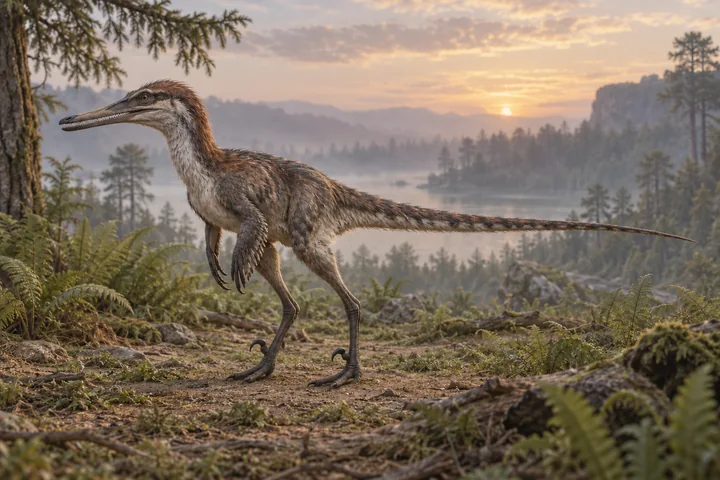
Buitreraptor gonzalezorum
Buitreraptor had a long, low snout and numerous tiny teeth.
Qianzhousaurus sinensis
Qianzhousaurus was a long-snouted tyrannosaur from southern China, with skull proportions very different from deep-headed relatives.
Alioramus altai
Alioramus had a long low snout; its best-described skeleton was young.