EXPLORE PREHISTORY 220 prehistoric animal profiles · Scientific & movie-style image galleries

EXHIBIT 95

Qianzhousaurus

Qianzhousaurus sinensis

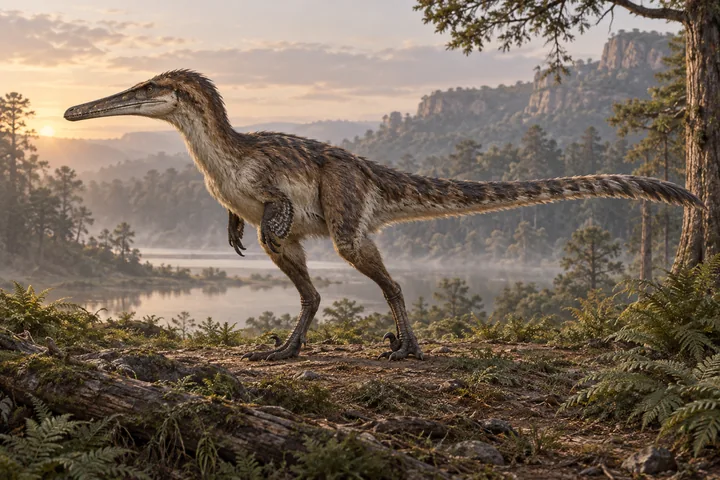
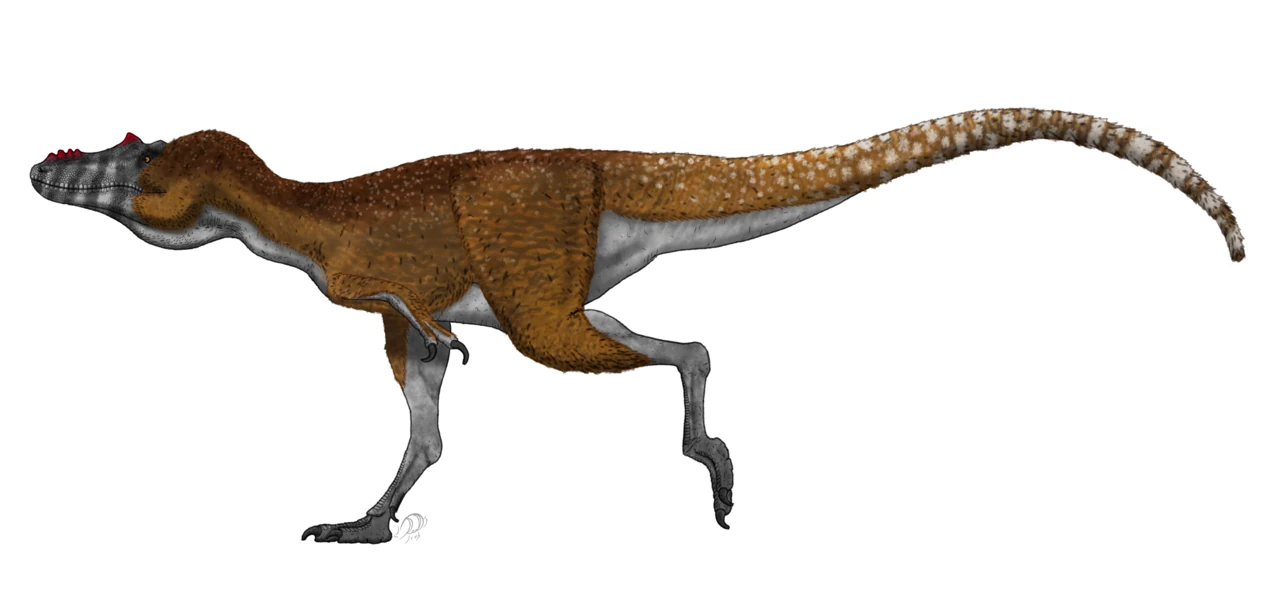
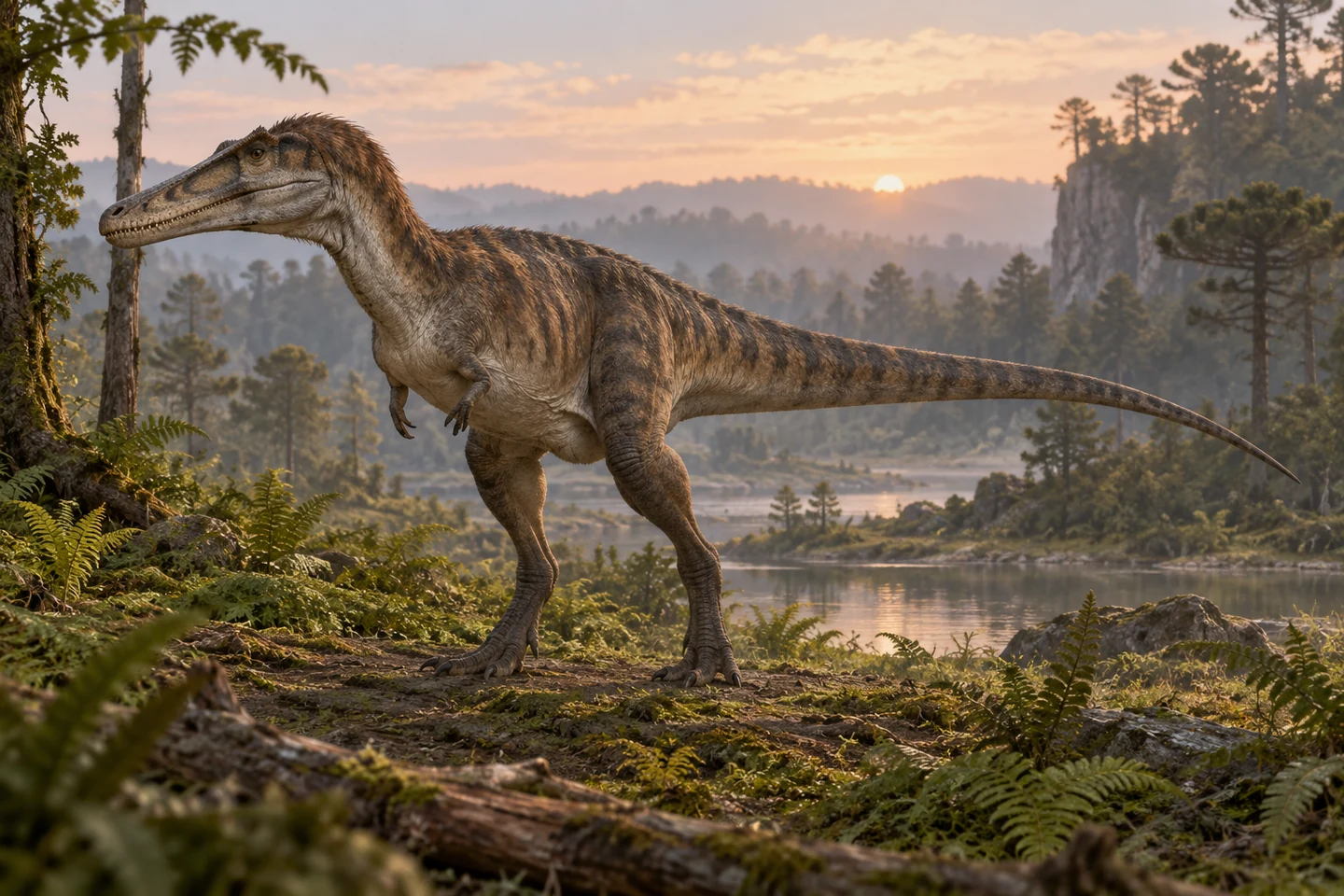
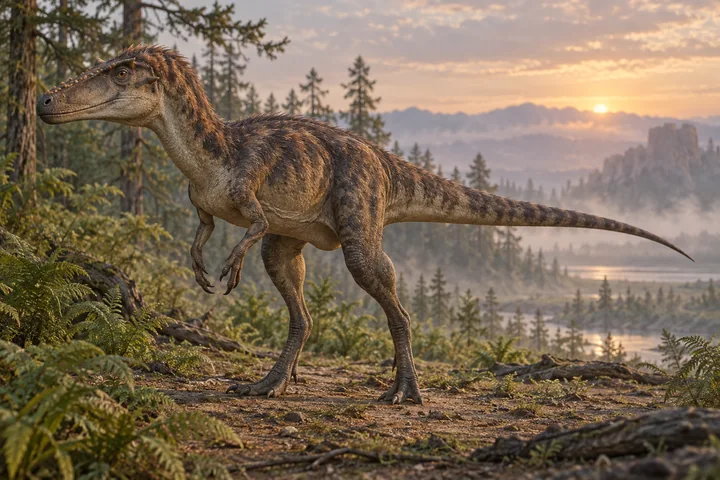
Qianzhousaurus was a long-snouted tyrannosaur from southern China, with skull proportions very different from deep-headed relatives.

Evidence profile
PERIODLate Cretaceous[1]
DIETCarnivoreEvidence and uncertainty in the dossier
TOTAL LENGTHSee the dossierEstimate scope matters
FOSSILS FOUNDJiangxi, China[1]
CompareRead the dossierView the sources

MEET THE ANIMAL

Meet Qianzhousaurus

Qianzhousaurus was a meat-eating tyrannosaur from Late Cretaceous Asia. Its long, low skull and narrow teeth gave it a different outline from the deep-headed tyrannosaurs that often dominate popular images. Those jaws identify an unusual predator, but they do not provide a precise prey list or show how it behaved during a hunt. [D3]

Published body reconstructions for its original individual give an approximate length of 7.5 to 9 metres. That interval concerns an estimated animal assembled from incomplete evidence, not a measured population of adults. A large footprint has also been discussed as a possible match. Possible attribution should remain separate from a footprint securely linked to the animal that made it. [D5]

The original skeleton includes leg bones that support a two-legged reconstruction. Its fossils came from the Nanxiong Formation near Ganzhou in southern China. Nearby discoveries help picture the ancient community, but a shared rock formation does not prove interaction. The identified bones provide a firmer portrait than an imagined hunting scene. [D1]

PREHISTORIC ANIMAL DOSSIER

A life in profile.

The animal, the evidence, and the questions still open.

Later cranial work retains Qianzhousaurus separately from Alioramus while considering growth-related similarities.

Profile scope: Species: Q. sinensis. GM F10004 is the holotype; its mass estimate is a fossil-individual calculation, not an adult species range.

Time
Late Cretaceous
Fossil locations in this exhibit
Jiangxi, China
How to read the evidence

Source supported identifies a description documented by the cited source. Inferred marks a reconstruction or functional estimate. Debated marks competing interpretations. Not established means the sources reviewed for this dossier do not support a firm conclusion; it does not mean a behavior never occurred.

A size reference is an estimate, not a population range. Nesting evidence does not by itself establish courtship, mate choice, or lifelong pairing.

Length

Inferred

About 7.5–9 m (reported holotype reconstruction)

The 2019 track paper reports Lü’s reconstruction of GM F10004. This is an approximate individual-body estimate, not the footprint’s measured length or an adult population interval. [D5]
Mass

Inferred

About 757 kg (holotype estimate)

The 2014 estimate uses femur length and a published regression for GM F10004. Later predicted adult-level maturity does not make this a species range. [D1]

Diet and feeding

Source supported

Animal-eater

Research-team sources identify carnivory. Its long narrow jaws do not identify a preserved meal or a particular prey species. [D3]

Habitat and range

Source supported

Jiangxi; Nanxiong Formation

The holotype comes from Nankang, Ganzhou, in Maastrichtian strata of southern China. Formation-wide dinosaur eggs are not assigned to this species. [D1]

Movement

Inferred

Hindlimb-supported walking inferred

Preserved leg anatomy and tyrannosaur comparison support bipedal reconstruction; running speed is not established. [D1]

Distinctive anatomy

Source supported

Long, low tyrannosaur skull

The revised diagnosis retains distinctive cranial features beyond similarities expected from growth in Alioramus. [D2]

Reproduction & life together

Reproduction and care

Not established

Not established here

Focused review found no securely species-assigned nest, egg, incubation or care evidence.

Courtship and mating

Not established

Not established here

Skull ridges and bumps do not establish display behavior, sexual dimorphism or a mating system.

Social behavior

Not established

Not established here

The holotype and regional coexistence with other predators do not establish pack hunting or lasting social groups.

Dossier research & sources

Sources and inspection notes for the claims in this profile.

  1. A new clade of Asian Late Cretaceous long-snouted tyrannosauridsNature Communications; Lü and colleagues (2014) · Accessed 2026-10-02Original article inspected: holotype GM F10004, Jiangxi Nanxiong Formation locality, Maastrichtian age, elongate skull, preserved hindlimbs and femur-based 757 kg estimate. · Inspected: page
  2. The cranial anatomy of the long-snouted tyrannosaurid dinosaur Qianzhousaurus sinensis from the Late Cretaceous of ChinaJournal of Vertebrate Paleontology; Foster, Brusatte, Carr, Williamson, Yi and Lü (2022), University of Edinburgh repository copy · Accessed 2026-10-02Publisher version PDF and institutional abstract inspected: revised diagnosis retaining Qianzhousaurus, morphological maturity assessment and comparisons with Alioramus; further growth-series evidence remains necessary. · Inspected: page
  3. Newly found dinosaur is long-nosed cousin of Tyrannosaurus rexUniversity of Edinburgh news release (May 2014) · Accessed 2026-10-02Research-team news release inspected: carnivory, Asian Late Cretaceous context and elongate narrow-toothed skull; no specific prey or reproductive evidence. · Inspected: page
  4. The first deep-snouted tyrannosaur from Upper Cretaceous Ganzhou City of southeastern ChinaScientific Reports; Zheng, Jin, Xie and Du (2024) · Accessed 2026-10-02Article context and discussion inspected: Qianzhousaurus from the Maastrichtian Nanxiong Formation, approximately 90 cm skull and sympatry with Asiatyrannus; niche separation remains inferred. · Inspected: page
  5. A probable tyrannosaurid track from the Upper Cretaceous of Southern ChinaScience Bulletin; Xing, Niu, Lockley, Klein, Romilio, Persons and Brusatte (2019), University of Edinburgh author manuscript · Accessed 2026-10-02Primary manuscript inspected: reports Lü’s approximately 7.5–9 m holotype-body reconstruction. The large footprint is only possibly Qianzhousaurus and is not treated as securely genus-assigned behavior. · Inspected: page

THE STORY IN THE FOSSILS

Meet Qianzhousaurus.

Qianzhousaurus helped show that a long slender tyrannosaur snout was not confined to very young fossils. A later skull revision retained it as a distinct genus alongside Alioramus. [2]

The same formation later yielded the smaller, deeper-snouted Asiatyrannus. Different skull proportions suggest different feeding niches, but coexistence alone does not show the two predators interacting. [4]

A note on scale and time

The dossier identifies the scope of each reference estimate. A mount, an individual fossil and a species-wide adult range are different measurements. Comparison metrics remain unavailable where adult scope has not been established. Unknown does not mean zero.

Sources & editorial notes

Sources support the stated claims and scopes. Refer to the evidence notes for uncertainty.

  1. A new clade of Asian Late Cretaceous long-snouted tyrannosauridsNature Communications; Lü and colleagues (2014) · Accessed 2026-10-02Original article inspected: holotype GM F10004, Jiangxi Nanxiong Formation locality, Maastrichtian age, elongate skull, preserved hindlimbs and femur-based 757 kg estimate. · Inspected: page
  2. The cranial anatomy of the long-snouted tyrannosaurid dinosaur Qianzhousaurus sinensis from the Late Cretaceous of ChinaJournal of Vertebrate Paleontology; Foster, Brusatte, Carr, Williamson, Yi and Lü (2022), University of Edinburgh repository copy · Accessed 2026-10-02Publisher version PDF and institutional abstract inspected: revised diagnosis retaining Qianzhousaurus, morphological maturity assessment and comparisons with Alioramus; further growth-series evidence remains necessary. · Inspected: page
  3. Newly found dinosaur is long-nosed cousin of Tyrannosaurus rexUniversity of Edinburgh news release (May 2014) · Accessed 2026-10-02Research-team news release inspected: carnivory, Asian Late Cretaceous context and elongate narrow-toothed skull; no specific prey or reproductive evidence. · Inspected: page
  4. The first deep-snouted tyrannosaur from Upper Cretaceous Ganzhou City of southeastern ChinaScientific Reports; Zheng, Jin, Xie and Du (2024) · Accessed 2026-10-02Article context and discussion inspected: Qianzhousaurus from the Maastrichtian Nanxiong Formation, approximately 90 cm skull and sympatry with Asiatyrannus; niche separation remains inferred. · Inspected: page
  5. A probable tyrannosaurid track from the Upper Cretaceous of Southern ChinaScience Bulletin; Xing, Niu, Lockley, Klein, Romilio, Persons and Brusatte (2019), University of Edinburgh author manuscript · Accessed 2026-10-02Primary manuscript inspected: reports Lü’s approximately 7.5–9 m holotype-body reconstruction. The large footprint is only possibly Qianzhousaurus and is not treated as securely genus-assigned behavior. · Inspected: page

FOLLOW YOUR CURIOSITY

Who will you meet next?

KEEP EXPLORING

More from the collection