
Body length
InferredAbout 10–12 m (museum reference)
The museum gives this approximate species reference interval. It does not establish a measured adult population distribution or maturity assessment for each estimate. [D1]
EXHIBIT 19
Tarbosaurus bataar
Tarbosaurus combined a huge head with exceptionally reduced forelimbs.
TWO WAYS TO PICTURE THE PAST
Compare the evidence with the familiar movie image. The illustrations are not to a shared scale.

The artist identifies this reconstruction as Tarbosaurus bataar. Fossil-informed anatomy: Large relatively slender tyrannosaur skull, serrated teeth, sturdy hind limbs and extremely small arms. Coloration and some soft tissues are interpretive; species reconstruction represents the genus. [1]
Tarbosaurus TD.png — TotalDino. CC BY-SA 4.0. Remote source artwork displayed without additional cropping; Wikimedia supplies any display-size derivative.
Scientific picture served by Wikimedia · internet connection required.
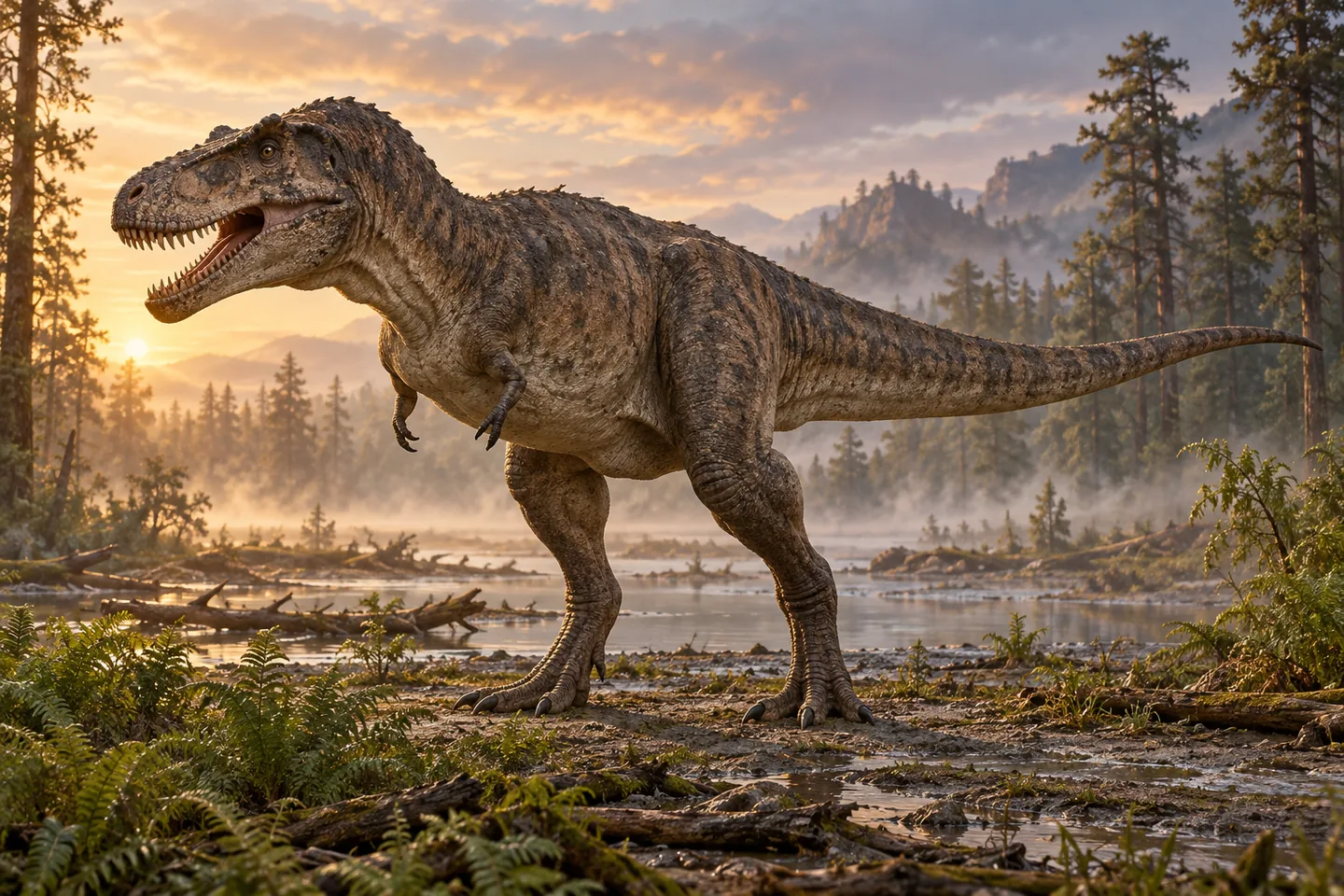
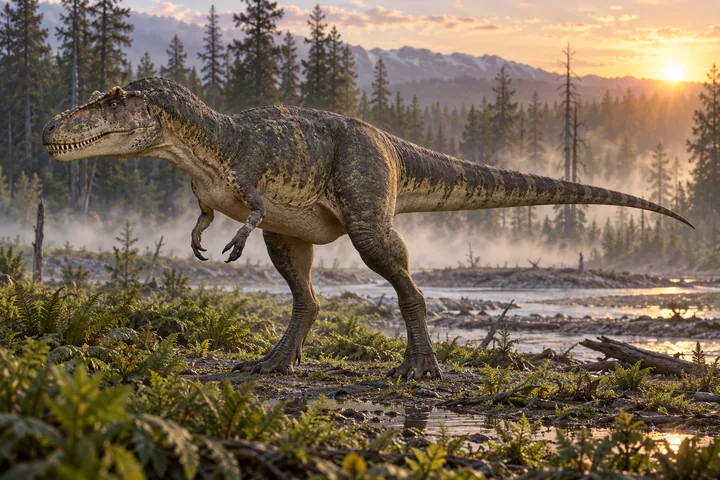
Cinematic Tarbosaurus bataar with a long tyrannosaur head and extremely reduced forelimbs; preserve sturdy hind limbs and use artistic surface coloring. Dramatic lighting, surface detail and scenery are artistic choices. This is an original cinema-inspired picture, rather than a frame from a film or a documented fossil locality.
Original artwork · artistic interpretation.
Scientific view: credited paleoart interpreting fossil evidence, served online by Wikimedia. Movie-style view: Original artistic interpretation. Colors, soft tissues and settings involve reconstruction.
MEET THE ANIMAL
Tarbosaurus bataar was a large tyrannosaur from Late Cretaceous Asia. Its fossil record includes the Nemegt Formation of Mongolia. The skull had deep, powerful jaws, but it was not identical to the head of Tyrannosaurus rex. Detailed comparisons help distinguish these animals rather than treating every huge tyrannosaur as the same dinosaur in a different place. [S1]
Viewed from the side, both skulls look deep. Seen from above, the Tarbosaurus skull is narrower, with less abrupt widening toward the rear. Its lower-jaw bones also fit together in a way the researchers interpreted as producing a more rigid jaw. These are anatomical observations and functional interpretations: they explain how parts could handle biting forces, rather than preserving a direct measurement of a living bite. [S1]
The main Tarbosaurus skull studied in this research was only partly preserved, so preparation, comparison and restoration were important. A scientific reconstruction can be informative without making every part equally certain. The skull gives useful evidence about identity and feeding capability, while nests, parental care, courtship and coordinated hunting remain unresolved in the sources reviewed here. Understanding these distinctive bones helps separate preserved anatomy from a more uncertain whole-body restoration. [S1]
PREHISTORIC ANIMAL DOSSIER
The animal, the evidence, and the questions still open.
Tarbosaurus bataar was a large Asian tyrannosaur with a relatively long, narrow skull and very small two-fingered forelimbs. Its reviewed fossil profile supports a large terrestrial carnivore more directly than a detailed social or reproductive reconstruction.
Profile scope: Species — Tarbosaurus bataar
Source supported identifies a description documented by the cited source. Inferred marks a reconstruction or functional estimate. Debated marks competing interpretations. Not established means the sources reviewed for this dossier do not support a firm conclusion; it does not mean a behavior never occurred.
A size reference is an estimate, not a population range. Nesting evidence does not by itself establish courtship, mate choice, or lifelong pairing.
About 10–12 m (museum reference)
The museum gives this approximate species reference interval. It does not establish a measured adult population distribution or maturity assessment for each estimate. [D1]
Not established here
A T. bataar mass estimate with a reviewed reconstruction method is not established in the inspected source.
Meat eater
The large jaw and serrated teeth support carnivory. Anatomy does not by itself determine the balance of hunting and scavenging. [D1]
Late Cretaceous Asian river floodplains
The museum lists Mongolia and China and reconstructs a humid floodplain environment. Regional deposits do not establish an exclusive habitat preference. [D1]
Probably two-legged terrestrial movement
The tyrannosaur limb reconstruction supports terrestrial bipedal movement. Precise running speed is not established by this source. [D1]
Long narrow skull and tiny two-fingered arms
Compared with T. rex, the museum describes a longer, narrower skull and relatively small forelimbs. Skull cavities contribute to a lighter skeletal structure. [D1]
Not established here
Reviewed sources do not establish T. bataar nest architecture, clutch size or parental care.
Not established here
Reviewed sources do not establish T. bataar mating displays, posture or courtship sequence.
Not established here
Reviewed sources do not establish T. bataar group size or coordinated hunting; multiple known skeletons alone do not demonstrate social grouping.
Sources and inspection notes for the claims in this profile.
THE STORY IN THE FOSSILS
Tarbosaurus bataar lived in river-crossed floodplains of what is now Mongolia and China. Its head contained air spaces that reduced skeletal weight, while its forelimbs were extremely small. Serrated teeth and powerful jaws indicate a carnivore capable of exploiting large dinosaur carcasses and prey. [1]
A Soviet–Mongolian expedition found its first fossils in the Gobi in 1946. Maleev originally named the animal Tyrannosaurus bataar in 1955. Researchers have since debated that generic placement, with skull anatomy and internal nerve pathways supporting recognition of Tarbosaurus as a separate genus. [1]
We have not established a comparable adult total-length estimate for this taxon in this draft. Specimen measurements in the text describe those individuals. The cited dates are approximately 72–68 million years ago. Published species-level educational dating; not a complete occurrence survey. Unknown does not mean zero.
Sources and evidence notes for this exhibit.
KEEP EXPLORING
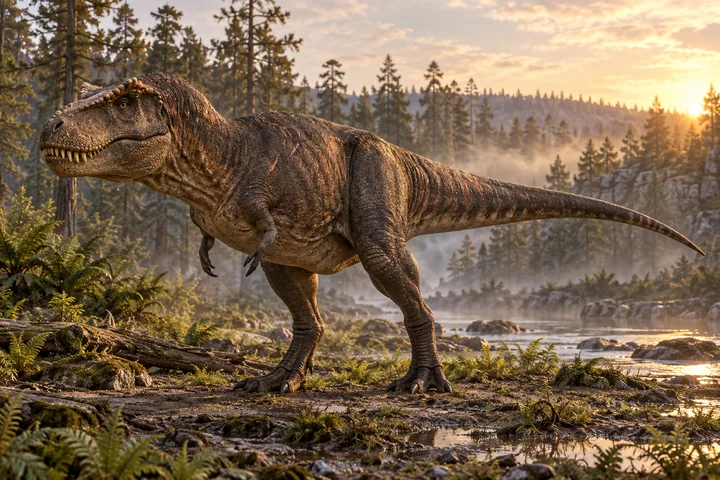
Daspletosaurus torosus
Daspletosaurus fossils include healed facial bites and evidence of a hadrosaur meal.
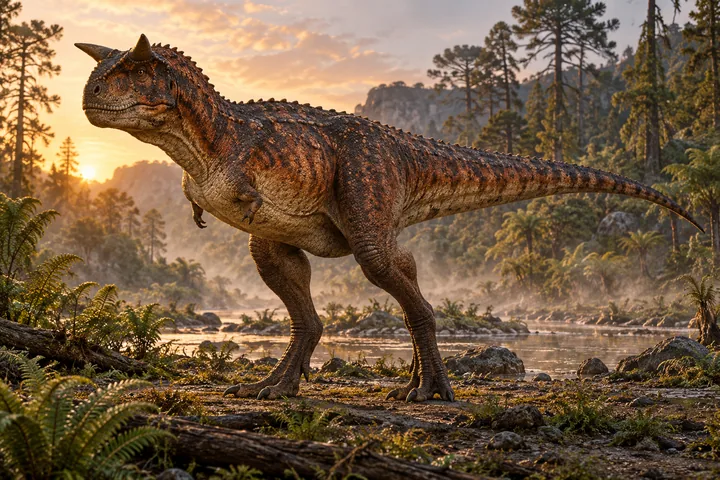
Carnotaurus
Carnotaurus paired two head horns with extraordinarily reduced forelimbs.
Albertosaurus sarcophagus
Albertosaurus had proportionately longer lower hind limbs than the heavier-built tyrannosaurines.