
Body length
Not establishedNot established here
Focused searches did not locate a specimen-scoped whole-body length calculation in the inspected skeletal revision. Its 1,190 mm femur is a limb measurement, not total body length. [D1]
EXHIBIT 185
Chilantaisaurus tashuikouensis
Chilantaisaurus is known from large limb bones in Inner Mongolia. Its head and much of its body remain reconstructed. [1]
TWO WAYS TO PICTURE THE PAST
Compare the evidence with the familiar movie image. The illustrations are not to a shared scale.
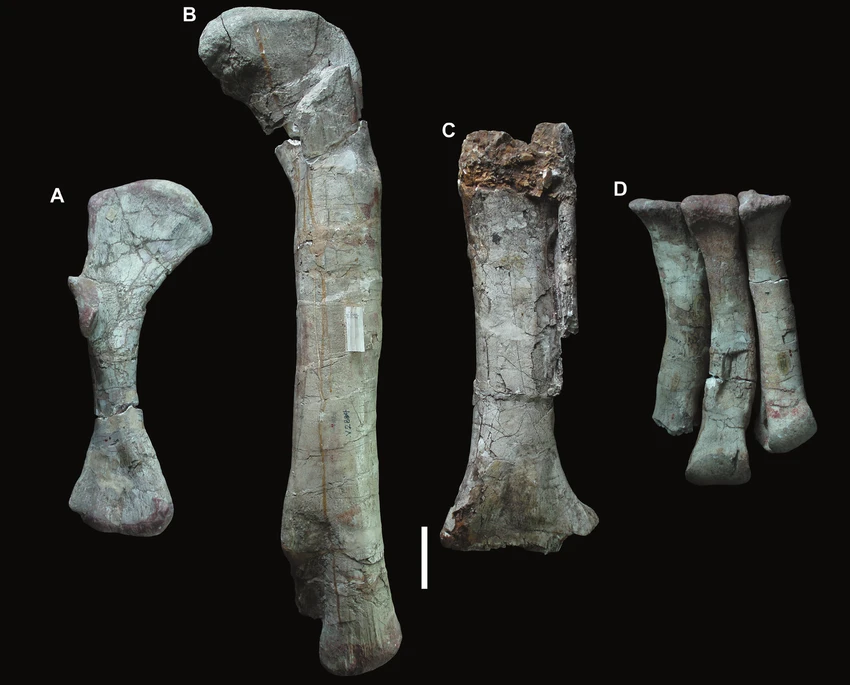
Published photographs of Chilantaisaurus tashuikouensis: lectotype humerus and associated femur, tibia/fibula and metatarsus. The Commons filename says holotype, but the 2008 revision designates a lectotype and paralectotypes. These bones do not preserve an assigned head or total body length. [1]
Chilantaisaurus lectotype and associated limbs · Xu Xing. CC BY 4.0. Converted to WebP and resized proportionally within verified native dimensions; no anatomical edits. Existing Commons crops or figure revisions are retained under the inspected file license.
The photograph or figure shows the credited fossil material; displayed mounts and labels can include interpretation.
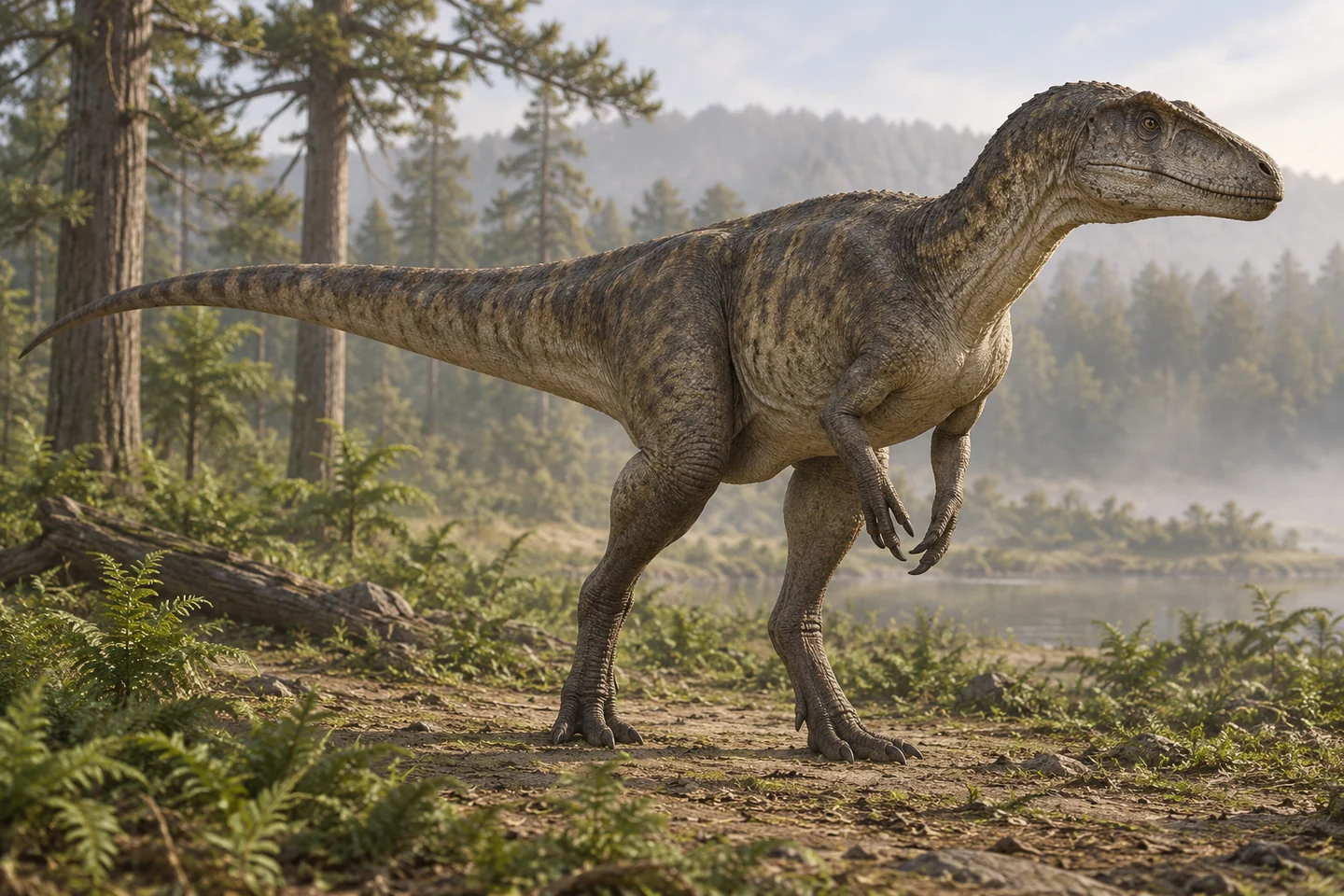
Original cinematic interpretation of Chilantaisaurus. The lectotype humerus and associated limb material guide this reconstruction. Head, trunk, soft tissues and total proportions are comparative; the image cannot settle its debated placement. Lighting, colors and scenery are artistic choices; this image does not document directly observed behavior. Lighting, coloration and scenery are artistic choices. This image does not document a fossil locality or behavior.
Original artwork · artistic interpretation.
Scientific view: source-informed reconstruction, credited paleoart or specimen-based imagery. Movie-style view: Original artistic interpretation. Reconstructions involve uncertainty.
MEET THE ANIMAL
Chilantaisaurus was a very large predatory dinosaur from Inner Mongolia in China. Its known material includes an upper-arm bone, part of the pelvis and hindlimb bones. These fossils help place it among the two-legged meat-eating dinosaurs. They do not supply a complete skull and body that can simply be measured from nose to tail. [D2]
Its rock formation has a complicated dating history. Regional evidence places the deposits after an older underlying volcanic layer, but a date inferred for another fossil locality is not automatically this animal's exact age. Rocks from nearby places can have different histories. A regional age estimate therefore leaves some uncertainty about exactly when Chilantaisaurus lived. [D3]
The name also needs care. Fossils once called Chilantaisaurus maortuensis are now treated as Shaochilong. Those remains preserve different parts of the skeleton, so comparing them requires more than a shared old label. The fossils of Shaochilong do not supply Chilantaisaurus with a missing skull. [D2]
PREHISTORIC ANIMAL DOSSIER
The animal, the evidence, and the questions still open.
A 580 mm humerus anchors the revised type identity. Associated hindlimbs indicate great size, but excluded teeth and vertebrae cannot supply a securely identified skull or skeleton. [D1]
Profile scope: Genus profile restricted to C. tashuikouensis at Tashuikou. Former C. maortuensis is treated separately as Shaochilong; disputed nonoverlap is conservatively reserved. [D2]
Source supported identifies a description documented by the cited source. Inferred marks a reconstruction or functional estimate. Debated marks competing interpretations. Not established means the sources reviewed for this dossier do not support a firm conclusion; it does not mean a behavior never occurred.
A size reference is an estimate, not a population range. Nesting evidence does not by itself establish courtship, mate choice, or lifelong pairing.
Not established here
Focused searches did not locate a specimen-scoped whole-body length calculation in the inspected skeletal revision. Its 1,190 mm femur is a limb measurement, not total body length. [D1]
About 3.59 tonnes; associated-femur model
The 2014 table models IVPP V2884 at 3,590 kg from measured femoral circumference. That femur is associated type-series material, not the lectotype humerus; life stage remains unverified. [D4]
Carnivory inferred comparatively
Theropod relationships support predatory feeding as a comparative interpretation. The historically associated tooth was excluded, so it is not secure direct evidence of this species’ dentition or meals. [D1]
Ulansuhai deposits; stage uncertain
The Inner Mongolian formation is regionally constrained as post-Cenomanian by underlying basalt. The more specific Sinocephale locality age does not directly date the Tashuikou animal; stage uncertainty remains. [D3]
Bipedal reconstruction from hindlimbs
Large femora, tibiae and a narrow metatarsus support a two-legged theropod reconstruction. Missing axial and cranial regions prevent a complete measured posture or speed estimate. [D1]
Very large humerus and associated leg bones
The designated lectotype is the right humerus, IVPP V2884.1. The remaining limb elements probably belong to the same animal, but that association is an interpretation. [D1]
Not established here
Focused searches did not establish securely assigned eggs, embryos, nests, clutch size, incubation or parental care. Broader theropod evidence cannot identify this genus’s reproductive habits.
Not established here
No inspected source establishes sexual differences or display structures. A restored head cannot supply horn, crest or courtship evidence.
Not established here
A probably associated type series is insufficient to establish herd structure, cooperative hunting or family behavior. Focused searches found no securely attributed behavioral assemblage. [D1]
Sources and inspection notes for the claims in this profile.
THE STORY IN THE FOSSILS
The historical name Chilantaisaurus maortuensis became Shaochilong. The two type series do not overlap anatomically; published contrasting affinities argue against synonymy, but the unresolved comparison is retained in the duplicate guard. [2]
A regional date is not an individual date: the 2021 geological review distinguishes different Ulansuhai localities. The catalog therefore avoids a precise numerical age for the Tashuikou specimen. [3]
The dossier identifies the scope of each reference estimate. A mount, an individual fossil and a species-wide adult range are different measurements. Comparison metrics remain unavailable where adult scope has not been established. Unknown does not mean zero.
Sources support the stated claims and scopes. Refer to the evidence notes for uncertainty.
KEEP EXPLORING
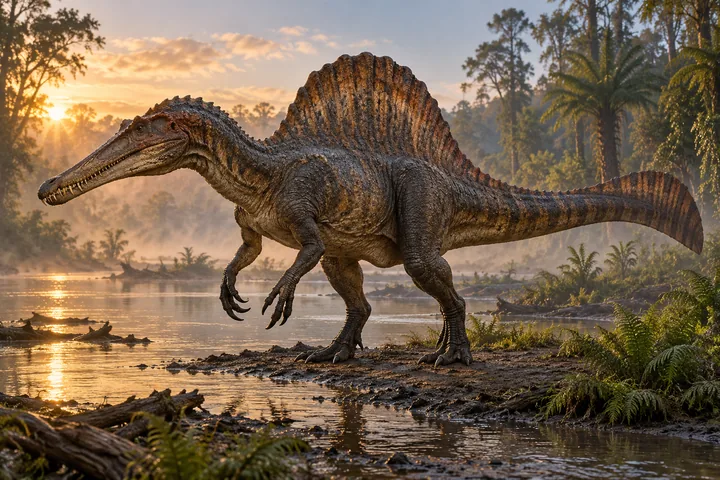
Spinosaurus
This North African spinosaur combined a narrow snout with a tall back sail. Its relationship with water remains actively debated.
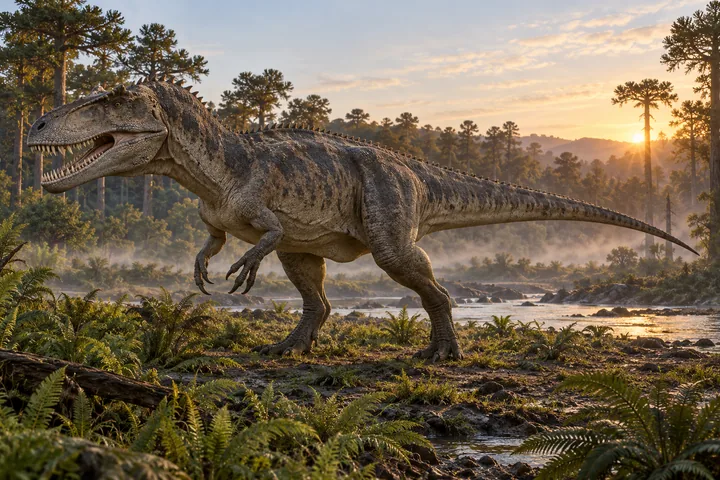
Giganotosaurus
This huge Argentine carnivore belonged to Carcharodontosauridae. Incomplete skeletons make its exact size and prey choices difficult to establish.
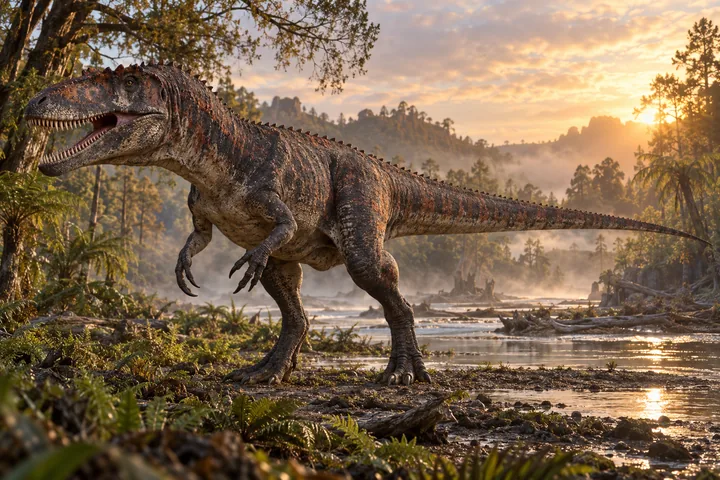
Carcharodontosaurus
This giant carnivore lived across North Africa. Its flesh-cutting teeth contrast with the thicker, bone-crushing teeth associated with Tyrannosaurus.