
Body length
InferredAbout 14 m (museum reference)
The reference depends on reconstructed missing parts of incomplete fossils. It is not a directly measured complete animal or verified adult maximum. [D1]
EXHIBIT 08
Spinosaurus
Spinosaurus had short hind limbs and a broad, paddle-shaped tail.
TWO WAYS TO PICTURE THE PAST
Compare the evidence with the familiar movie image. The illustrations are not to a shared scale.

The artist identifies this reconstruction as Spinosaurus. Fossil-informed anatomy: Narrow notched snout, conical teeth, tall dorsal sail, short hind limbs and deep tail. Body proportions and aquatic adaptations remain debated; coloration is speculative. [1]
Spinosaurus 2020 reconstruction.jpg — Mariolanzas. CC BY-SA 4.0. Remote source artwork displayed without additional cropping; Wikimedia supplies any display-size derivative.
Scientific picture served by Wikimedia · internet connection required.
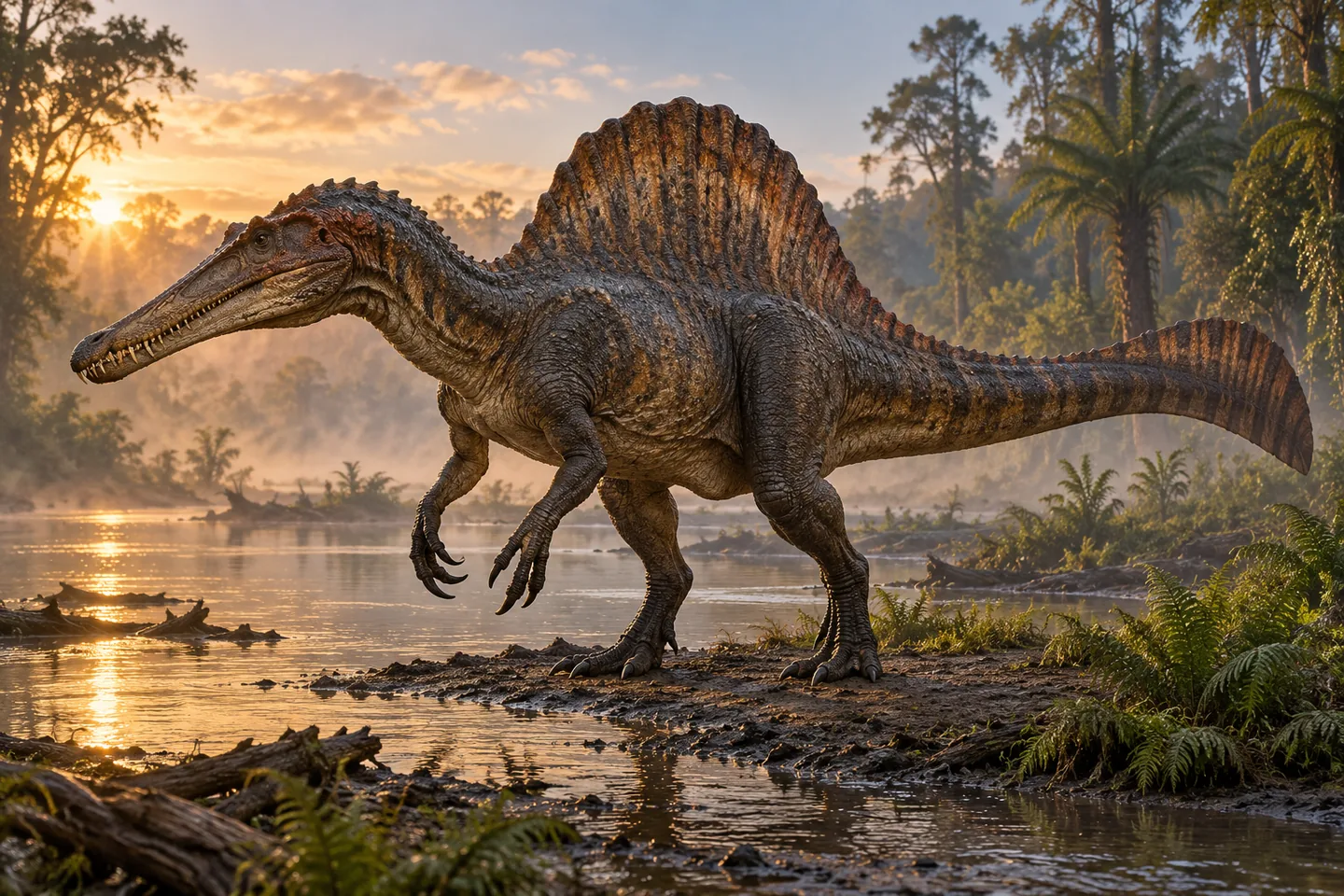
Cinematic Spinosaurus with tall sail, elongated fish-catching snout, short hind limbs and broad tail; speculative coloring is an artistic choice. Dramatic lighting, surface detail and scenery are artistic choices. This is an original cinema-inspired picture, rather than a frame from a film or a documented fossil locality.
Original artwork · artistic interpretation.
Scientific view: credited paleoart interpreting fossil evidence, served online by Wikimedia. Movie-style view: Original artistic interpretation. Colors, soft tissues and settings involve reconstruction.
MEET THE ANIMAL
Spinosaurus was a large Late Cretaceous predator known from North Africa. Long jaws and spaced, cone-shaped teeth supported the original interpretation of a fish-eating dinosaur. Tall spines formed its familiar back sail. Later discoveries, including a deep tail, have made its outline more complete and renewed the debate about how this unusual animal moved and fed. [S1]
Researchers agree less closely about its activities than its recognizable bones might suggest. Proposed lifestyles range from taking food at the water's edge to chasing prey underwater. A 2024 study reviewed evidence for these ideas and challenged an earlier analysis that used bone density to identify diving animals. The criticism concerns the comparisons, measurements and statistical method, rather than denying that Spinosaurus had unusual anatomy. [S1]
The distinction matters because a bone can be directly examined, while an entire swimming animal must be reconstructed and tested through models. Different models make different assumptions about missing parts, body density and movement. This is an active scientific question, not a settled underwater hunting routine. The reviewed material also leaves specific courtship, nest arrangements and parenting unresolved. Its striking sail and fish-feeding adaptations remain useful starting points without supplying every detail of its life. [S1]
PREHISTORIC ANIMAL DOSSIER
The animal, the evidence, and the questions still open.
Spinosaurus combined a long, narrow snout with a tall back sail and a deep tail. Its relationship to water is central to current research: fish feeding is well supported as an interpretation, while underwater pursuit and swimming capability remain disputed.
Profile scope: Genus — Spinosaurus; much functional research concerns S. aegyptiacus
Source supported identifies a description documented by the cited source. Inferred marks a reconstruction or functional estimate. Debated marks competing interpretations. Not established means the sources reviewed for this dossier do not support a firm conclusion; it does not mean a behavior never occurred.
A size reference is an estimate, not a population range. Nesting evidence does not by itself establish courtship, mate choice, or lifelong pairing.
About 14 m (museum reference)
The reference depends on reconstructed missing parts of incomplete fossils. It is not a directly measured complete animal or verified adult maximum. [D1]
About 7.4 tonnes (museum reference)
The museum's rounded reference is 7,400 kg. Mass depends on the chosen body reconstruction and is not a measured living weight. [D1]
Fish eating likely; other prey possible
The narrow snout and conical teeth support fish feeding. They do not establish an exclusively fish diet. [D1]
North African waterside environments
Museum and research reconstructions associate it with coastal and inland waters. The degree of aquatic specialization remains disputed. [D1] [D2]
Terrestrial gait and aquatic performance debated
The eLife model supports a terrestrial biped with limited swimming and diving performance. Other reconstructions favour greater aquatic specialization. [D2] [D1]
Long snout, high sail, deep tail
Tall vertebral spines and an unusually deep tail distinguish its skeleton. Assigning sail and tail functions requires additional interpretation. [D1]
Not established here
Reviewed sources do not establish a Spinosaurus nest, clutch size or parental-care pattern.
Sail display proposed; mating role unresolved
Visual display is a proposed sail function. The reviewed sources do not establish a mating ritual or sex-specific sail shape. [D2] [D1]
Not established here
Reviewed sources do not establish Spinosaurus group size or coordinated hunting behaviour.
Sources and inspection notes for the claims in this profile.
THE STORY IN THE FOSSILS
The smooth, cone-shaped teeth and notched, narrow jaws are interpreted as adaptations for catching fish. Newer fossils changed a once conventional land-predator reconstruction: the hind limbs were relatively short and the tail broad, rather than the familiar slender theropod profile. [1]
The first Egyptian remains were destroyed during the Second World War, and no complete skeleton is known. Reconstructions therefore combine incomplete evidence. Proposed sail functions include display and temperature regulation; the balance between shoreline activity and sustained swimming remains unresolved by current research. [1]
We have not established a comparable adult total-length estimate for this taxon in this draft. Specimen measurements in the text describe those individuals. The cited dates are approximately 99–94 million years ago. Published genus-level educational dating; not a specimen age. Unknown does not mean zero.
Sources and evidence notes for this exhibit.
KEEP EXPLORING
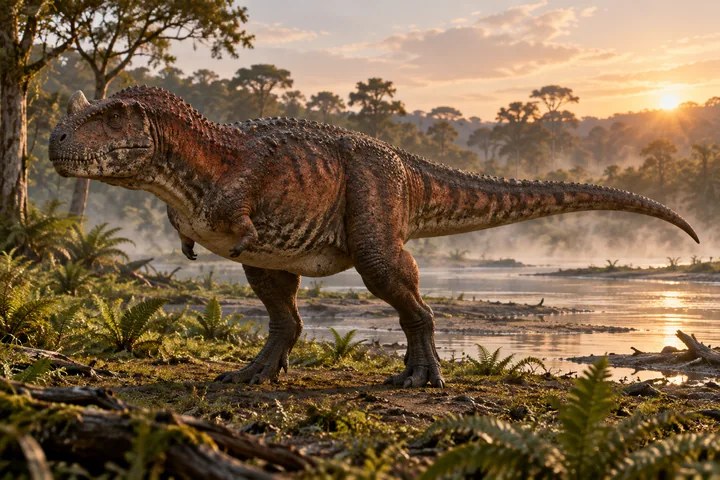
Majungasaurus crenatissimus
Majungasaurus left feeding marks on bones of both sauropods and its own species.
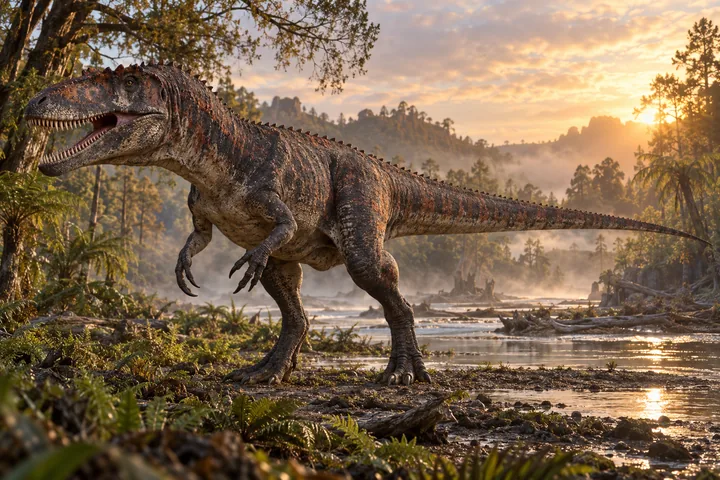
Carcharodontosaurus
Carcharodontosaurus was named for teeth resembling those of sharks.
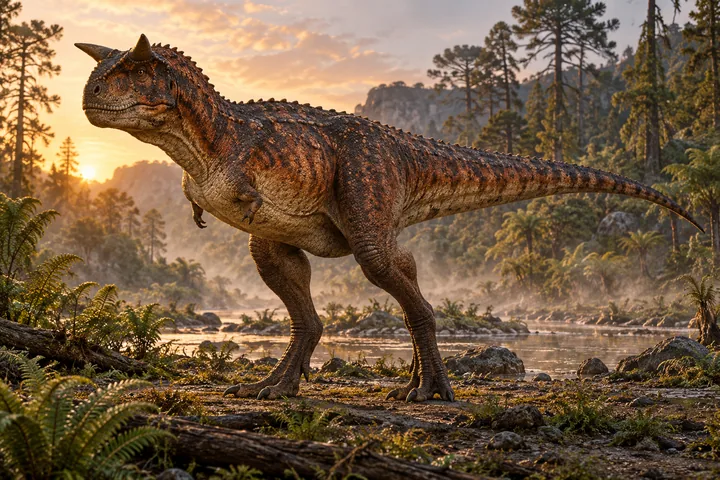
Carnotaurus
Carnotaurus paired two head horns with extraordinarily reduced forelimbs.