
Body length
Not establishedNot established here
The reviewed sources do not establish a numerical body-length estimate for this record.
EXHIBIT 23
Majungasaurus crenatissimus
Majungasaurus left feeding marks on bones of both sauropods and its own species.
TWO WAYS TO PICTURE THE PAST
Compare the evidence with the familiar movie image. The illustrations are not to a shared scale.

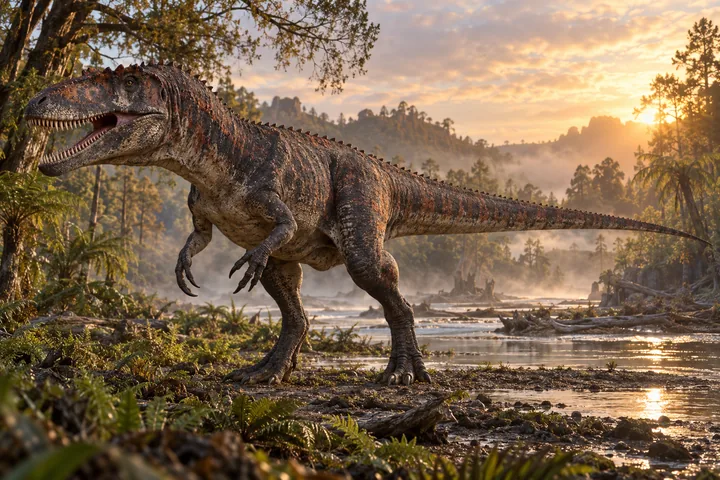
The artist identifies this reconstruction as Majungasaurus. It is used as a genus-level illustration alongside the Majungasaurus crenatissimus facts, rather than a species-identified specimen restoration. Fossil-informed anatomy: Robust ornamented skull, single median frontal horncore and extremely short, robust forelimbs. Skin and coloration are interpretive. [1] [2] [3] [4] [5]
Majungasaurus TD.png — TotalDino. CC BY-SA 4.0. Remote source artwork displayed without additional cropping; Wikimedia supplies any display-size derivative.
Scientific picture served by Wikimedia · internet connection required.
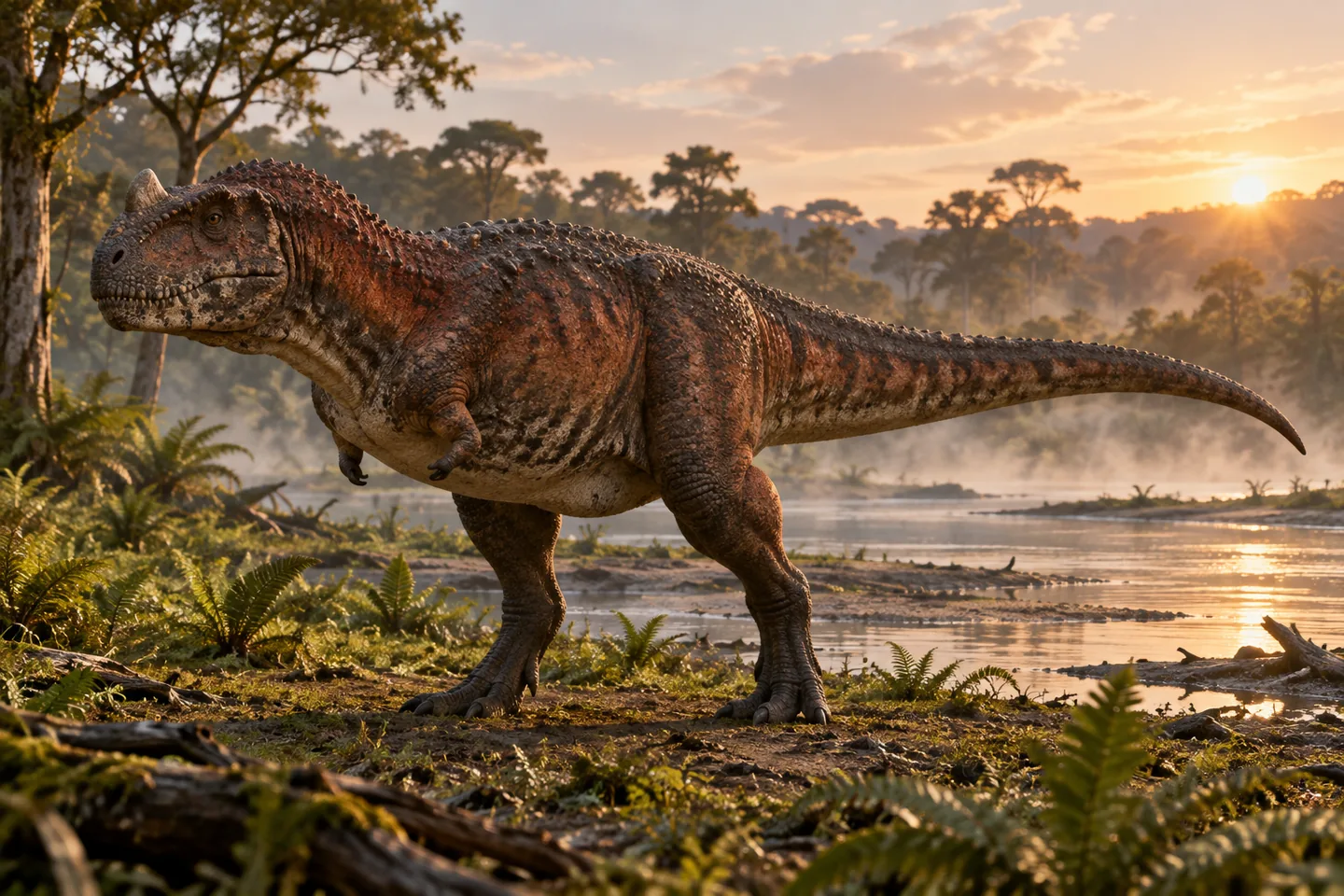
Cinematic Majungasaurus crenatissimus with a robust rough-surfaced head, small median forehead horn and extremely reduced arms; colors and fleshy ornament are artistic. Dramatic lighting, surface detail and scenery are artistic choices. This is an original cinema-inspired picture, rather than a frame from a film or a documented fossil locality.
Original artwork · artistic interpretation.
Scientific view: credited paleoart interpreting fossil evidence, served online by Wikimedia. Movie-style view: Original artistic interpretation. Colors, soft tissues and settings involve reconstruction.
MEET THE ANIMAL
Majungasaurus crenatissimus was a predatory dinosaur from Late Cretaceous Madagascar. Skull material from the Maevarano Formation includes an unusually complete, well-preserved example studied in detail. It belonged to the abelisaur family, whose members were distinctive meat-eating dinosaurs. Its short, deep and broad skull gives it a different outline from the long, narrow heads of some other predators. [S1]
The head combines thickened bones with extensive internal air spaces. Researchers described a thickened area on top of the skull and strongly modified bones around the nose. These features are useful for identification and for investigating how the skull worked. They also remind us that a rough or heavy-looking fossil does not mean every bone was solid throughout. Understanding the interior can change the picture suggested by the surface alone. [S1]
Tooth marks document feeding on sauropod carcasses and on members of its own species. These traces establish consumption, but they do not establish that Majungasaurus killed those particular animals. [D2]
The rest of the body provides another striking contrast: its forelimbs were highly reduced. Research on these small arms complements the detailed work on the skull. Preserved anatomy gives a stronger starting point than an imagined daily routine. The reviewed evidence does not establish courtship displays, parenting or an ordinary social-group size for this species. [D3]
PREHISTORIC ANIMAL DOSSIER
The animal, the evidence, and the questions still open.
Majungasaurus crenatissimus was an abelisaurid predator from Cretaceous Madagascar with an unusually roughened and ornamented skull. Tooth marks document feeding on sauropod carcasses and members of its own species, while the manner of death remains unresolved.
Profile scope: Species: Majungasaurus crenatissimus; older research uses Majungatholus atopus.
Source supported identifies a description documented by the cited source. Inferred marks a reconstruction or functional estimate. Debated marks competing interpretations. Not established means the sources reviewed for this dossier do not support a firm conclusion; it does not mean a behavior never occurred.
A size reference is an estimate, not a population range. Nesting evidence does not by itself establish courtship, mate choice, or lifelong pairing.
Not established here
The reviewed sources do not establish a numerical body-length estimate for this record.
Not established here
The reviewed sources do not establish a numerical body-mass estimate for this record.
Carnivore; sauropods and conspecific carcasses
Tooth-marked bones establish carcass consumption, including its own species. They do not establish that Majungasaurus killed the individuals it consumed. [D2] [D3]
Maevarano Formation, Madagascar
The feeding study samples Late Cretaceous Maevarano sites. Fossil locality is established; a specific habitat preference is not established here. [D2]
Bipedal theropod; gait details unreviewed
Two-legged posture is inferred from its theropod skeletal reconstruction. These inspected summaries do not establish speed or a detailed gait. [D1]
Roughened, ornamented skull; reduced forelimbs
Skull research documents unusual surface ornamentation and extensive air sinuses. The university project account documents research on the highly reduced forelimbs. [D1] [D3]
Not established here
The reviewed sources do not establish taxon-specific nest structure, clutch size or parental care.
Not established here
The reviewed sources do not establish a mating ritual, pair bond or breeding season for this taxon.
Not established here
The reviewed sources do not establish a taxon-specific group structure or social hierarchy.
Sources and inspection notes for the claims in this profile.
THE STORY IN THE FOSSILS
Majungasaurus had roughened skull bones and a median frontal horncore. A partial growth series shows that the skull became taller and more robust in larger individuals. Its exceptionally short forelimbs retained muscle attachment features, so their reduction does not imply that they were entirely functionless. [2] [3] [5]
Tooth-marked bones from Madagascar’s Maevarano Formation document feeding on sauropods and other Majungasaurus. This establishes consumption of its own species, but cannot by itself show whether those animals were killed or scavenged. Earlier research used the name Majungatholus, now superseded by Majungasaurus. [4] [1]
We have not established a comparable adult total-length estimate for this taxon in this draft. Specimen measurements in the text describe those individuals. A numerical age interval has not been reviewed here. Unknown does not mean zero.
Sources and evidence notes for this exhibit.
KEEP EXPLORING
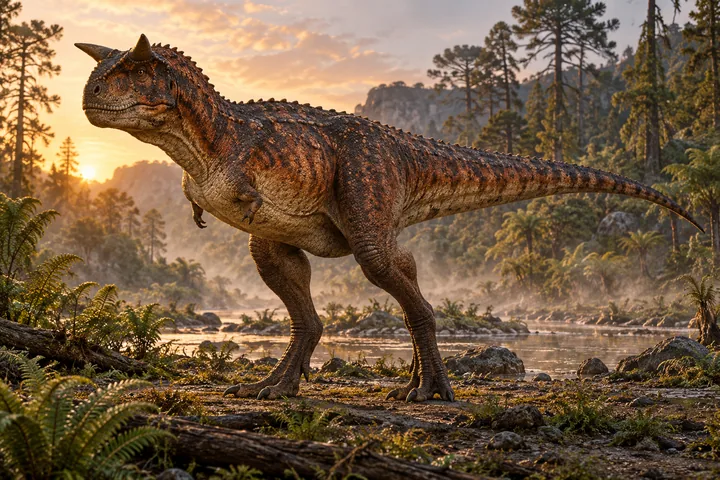
Carnotaurus
Carnotaurus paired two head horns with extraordinarily reduced forelimbs.
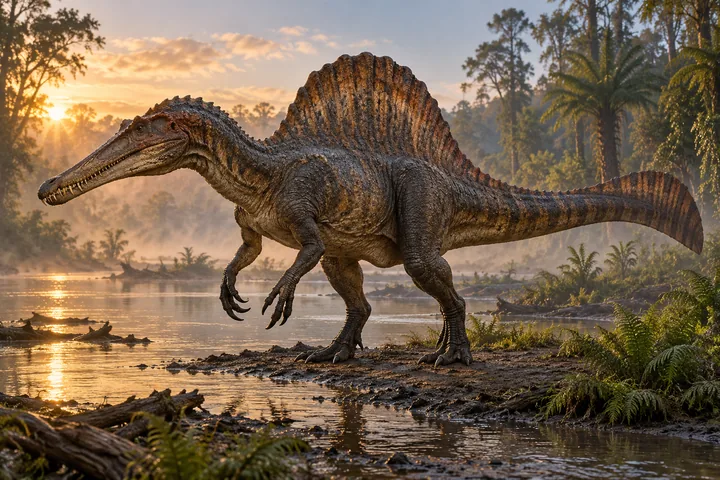
Spinosaurus
Spinosaurus had short hind limbs and a broad, paddle-shaped tail.
Carcharodontosaurus
Carcharodontosaurus was named for teeth resembling those of sharks.