
Length
InferredAbout 6 m (holotype reference)
The original description gives this approximate length for its nearly complete skeleton. It does not establish an adult average, maximum or population range. [D1]
EXHIBIT 76
Concavenator corcovatus
Concavenator was a meat-eating theropod from Early Cretaceous Spain with a pointed back structure. Its possible forearm feather attachments remain disputed.
TWO WAYS TO PICTURE THE PAST
Compare the evidence with the familiar movie image. The illustrations are not to a shared scale.
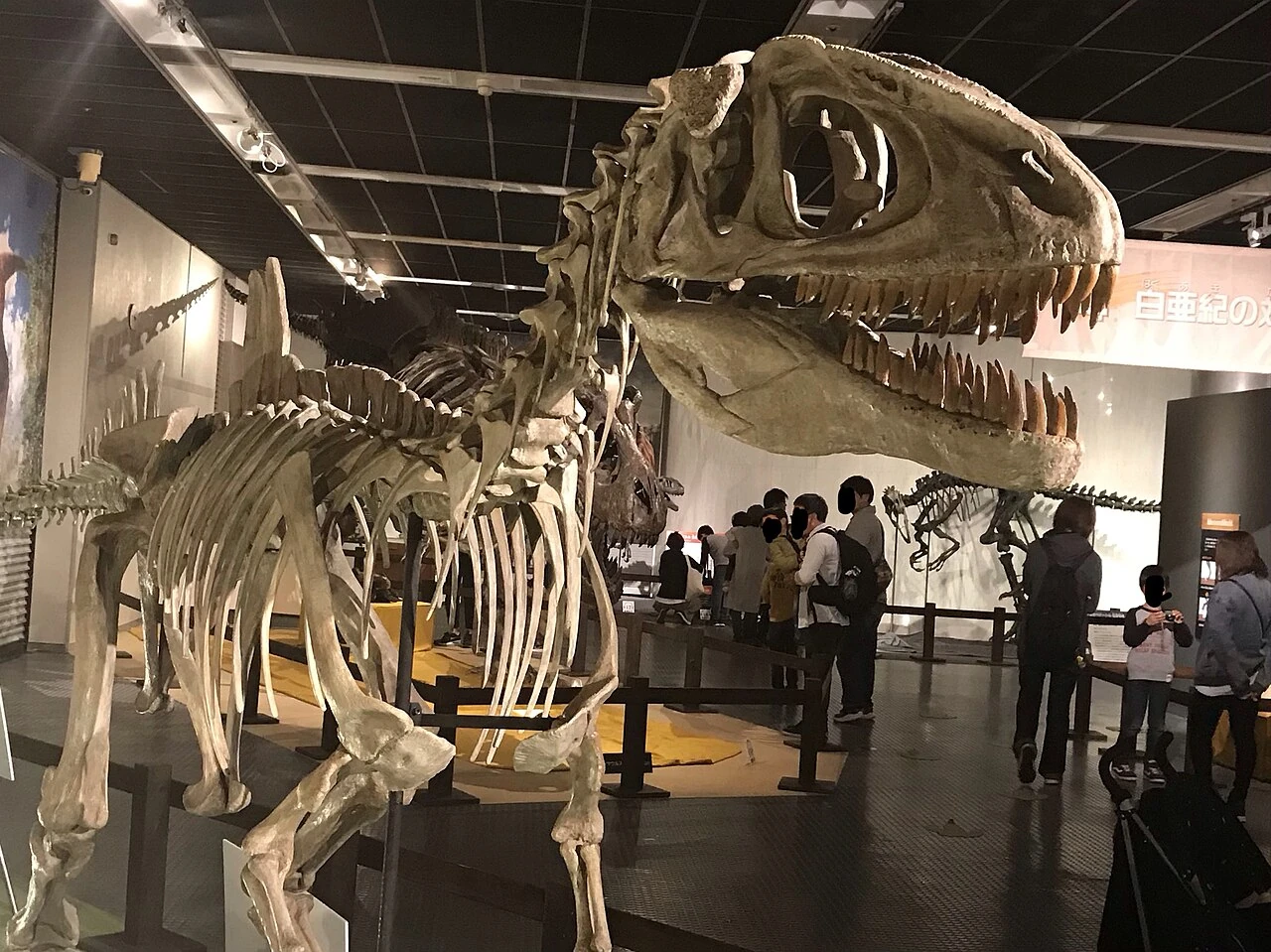
Reconstructed Concavenator corcovatus skeleton photographed in Japan. The two neighboring tall back spines are bony anatomy; the mount's pose and missing parts are reconstructed. It does not resolve living color, hump soft tissues or the disputed forearm-quill interpretation. [1]
Concavenator skeleton · ケラトプスユウタ. CC BY-SA 4.0. Commons-listed 1280 px preview converted to WebP; smaller responsive copy resized. No crop or color changes; these copies remain CC BY-SA 4.0.
Skeletal mounts and drawings may restore missing parts; the caption identifies the displayed material.
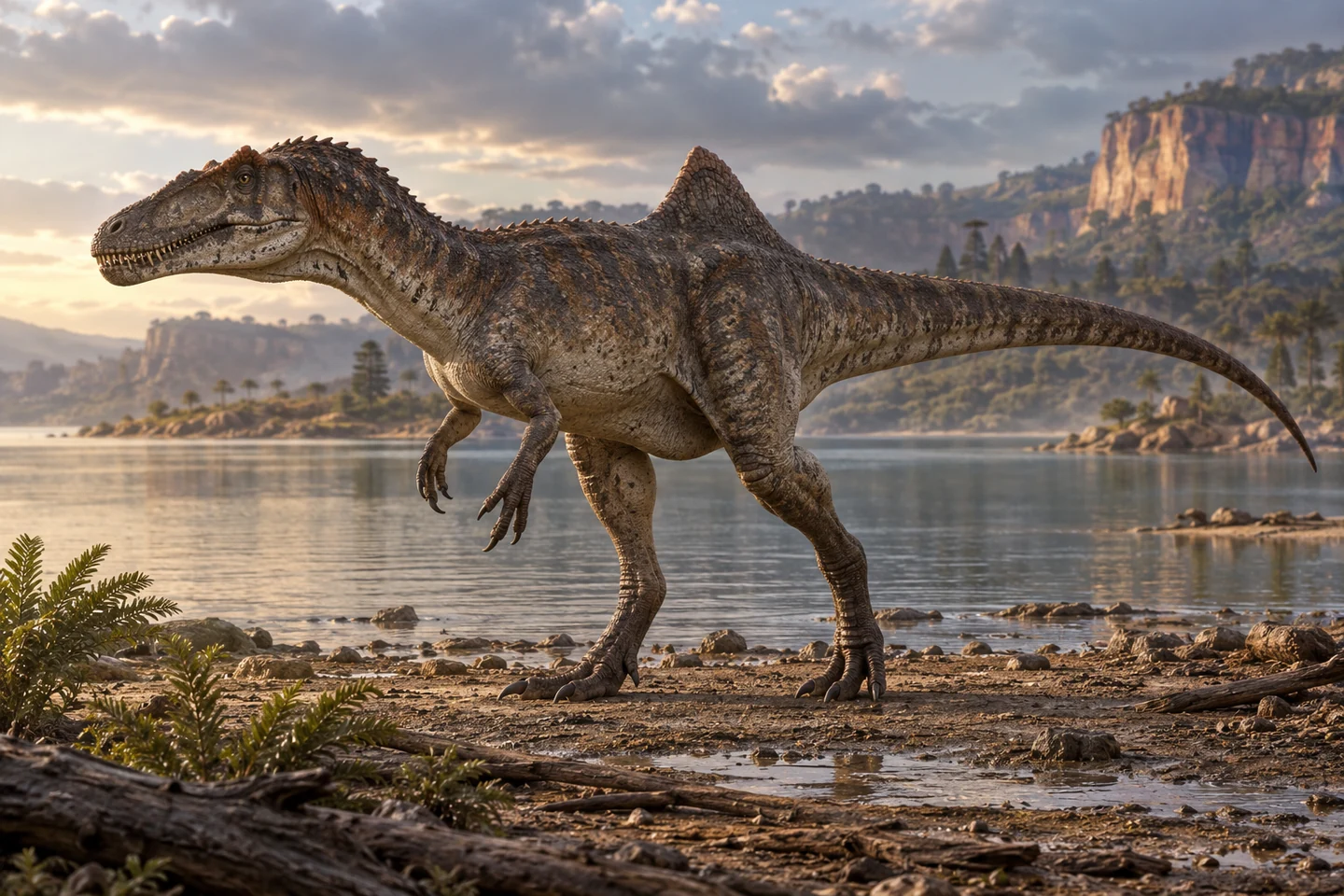
Original cinematic interpretation of Concavenator. Anatomy, soft tissues and colors are reconstructed choices. Lighting, coloration and scenery are artistic choices. This image does not document a fossil locality or behavior.
Original artwork · artistic interpretation.
Scientific view: source-informed reconstruction, credited paleoart or specimen-based imagery. Movie-style view: Original artistic interpretation. Reconstructions involve uncertainty.
MEET THE ANIMAL
Concavenator corcovatus was an Early Cretaceous dinosaur from Spain. Its limb bones place it among theropods, the group that includes many familiar meat-eating dinosaurs. Researchers use comparisons with related skeletons to reconstruct it standing on its hind legs. The fossils do not provide a measured running speed or a record of its usual hunting routine. [D3]
The skull was flattened during burial, so understanding its original shape required reconstruction. Researchers combined photographs and comparisons to build a three-dimensional model. Preserved scales on parts of the feet and tail provide another kind of evidence: pieces of the animal's outer covering, rather than just the supporting bones beneath it. [D2]
Small bumps on a forearm bone have been interpreted as attachment points for feather-like structures. That idea remains disputed because the position and spacing of the bumps allow other explanations. They are not feathers preserved in the rock. Concavenator shows why a suggested soft-tissue feature should stay separate from directly preserved skin. [D4]
PREHISTORIC ANIMAL DOSSIER
The animal, the evidence, and the questions still open.
Concavenator preserves tall back spines; their covering and the forearm bumps remain uncertain.
Profile scope: Species: Concavenator corcovatus, chiefly the nearly complete Las Hoyas holotype MCCM-LH 6666. The roughly 6 m size applies to this fossil, not a measured species range.
Source supported identifies a description documented by the cited source. Inferred marks a reconstruction or functional estimate. Debated marks competing interpretations. Not established means the sources reviewed for this dossier do not support a firm conclusion; it does not mean a behavior never occurred.
A size reference is an estimate, not a population range. Nesting evidence does not by itself establish courtship, mate choice, or lifelong pairing.
About 6 m (holotype reference)
The original description gives this approximate length for its nearly complete skeleton. It does not establish an adult average, maximum or population range. [D1]
Not established here
No adequately scoped body-mass estimate was established in the inspected sources.
Meat eater
Skull anatomy supports carnivory. The reviewed team account does not identify a particular prey species or demonstrate pack hunting. [D2]
Barremian Las Hoyas, Spain
The holotype came from the Lower Cretaceous Las Hoyas fossil site in Cuenca. Burial at a fossil site does not alone establish the animal's preferred habitat. [D1]
Hindlimb-supported walking inferred
Limb anatomy and comparison with other allosauroid theropods support bipedal reconstruction. Speed and exact gait are not established by the reviewed abstract. [D3]
Back spines; disputed forearm quill evidence
Two elongated vertebral spines formed a pointed back structure. Ulnar bumps were interpreted as quill attachments, but their position and spacing leave that interpretation disputed; they are not preserved feathers. [D1] [D4]
Not established here
The inspected sources do not establish Concavenator nesting, incubation or parental care.
Not established here
A distinctive back structure does not by itself demonstrate sexual display, dimorphism or a mating system.
Not established here
The holotype does not establish pack hunting, herd membership or solitary behavior.
Sources and inspection notes for the claims in this profile.
THE STORY IN THE FOSSILS
Concavenator corcovatus was described in 2010 from a nearly complete skeleton at Las Hoyas, Spain. Two unusually tall vertebral spines produced its conspicuous back outline, but the function of that structure is not securely established. [1]
Its skull was compressed during burial. Researchers later used photogrammetry and comparisons with related dinosaurs to build a three-dimensional reconstruction. Scales survive on parts of the feet and tail, while the proposed feather attachments on the forearm remain a separate, debated line of evidence. [2] [4]
The dossier identifies the scope of each reference estimate. A mount, an individual fossil and a species-wide adult range are different measurements. Comparison metrics remain unavailable where adult scope has not been established. Unknown does not mean zero.
Sources support the stated claims and scopes. Refer to the evidence notes for uncertainty.
KEEP EXPLORING
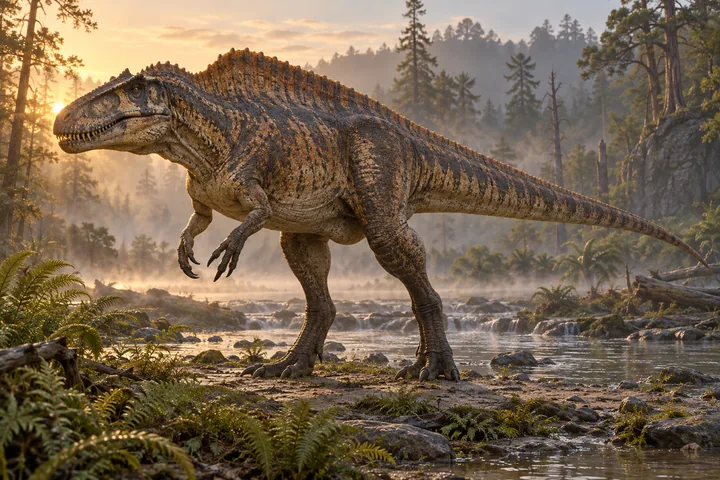
Acrocanthosaurus
This Early Cretaceous carnivore is known from North American fossils. Its high vertebral spines give it a distinctive raised back profile.
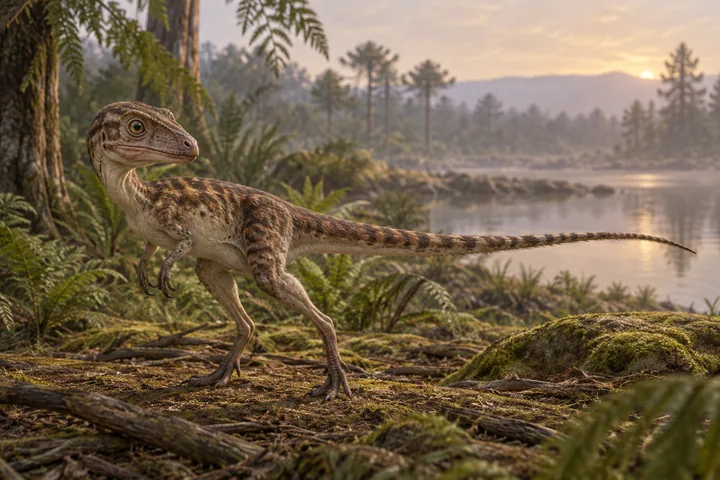
Scipionyx samniticus
Scipionyx is a tiny juvenile preserving exceptional internal tissues.
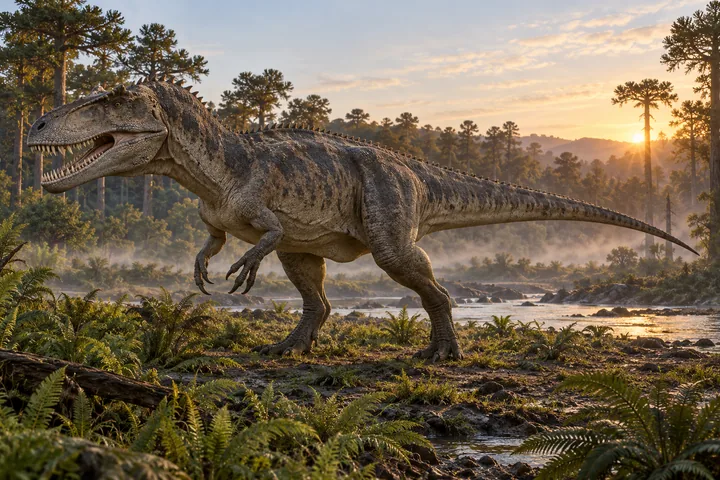
Giganotosaurus
This huge Argentine carnivore belonged to Carcharodontosauridae. Incomplete skeletons make its exact size and prey choices difficult to establish.