
Body length
InferredAbout 12 m (museum reference)
Both museum sources give approximately 12 m. This is a reconstructed reference, not a verified adult population range. [D1] [D2]
EXHIBIT 11
Acrocanthosaurus
Acrocanthosaurus carried unusually tall spines on its back, hip and tail vertebrae.
TWO WAYS TO PICTURE THE PAST
Compare the evidence with the familiar movie image. The illustrations are not to a shared scale.

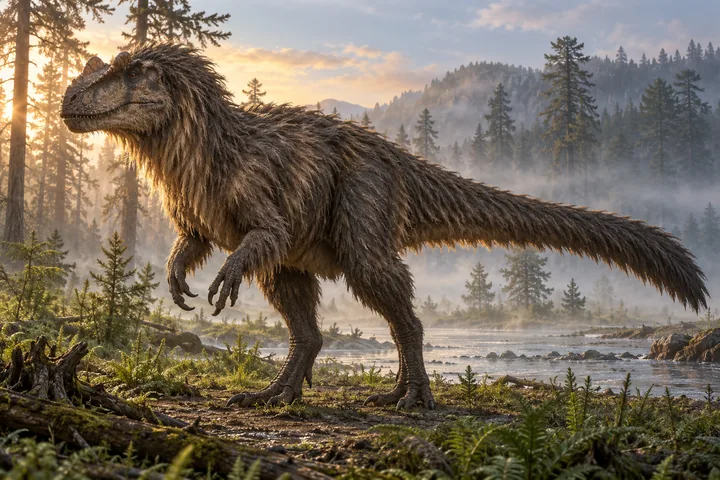
The artist identifies this reconstruction as Acrocanthosaurus. Fossil-informed anatomy: Raised vertebral profile, narrow large skull, knife-like teeth and three-clawed forelimbs. Soft-tissue depth over the neural spines and coloration are interpretive. [1] [2]
Acrocanthosaurus TD.png — TotalDino. CC BY-SA 4.0. Remote source artwork displayed without additional cropping; Wikimedia supplies any display-size derivative.
Scientific picture served by Wikimedia · internet connection required.
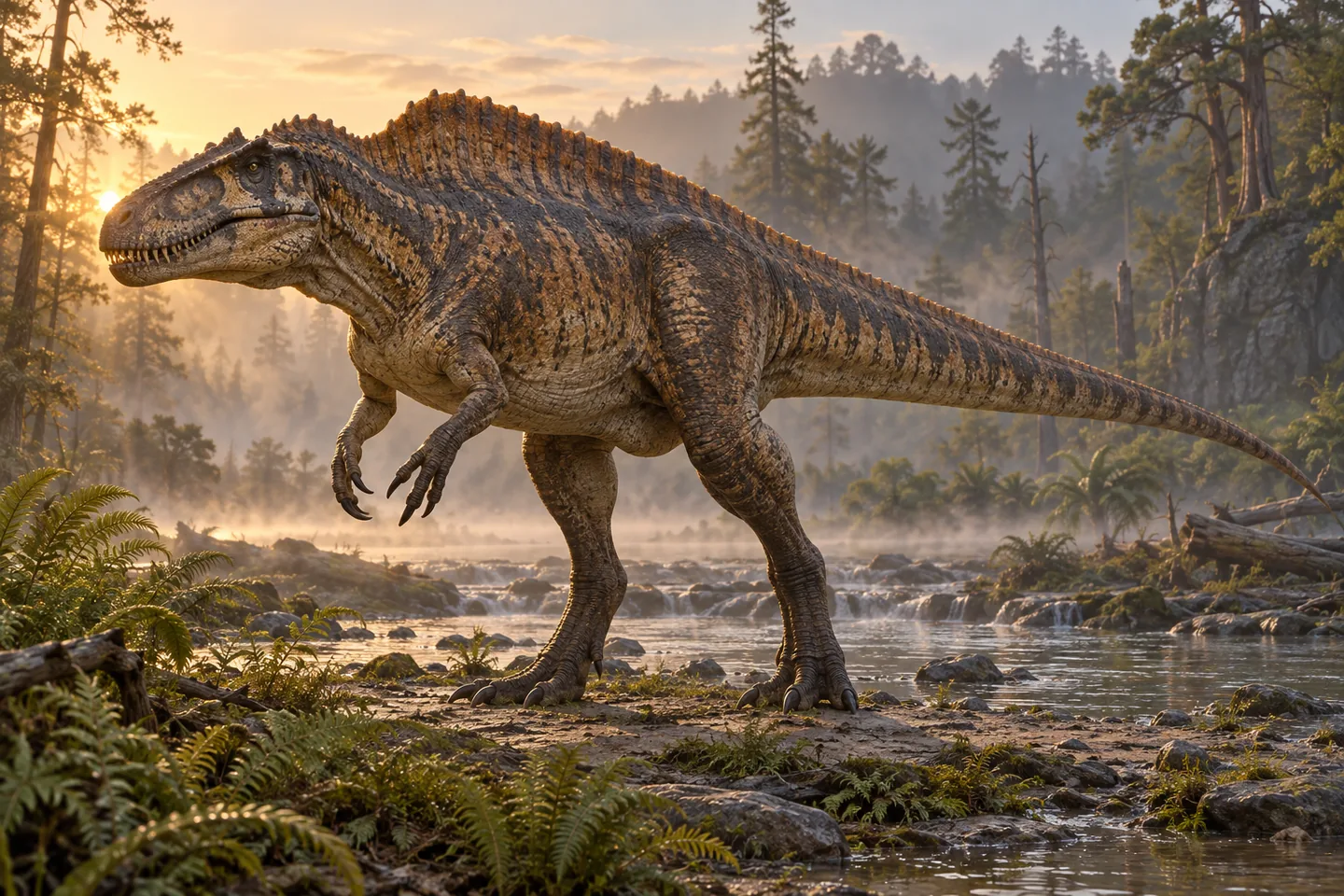
Cinematic Acrocanthosaurus with tall neural spines forming a raised back profile and three-clawed arms; outer ridge tissues and colors are artistic. Dramatic lighting, surface detail and scenery are artistic choices. This is an original cinema-inspired picture, rather than a frame from a film or a documented fossil locality.
Original artwork · artistic interpretation.
Scientific view: credited paleoart interpreting fossil evidence, served online by Wikimedia. Movie-style view: Original artistic interpretation. Colors, soft tissues and settings involve reconstruction.
MEET THE ANIMAL
Acrocanthosaurus was a large meat-eating dinosaur from Early Cretaceous North America. It moved on two legs and had a substantial skull. These basic features place it among predatory dinosaurs, while the rest of its skeleton gives it a particularly recognizable outline. [D1]
Tall spines project upward from its vertebrae, the bones forming the backbone. This is one of the features researchers use to recognize Acrocanthosaurus. A particularly important specimen, NCSM 14345, was discovered in Oklahoma. It combines a nearly intact skull with an incomplete body skeleton. Preparing the fossil exposed previously hidden areas of the skull, so studying an old discovery more closely could still reveal new anatomical information. [S1]
The skull study compared its features with those of other meat-eating dinosaurs to investigate their relationships. Such comparisons placed Acrocanthosaurus among the allosauroids, within the carcharodontosaur family. A family assignment describes shared anatomical history; it does not establish identical habits for every relative. Its back spines and skull provide strong identification clues, while the reviewed evidence does not establish a courtship routine, nest arrangement or coordinated hunting behavior. [S1]
PREHISTORIC ANIMAL DOSSIER
The animal, the evidence, and the questions still open.
Acrocanthosaurus was a large Early Cretaceous North American carnivore with tall vertebral spines. The North Carolina museum skeleton preserves a substantial portion of its skeleton, including the skull, while the spines' function remains uncertain.
Profile scope: Genus — Acrocanthosaurus; museum skeleton concerns A. atokensis
Source supported identifies a description documented by the cited source. Inferred marks a reconstruction or functional estimate. Debated marks competing interpretations. Not established means the sources reviewed for this dossier do not support a firm conclusion; it does not mean a behavior never occurred.
A size reference is an estimate, not a population range. Nesting evidence does not by itself establish courtship, mate choice, or lifelong pairing.
About 12 m (museum reference)
Both museum sources give approximately 12 m. This is a reconstructed reference, not a verified adult population range. [D1] [D2]
Not established here
The inspected museum material does not establish a mass estimate with a reviewed reconstruction method; its older weight figure is not adopted here.
Meat eater
The skull and blade-like teeth support carnivory. Trackway-based stories about particular hunting sequences are not adopted as demonstrated behaviour. [D1] [D2]
Early Cretaceous North America
The museum records fossils from Oklahoma and Texas and attributed fragments from Maryland. Occurrence does not establish every inferred part of its range or preferred habitat. [D2]
Two-legged terrestrial movement
The museum describes bipedal movement and short forelimbs. Precise speed is not established here. [D2]
Tall back spines and three-fingered hands
High neural spines extend along the back, hips and tail. Thermoregulation and other proposed functions require interpretation. [D2]
Not established here
Reviewed sources do not establish Acrocanthosaurus nest architecture, clutch size or parental care.
Not established here
Reviewed sources do not establish that the tall spines were used in a mating display, or document a courtship sequence.
Not established here
Reviewed sources do not establish Acrocanthosaurus group structure or coordinated hunting.
Sources and inspection notes for the claims in this profile.
THE STORY IN THE FOSSILS
The name Acrocanthosaurus refers to its high vertebral spines. The North Carolina museum describes thin, knife-shaped teeth and strong forelimbs ending in three curved claws. Its skull was narrower than that of Tyrannosaurus, reflecting a different large-predator anatomy within the carcharodontosaur family. [2] [1]
The North Carolina museum’s fossil was excavated in southeastern Oklahoma and includes approximately 54 percent of the original bones. It preserves a complete skull, a particularly valuable part of the specimen. Additional remains from Oklahoma, Texas and Maryland document a wider North American distribution. [2]
We have not established a comparable adult total-length estimate for this taxon in this draft. Specimen measurements in the text describe those individuals. The cited dates are approximately 115–105 million years ago. Published genus-level educational dating; not a specimen age. Unknown does not mean zero.
Sources and evidence notes for this exhibit.
KEEP EXPLORING
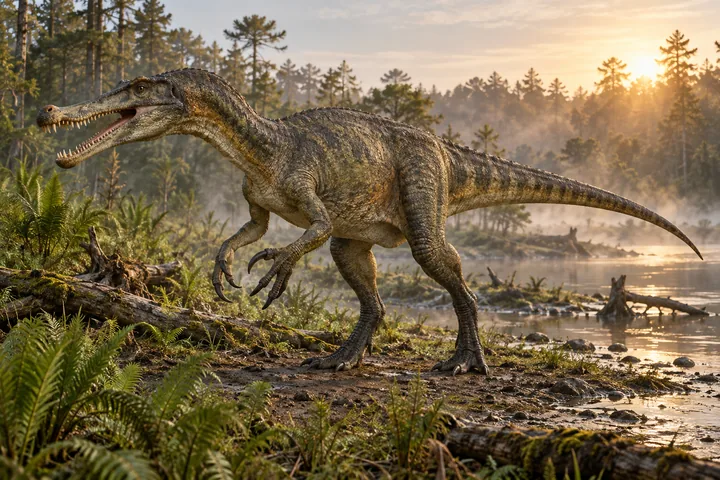
Baryonyx
A Baryonyx fossil preserved fish scales and dinosaur bones in its abdominal region.
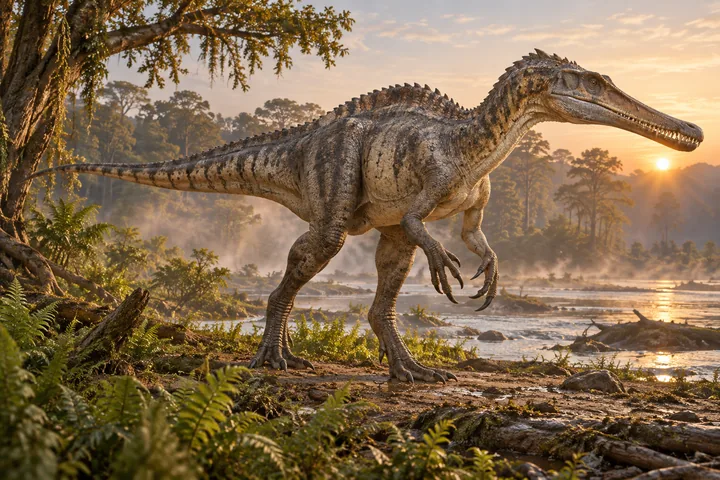
Suchomimus
Suchomimus combined a crocodile-like snout with enormous curved thumb claws.
Yutyrannus huali
Yutyrannus preserves direct evidence of long filamentous feathers on a giant theropod.