
Body length
InferredAbout 11 m (museum reference)
The museum and discovery account give approximately 11 m. This is a reconstructed reference, not a verified adult population range. [D1] [D2]
EXHIBIT 16
Suchomimus
Suchomimus combined a crocodile-like snout with enormous curved thumb claws.
TWO WAYS TO PICTURE THE PAST
Compare the evidence with the familiar movie image. The illustrations are not to a shared scale.

The artist identifies this reconstruction as Suchomimus tenerensis. This view illustrates one form within the genus, rather than every species or individual. Fossil-informed anatomy: Long narrow snout, rounded fluted teeth, powerful forelimbs, large thumb claws and low raised hip spines. Coloration and some soft tissues are interpretive; species reconstruction represents the genus. [1] [2] [3]
Life reconstruction of Suchomimus tenerensis.png — Connor Ashbridge. CC BY-SA 4.0. Remote source artwork displayed without additional cropping; Wikimedia supplies any display-size derivative.
Scientific picture served by Wikimedia · internet connection required.
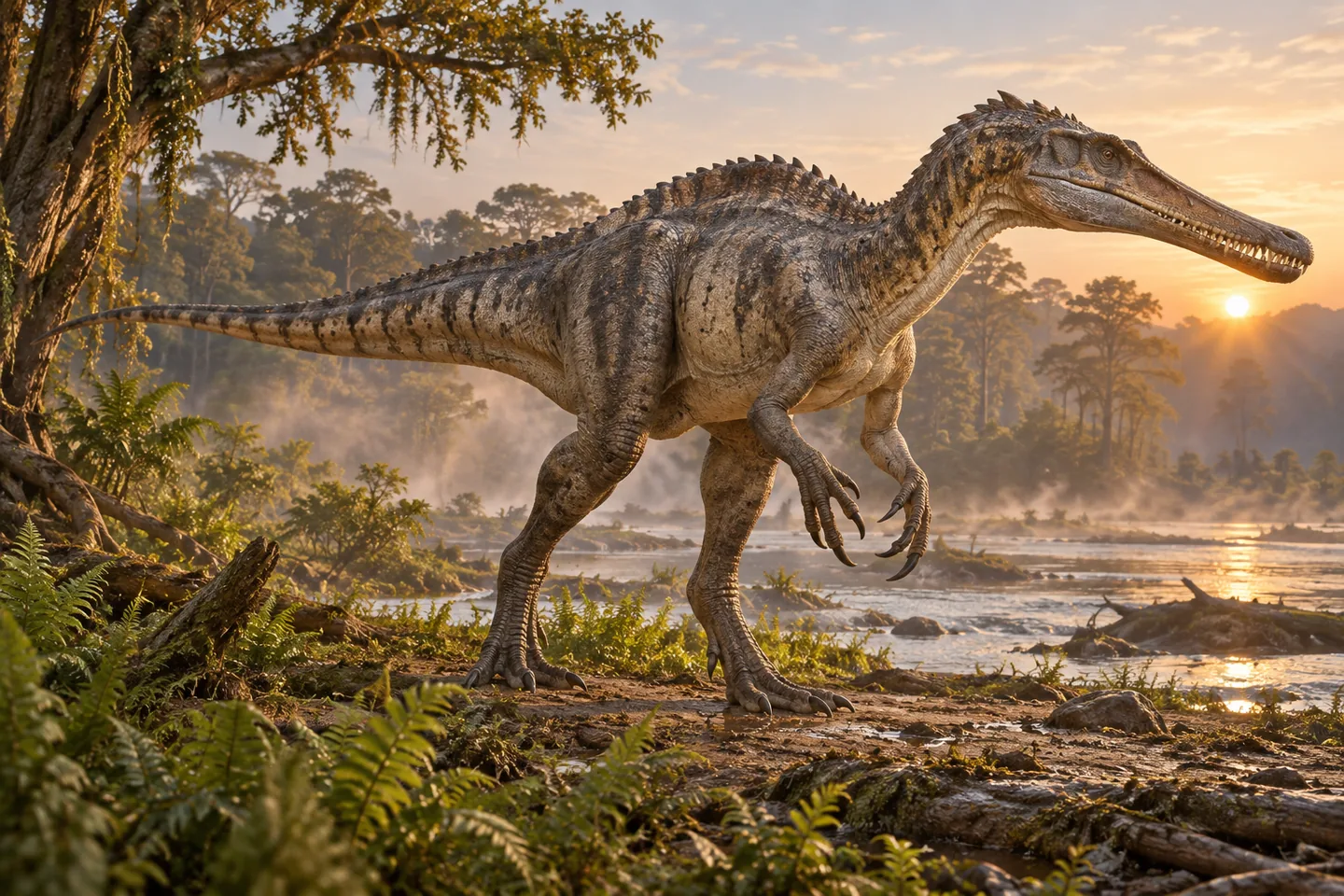
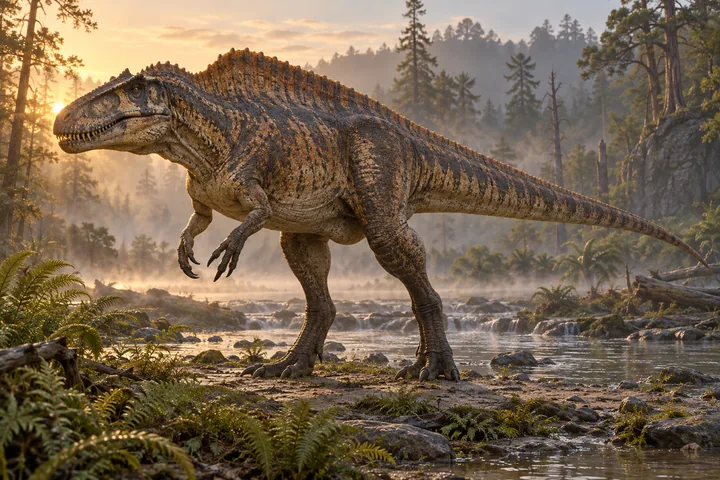
Cinematic Suchomimus with a long crocodile-like head, strong grasping arms and enlarged thumb claws; a modest raised ridge crosses its hips. Dramatic lighting, surface detail and scenery are artistic choices. This is an original cinema-inspired picture, rather than a frame from a film or a documented fossil locality.
Original artwork · artistic interpretation.
Scientific view: credited paleoart interpreting fossil evidence, served online by Wikimedia. Movie-style view: Original artistic interpretation. Colors, soft tissues and settings involve reconstruction.
MEET THE ANIMAL
Suchomimus tenerensis was an Early Cretaceous spinosaur from Niger in Africa. Its fossils include a partial skull and skeleton from rocks now exposed in the Tenere Desert. The long, low, narrow snout carries nearly cone-shaped teeth. These features gave researchers a different picture of a predatory dinosaur's head from the deeper skulls familiar in many other large meat eaters. [S1]
The rest of the body adds its own distinctive features. A strong forearm and enlarged thumb claw accompanied elongated spines along the back, forming a low sail deepest over the hips. The original study associated its jaws and teeth with fish feeding. That interpretation describes anatomical capability; it does not establish that every meal was a fish or preserve the precise action of the hands during feeding. [S1]
The discovery also helped researchers compare African and European spinosaurs. Suchomimus shares features with Baryonyx, even though their fossils were found on different continents. The original study used this relationship to propose dispersal between landmasses during the Early Cretaceous. This is an explanation of evolutionary history, not a trackway showing an individual's journey. Its skull and skeleton are more securely known than courtship, nesting and group behavior in the reviewed evidence. [S1]
PREHISTORIC ANIMAL DOSSIER
The animal, the evidence, and the questions still open.
Suchomimus was a Niger spinosaur with a narrow snout, rounded teeth and large grasping forelimbs. Its original research team's account links these features to fish feeding in an ancient river landscape.
Profile scope: Genus — Suchomimus; evidence concerns S. tenerensis
Source supported identifies a description documented by the cited source. Inferred marks a reconstruction or functional estimate. Debated marks competing interpretations. Not established means the sources reviewed for this dossier do not support a firm conclusion; it does not mean a behavior never occurred.
A size reference is an estimate, not a population range. Nesting evidence does not by itself establish courtship, mate choice, or lifelong pairing.
About 11 m (museum reference)
The museum and discovery account give approximately 11 m. This is a reconstructed reference, not a verified adult population range. [D1] [D2]
Not established here
A mass estimate with a reviewed reconstruction method is not established in the inspected sources.
Fish eating proposed
Its long narrow snout and rounded, fluted teeth support a fish-feeding interpretation. They do not prove an exclusively fish diet. [D2]
Early Cretaceous Niger river landscapes
The discovery team reconstructs broad streams and vegetation from the fossil setting. Burial environment does not prove an exclusive habitat preference. [D2] [D1]
Probably two-legged terrestrial movement
Its theropod limb reconstruction supports bipedal movement. Detailed swimming or diving performance is not established by these inspected accounts. [D2]
Long snout, strong forelimbs, large thumb claws
The discovery account describes powerful grasping hands and elongated neural spines over the hips. Their precise behavioural roles remain interpretations. [D2]
Not established here
Reviewed sources do not establish Suchomimus eggs, clutch size or parental care.
Not established here
Reviewed sources do not establish Suchomimus mating displays; general suggestions about spinosaur sails do not establish a courtship ritual.
Not established here
Reviewed sources do not establish Suchomimus group structure or coordinated hunting.
Sources and inspection notes for the claims in this profile.
THE STORY IN THE FOSSILS
An exposed thumb claw led David Varricchio to the Suchomimus remains during a 1997 Niger expedition. Its elongated skull inspired the name, meaning crocodile mimic. The forelimbs were strongly developed, while nearly round, fluted teeth differed from the slicing blades of many theropods. [2]
Raised vertebral spines formed a low profile over the hips, rather than the towering outline familiar in Spinosaurus. A 2022 bone-density study inferred non-diving habits for Suchomimus. That ecological interpretation is a model-based inference and does not directly record its daily hunting behavior. [2] [3]
We have not established a comparable adult total-length estimate for this taxon in this draft. Specimen measurements in the text describe those individuals. The cited dates are approximately 121–112 million years ago. Published genus-level educational dating; not a specimen age. Unknown does not mean zero.
Sources and evidence notes for this exhibit.
KEEP EXPLORING
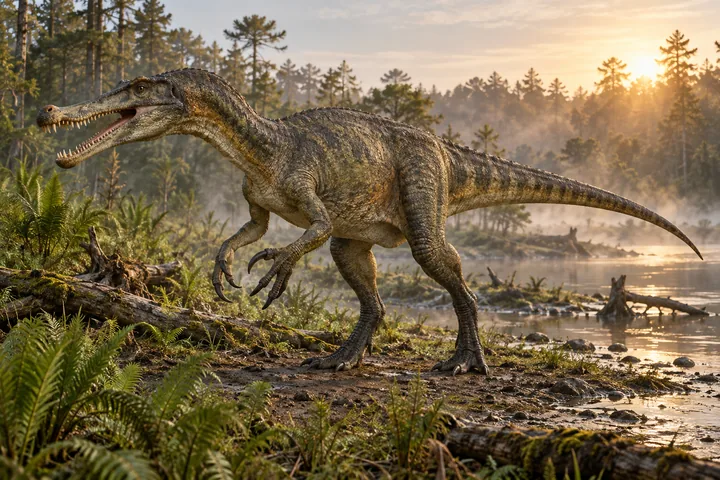
Baryonyx
A Baryonyx fossil preserved fish scales and dinosaur bones in its abdominal region.
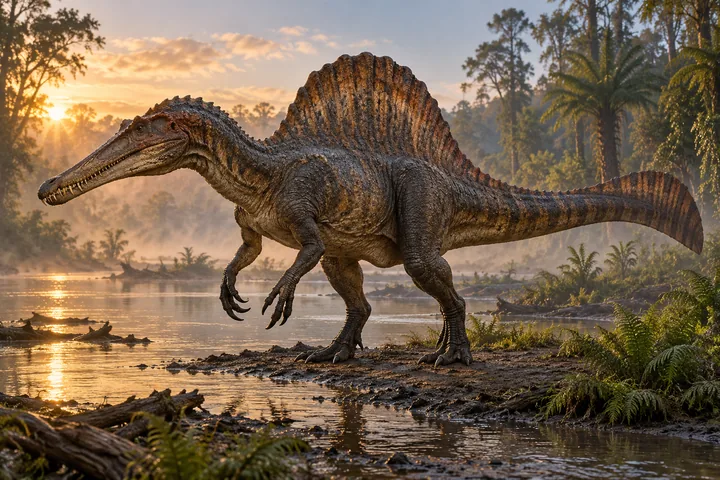
Spinosaurus
Spinosaurus had short hind limbs and a broad, paddle-shaped tail.
Acrocanthosaurus
Acrocanthosaurus carried unusually tall spines on its back, hip and tail vertebrae.