
Length
Inferred17.65 m (holotype model)
Humerus-based regression for LACMDI157871; 95% prediction interval 12.48–24.96 m, not an adult species range. [D1]
EXHIBIT 271
Cymbospondylus youngorum
Marine reptile
A giant ichthyosaur whose Nevada skull documents very early marine-reptile gigantism. [2]
TWO WAYS TO PICTURE THE PAST
Compare the evidence with the familiar movie image. The illustrations are not to a shared scale.
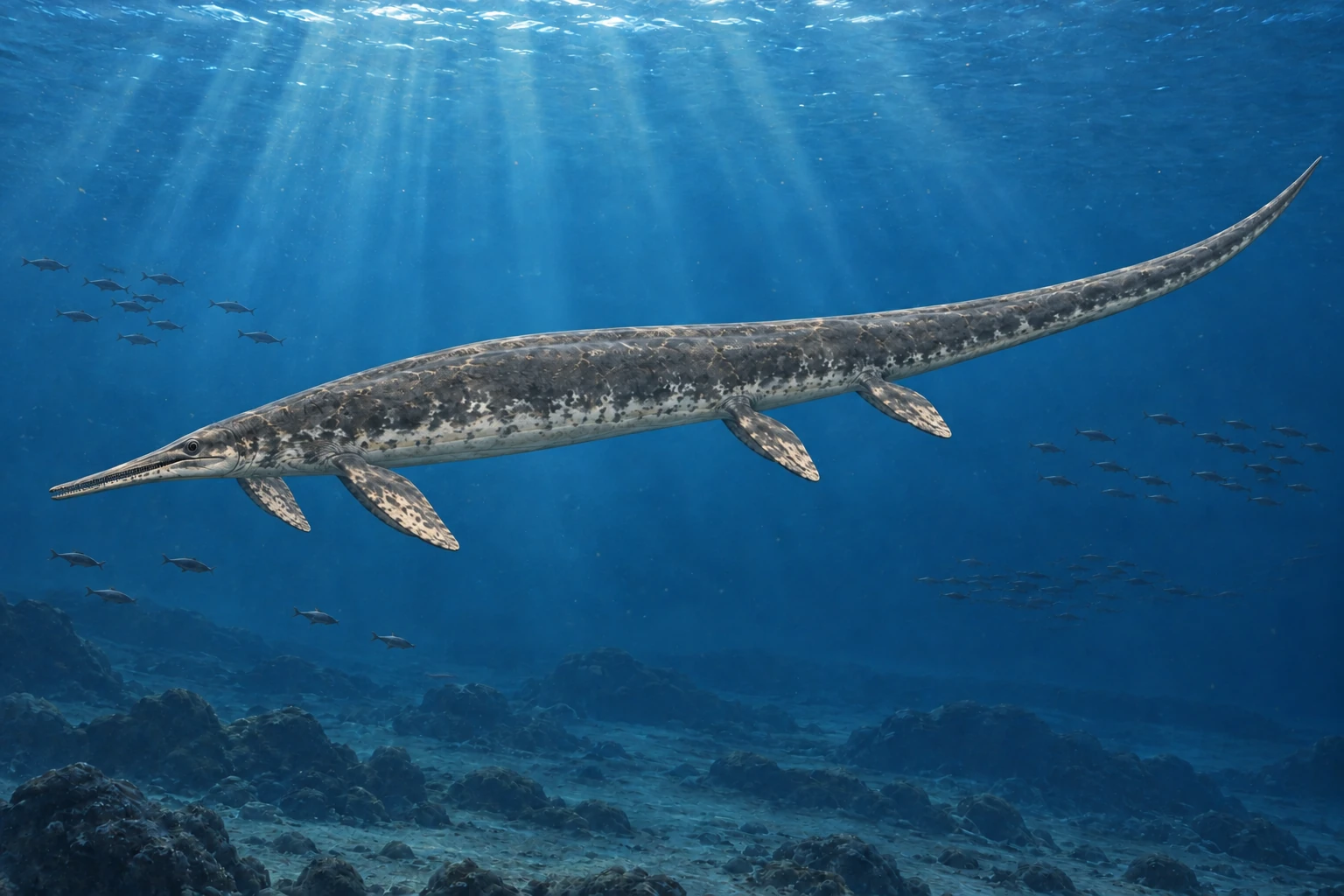
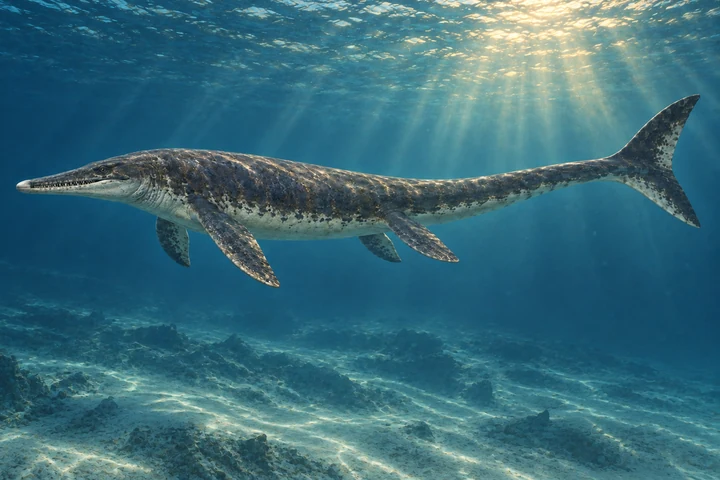
An illustrative reconstruction. Compare its anatomy with the evidence and limitations in the dossier. [1]
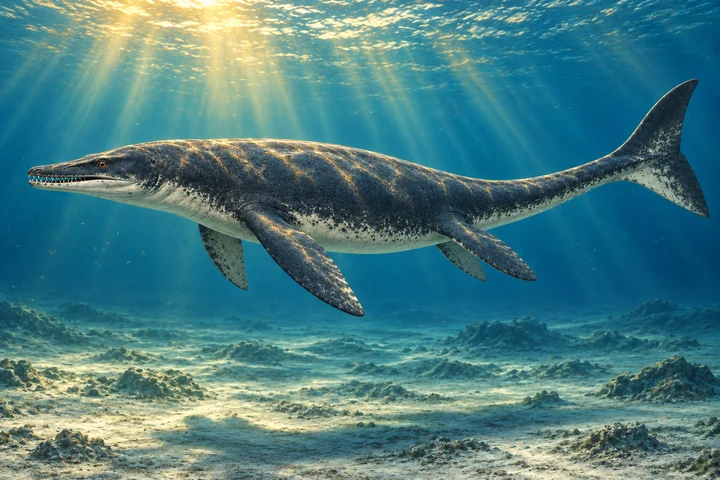
Source-informed reconstruction. Appearance evidence [1]. Original illustration; missing anatomy, coloration and scenery include interpretation.
Fossils constrain this life reconstruction. Missing anatomy, coloration and the environmental scene include interpretation; the dossier explains the evidence limits.
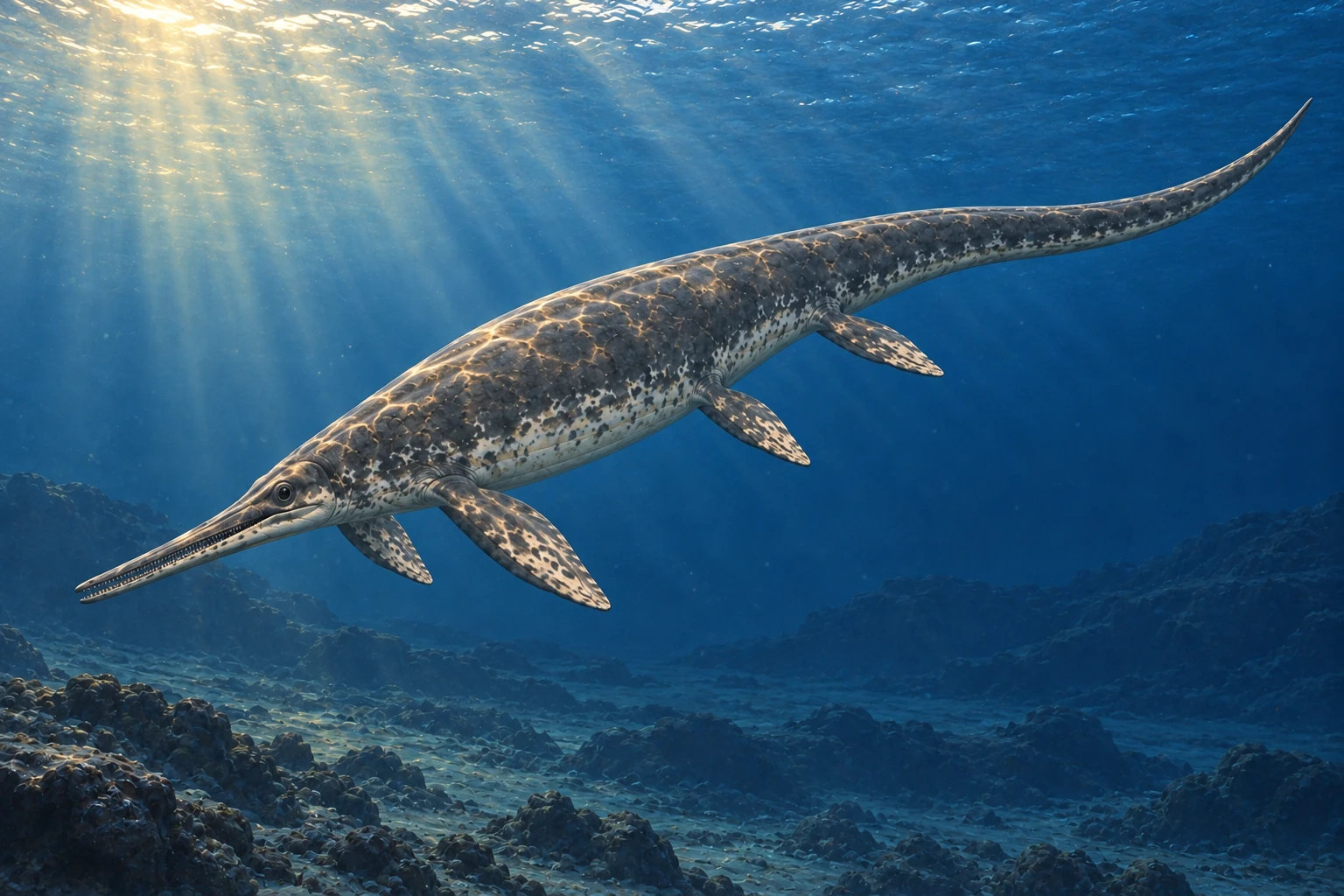
An illustrative reconstruction. Compare its anatomy with the evidence and limitations in the dossier. Lighting, coloration and scenery are artistic choices. This image does not document a fossil locality or behavior.
Original artwork · artistic interpretation.
Scientific view: source-informed reconstruction, credited paleoart or specimen-based imagery. Movie-style view: Original artistic interpretation. Reconstructions involve uncertainty.
MEET THE ANIMAL
Cymbospondylus youngorum was a giant ichthyosaur, a marine reptile that breathed air. Its Nevada fossil includes an enormous skull about two meters long. The museum explains that its pointed teeth suggest a diet of fish, squid-like animals and perhaps smaller marine reptiles. [D2]
The discovery began with large bones in Nevada’s mountains, where rocks record an ancient sea. Recovering the fossil required difficult fieldwork. Researchers then considered how that sea’s animals could supply enough food for very large predators. Their food-web model is a way of testing an ecological idea. [D3]
Preparing the fossil was another long project. A museum exhibition showed the skull and explained the careful work involved in freeing bones from rock. Such a display helps visitors see the evidence itself, rather than assuming that every part of a full-body picture was found together. [D4]
Much of the animal’s rear body is missing. Scientists estimate its size from preserved bones and comparisons, so a reconstructed length carries uncertainty. This particular fossil does not reveal every detail of the tail. A giant animal can be well supported even when parts of its appearance remain interpretations. [D1]
PREHISTORIC ANIMAL DOSSIER
The animal, the evidence, and the questions still open.
A roughly two-meter skull and associated bones support a giant-body model. Missing posterior remains and regression uncertainty limit the reconstruction. [D1]
Profile scope: One genus exhibit anchored to the partial C. youngorum holotype LACMDI157871; posterior anatomy requires comparisons, not direct preservation. [D1]
Source supported identifies a description documented by the cited source. Inferred marks a reconstruction or functional estimate. Debated marks competing interpretations. Not established means the sources reviewed for this dossier do not support a firm conclusion; it does not mean a behavior never occurred.
A size reference is an estimate, not a population range. Nesting evidence does not by itself establish courtship, mate choice, or lifelong pairing.
17.65 m (holotype model)
Humerus-based regression for LACMDI157871; 95% prediction interval 12.48–24.96 m, not an adult species range. [D1]
44.7 tonnes (holotype model)
Two-stage regression estimate, with broad uncertainty; not a weighed animal or adult range. [D1]
Fish and cephalopods proposed
Conical teeth suggest animal prey; proposed meals, including smaller reptiles, are not preserved stomach contents in this holotype. [D2]
Middle Triassic Nevada marine setting
Fossil Hill Member rocks preserve an ancient sea community; reconstructed food-web resources do not establish a precise preferred depth. [D3]
Body-and-tail swimming
Ichthyosaur comparisons guide propulsion; this individual lacks its posterior skeleton, so tail shape and performance are reconstructed. [D1]
Giant skull and preserved forelimb bones
The holotype retains skull, anterior vertebrae, shoulder material and humeri; a complete animal silhouette is not directly preserved. [D1]
Live-bearing expected by comparison
Other ichthyosaurs preserve pregnancies; no C. youngorum pregnancy was inspected here. [D5]
Not established here
Discovery and ecosystem studies do not document a courtship ritual or mating display. [D3]
Not established here
A productive marine food web can sustain giants without demonstrating that they formed social groups. [D3]
Sources and inspection notes for the claims in this profile.
THE STORY IN THE FOSSILS
The preparation display centered on the enormous skull and the work required to reveal it. Museum visitors see the preserved pieces; the whole-body reconstruction supplies missing proportions through scientific comparison. [4]
The Nevada community allowed researchers to model energy flow and the resources available to large predators. An ecosystem model explains a possible food supply, not an observed hunting party. [3]
The dossier identifies the scope of each reference estimate. A mount, an individual fossil and a species-wide adult range are different measurements. Comparison metrics remain unavailable where adult scope has not been established. Unknown does not mean zero.
Sources support the stated claims and scopes. Refer to the evidence notes for uncertainty.
KEEP EXPLORING
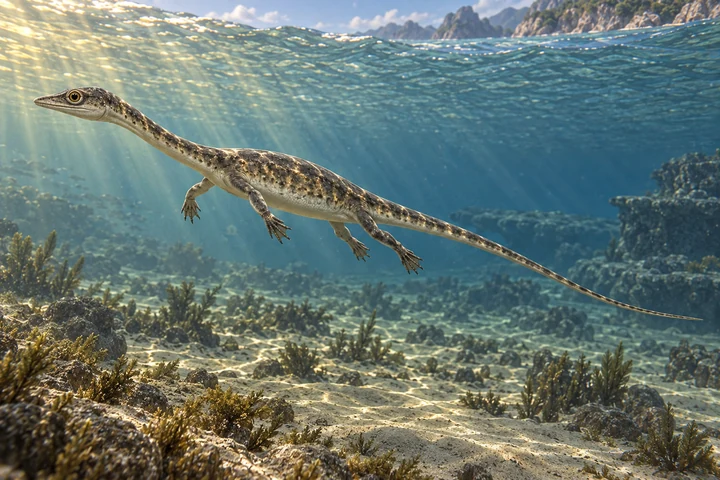
Keichousaurus hui
Aquatic reptile
A small aquatic reptile from southern China, with fish meals and pregnancies preserved in remarkable fossils.
Tylosaurus proriger
Marine reptile
A marine lizard with an elongated adult snout tip, whose fossil identities are still being revised.
Platecarpus tympaniticus
Marine reptile
A streamlined mosasaur known from an exceptional fossil preserving skin traces and digested fish.