
Length
Source supported5.67 m fossil individual
The described LACM128319 skeleton is5.67 m long. Its measurement is not a maturity-qualified species range. [D1]
EXHIBIT 228
Platecarpus tympaniticus
Marine reptile
A streamlined mosasaur known from an exceptional fossil preserving skin traces and digested fish. [1]
TWO WAYS TO PICTURE THE PAST
Compare the evidence with the familiar movie image. The illustrations are not to a shared scale.
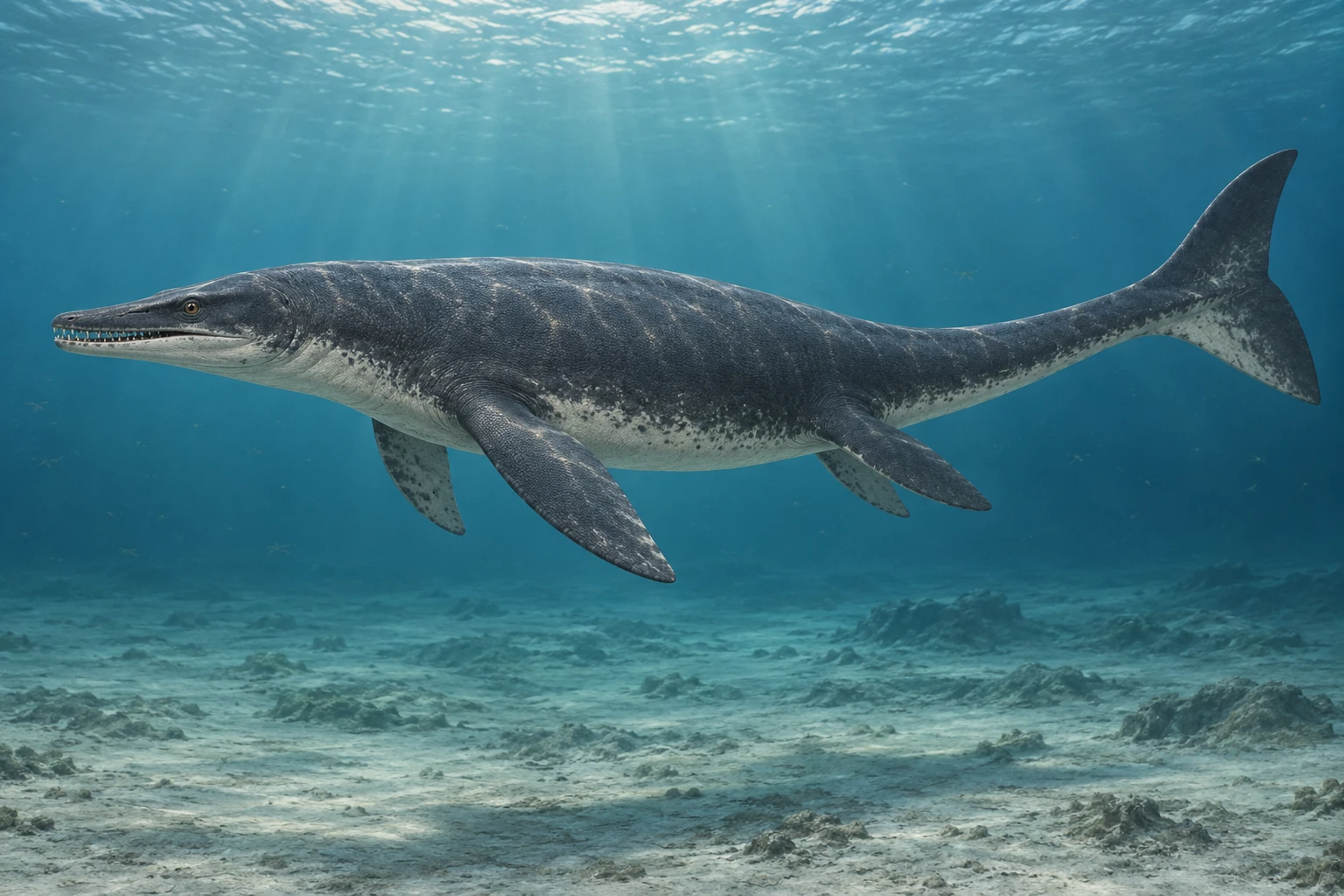
An illustrative reconstruction. Compare its anatomy with the evidence and limitations in the dossier. [1]
Source-informed reconstruction. Appearance evidence [1]. Original illustration; missing anatomy, coloration and scenery include interpretation.
Fossils constrain this life reconstruction. Missing anatomy, coloration and the environmental scene include interpretation; the dossier explains the evidence limits.
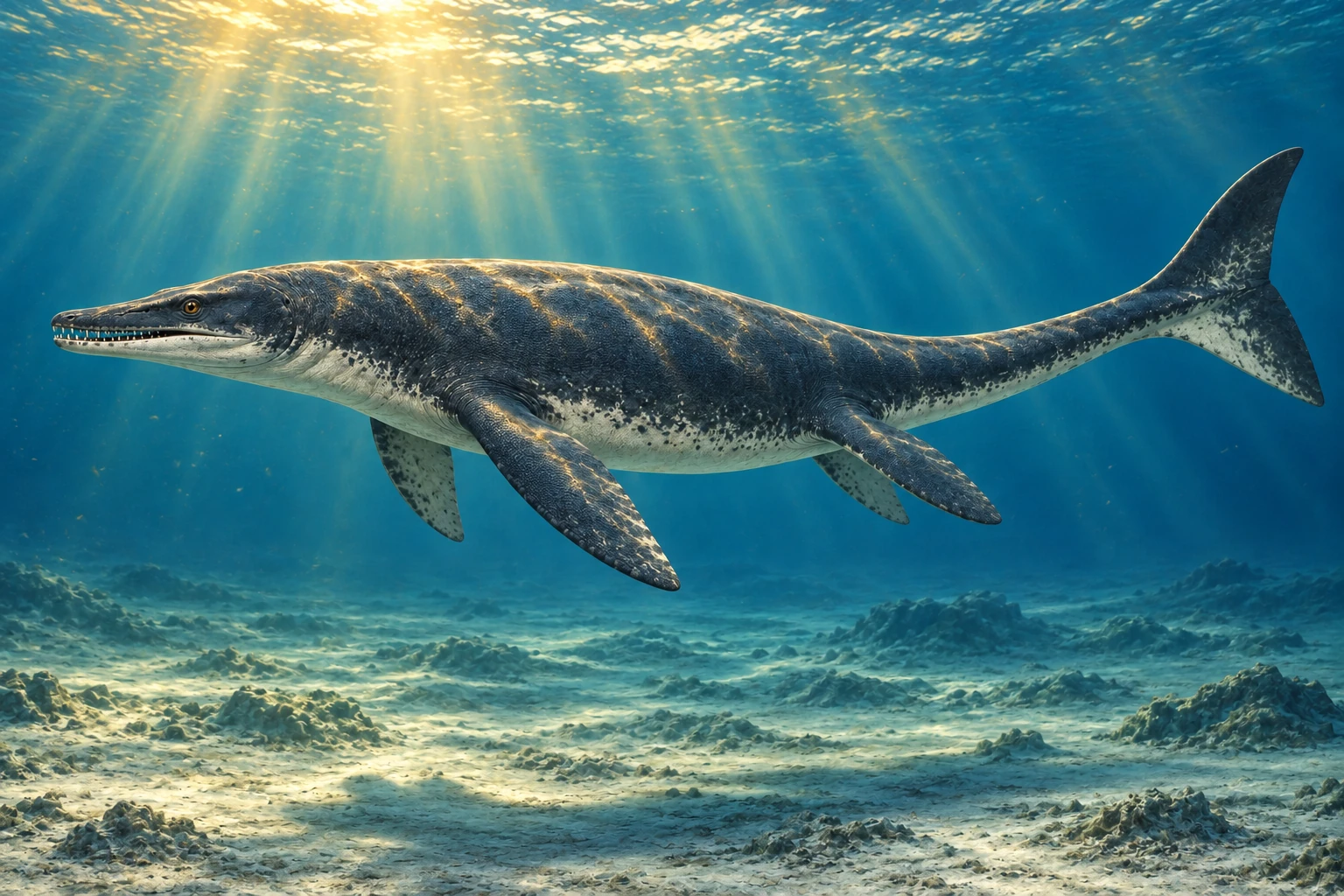
An illustrative reconstruction. Compare its anatomy with the evidence and limitations in the dossier. Lighting, coloration and scenery are artistic choices. This image does not document a fossil locality or behavior.
Original artwork · artistic interpretation.
Scientific view: source-informed reconstruction, credited paleoart or specimen-based imagery. Movie-style view: Original artistic interpretation. Reconstructions involve uncertainty.
MEET THE ANIMAL
Platecarpus was a mosasaur, part of a group of marine lizards. One especially informative fossil is LACM128319 from Kansas. Its articulated skeleton and traces of soft tissues help scientists reconstruct more than the general shape of the bones: they can investigate skin and the tail. [D1]
The museum records both skull and body remains belonging together. That matters because a loose tooth or vertebra provides a smaller window into an animal. The catalogue also keeps the discovery connected with the Niobrara Chalk, rocks deposited in an ancient sea rather than a freshwater lake. [D2]
Microscopic tooth research shows that even a familiar jaw has hidden complexity. Researchers examined Platecarpus samples and found tissues that anchored teeth as they developed. Those samples represent the genus, so their results should not be confused with a direct test of every tooth in the gallery fossil. [D3]
Evidence for live birth comes from other mosasaurs, including very young Clidastes fossils found in marine deposits. Applying that evidence to Platecarpus is a comparison, not a discovery of its own embryos. Its mating displays, exact litter sizes and family arrangements remain unknown in the reviewed material. [D4]
PREHISTORIC ANIMAL DOSSIER
The animal, the evidence, and the questions still open.
An articulated Kansas skeleton is catalogued in the Natural History Museum of Los Angeles County. Its bones remain a physical reference behind reconstructions. [D2]
Profile scope: Genus exhibit represented by P. tympaniticus, especially LACM128319; one fossil individual does not define a complete adult size range. [D1]
Source supported identifies a description documented by the cited source. Inferred marks a reconstruction or functional estimate. Debated marks competing interpretations. Not established means the sources reviewed for this dossier do not support a firm conclusion; it does not mean a behavior never occurred.
A size reference is an estimate, not a population range. Nesting evidence does not by itself establish courtship, mate choice, or lifelong pairing.
5.67 m fossil individual
The described LACM128319 skeleton is5.67 m long. Its measurement is not a maturity-qualified species range. [D1]
Not established here
The museum catalogue identifies a skeleton, not a weighed living animal or an adopted adult mass model. [D2]
Fish eating directly supported
Partly digested fish occur inside LACM128319; their exact original gut position is uncertain. [D1]
Niobrara marine setting
The specimen record places this mosasaur in Late Cretaceous Niobrara Chalk of Kansas. [D2]
Tail-driven swimming inferred
Tail vertebrae indicate a downturned support for a vertical fluke, interpreted as an important propulsive surface. [D1]
Scaled skin and paddle limbs
Preserved skin documents scales. The exact upper tail-lobe outline is not established by the fossil. [D1]
Live birth inferred comparatively
Neonatal Clidastes material supports broader mosasaur viviparity; it does not show a Platecarpus pregnancy or litter size. [D4]
Not established here
The inspected tooth study concerns attachment tissues, without demonstrating mating displays or sex-specific colors. [D3]
Not established here
One articulated skeleton records an individual; it does not establish a pack, pair bond or parental group. [D2]
Sources and inspection notes for the claims in this profile.
THE STORY IN THE FOSSILS
An articulated skeleton preserves relationships between bones that isolated fragments cannot show. The museum catalogue keeps LACM128319 connected with its identity and locality, so a reconstruction can be checked against a particular fossil. [2]
Tooth sections reveal another scale of evidence. A Platecarpus study found attachment tissues including a calcified periodontal ligament. These genus-level samples explain how teeth were anchored; they do not document a hunting technique or belong automatically to the gallery specimen. [3]
The dossier identifies the scope of each reference estimate. A mount, an individual fossil and a species-wide adult range are different measurements. Comparison metrics remain unavailable where adult scope has not been established. Unknown does not mean zero.
Sources support the stated claims and scopes. Refer to the evidence notes for uncertainty.
KEEP EXPLORING
Tylosaurus proriger
Marine reptile
A marine lizard with an elongated adult snout tip, whose fossil identities are still being revised.
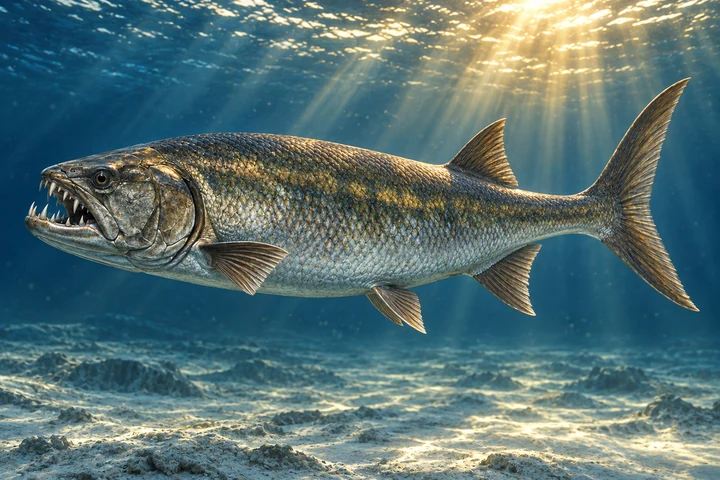
Xiphactinus audax
Prehistoric fish
A large toothed ray-finned fish, with a famous fossil preserving another fish inside it.
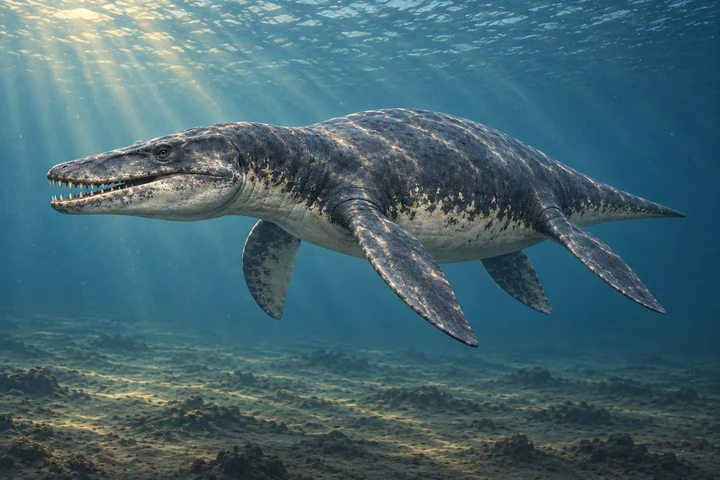
Pliosaurus kevani
Marine reptile
A large-skulled pliosaur whose Dorset holotype provides a detailed view of a Jurassic marine predator.