
Length
Inferred2.958 m (individual model)
FHSMVP404 reconstruction; not an adult species range. [D1]
EXHIBIT 268
Dolichorhynchops osborni
Marine reptile
A long-snouted, short-necked plesiosaur known from Kansas marine skeletons. [4]
TWO WAYS TO PICTURE THE PAST
Compare the evidence with the familiar movie image. The illustrations are not to a shared scale.
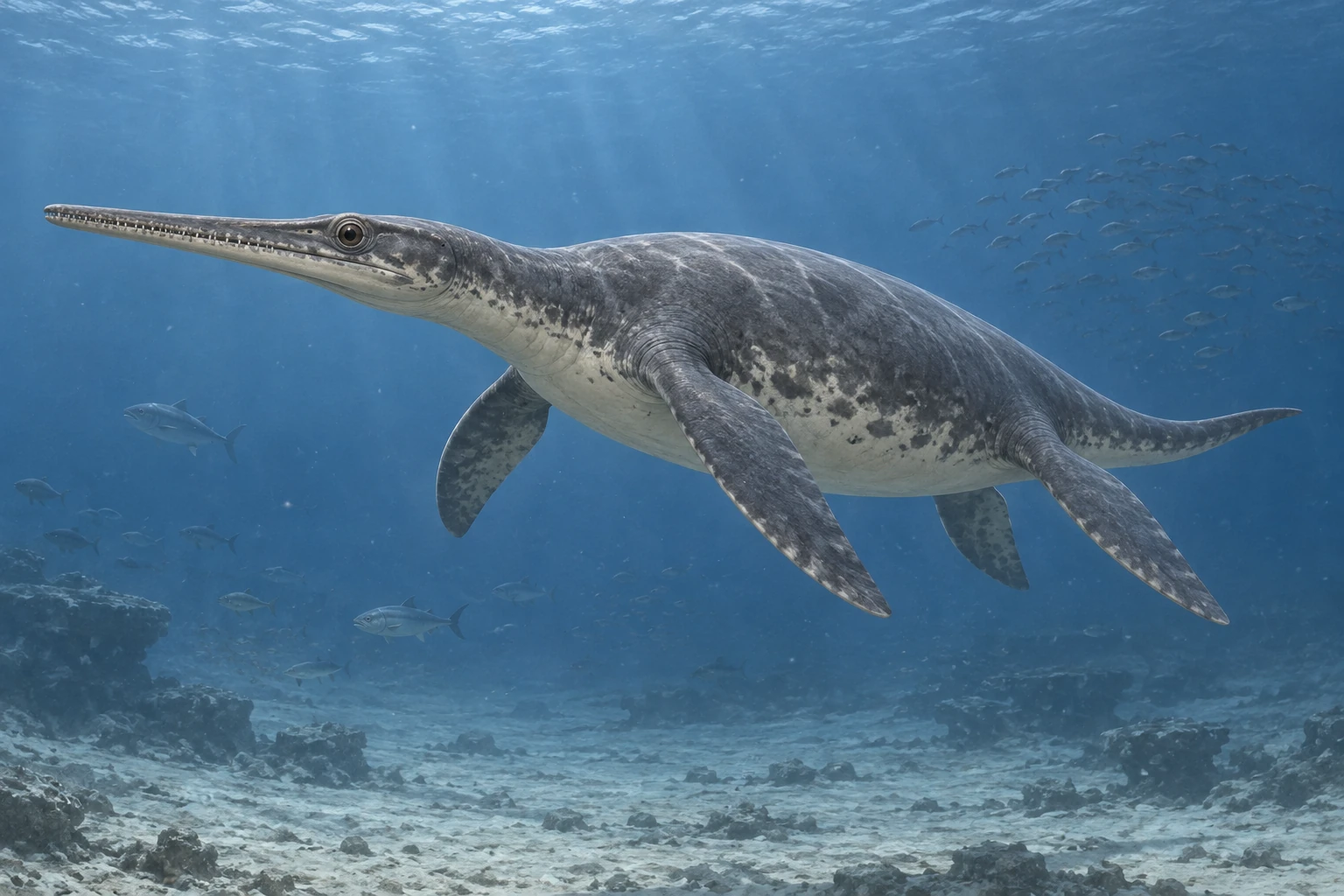
An illustrative reconstruction. Compare its anatomy with the evidence and limitations in the dossier. [2]
Source-informed reconstruction. Appearance evidence [2]. Original illustration; missing anatomy, coloration and scenery include interpretation.
Fossils constrain this life reconstruction. Missing anatomy, coloration and the environmental scene include interpretation; the dossier explains the evidence limits.
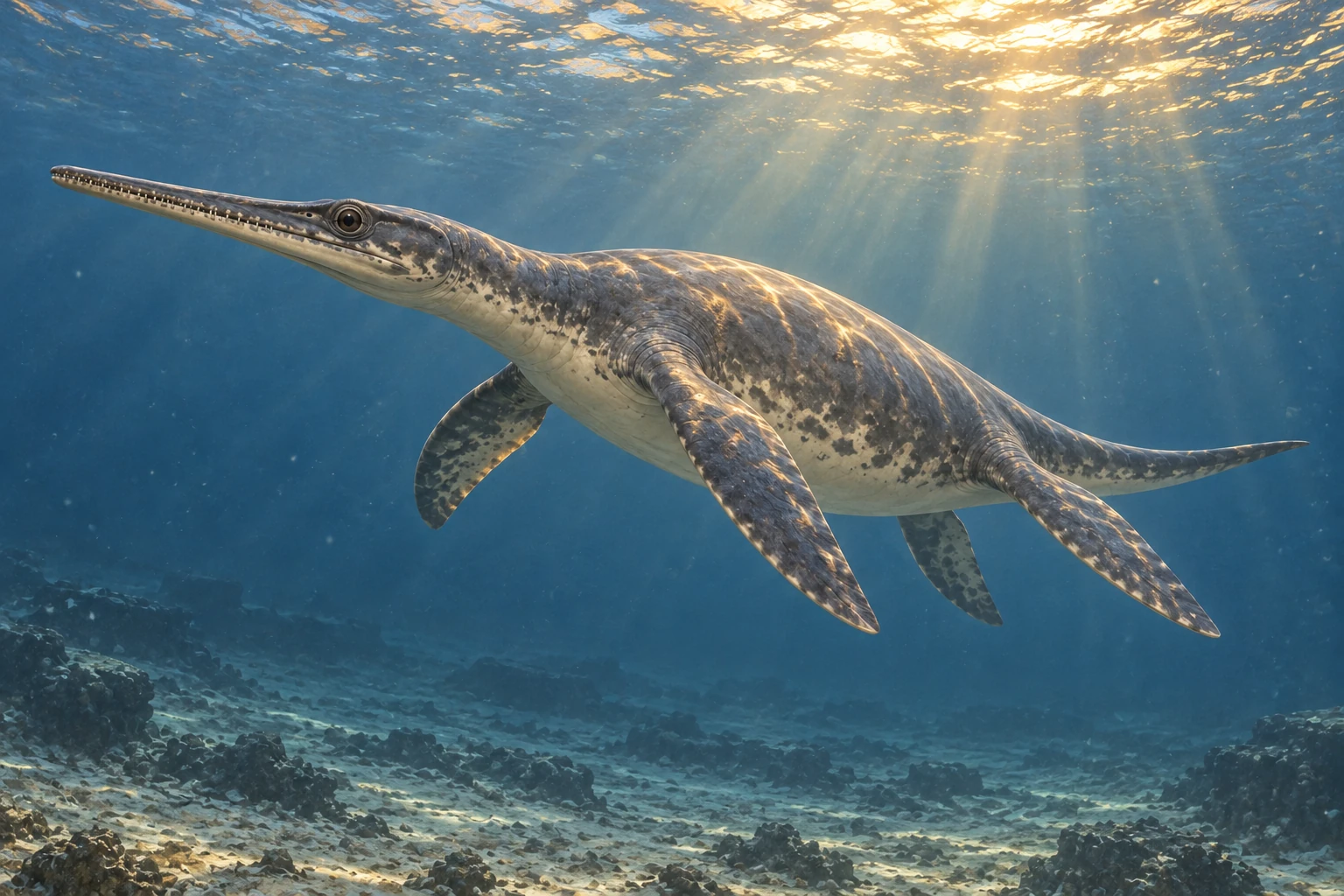
An illustrative reconstruction. Compare its anatomy with the evidence and limitations in the dossier. Lighting, coloration and scenery are artistic choices. This image does not document a fossil locality or behavior.
Original artwork · artistic interpretation.
Scientific view: source-informed reconstruction, credited paleoart or specimen-based imagery. Movie-style view: Original artistic interpretation. Reconstructions involve uncertainty.
MEET THE ANIMAL
Dolichorhynchops was a plesiosaur that lived in an ancient sea covering Kansas. Its long snout, short neck and swimming body look different from the long-necked plesiosaurs many people picture. Fossils from the Smoky Hill Chalk preserve important evidence about its skeleton and its discovery. [D4]
Its limbs formed four flippers. Comparisons of polycotylid skulls and neck bones help scientists tell close relatives apart. The long jaws and pointed teeth support an animal-eating diet, but the shape of a mouth cannot supply a complete list of meals or a measured swimming speed. [D2]
Names matter when reading old research. A recent revision moved two former Dolichorhynchops species into other genera. It also recognized that a supposed youngster belonged to a different small animal. Information about those fossils should not automatically become information about Dolichorhynchops osborni. [D3]
The specimen MCZ1064 offers another lesson. Early photographs and letters recorded details later covered by its plaster display mount. Researchers revisited those records to understand the original fossil. Museum displays can make ancient animals easier to picture, while old field notes help check which parts are fossil and which parts were restored. [D4]
PREHISTORIC ANIMAL DOSSIER
The animal, the evidence, and the questions still open.
Museum skeletons reveal anatomy and discovery history. The revised taxonomy prevents unrelated specimens from supplying this species’ life history. [D3]
Profile scope: One genus exhibit anchored to D. osborni; excludes former D. bonneri and D. tropicensis, now Martinectes and Scalamagnus. [D3]
Source supported identifies a description documented by the cited source. Inferred marks a reconstruction or functional estimate. Debated marks competing interpretations. Not established means the sources reviewed for this dossier do not support a firm conclusion; it does not mean a behavior never occurred.
A size reference is an estimate, not a population range. Nesting evidence does not by itself establish courtship, mate choice, or lifelong pairing.
2.958 m (individual model)
FHSMVP404 reconstruction; not an adult species range. [D1]
425 kg (individual model)
FHSMVP404 volumetric estimate; not measured body weight. [D1]
Animal prey
A long toothed head is consistent with predation; the reviewed account does not establish a complete menu. [D2]
Western Interior Seaway
D. osborni skeletons occur in the Upper Cretaceous Smoky Hill Chalk of Kansas; burial sediments do not fix daily depth. [D4]
Four-flipper swimming
The polycotylid body has four substantial paddles and a short tail; exact stroke timing and speed are reconstructed. [D3]
Elongate snout and short neck
Comparative descriptions document its extended preorbital skull and short cervical series; preserve four distinct limb flippers. [D2]
Not established here
Histology once labeled D. bonneri concerns a taxon now assigned to Martinectes; it cannot establish D. osborni reproduction. [D3]
Not established here
Focused searches and reviewed skeleton accounts do not document an attributable courtship or mating display. [D4]
Not established here
Discovery photographs and mounted skeletons do not demonstrate social groups, pair bonds or parental care. [D4]
Sources and inspection notes for the claims in this profile.
THE STORY IN THE FOSSILS
Old identification labels are evidence to recheck, not permission to combine specimens. The 2024 revision separated several animals formerly grouped under Dolichorhynchops. [3]
MCZ1064 correspondence and early photographs reveal skeletal details that a later plaster mount hid. Preparation history can affect what a researcher can actually inspect. [4]
The dossier identifies the scope of each reference estimate. A mount, an individual fossil and a species-wide adult range are different measurements. Comparison metrics remain unavailable where adult scope has not been established. Unknown does not mean zero.
Sources support the stated claims and scopes. Refer to the evidence notes for uncertainty.
KEEP EXPLORING
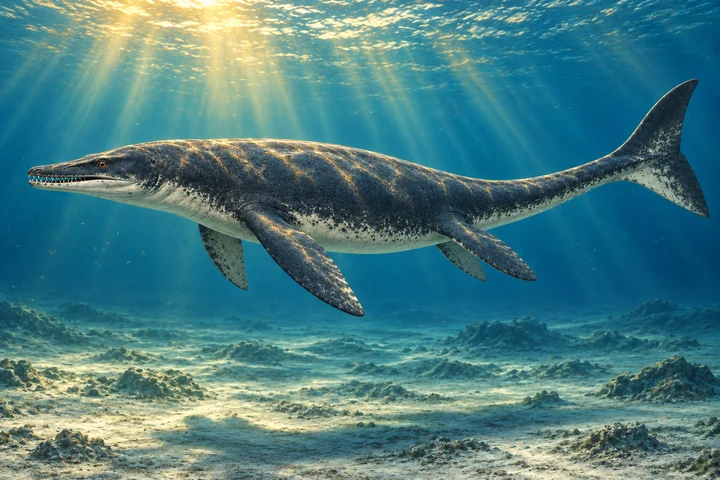
Tylosaurus proriger
Marine reptile
A marine lizard with an elongated adult snout tip, whose fossil identities are still being revised.
Platecarpus tympaniticus
Marine reptile
A streamlined mosasaur known from an exceptional fossil preserving skin traces and digested fish.
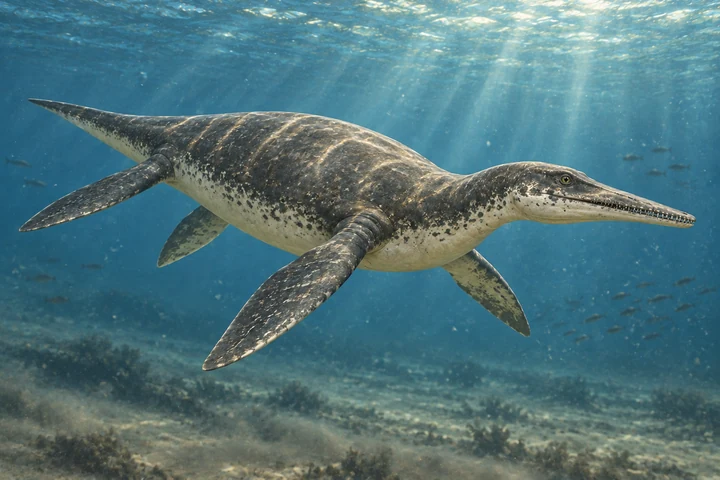
Polycotylus latipinnis
Marine reptile
A short-necked plesiosaur whose pregnant fossil provides direct evidence of live birth.