
Length
InferredUsually under 0.5 m (reference)
Literature body-size reference in the anatomical study, not a measured adult range; its snout–vent table is a different measurement. [D1]
EXHIBIT 270
Keichousaurus hui
Aquatic reptile
A small aquatic reptile from southern China, with fish meals and pregnancies preserved in remarkable fossils. [2]
TWO WAYS TO PICTURE THE PAST
Compare the evidence with the familiar movie image. The illustrations are not to a shared scale.
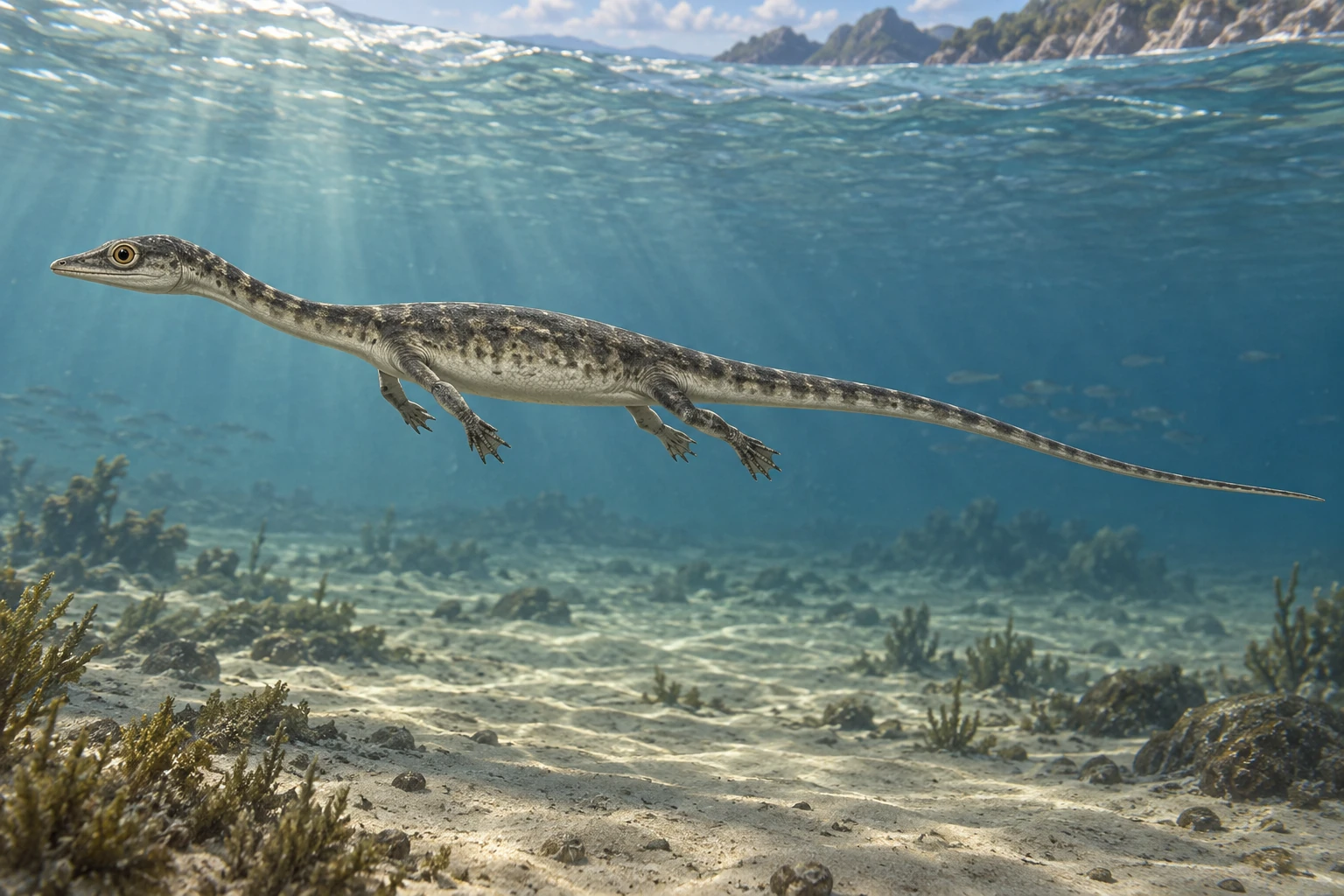
An illustrative reconstruction. Compare its anatomy with the evidence and limitations in the dossier. [1]
Source-informed reconstruction. Appearance evidence [1]. Original illustration; missing anatomy, coloration and scenery include interpretation.
Fossils constrain this life reconstruction. Missing anatomy, coloration and the environmental scene include interpretation; the dossier explains the evidence limits.
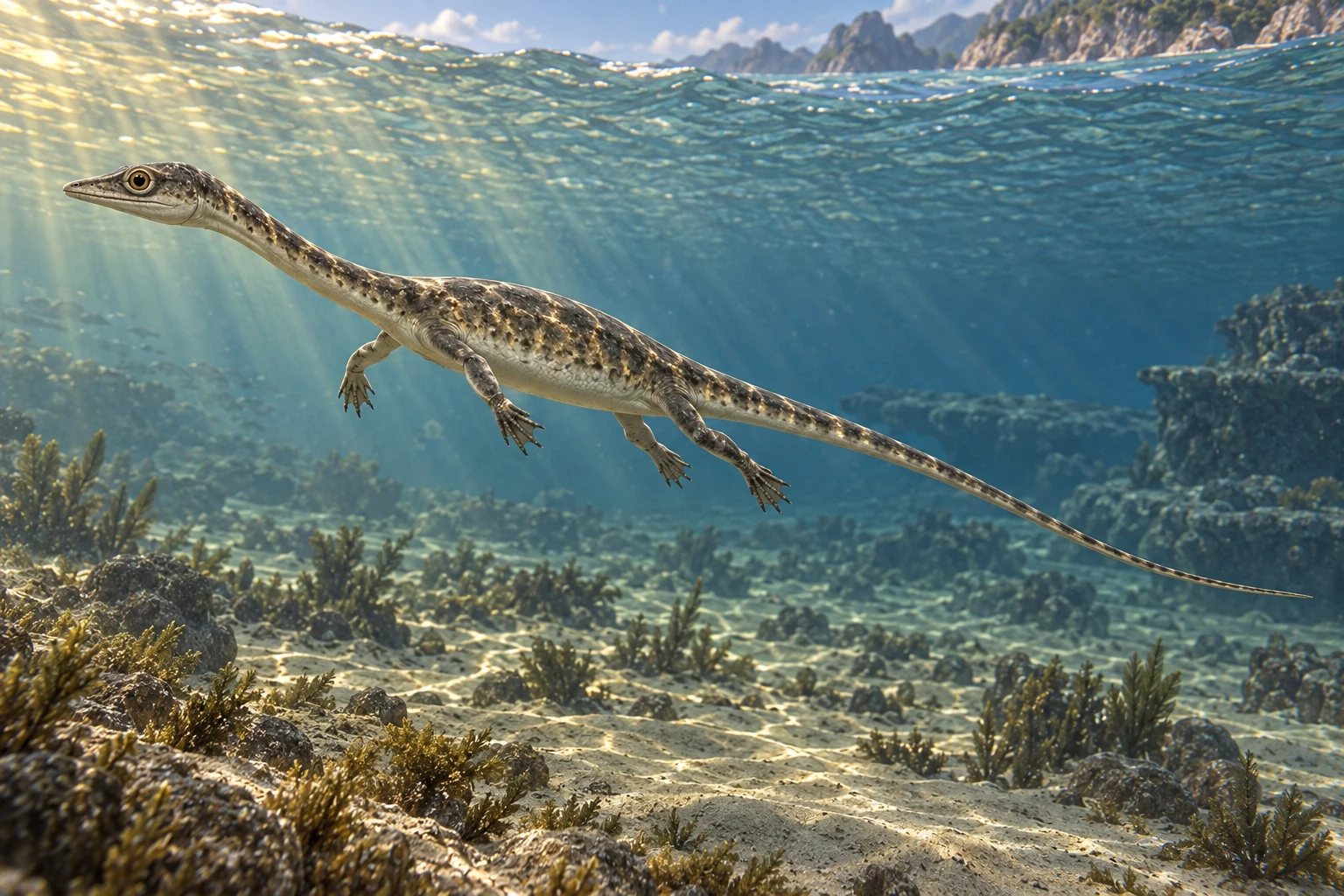
An illustrative reconstruction. Compare its anatomy with the evidence and limitations in the dossier. Lighting, coloration and scenery are artistic choices. This image does not document a fossil locality or behavior.
Original artwork · artistic interpretation.
Scientific view: source-informed reconstruction, credited paleoart or specimen-based imagery. Movie-style view: Original artistic interpretation. Reconstructions involve uncertainty.
MEET THE ANIMAL
Keichousaurus hui was a small aquatic reptile from Middle Triassic southern China. It had a small head, long neck and long tail. Computer scans let researchers study delicate bones that are difficult to separate from the surrounding rock, including important details of its skull. [D1]
Some fossils preserve evidence beyond the skeleton. A study found fish remains inside the digestive region, including an articulated fish revealed by scans. This is direct evidence that the reptile ate fish. Damage during digestion makes the fish’s exact identity uncertain, so researchers cannot confidently name the prey species. [D2]
Two pregnant fossils answer another life-history question: this animal gave birth to live young. That evidence comes from developing offspring preserved with adult reptiles. A companion’s decorative egg in a collecting game is a fictional design; it should not be mistaken for how the actual animal reproduced. [D4]
Differences between male and female skeletons have inspired ideas about sexual selection. A large fossil sample also contains unequal numbers of adults assigned to each sex. Those patterns are clues, but they are not a preserved courtship scene or proof of a herd. Researchers must consider how fossils were collected and preserved before explaining an ancient animal’s behavior. [D3]
PREHISTORIC ANIMAL DOSSIER
The animal, the evidence, and the questions still open.
CT studies expose delicate bones and swallowed fish. Gravid fossils establish live-bearing; proposed sexual selection does not reveal an actual courtship ritual. [D2]
Profile scope: One genus exhibit anchored to K. hui from Chinese Middle Triassic deposits; individual life stages and sex-assigned specimens are distinguished. [D1]
Source supported identifies a description documented by the cited source. Inferred marks a reconstruction or functional estimate. Debated marks competing interpretations. Not established means the sources reviewed for this dossier do not support a firm conclusion; it does not mean a behavior never occurred.
A size reference is an estimate, not a population range. Nesting evidence does not by itself establish courtship, mate choice, or lifelong pairing.
Usually under 0.5 m (reference)
Literature body-size reference in the anatomical study, not a measured adult range; its snout–vent table is a different measurement. [D1]
Not established here
Zinc mapping addresses ossification, not a validated body-mass estimate. [D5]
Fish
Micro-CT reveals swallowed fish in PCGU4281; preservation prevents confident identification of the prey species. [D2]
Shallow marine southern China
K. hui comes from Middle Triassic Zhuganpo/Falang deposits; burial setting does not establish its exact daily swimming depth. [D2]
Aquatic swimming
The small body, long tail and limb anatomy support swimming; the reviewed CT study does not measure stroke timing or speed. [D1]
Small head, long neck and tail
CT reconstruction resolves delicate skull and limb bones; large eyes and a narrow head distinguish it from broad-bodied plesiosaurs. [D1]
Live birth
The original study reports two gravid K. hui fossils. No egg nest or particular litter count is asserted from the inspected abstract. [D4]
Sexual selection proposed
Sexual dimorphism and sex ratios motivate selection hypotheses; suggested displays or grasping are comparisons, not observed rituals. [D3]
Not established here
A fossil sample’s adult sex ratio does not by itself demonstrate herd membership, pair bonds or parental care. [D3]
Sources and inspection notes for the claims in this profile.
THE STORY IN THE FOSSILS
A fish visible inside PCGU4281 is stronger dietary evidence than a tooth-shape prediction. Acid alteration limits its identification, so the fossil supports fish consumption without naming a particular prey genus. [2]
Zinc distributions can reveal active bone development in tiny skeletons. Such chemical maps address ossification and life stage, rather than directly weighing the living reptile. [5]
The dossier identifies the scope of each reference estimate. A mount, an individual fossil and a species-wide adult range are different measurements. Comparison metrics remain unavailable where adult scope has not been established. Unknown does not mean zero.
Sources support the stated claims and scopes. Refer to the evidence notes for uncertainty.
KEEP EXPLORING
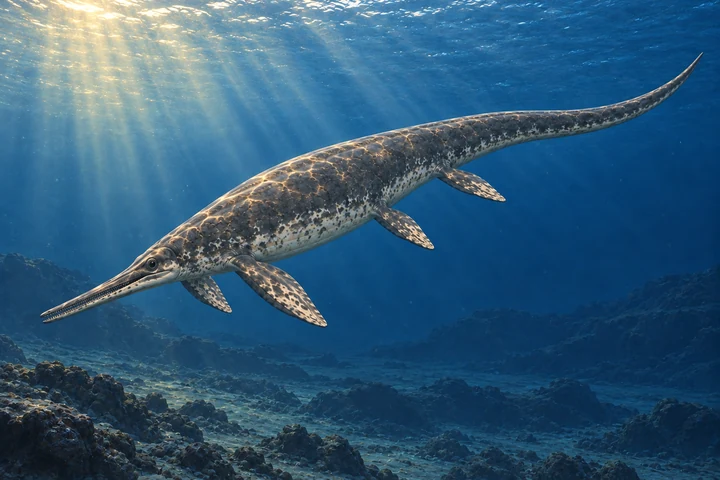
Cymbospondylus youngorum
Marine reptile
A giant ichthyosaur whose Nevada skull documents very early marine-reptile gigantism.
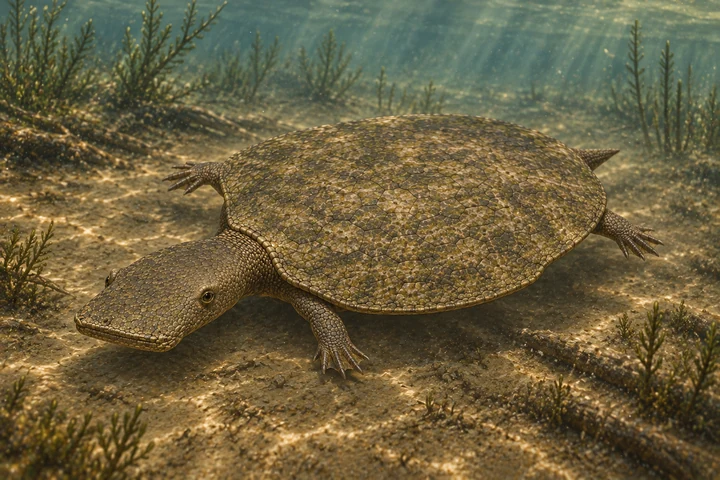
Henodus chelyops
Aquatic reptile
A turtle-like armored placodont reptile with a broad rectangular skull and reduced crushing teeth.
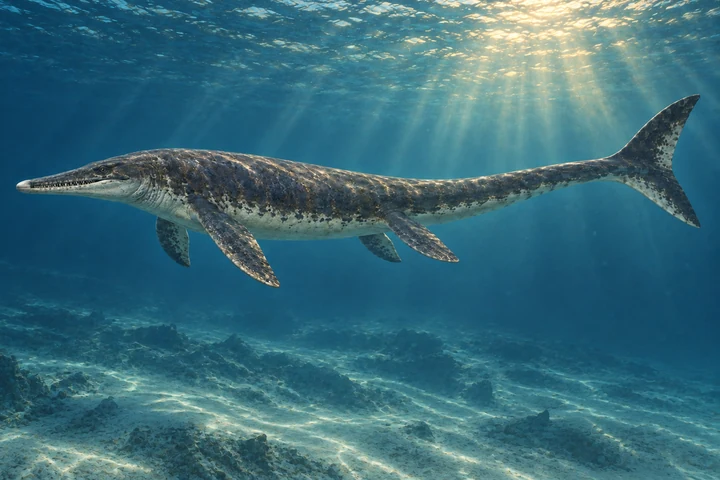
Tylosaurus proriger
Marine reptile
A marine lizard with an elongated adult snout tip, whose fossil identities are still being revised.