
Length
InferredAbout 1 m (museum reference)
Tübingen gives an approximate reference size, not a measured adult species range or Portuguese specimen length. [D2]
EXHIBIT 252
Henodus chelyops
Aquatic reptile
A turtle-like armored placodont reptile with a broad rectangular skull and reduced crushing teeth. [4]
TWO WAYS TO PICTURE THE PAST
Compare the evidence with the familiar movie image. The illustrations are not to a shared scale.
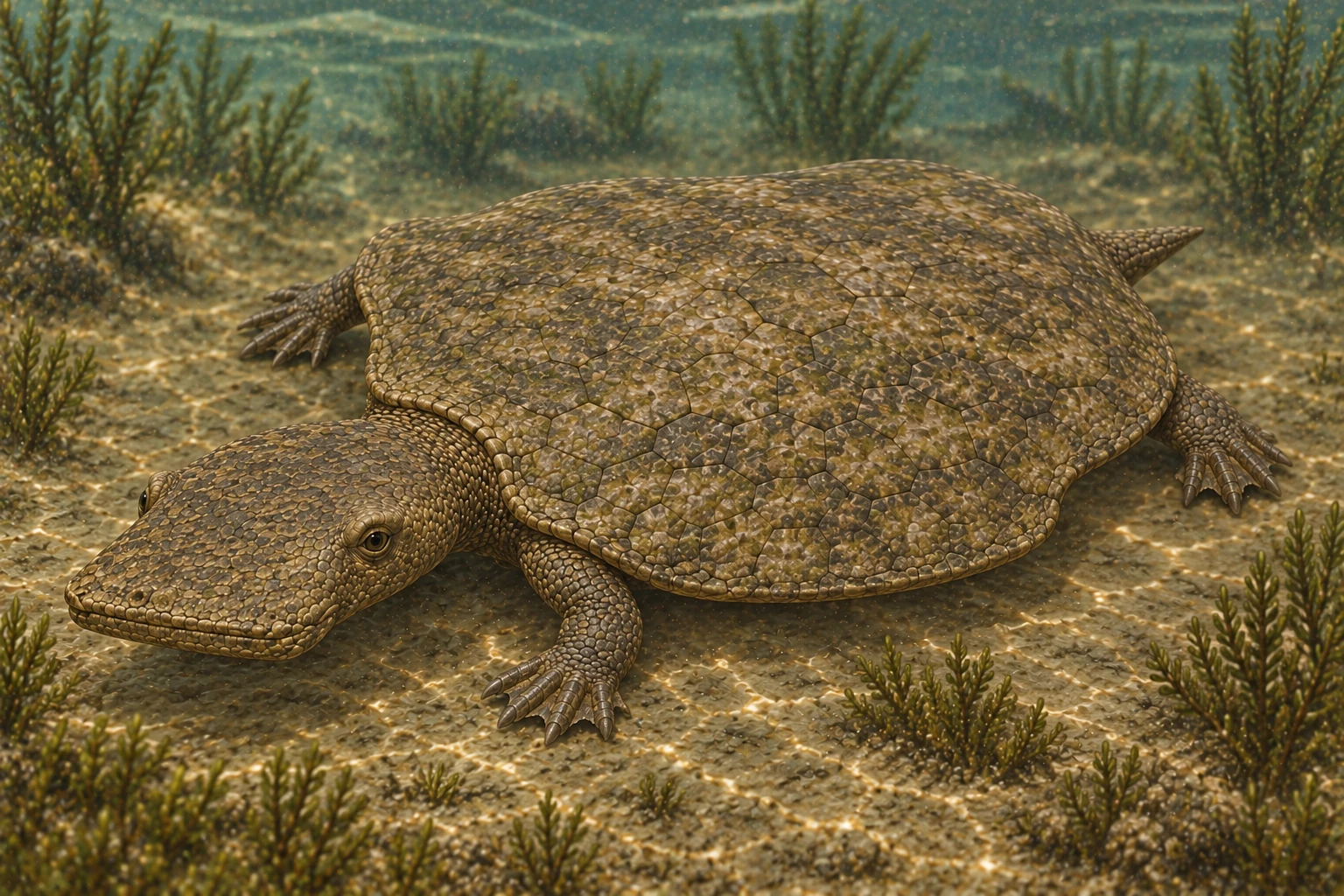
An illustrative reconstruction. Compare its anatomy with the evidence and limitations in the dossier. [4]
Source-informed reconstruction. Appearance evidence [4]. Original illustration; missing anatomy, coloration and scenery include interpretation.
Fossils constrain this life reconstruction. Missing anatomy, coloration and the environmental scene include interpretation; the dossier explains the evidence limits.
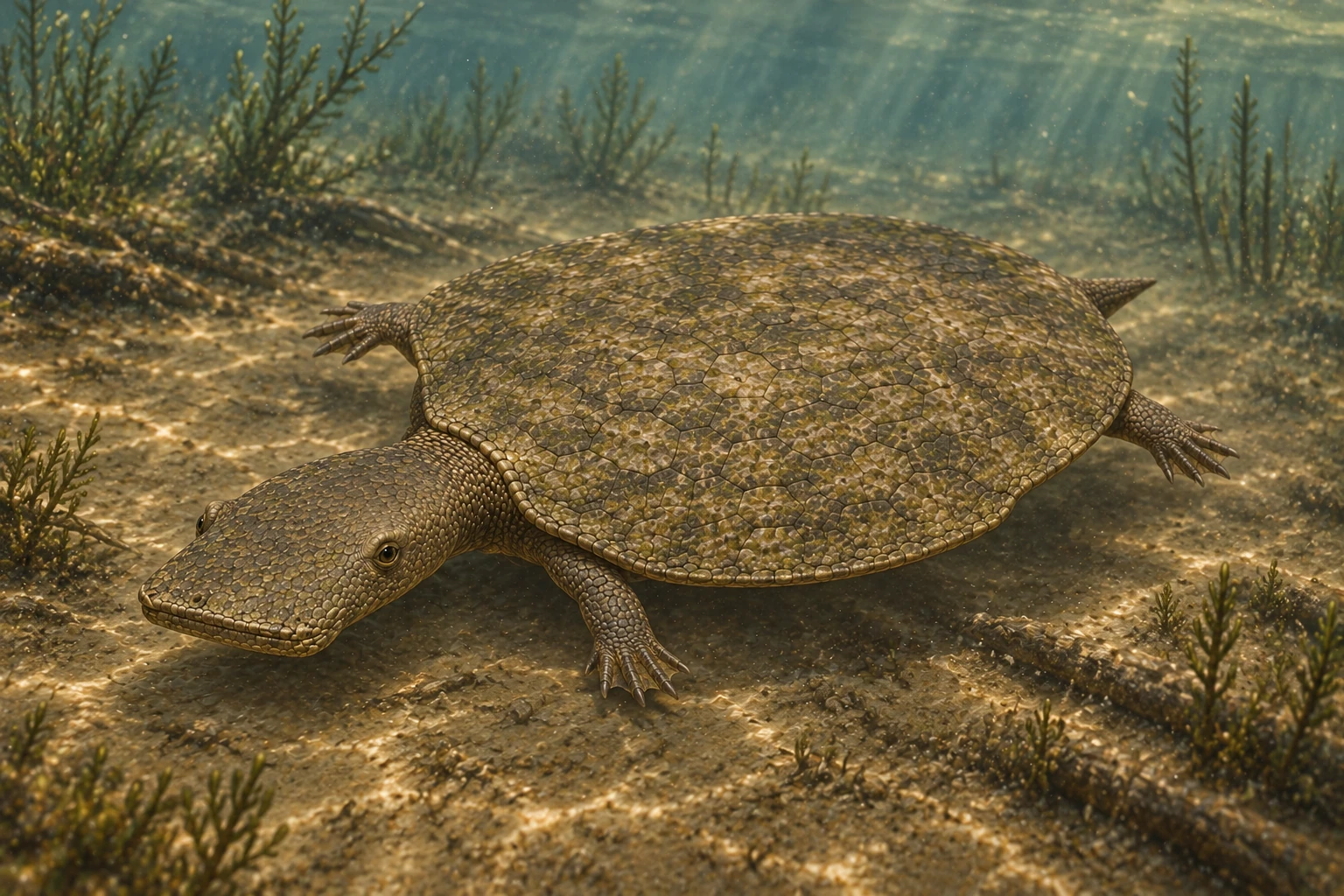
An illustrative reconstruction. Compare its anatomy with the evidence and limitations in the dossier. Lighting, coloration and scenery are artistic choices. This image does not document a fossil locality or behavior.
Original artwork · artistic interpretation.
Scientific view: source-informed reconstruction, credited paleoart or specimen-based imagery. Movie-style view: Original artistic interpretation. Reconstructions involve uncertainty.
MEET THE ANIMAL
Henodus looked a little like a turtle, but it belonged to a different reptile group called placodonts. Its wide armored body carried a broad, flat, rectangular head. Scientists use those details to identify it instead of relying only on its turtle-like silhouette. [D4]
The University of Tübingen collection records eight German specimens excavated between 1934 and1957. Its approximate one-meter size gives a useful reference for picturing the animal, but it is not a complete measured range for every adult. Museum records also preserve the history of discovery. [D2]
A 2025 paper described a partial Henodus skull from Portugal. The skull is too incomplete to decide which species it represents. Sediments suggest a changing coastal environment that could include brackish or fresh water with marine influence. A fossil burial setting still leaves questions about the animal’s exact daily habitat. [D3]
Its small crushing teeth have inspired several feeding ideas, including tiny crustaceans and snails. Other researchers have proposed plant scraping or filtering. We keep that debate visible, because distinctive teeth do not supply a complete menu. The reviewed material also leaves reproduction, courtship and social life uncertain. [D1]
PREHISTORIC ANIMAL DOSSIER
The animal, the evidence, and the questions still open.
New Portuguese material extends the genus record, without establishing its species. [D3]
Profile scope: Genus exhibit represented by German H. chelyops; Portugal supplies separately scoped Henodus sp. skull material. [D4] [D3]
Source supported identifies a description documented by the cited source. Inferred marks a reconstruction or functional estimate. Debated marks competing interpretations. Not established means the sources reviewed for this dossier do not support a firm conclusion; it does not mean a behavior never occurred.
A size reference is an estimate, not a population range. Nesting evidence does not by itself establish courtship, mate choice, or lifelong pairing.
About 1 m (museum reference)
Tübingen gives an approximate reference size, not a measured adult species range or Portuguese specimen length. [D2]
Not established here
The reviewed museum record does not establish a defensible mass estimate. [D2]
Feeding ecology debated
Small crustaceans/snails, plant scraping and suction or filtering have been proposed; four crushing teeth do not settle the complete diet. [D1] [D4]
Restricted coastal waters inferred
German and Portuguese deposits suggest brackish-to-freshwater settings with variable shallow marine influence; burial environments do not fix every living preference. [D3]
Aquatic movement inferred
Short gracile limbs occur beneath broad armor; the Portuguese skull does not preserve a swimming sequence. [D3]
Turtle-like armor; not a turtle
A broad flat rectangular skull and short wide carapace made from many osteoderms distinguish this placodont reptile. [D4]
Not established here
Focused searches and reviewed dental studies provide no direct eggs, pregnancy or birth evidence. [D1]
Not established here
The reviewed feeding study establishes teeth and replacement, not courtship or mate choice. [D1]
Not established here
The reviewed remains do not establish herds, pair bonds or parental care. [D1]
Sources and inspection notes for the claims in this profile.
THE STORY IN THE FOSSILS
A familiar outline can hide a different evolutionary history. Henodus resembles a turtle because its body is armored, yet its skull and armor diagnose a placodont reptile. The 2025 German treatment identifies a broad rectangular head, small posterior crushing teeth and a carapace wider than its length. Its resemblance does not make it a turtle ancestor. [4]
For decades the eight German specimens defined the known distribution. A partial skull from Portugal, described in 2025, expanded that picture. Its preservation supports the genus but not a particular species. The new record therefore changes the genus map without proving that the German species inhabited both places. [3]
The dossier identifies the scope of each reference estimate. A mount, an individual fossil and a species-wide adult range are different measurements. Comparison metrics remain unavailable where adult scope has not been established. Unknown does not mean zero.
Sources support the stated claims and scopes. Refer to the evidence notes for uncertainty.
KEEP EXPLORING
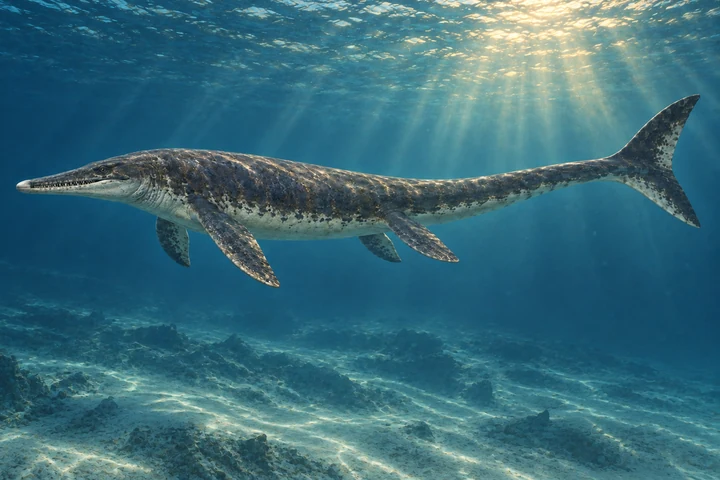
Tylosaurus proriger
Marine reptile
A marine lizard with an elongated adult snout tip, whose fossil identities are still being revised.
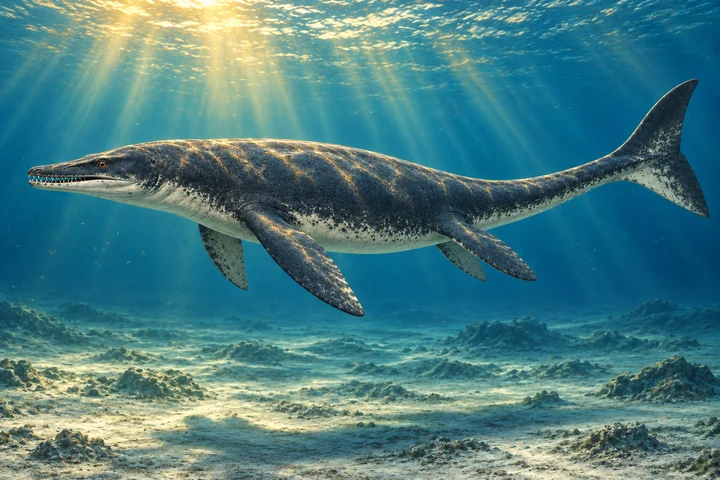
Platecarpus tympaniticus
Marine reptile
A streamlined mosasaur known from an exceptional fossil preserving skin traces and digested fish.
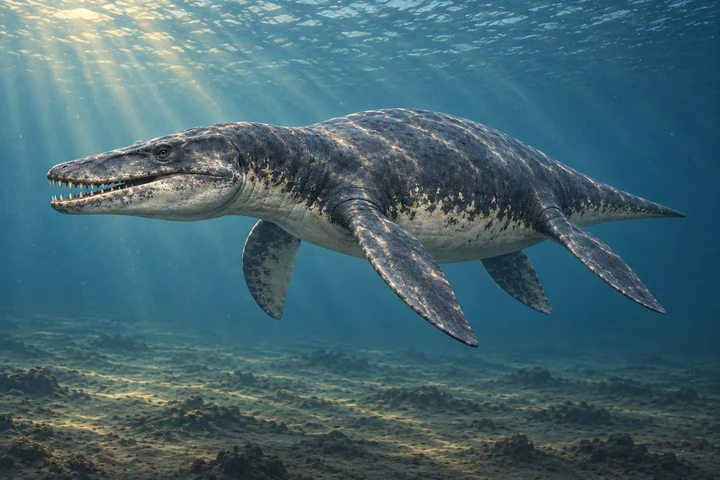
Pliosaurus kevani
Marine reptile
A large-skulled pliosaur whose Dorset holotype provides a detailed view of a Jurassic marine predator.