
Length
Source supportedApproximately2 m holotype skull
DORCMG.13,675 is a skull, not a complete body. Its length must not be reported as whole-animal length. [D1]
EXHIBIT 229
Pliosaurus kevani
Marine reptile
A large-skulled pliosaur whose Dorset holotype provides a detailed view of a Jurassic marine predator. [1]
TWO WAYS TO PICTURE THE PAST
Compare the evidence with the familiar movie image. The illustrations are not to a shared scale.
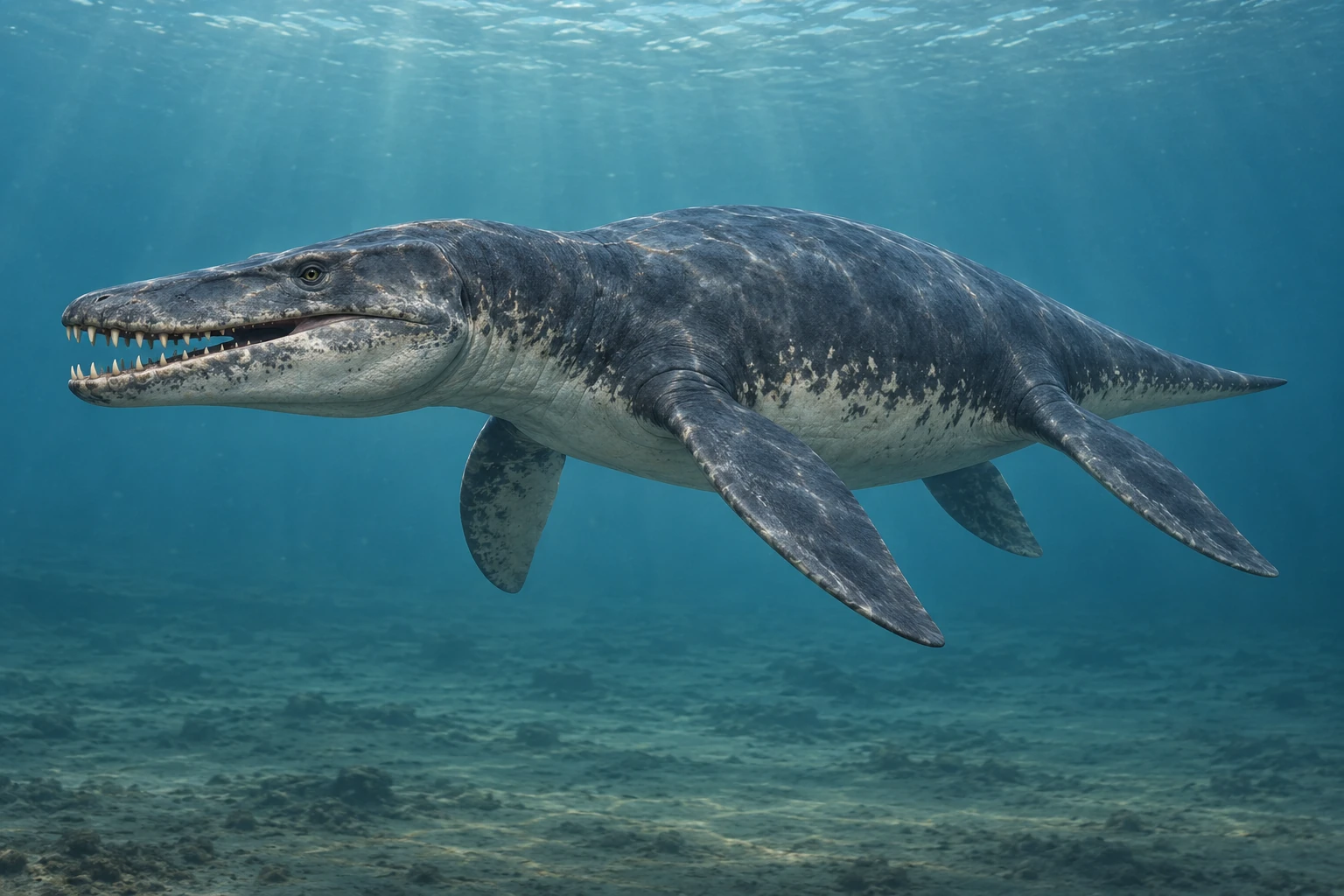
An illustrative reconstruction. Compare its anatomy with the evidence and limitations in the dossier. [4]
Source-informed reconstruction. Appearance evidence [4]. Original illustration; missing anatomy, coloration and scenery include interpretation.
Fossils constrain this life reconstruction. Missing anatomy, coloration and the environmental scene include interpretation; the dossier explains the evidence limits.
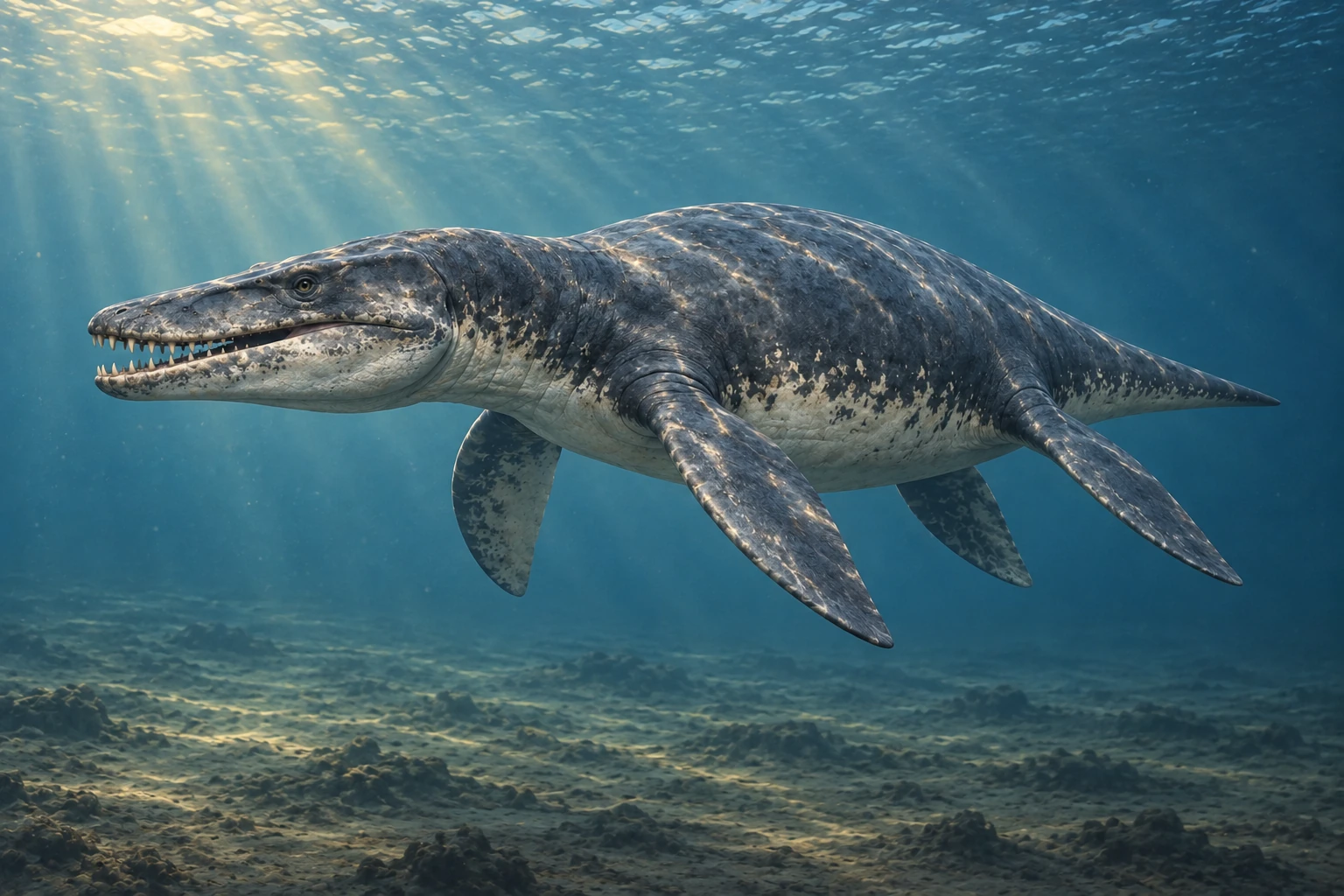
An illustrative reconstruction. Compare its anatomy with the evidence and limitations in the dossier. Lighting, coloration and scenery are artistic choices. This image does not document a fossil locality or behavior.
Original artwork · artistic interpretation.
Scientific view: source-informed reconstruction, credited paleoart or specimen-based imagery. Movie-style view: Original artistic interpretation. Reconstructions involve uncertainty.
MEET THE ANIMAL
Pliosaurus was a pliosaurid marine reptile, related to the broader plesiosaur group. The representative here is P. kevani from Jurassic Dorset. Its type fossil is a large skull. That gives scientists detailed evidence about jaws and teeth, while leaving the exact body of this individual incomplete. [D1]
Finding the skull was a patient process. Kevan Sheehan returned to a coastal site after rough weather and collected pieces exposed from a landslide. Specialists then cleaned and joined them. The museum account describes eighteen months of preparation before the specimen could be displayed and studied. [D2]
The reconstructed jaws suggest an animal able to take large prey. Researchers also scanned the skull and built mechanical models of its feeding anatomy. A model can explore what a jaw might do, but it does not prove how this animal hunted, which prey it preferred or its exact maximum bite. [D4]
Other plesiosaurs provide evidence for live birth, including a fossil Polycotylus with a fetus. That helps scientists reason about the broader group, but it is not a Pliosaurus pregnancy. Suggestions about parental care or social living therefore need the same careful distinction between direct evidence and comparison. [D3]
PREHISTORIC ANIMAL DOSSIER
The animal, the evidence, and the questions still open.
Separate skull pieces were recovered over several years and prepared for display. Reassembly allows research on structures hidden inside the fossil. [D2]
Profile scope: Genus exhibit represented by P. kevani, based on skull DORCMG.13,675 from lower Kimmeridgian Dorset; the holotype has no associated body skeleton. [D1]
Source supported identifies a description documented by the cited source. Inferred marks a reconstruction or functional estimate. Debated marks competing interpretations. Not established means the sources reviewed for this dossier do not support a firm conclusion; it does not mean a behavior never occurred.
A size reference is an estimate, not a population range. Nesting evidence does not by itself establish courtship, mate choice, or lifelong pairing.
Approximately2 m holotype skull
DORCMG.13,675 is a skull, not a complete body. Its length must not be reported as whole-animal length. [D1]
Not established here
The holotype lacks associated body remains; no comparable adult kilogram estimate is adopted from this review. [D1]
Large animal prey inferred
Robust jaws and teeth support macropredatory interpretation; CT-based biting models do not identify a particular meal. [D4]
Kimmeridge Clay marine shelf
The holotype comes from lower Kimmeridgian Wyke Siltstone at Osmington Bay, Dorset. [D1]
Four-flipper swimming reconstructed
The whole-body restoration uses comparative pliosaurid anatomy and tentatively referred postcrania, not a complete P. kevani holotype. [D1]
Robust skull and subtrihedral teeth
The teeth have a flattened outer surface; internal skull structures were investigated with CT. [D4]
Live birth inferred comparatively
Pregnancy evidence is from Polycotylus, another plesiosaur. No P. kevani embryo, litter size or nesting site is established here. [D3]
Not established here
The inspected skull work supplies no demonstrated P. kevani mating display or identified breeding pair. [D4]
Not established here
Parental care and sociality proposed for other plesiosaurs remain hypotheses, not direct Pliosaurus group evidence. [D3]
Sources and inspection notes for the claims in this profile.
THE STORY IN THE FOSSILS
Kevan Sheehan collected bones as they weathered from a coastal landslide. Recovering different pieces over several years and preparing them for eighteen months transformed scattered material into a researchable skull. [2]
A CT model reveals anatomy hidden inside the skull, while mechanical models test possible biting performance. These tools extend observation, but the calculations remain estimates and do not replay an observed prehistoric hunt. [4]
The dossier identifies the scope of each reference estimate. A mount, an individual fossil and a species-wide adult range are different measurements. Comparison metrics remain unavailable where adult scope has not been established. Unknown does not mean zero.
Sources support the stated claims and scopes. Refer to the evidence notes for uncertainty.
KEEP EXPLORING
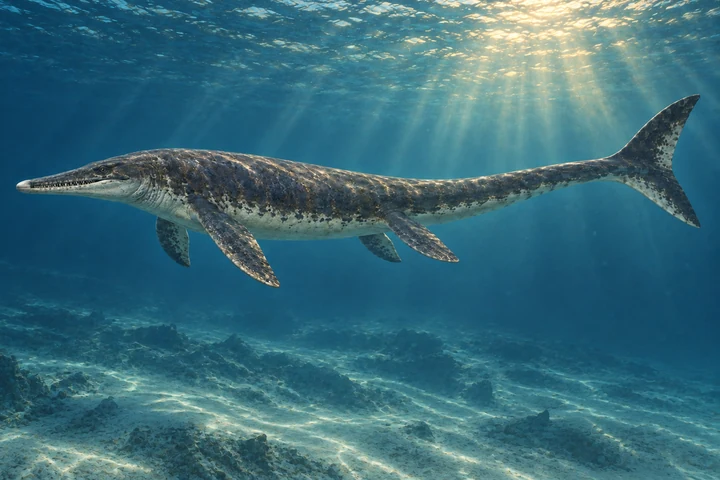
Tylosaurus proriger
Marine reptile
A marine lizard with an elongated adult snout tip, whose fossil identities are still being revised.
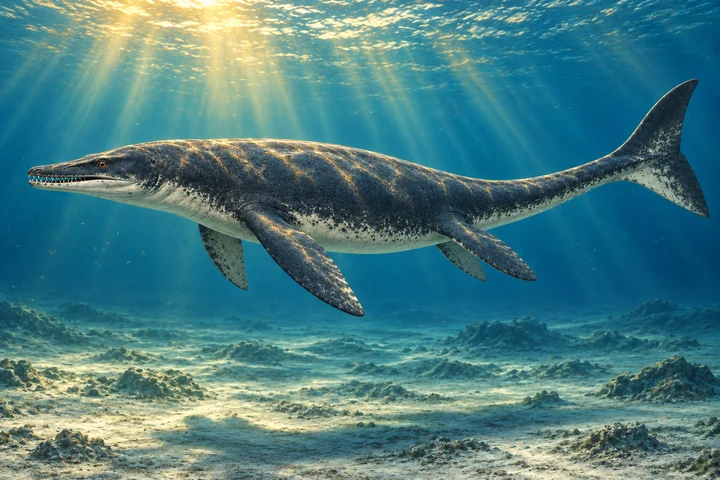
Platecarpus tympaniticus
Marine reptile
A streamlined mosasaur known from an exceptional fossil preserving skin traces and digested fish.
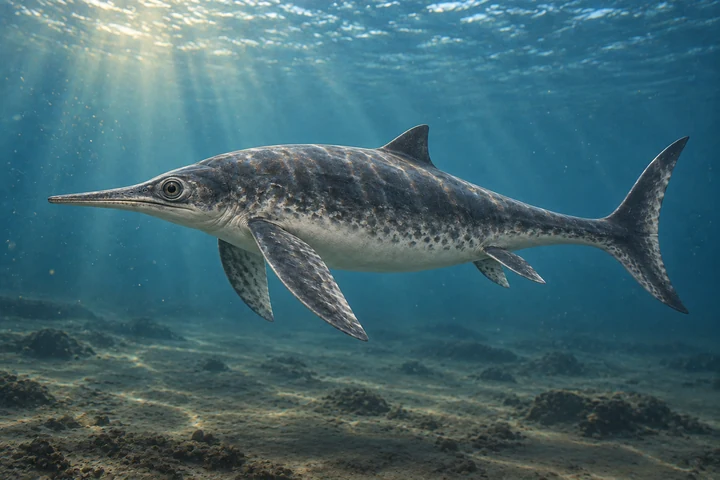
Stenopterygius quadriscissus
Marine reptile
A fish-shaped marine reptile with direct pregnancy fossils and teeth that changed as it grew.