
Length
Inferred4.49 m and about4.8 m (different individuals)
SMNS82043: 4.49 m jaw-based estimate (2012); DMA-JP-2009/001: about4.8 m connected body (2026). Distinct individuals, not a species range. [D1] [D2]
EXHIBIT 292
Dakosaurus maximus
Marine reptile
A marine crocodile-line reptile with cutting teeth and a tail adapted for swimming. [1]
TWO WAYS TO PICTURE THE PAST
Compare the evidence with the familiar movie image. The illustrations are not to a shared scale.
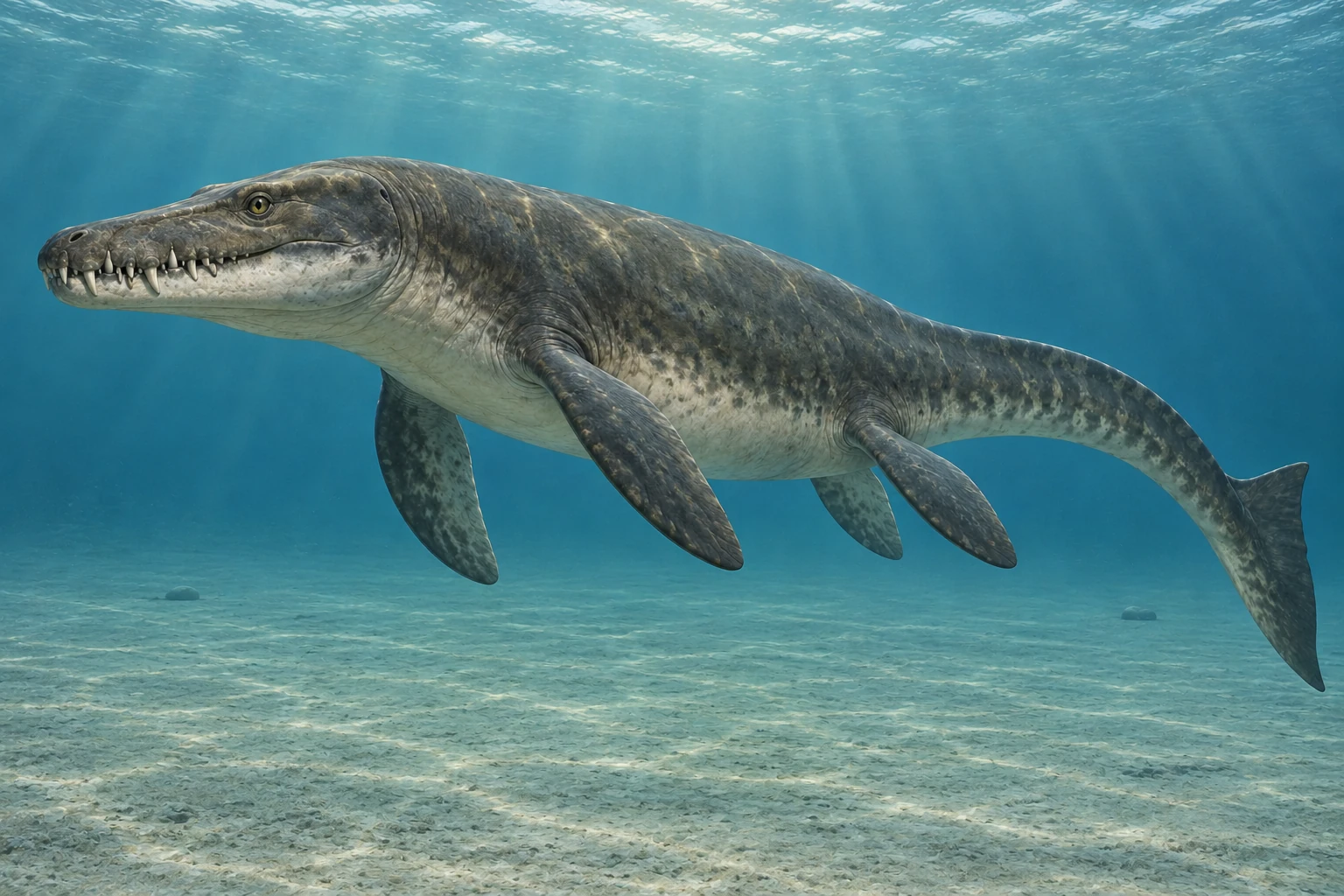
An illustrative reconstruction. Compare its anatomy with the evidence and limitations in the dossier. [2]
Source-informed reconstruction. Appearance evidence [2]. Original illustration; missing anatomy, coloration and scenery include interpretation.
Fossils constrain this life reconstruction. Missing anatomy, coloration and the environmental scene include interpretation; the dossier explains the evidence limits.
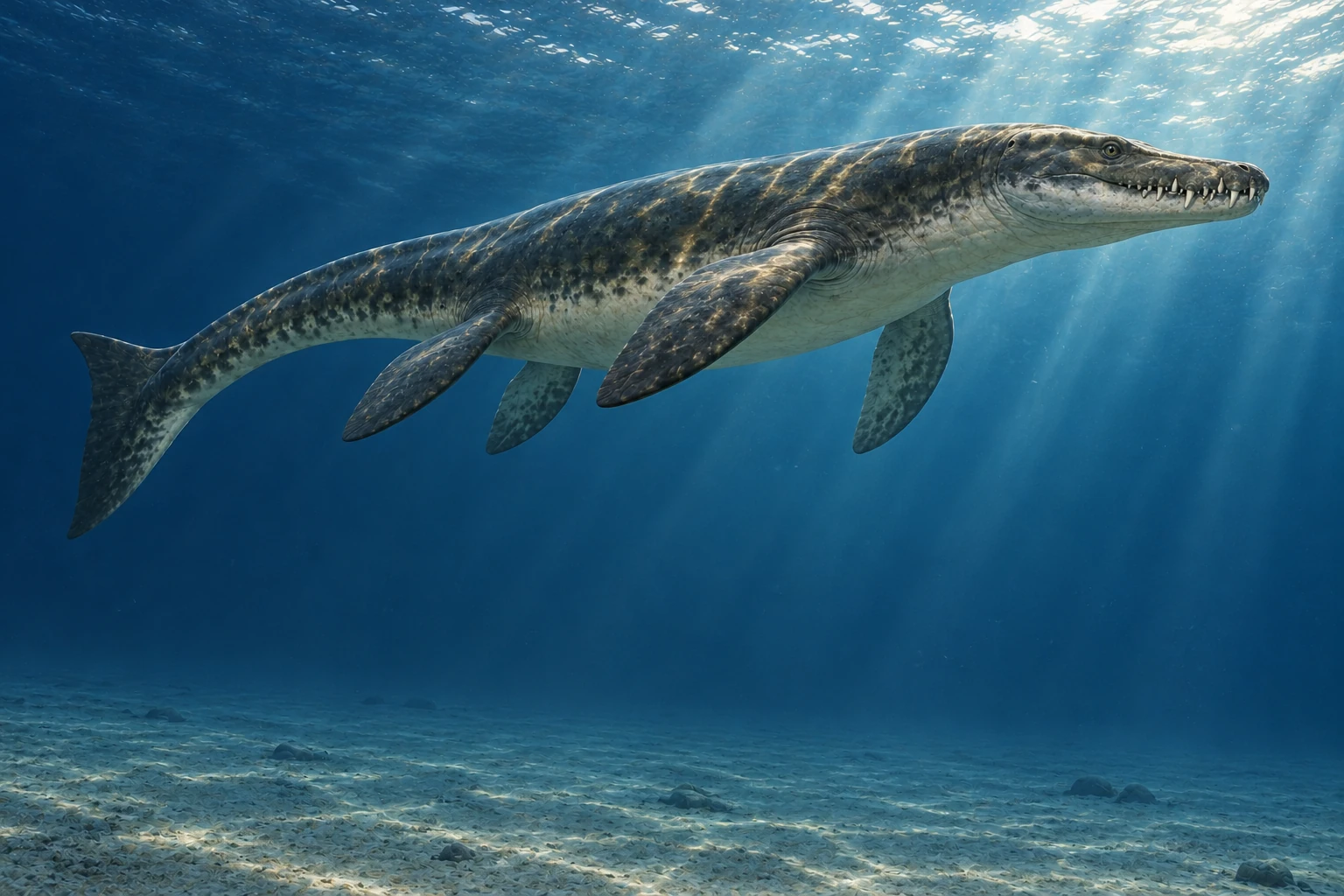
An illustrative reconstruction. Compare its anatomy with the evidence and limitations in the dossier. Lighting, coloration and scenery are artistic choices. This image does not document a fossil locality or behavior.
Original artwork · artistic interpretation.
Scientific view: source-informed reconstruction, credited paleoart or specimen-based imagery. Movie-style view: Original artistic interpretation. Reconstructions involve uncertainty.
MEET THE ANIMAL
Dakosaurus was a crocodile-line reptile adapted for the sea. The species featured here, Dakosaurus maximus, had sturdy jaws and teeth with cutting edges. The way those teeth met and wore against each other helps researchers investigate how its mouth handled food, rather than simply calling it dangerous. [D1]
A recently studied German skeleton preserves much of the body connected together. Its limbs formed paddles, and the tail bent downward where a swimming fin could have been supported. Its skull also bears healed bite marks. The animal survived those injuries, although the identity of the attacker remains uncertain. [D2]
Living crocodiles lay eggs, but this marine relative raises a different question. Researchers compared the pelvic region and limbs of metriorhynchids, its wider group, with other marine reptiles. Their study favored live birth as a hypothesis because ordinary land movement would have been difficult. Direct reproductive fossils are still missing. [D3]
Names also affect comparisons. A species once included in Dakosaurus was returned to the separate genus Plesiosuchus. Its larger size estimates should therefore stay with that animal. A reconstruction can look convincing while still combining evidence incorrectly unless anatomy, measurements and names are checked together. [D1]
PREHISTORIC ANIMAL DOSSIER
The animal, the evidence, and the questions still open.
A connected skeleton reveals swimming anatomy and healed bites. The attacker and circumstances remain interpretations. [D2]
Profile scope: One genus exhibit anchored to D. maximus. Plesiosuchus manselii and its larger measurements are excluded. [D1]
Source supported identifies a description documented by the cited source. Inferred marks a reconstruction or functional estimate. Debated marks competing interpretations. Not established means the sources reviewed for this dossier do not support a firm conclusion; it does not mean a behavior never occurred.
A size reference is an estimate, not a population range. Nesting evidence does not by itself establish courtship, mate choice, or lifelong pairing.
4.49 m and about4.8 m (different individuals)
SMNS82043: 4.49 m jaw-based estimate (2012); DMA-JP-2009/001: about4.8 m connected body (2026). Distinct individuals, not a species range. [D1] [D2]
Not established here
Reviewed skull/skeleton studies provide no attributable body-mass estimate with method. [D1]
Chondrichthyan prey directly preserved
DMA-JP-2009/001 contains a chondrichthyan fragment inside its abdomen, tentatively hybodontiform; the complete menu remains unknown. [D2]
Late Jurassic European marine deposits
European marine deposits support occurrence; carbonate burial does not establish its complete habitat range. [D2]
Tail-driven aquatic swimming
Tailbend and four paddle limbs support swimming; fin contours restored comparatively, with no measured speed. [D2]
Robust snout and serrated teeth
Compressed serrated crowns, connected skeleton and scale-less skin preserved; some skull proportions are distorted. [D2]
Live birth hypothesized, not demonstrated
Pelvic/limb comparisons favor livebearing in metriorhynchids. The study explicitly lacks attributable embryos, eggs or pregnant females. [D3]
Not established here
Reproductive anatomy does not reveal a courtship sequence, mating display or parental pair bond. [D3]
Interaction evidence, grouping unknown
Healed bites allow alternative attackers or feeding accidents; no grouping established. [D2]
Sources and inspection notes for the claims in this profile.
THE STORY IN THE FOSSILS
Healed bites record survival without identifying an attacker. [2]
Pelvic comparisons support a reproductive hypothesis; an actual pregnancy fossil would provide more direct evidence. [3]
The dossier identifies the scope of each reference estimate. A mount, an individual fossil and a species-wide adult range are different measurements. Comparison metrics remain unavailable where adult scope has not been established. Unknown does not mean zero.
Sources support the stated claims and scopes. Refer to the evidence notes for uncertainty.
KEEP EXPLORING
Pliosaurus kevani
Marine reptile
A large-skulled pliosaur whose Dorset holotype provides a detailed view of a Jurassic marine predator.
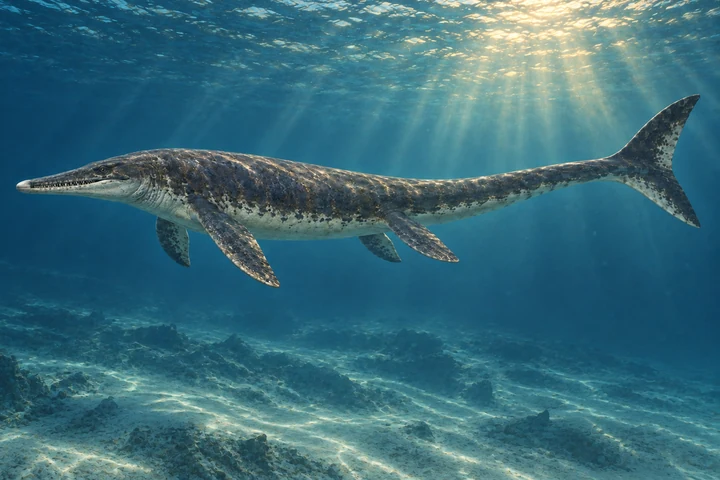
Tylosaurus proriger
Marine reptile
A marine lizard with an elongated adult snout tip, whose fossil identities are still being revised.
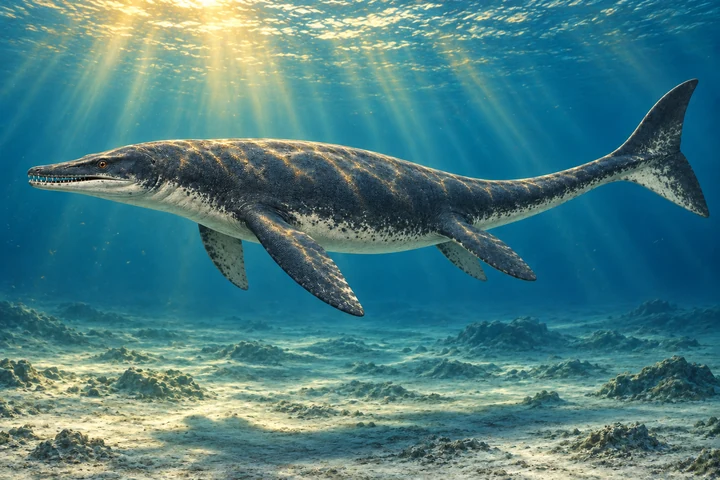
Platecarpus tympaniticus
Marine reptile
A streamlined mosasaur known from an exceptional fossil preserving skin traces and digested fish.