Body length
InferredAbout 15–16 m (educational reference)
The institutional estimate lacks an explicit measured individual and growth-stage qualification; it is not an established species range. [D4]
EXHIBIT 218
Diamantinasaurus matildae
Dinosaur
Diamantinasaurus was a heavy-bodied Australian sauropod, now known from a skull as well as limb and body bones. [1]
TWO WAYS TO PICTURE THE PAST
Compare the evidence with the familiar movie image. The illustrations are not to a shared scale.
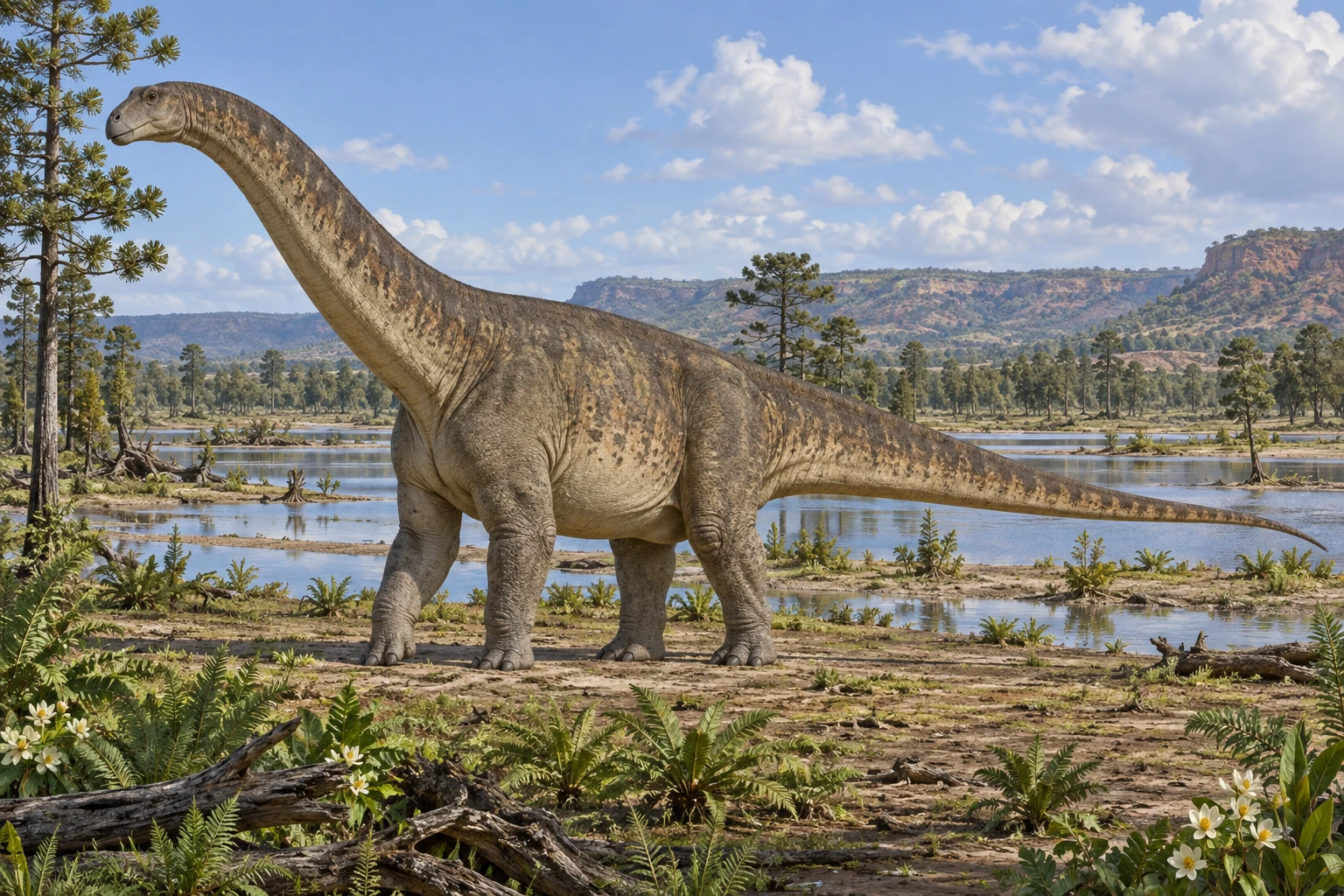
An illustrative reconstruction. Compare its anatomy with the evidence and limitations in the dossier. [1]
Source-informed reconstruction. Appearance evidence [1]. Original illustration; missing anatomy, coloration and scenery include interpretation.
Fossils constrain this life reconstruction. Missing anatomy, coloration and the environmental scene include interpretation; the dossier explains the evidence limits.
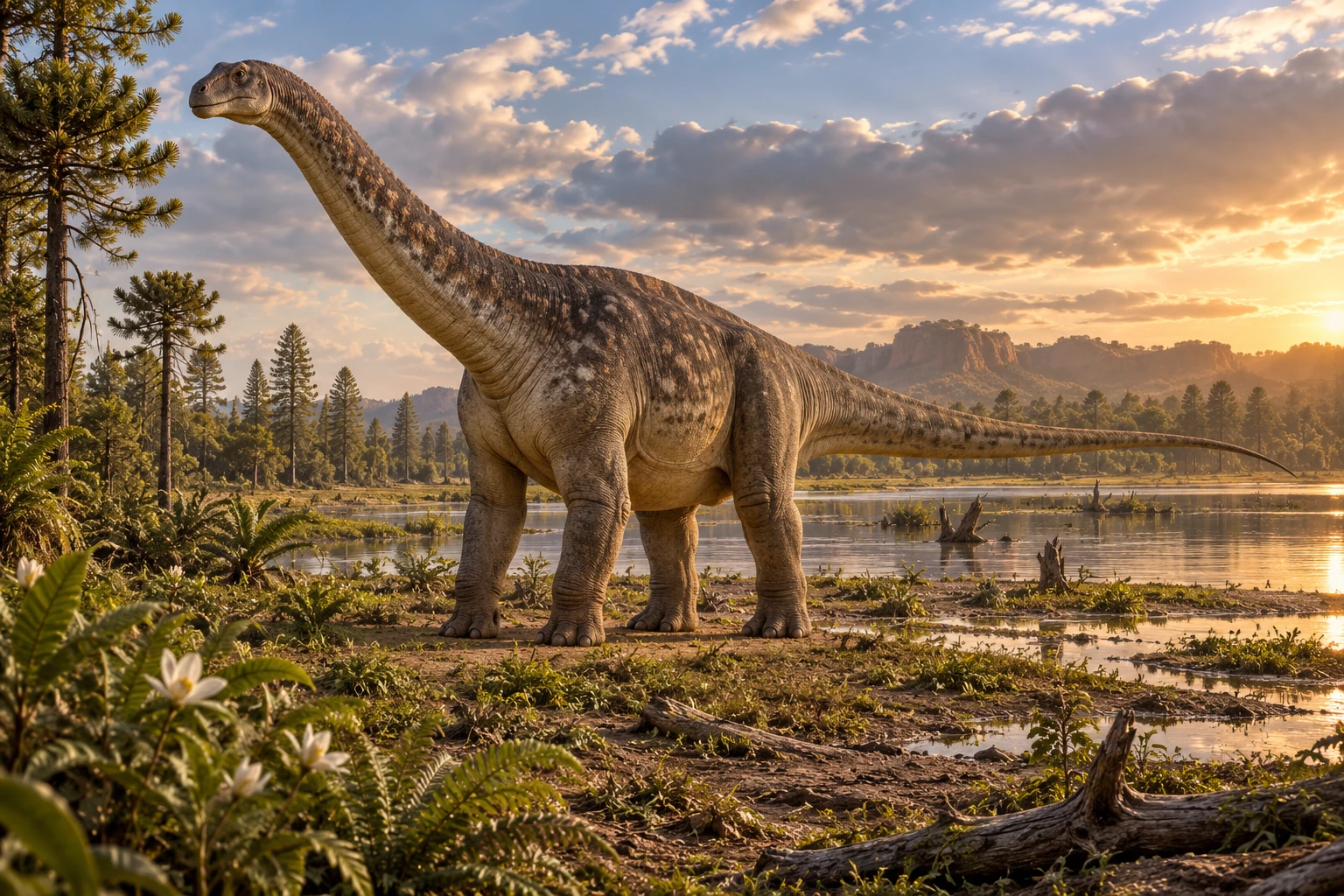
An illustrative reconstruction. Compare its anatomy with the evidence and limitations in the dossier. Lighting, coloration and scenery are artistic choices. This image does not document a fossil locality or behavior.
Original artwork · artistic interpretation.
Scientific view: source-informed reconstruction, credited paleoart or specimen-based imagery. Movie-style view: Original artistic interpretation. Reconstructions involve uncertainty.
MEET THE ANIMAL
Diamantinasaurus was a long-necked, heavy-bodied sauropod from Queensland, Australia. Sauropods are the four-legged dinosaurs with long necks and tails. An institutional profile estimates this animal at about fifteen to sixteen metres long, but does not identify a particular growth stage for that value. Its first fossils came from an ancient billabong, where bones were mixed with remains of several other animals. [D4]
Its surroundings were not simply the dry landscape seen in western Queensland today. Research on the Winton Formation describes a freshwater plain with winding rivers, small lakes and wet patches. Rainfall was seasonal, and conifers grew alongside early flowering plants. Those deposits help reconstruct the environment. They do not show that the sauropod was adapted to living underwater merely because some bones ended up beside aquatic animals. [D6]
A specimen nicknamed Ann brought a particularly useful discovery: a nearly complete skull. Its description in 2023 gives researchers a direct basis for studying the head and teeth, instead of borrowing a whole skull from another dinosaur. The tooth crowns help scientists consider how it fed. Even with this new information, exact plant preferences and the details of a fully restored head remain questions for further research. [D1]
PREHISTORIC ANIMAL DOSSIER
The animal, the evidence, and the questions still open.
The Ann skull described in 2023 provides a direct head reference that older skull-less reconstructions lacked. [D1]
Profile scope: Genus — Diamantinasaurus matildae; Winton Formation sauropod from Queensland. Australotitan is reserved because published overlap remains unresolved. [D2]
Source supported identifies a description documented by the cited source. Inferred marks a reconstruction or functional estimate. Debated marks competing interpretations. Not established means the sources reviewed for this dossier do not support a firm conclusion; it does not mean a behavior never occurred.
A size reference is an estimate, not a population range. Nesting evidence does not by itself establish courtship, mate choice, or lifelong pairing.
About 15–16 m (educational reference)
The institutional estimate lacks an explicit measured individual and growth-stage qualification; it is not an established species range. [D4]
About 15–20 tonnes (educational reference)
No stated fossil individual or maturity accompanies this estimate, so it is excluded from adult comparison sliders. [D4]
Plant feeding inferred
Tooth crowns and wear motivate feeding hypotheses; exact plant preferences require further testing rather than a fixed menu. [D1]
Vegetated freshwater alluvial plain
Winton deposits record meandering rivers, small lakes and mires under warm seasonal rainfall. Floodplain ground was the living landscape. [D6]
Terrestrial quadruped inferred
The sauropod body plan and stout limb bones support four-legged movement; billabong burial is not swimming specialization. [D5]
Small skull and compressed tooth crowns
The Ann specimen documents skull anatomy directly; a fully restored head still needs missing parts completed. [D1]
Not established here
The inspected skeletal studies and focused searches do not identify Diamantinasaurus eggs, nests, clutch size or parental care. [D2]
Not established here
The reviewed cranial material does not reveal mate choice, mating posture, display sounds or sex-specific colors. [D1]
Not established here
Multiple specimens and bones mixed in a billabong do not independently demonstrate a living herd. [D4]
Sources and inspection notes for the claims in this profile.
THE STORY IN THE FOSSILS
The formation preserves a mosaic of river, lake and floodplain settings. Seasonal rainfall supported plant-rich habitats rather than a featureless desert. [6]
New comparisons can change dinosaur boundaries. A possible overlap is recorded conservatively while Diamantinasaurus retains its accepted name. [2]
The dossier identifies the scope of each reference estimate. A mount, an individual fossil and a species-wide adult range are different measurements. Comparison metrics remain unavailable where adult scope has not been established. Unknown does not mean zero.
Sources support the stated claims and scopes. Refer to the evidence notes for uncertainty.
KEEP EXPLORING
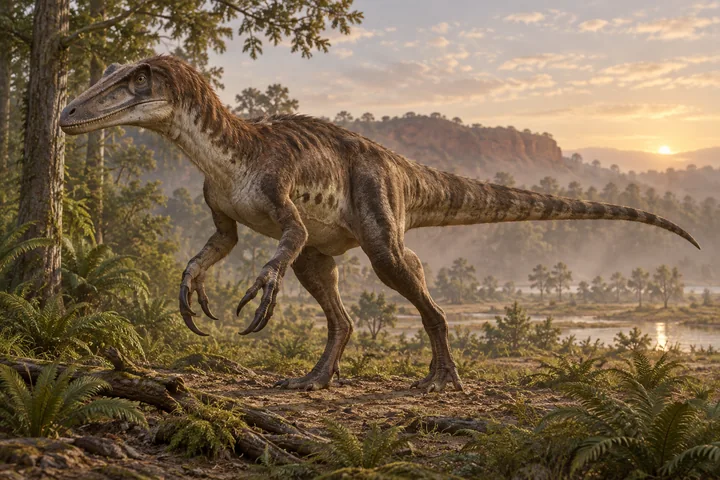
Australovenator wintonensis
Australovenator preserves powerful grasping arms and large hand claws.
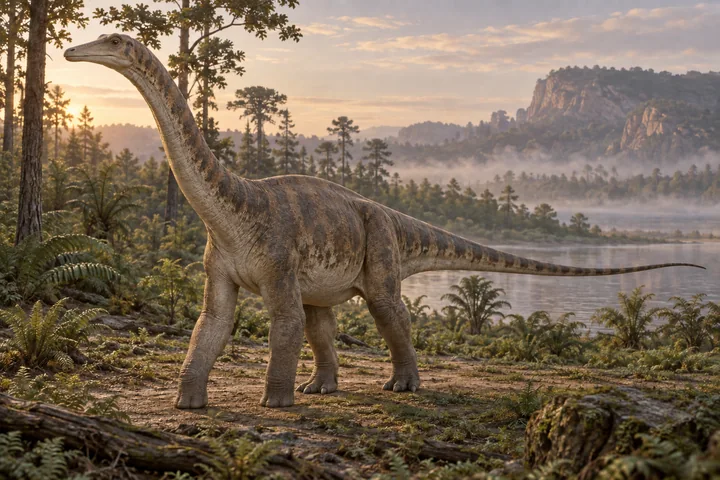
Rapetosaurus krausei
Rapetosaurus was a Malagasy titanosaur. Its famous Field Museum skeleton belonged to a growing youngster.
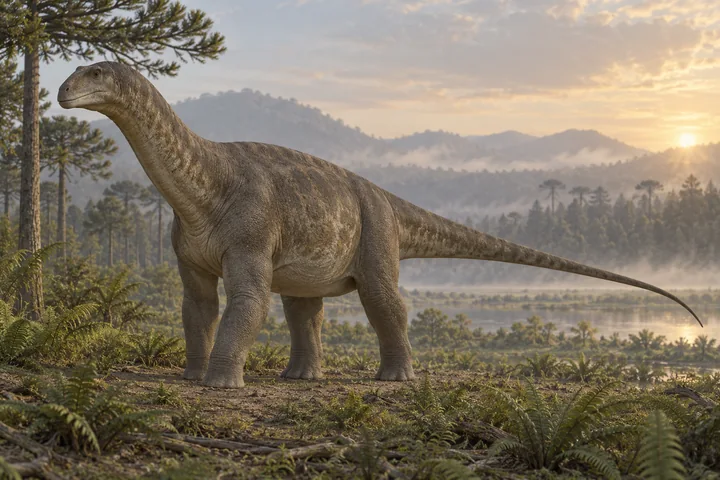
Isisaurus colberti
Isisaurus was an Indian titanosaur whose partial skeleton preserves distinctive neck vertebrae, shoulders and forelimbs.