Body length
Not establishedNot established here
Reviewed adult skull and juvenile skeleton studies did not yield an explicitly verified whole-body length. UA 9998’s 0.35 m measurement is hip height, not body length. [D4]
EXHIBIT 124
Rapetosaurus krausei
Rapetosaurus was a Malagasy titanosaur. Its famous Field Museum skeleton belonged to a growing youngster. [6]
TWO WAYS TO PICTURE THE PAST
Compare the evidence with the familiar movie image. The illustrations are not to a shared scale.
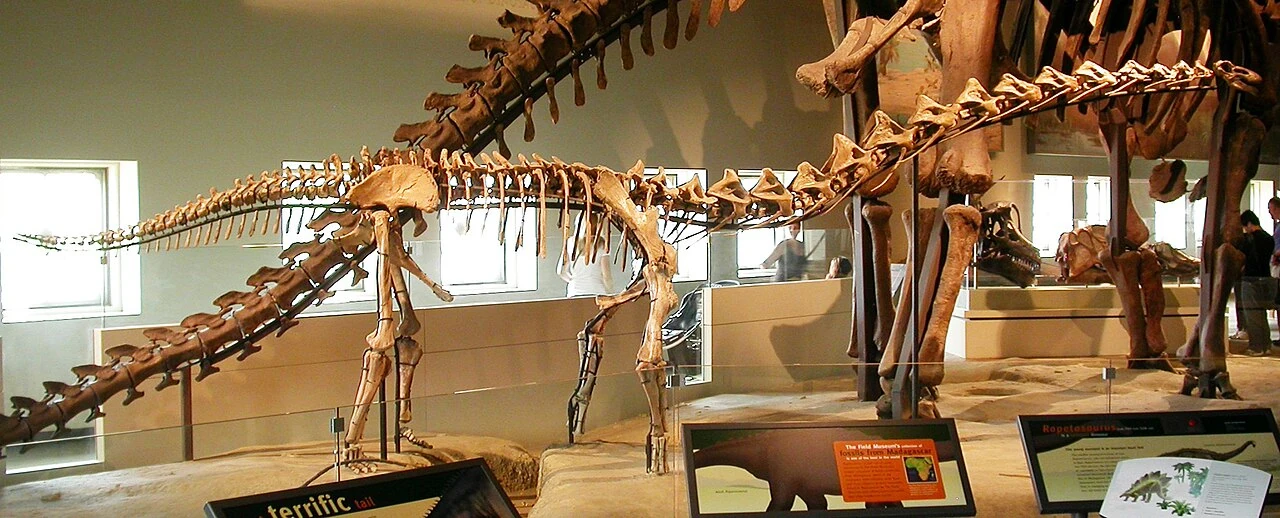
The smaller skeleton in front is the Field Museum’s juvenile Rapetosaurus. Restored portions and mounted neck posture are interpretations; the larger Apatosaurus behind it belongs to another genus. [3]
Rapetosaurus mount at the Field Museum · Matt Wedel. CC BY 3.0. Resized proportionally and converted to WebP; no anatomical edits. Same source license applies.
Skeletal mounts and drawings may restore missing parts; the caption identifies the displayed material.
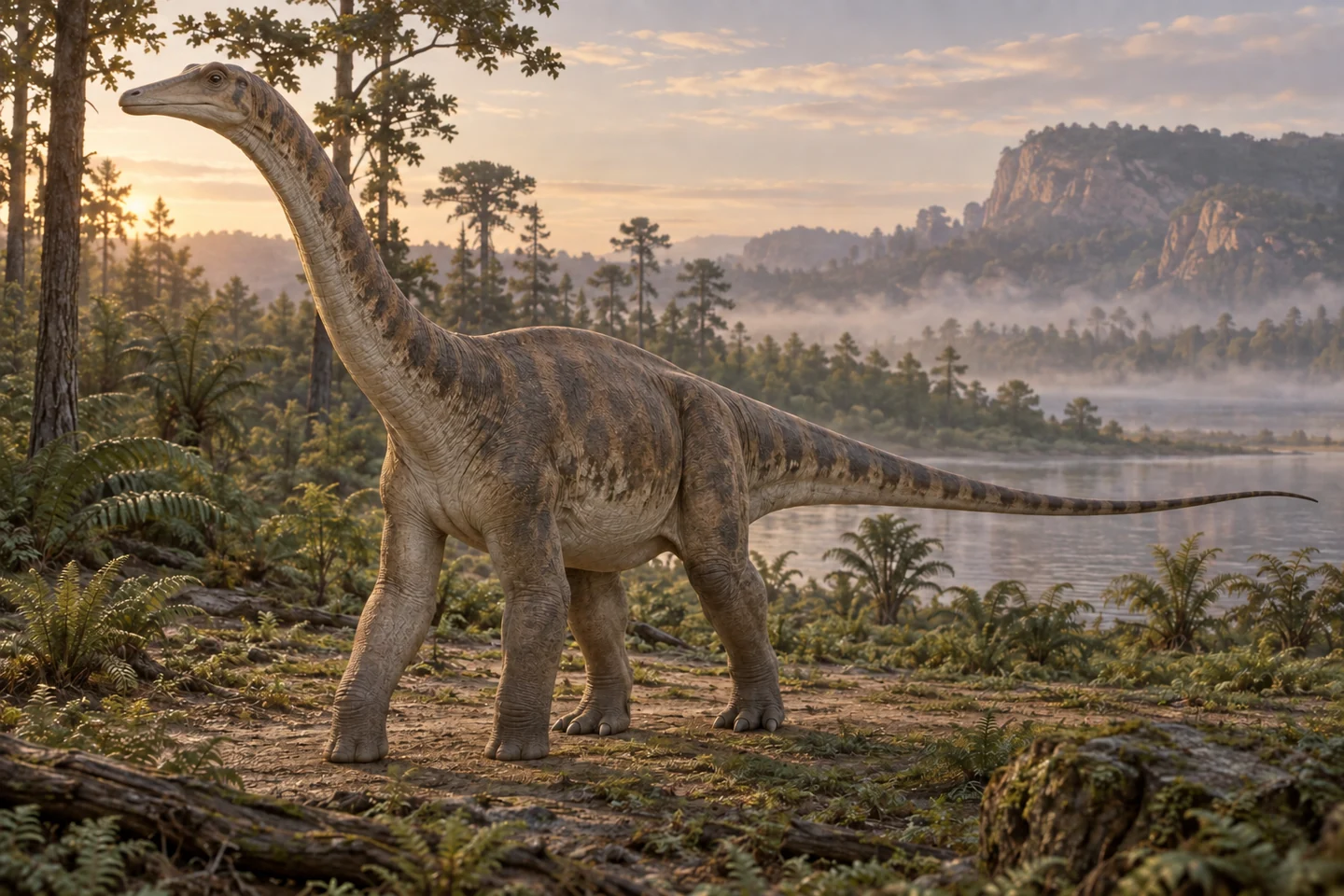
Original cinematic interpretation of Rapetosaurus krausei — juvenile interpretation. Colors, soft tissues, scenery and missing anatomy are reconstructed artistic choices; this is not a directly observed individual or behavior. The body is a juvenile comparative reconstruction; missing anatomy and any armor arrangement remain uncertain. Fine hand outlines and the raised mounted-looking neck posture are illustrative; exact juvenile cranial proportions remain uncertain. Lighting, coloration and scenery are artistic choices. This image does not document a fossil locality or behavior.
Original artwork · artistic interpretation.
Scientific view: source-informed reconstruction, credited paleoart or specimen-based imagery. Movie-style view: Original artistic interpretation. Reconstructions involve uncertainty.
MEET THE ANIMAL
Rapetosaurus was a plant-eating sauropod from Late Cretaceous Madagascar. Its slender jaws carried cylindrical teeth with matching wear facets, showing that teeth contacted each other during food processing. The tooth evidence supports herbivory without identifying a favorite plant or a fixed feeding height. Its record includes informative younger animals as well as larger remains. [D1]
Associated skin bones, or osteoderms, occur in material from different ages. An adult-sized example has a hollow interior, inspiring a hypothesis that it stored minerals. That suggested function is not a directly observed process. The bones establish part of the covering, while their exact arrangement across a living body remains unresolved. [D3]
The Field Museum's displayed Rapetosaurus is a juvenile. Its position beside the much larger Apatosaurus makes a dramatic comparison, but the smaller animal should not become a model for full-grown Rapetosaurus size. A museum display can represent a particular life stage rather than a standard adult. Keeping that label in view helps separate real growth evidence from the impression created by two neighboring skeletons. [D6]
PREHISTORIC ANIMAL DOSSIER
The animal, the evidence, and the questions still open.
A slender snout and cylindrical teeth accompany an elongated neck. Adult cranial material and associated juvenile skeletons provide complementary evidence. [D1]
Profile scope: Genus profile centered on Rapetosaurus krausei: adult skull UA 8698, juvenile skeleton FMNH PR 2209 and separately identified young specimens. [D2]
Source supported identifies a description documented by the cited source. Inferred marks a reconstruction or functional estimate. Debated marks competing interpretations. Not established means the sources reviewed for this dossier do not support a firm conclusion; it does not mean a behavior never occurred.
A size reference is an estimate, not a population range. Nesting evidence does not by itself establish courtship, mate choice, or lifelong pairing.
Not established here
Reviewed adult skull and juvenile skeleton studies did not yield an explicitly verified whole-body length. UA 9998’s 0.35 m measurement is hip height, not body length. [D4]
About 40 kg and 1.65 tonnes; different juveniles
UA 9998’s early juvenile estimate uses skeletal scaling and developmental evidence. Benson’s limb-based model gives about 1.65 tonnes for older juvenile FMNH PR 2209; neither estimates adult mass. [D4] [D5]
Plants
Cylindrical teeth with matching wear facets support herbivory and tooth-to-tooth contact. They do not identify a precise plant menu, feeding height or daily intake. [D1]
Maastrichtian northwestern Madagascar
Reviewed fossils come from the Anembalemba Member of the Maevarano Formation, Mahajanga Basin. Separate bone-bearing horizons record multiple burial events rather than one living herd. [D2]
Four-legged terrestrial walker
The associated juvenile skeleton preserves forelimbs, hindlimbs and their weight-bearing joints. Complete stance and habitual neck posture require restoration of missing parts and soft tissues. [D2]
Long neck, slender jaws and low-relief osteoderms
Associated juvenile and adult-sized osteoderms establish dermal bones at different ages. The adult-sized element is internally hollow; mineral storage is a hypothesis, and precise body arrangement is unresolved. [D3]
Tiny post-hatching growth is documented
UA 9998 histology records a hatching transition and rapid early growth, consistent with precocial young. Hatch mass is back-calculated, not a fossil egg measurement; clutch size, nesting layout and parental care remain unestablished. [D4]
Not established here
Focused searches did not establish mating rituals, mate choice or sexual dimorphism. Osteoderm mineral-storage hypotheses do not identify a female individual or demonstrate reproductive displays. [D3]
Not established here
Several individuals and burial horizons are represented. Reviewed research does not resolve persistent herds, family groups or whether adults cared for the tiny young. [D2]
Sources and inspection notes for the claims in this profile.
THE STORY IN THE FOSSILS
The small Field Museum mount is a juvenile. Its presence beside a much larger sauropod can obscure that distinction, so its proportions should not silently become adult measurements. [6]
Microscopic bone structure in UA 9998 opens a different window: growth immediately after hatching. The study interprets early mobility, while details of nesting and parenting remain uncertain. [4]
The dossier identifies the scope of each reference estimate. A mount, an individual fossil and a species-wide adult range are different measurements. Comparison metrics remain unavailable where adult scope has not been established. Unknown does not mean zero.
Sources support the stated claims and scopes. Refer to the evidence notes for uncertainty.
KEEP EXPLORING
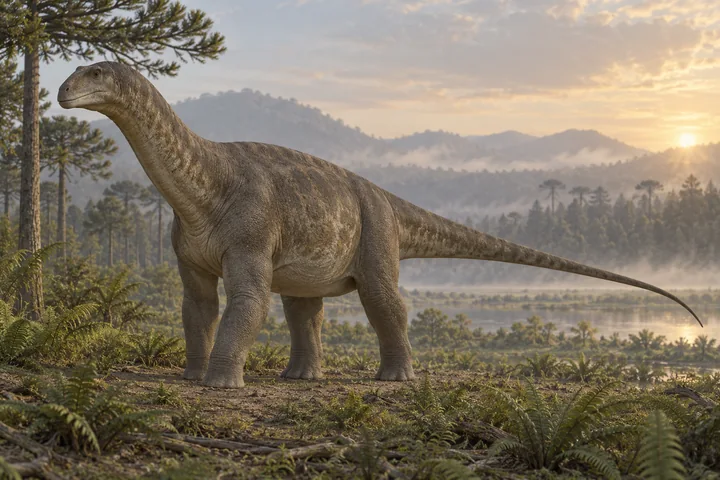
Isisaurus colberti
Isisaurus was an Indian titanosaur whose partial skeleton preserves distinctive neck vertebrae, shoulders and forelimbs.
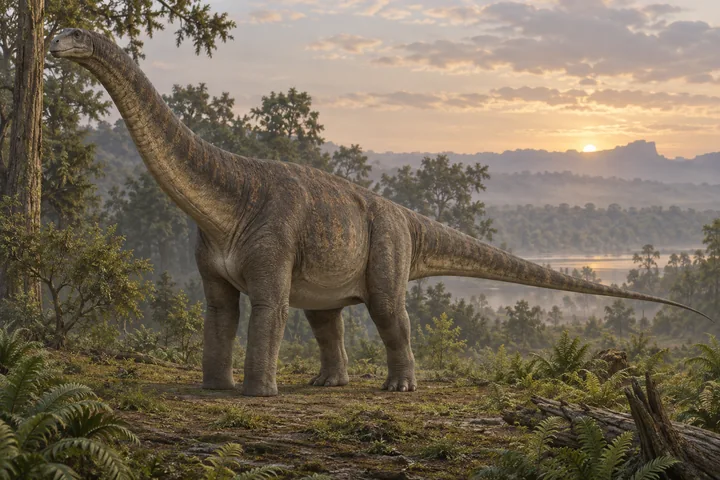
Malawisaurus dixeyi
Malawisaurus was a plant-eating titanosaur from Malawi, known from skull elements, vertebrae, limb bones and dermal armor.
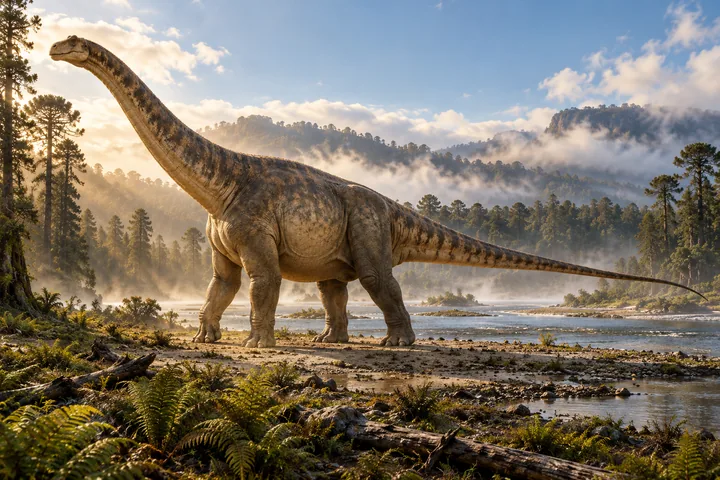
Argentinosaurus huinculensis
Argentinosaurus huinculensis was an enormous Late Cretaceous plant-eating titanosaur from Argentina. Its fragmentary remains reveal great scale while leaving its complete proportions uncertain.