
Length
InferredAbout 35 m (museum reconstruction)
The museum gives this approximate full-body estimate while emphasizing incomplete remains. It is not a measured complete skeleton or adult population range. [D1]
EXHIBIT 53
Argentinosaurus huinculensis
A giant known from fragments, with no skull yet found.
TWO WAYS TO PICTURE THE PAST
Compare the evidence with the familiar movie image. The illustrations are not to a shared scale.

The artist identifies this reconstruction as Argentinosaurus. It is used as a genus-level illustration alongside the Argentinosaurus huinculensis facts, rather than a species-identified specimen restoration. Fossil-informed anatomy: Enormous quadrupedal titanosaur with massive legs, long neck and tail; skull and complete proportions inferred from relatives, without invented ornament. The taxon is known from incomplete remains; skull, neck, tail and many limb proportions are reconstructed. Colour, soft tissue and any integument details are artistic hypotheses; no accuracy warning appears on this file page. [1] [2]
Argentinosaurus TD.png — TotalDino. CC BY 4.0. Remote source artwork displayed without additional cropping; Wikimedia supplies any display-size derivative.
Scientific picture served by Wikimedia · internet connection required.
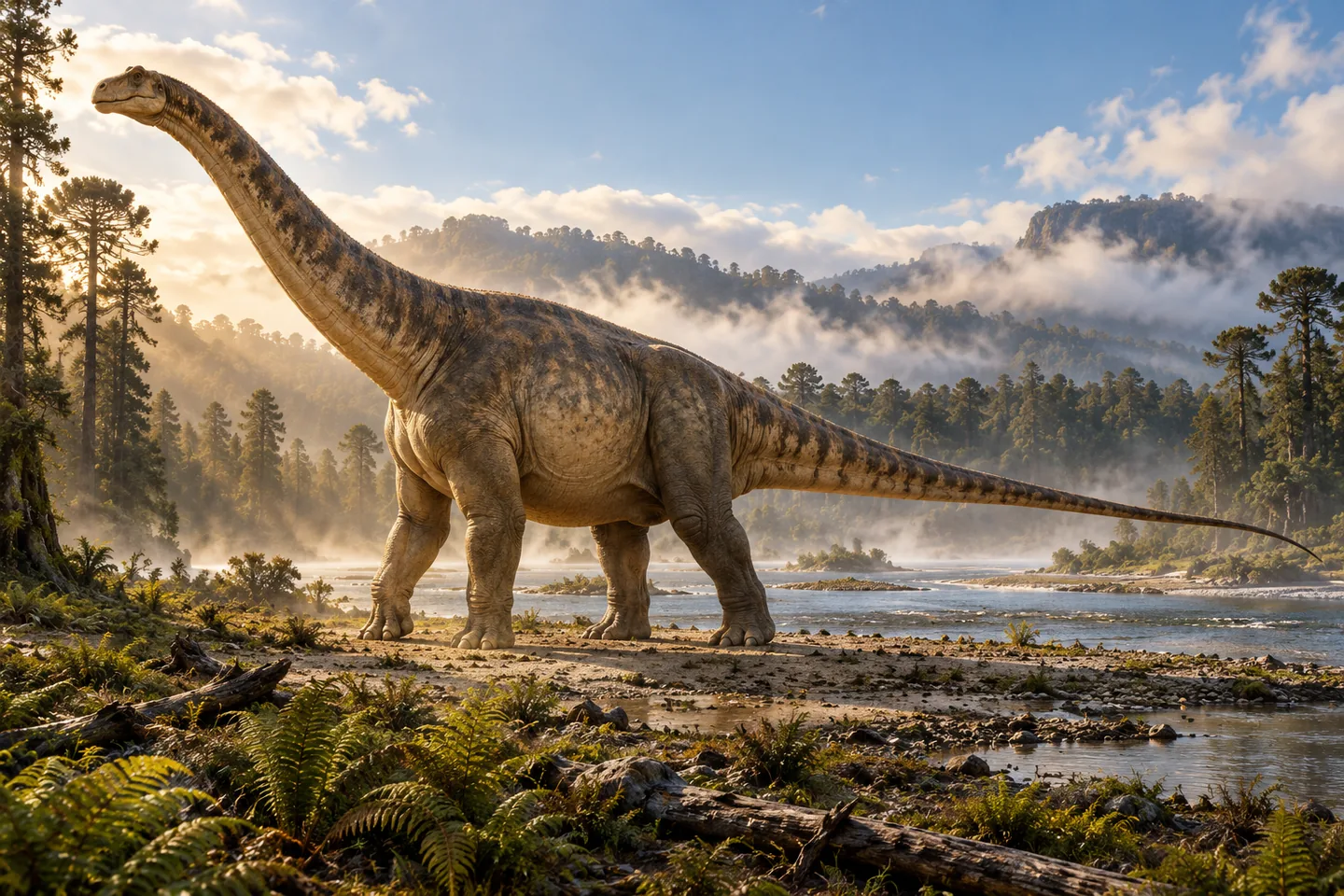
Cinematic giant Argentinosaurus on four massive legs with a long neck and tail; small inferred head, restrained speculative skin and no asserted exact dimensions. Dramatic lighting, surface detail and scenery are artistic choices. This is an original cinema-inspired picture, rather than a frame from a film or a documented fossil locality.
Original artwork · artistic interpretation.
Scientific view: credited paleoart interpreting fossil evidence, served online by Wikimedia. Movie-style view: Original artistic interpretation. Colors, soft tissues and settings involve reconstruction.
MEET THE ANIMAL
Argentinosaurus was a giant plant-eating dinosaur from Late Cretaceous Argentina. It belonged to the titanosaurs, a group of long-necked sauropods that walked on four legs. Its impressive size is reconstructed from incomplete remains, rather than measured along a complete fossil body. That distinction matters especially for such a large animal, whose missing parts strongly influence a restored outline. [D2]
Researchers investigating its movement scanned a reconstructed skeleton at the Carmen Funes Museum. The mount supplied a three-dimensional body framework for computer modeling, but it incorporated restored parts. A mounted animal can be useful for testing ideas without becoming a complete original skeleton. Calculating mass also requires estimates of the flesh around the bones, adding another layer of assumptions. [S1]
The resulting simulations explored whether an enormous four-legged animal could produce a workable walking cycle. Successful modeled movement depended on limits imposed on its joints; some alternative joint settings failed to produce stable walking. These results support possible movement under particular assumptions. They cannot tell us the exact speed, footfall pattern or route followed by an actual Argentinosaurus millions of years ago. [S1]
PREHISTORIC ANIMAL DOSSIER
The animal, the evidence, and the questions still open.
Argentinosaurus is known from giant vertebrae, ribs, sacral material and limb remains rather than a complete skeleton. Its remarkable scale is clear, while full-body proportions and mass remain difficult to reconstruct.
Profile scope: Species: Argentinosaurus huinculensis; full-body size is reconstructed from fragmentary remains.
Source supported identifies a description documented by the cited source. Inferred marks a reconstruction or functional estimate. Debated marks competing interpretations. Not established means the sources reviewed for this dossier do not support a firm conclusion; it does not mean a behavior never occurred.
A size reference is an estimate, not a population range. Nesting evidence does not by itself establish courtship, mate choice, or lifelong pairing.
About 35 m (museum reconstruction)
The museum gives this approximate full-body estimate while emphasizing incomplete remains. It is not a measured complete skeleton or adult population range. [D1]
About 70 tonnes (museum reconstruction)
Mass depends strongly on assumed body proportions and tissues. The museum stresses uncertainty; this single estimate is not a settled species-wide value. [D1]
Plant eater; precise menu unresolved
Herbivory follows its sauropod interpretation. Specific teeth, gut contents or foods are not established in this dossier from the fragmentary skeleton. [D2]
Late Cretaceous Neuquén fossil localities
The museum records remains from Neuquén Province, Argentina. The reviewed profiles do not establish a preferred local habitat. [D1]
Four-legged terrestrial reconstruction
The museum reconstructs a quadrupedal titanosaur. Gait and travel speed are not established by the reviewed sources. [D2]
Giant vertebrae, ribs, sacrum and limb remains
These preserved elements support exceptional size. Much of the neck, head and tail in a whole-body illustration requires reconstruction. [D1]
Not established here
The reviewed sources do not establish nest structure, incubation or parental care for Argentinosaurus huinculensis.
Not established here
The reviewed sources do not establish a courtship sequence or mating system for Argentinosaurus huinculensis.
Not established here
The reviewed sources do not establish usual group size or lasting social organization for Argentinosaurus huinculensis.
Sources and inspection notes for the claims in this profile.
THE STORY IN THE FOSSILS
Argentinosaurus remains were discovered near Plaza Huincul in Neuquén Province. Known pieces include leg bones, vertebrae, ribs and part of the sacrum. The Museo de La Plata describes it as a quadrupedal titanosaur with strong, massive legs, but notes that no skull has been found. [1] [2]
The Natural History Museum gives about 35 metres and 70 tonnes as reference estimates, while stressing the difficulty of calculating size from fragmentary remains. Reconstructing the whole animal requires comparison with more complete relatives, whose neck, tail and body proportions may differ. [1]
We have not established a comparable adult total-length estimate for this taxon in this draft. Specimen measurements in the text describe those individuals. The cited dates are approximately 97–90 million years ago. Unknown does not mean zero.
Sources and evidence notes for this exhibit.
KEEP EXPLORING
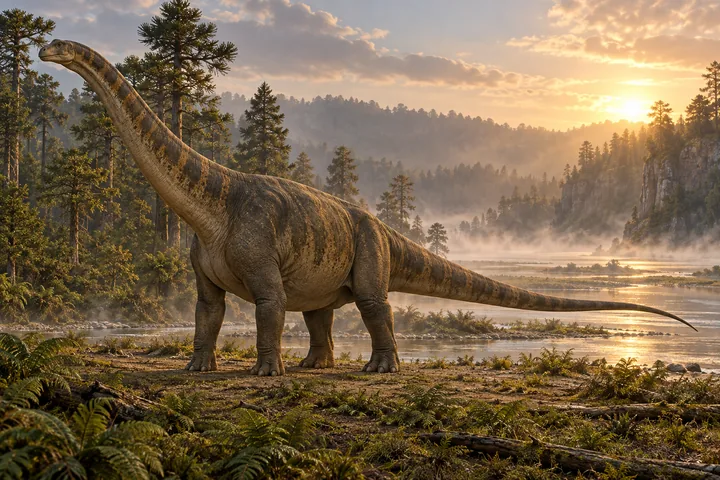
Dreadnoughtus schrani
An exceptionally complete giant that was still growing.
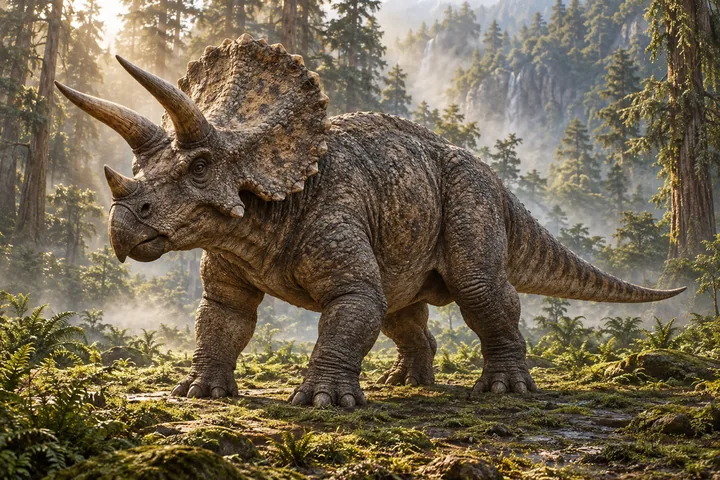
Triceratops horridus
Three horns, a broad frill, and a plant-eater beneath the formidable silhouette.
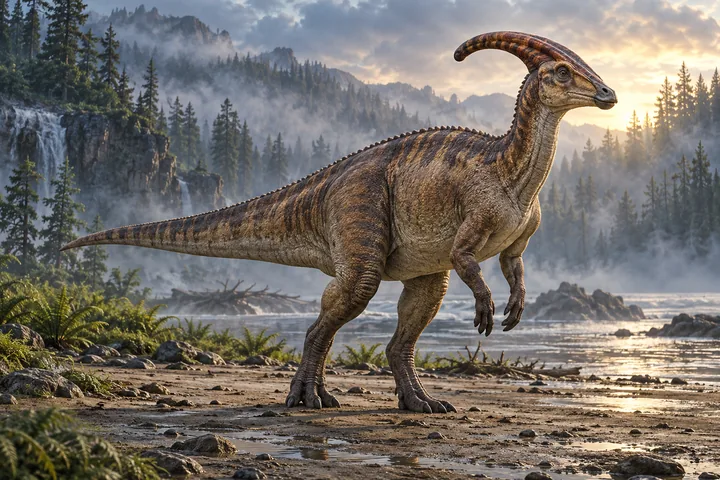
Parasaurolophus walkeri
A hollow crest and a skeleton that records an injured animal's life.