
Body length
Not establishedNot established here
No defensible total-length interval adopted. The 2023 humerus comparison permits Deinonychus-like size or a smaller animal with relatively longer arms; neither establishes an adult range. [D2]
EXHIBIT 259
Dineobellator notohesperus
Dinosaur
A New Mexico dromaeosaur whose arm bones preserve feather-attachment evidence. [3]
TWO WAYS TO PICTURE THE PAST
Compare the evidence with the familiar movie image. The illustrations are not to a shared scale.
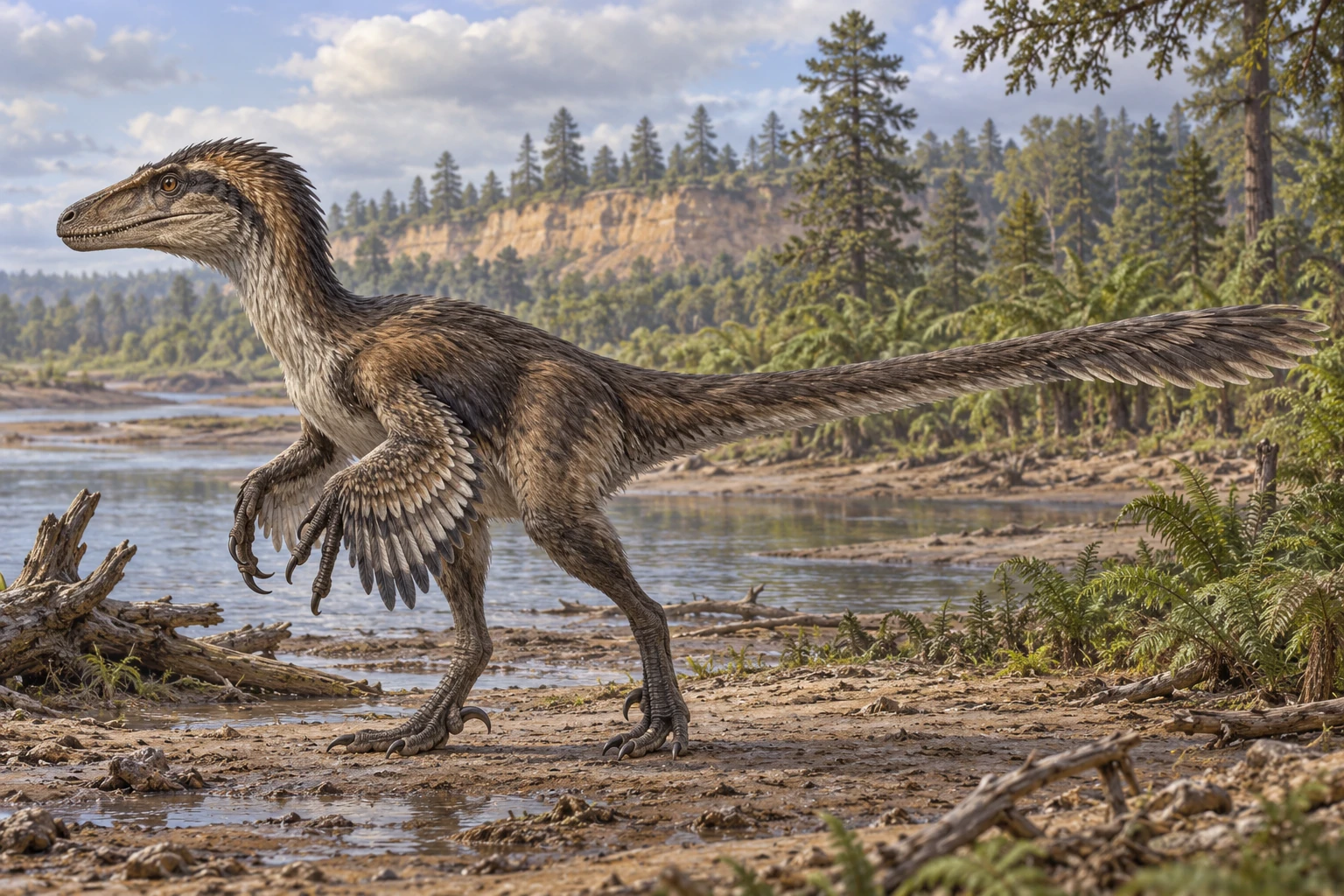
An illustrative reconstruction. Compare its anatomy with the evidence and limitations in the dossier. [1]
Source-informed reconstruction. Appearance evidence [1]. Original illustration; missing anatomy, coloration and scenery include interpretation.
Fossils constrain this life reconstruction. Missing anatomy, coloration and the environmental scene include interpretation; the dossier explains the evidence limits.
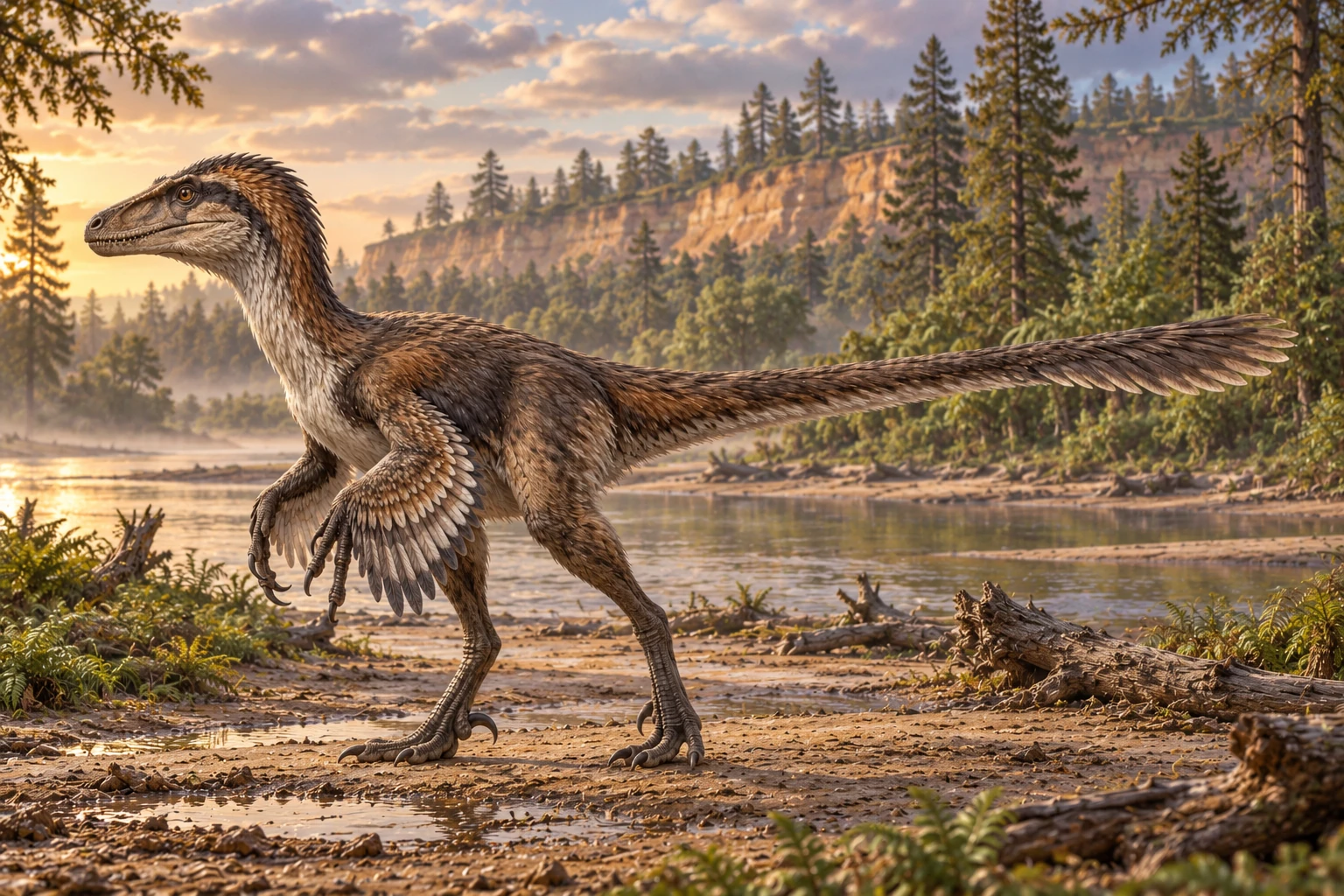
An illustrative reconstruction. Compare its anatomy with the evidence and limitations in the dossier. Lighting, coloration and scenery are artistic choices. This image does not document a fossil locality or behavior.
Original artwork · artistic interpretation.
Scientific view: source-informed reconstruction, credited paleoart or specimen-based imagery. Movie-style view: Original artistic interpretation. Reconstructions involve uncertainty.
MEET THE ANIMAL
Dineobellator was a feathered dinosaur from what is now New Mexico. Researchers found small bumps on its forearm bone where large feathers attached. This is a useful clue even though the feathers themselves are missing. Its fossil therefore supports a feathered reconstruction, while leaving the colors and many details of the plumage uncertain. [D3]
The animal belongs to the dromaeosaur group, which includes several familiar clawed predators. Its teeth, arm bones, claws and tail bones helped scientists identify a distinct species. The original discovery contains only part of one skeleton, so a complete drawing requires comparisons with relatives. It does not prove a particular hunting scene, a favorite prey animal or coordinated pack hunting. [D1]
A later examination revised some bone identifications and reconsidered its size. Its upper arm resembles that of Deinonychus in length, but this could indicate a similarly sized, lighter animal or a smaller one with longer arms. The later family-tree analysis also left its closest subgroup uncertain. Revisiting a fossil can therefore improve the account without making every answer definite. [D2]
PREHISTORIC ANIMAL DOSSIER
The animal, the evidence, and the questions still open.
The 2023 reassessment revised several bone identifications and its family-tree position; the original smaller size comparison remains uncertain. [D2]
Profile scope: The exhibit concerns Dineobellator notohesperus, based on the partial individual SMP VP-2430. [D1]
Source supported identifies a description documented by the cited source. Inferred marks a reconstruction or functional estimate. Debated marks competing interpretations. Not established means the sources reviewed for this dossier do not support a firm conclusion; it does not mean a behavior never occurred.
A size reference is an estimate, not a population range. Nesting evidence does not by itself establish courtship, mate choice, or lifelong pairing.
Not established here
No defensible total-length interval adopted. The 2023 humerus comparison permits Deinonychus-like size or a smaller animal with relatively longer arms; neither establishes an adult range. [D2]
Not established here
No precise mass adopted. Published ecological size classes and comparisons are approximate; missing anatomy prevents a narrow specimen-specific interval. [D2]
Carnivory inferred.
Dromaeosaurid teeth and grasping anatomy support animal feeding; a particular prey species or hunting method is not demonstrated. [D1]
Terrestrial Naashoibito Member, New Mexico.
Sandstone preserved the partial skeleton; competing age estimates caution against assigning a precise death date. [D2]
Two-legged terrestrial movement.
Tail and limb anatomy suggest maneuverability, without direct evidence of speed or coordinated hunting. [D3]
Feather attachments and distinctive arm, claw and tail bones.
Ulnar quill knobs support forearm feathers; missing plumage, most skull and complete foot anatomy are reconstructed comparatively. [D1]
Not established here
No nest or eggs assigned in reviewed material. The report's nest illustration is a restoration; the excavated partial individual does not establish nesting or parenting. [D3]
Not established here
No supported mating display. Bone injuries and feather attachments do not identify sex-specific appearance or a courtship ritual. [D3]
Not established here
Everyday social organization remains unresolved. A damaged claw was interpreted as possible combat evidence, but does not prove pack living, cooperative hunting or a specific opponent. [D1]
Sources and inspection notes for the claims in this profile.
THE STORY IN THE FOSSILS
Tiny attachment bumps on the forearm connect an incomplete fossil to an important living feature: large feathers anchored to the bone. Their presence does not preserve the feather color or the entire wing outline. [3]
Re-examining a previously described skeleton can change interpretations without requiring a new name. The later study reassigned uncertain fragments and considered alternatives to the original size comparison. [2]
The dossier identifies the scope of each reference estimate. A mount, an individual fossil and a species-wide adult range are different measurements. Comparison metrics remain unavailable where adult scope has not been established. Unknown does not mean zero.
Sources support the stated claims and scopes. Refer to the evidence notes for uncertainty.
KEEP EXPLORING
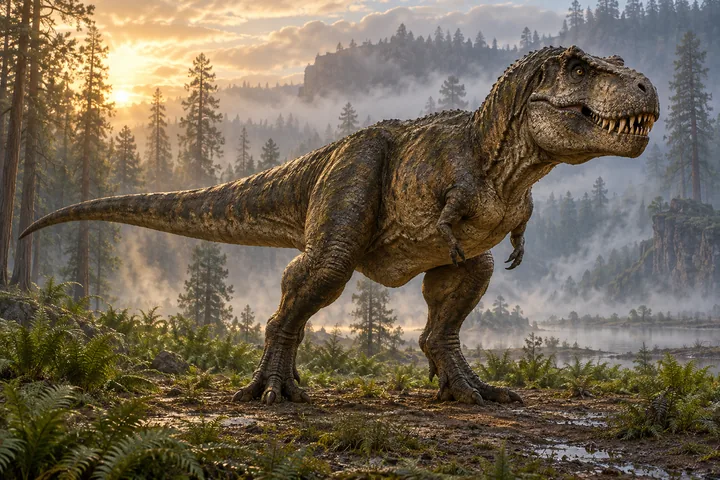
Tyrannosaurus rex
Tyrannosaurus rex was a large meat-eating dinosaur from the final part of the Cretaceous in western North America. Fossil teeth, bite marks and skeletons reveal a powerful animal whose behaviour still invites questions.
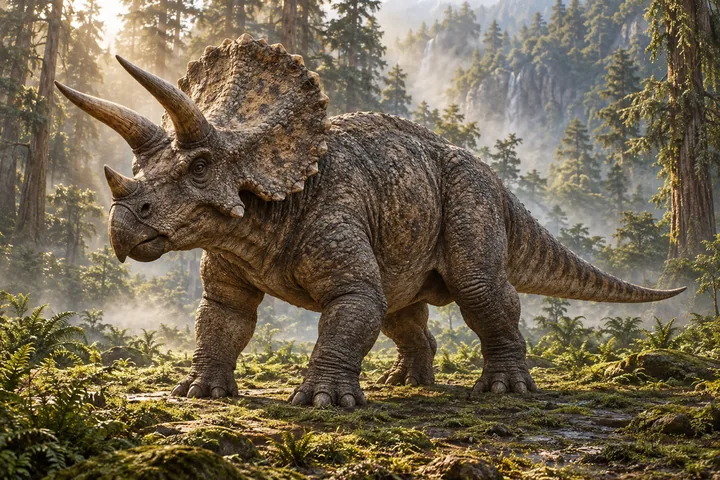
Triceratops horridus
Triceratops horridus was a horned dinosaur of the Late Cretaceous. Skin impressions attributed to this species reveal scales, while skulls and their positions in rock layers help researchers distinguish it from the later Triceratops prorsus.
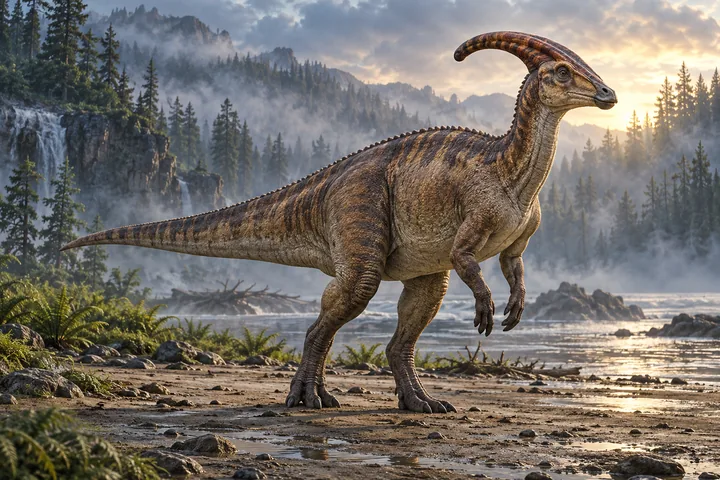
Parasaurolophus walkeri
Parasaurolophus walkeri was a crested duck-billed dinosaur from Late Cretaceous Alberta. Its famous Royal Ontario Museum skeleton preserves both an elongated tubular crest and healed injuries.