
Length
InferredCould exceed 6.7 m (model)
E. heinrichi size is scaled from whorls and a juvenile skull; no complete giant body was measured. [D1]
EXHIBIT 249
Edestus
Prehistoric fish
A Pennsylvanian cartilaginous fish with opposing curved tooth blades along the jaw midlines. [1]
TWO WAYS TO PICTURE THE PAST
Compare the evidence with the familiar movie image. The illustrations are not to a shared scale.
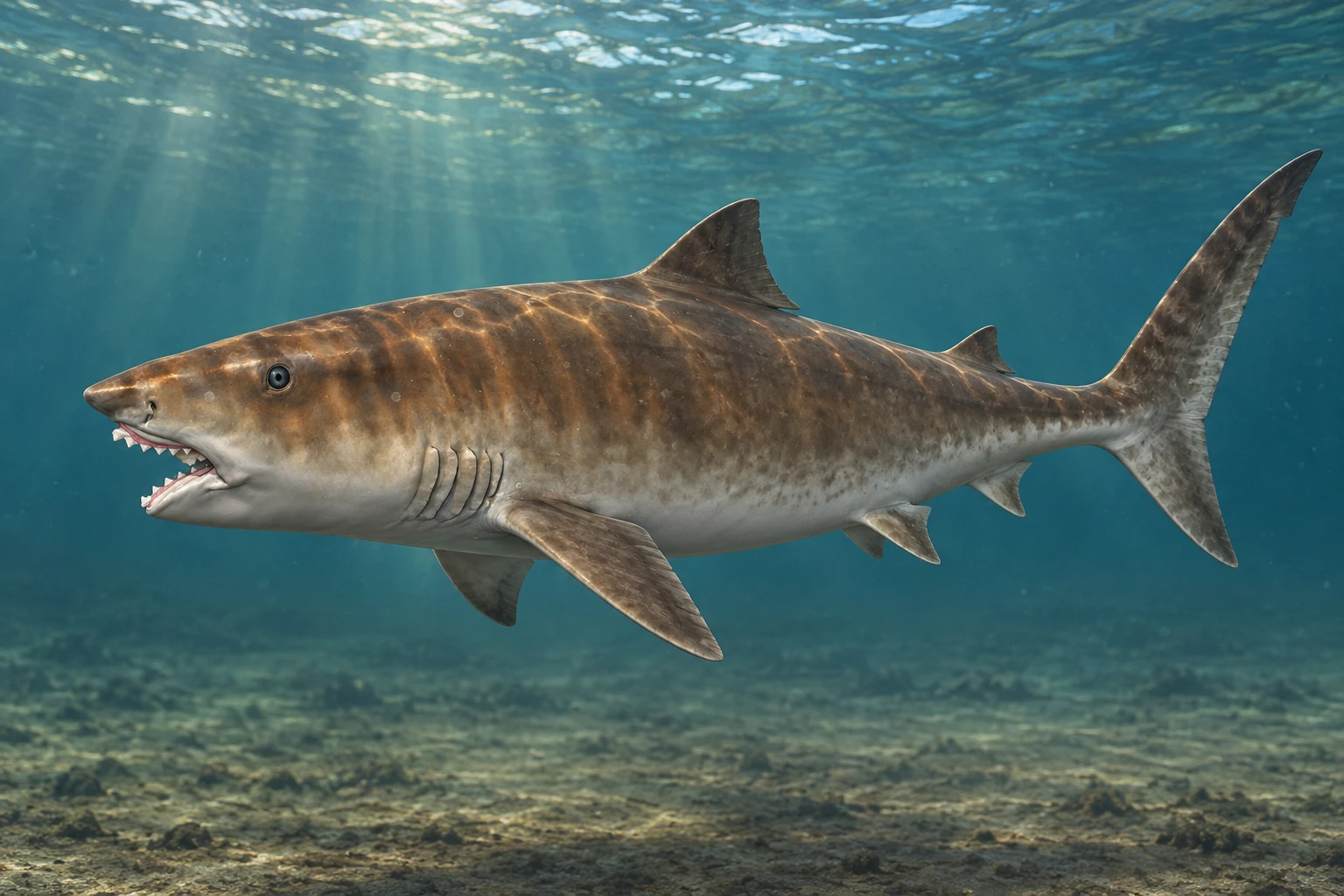
An illustrative reconstruction. Compare its anatomy with the evidence and limitations in the dossier. [1]
Source-informed reconstruction. Appearance evidence [1]. Original illustration; missing anatomy, coloration and scenery include interpretation.
Fossils constrain this life reconstruction. Missing anatomy, coloration and the environmental scene include interpretation; the dossier explains the evidence limits.
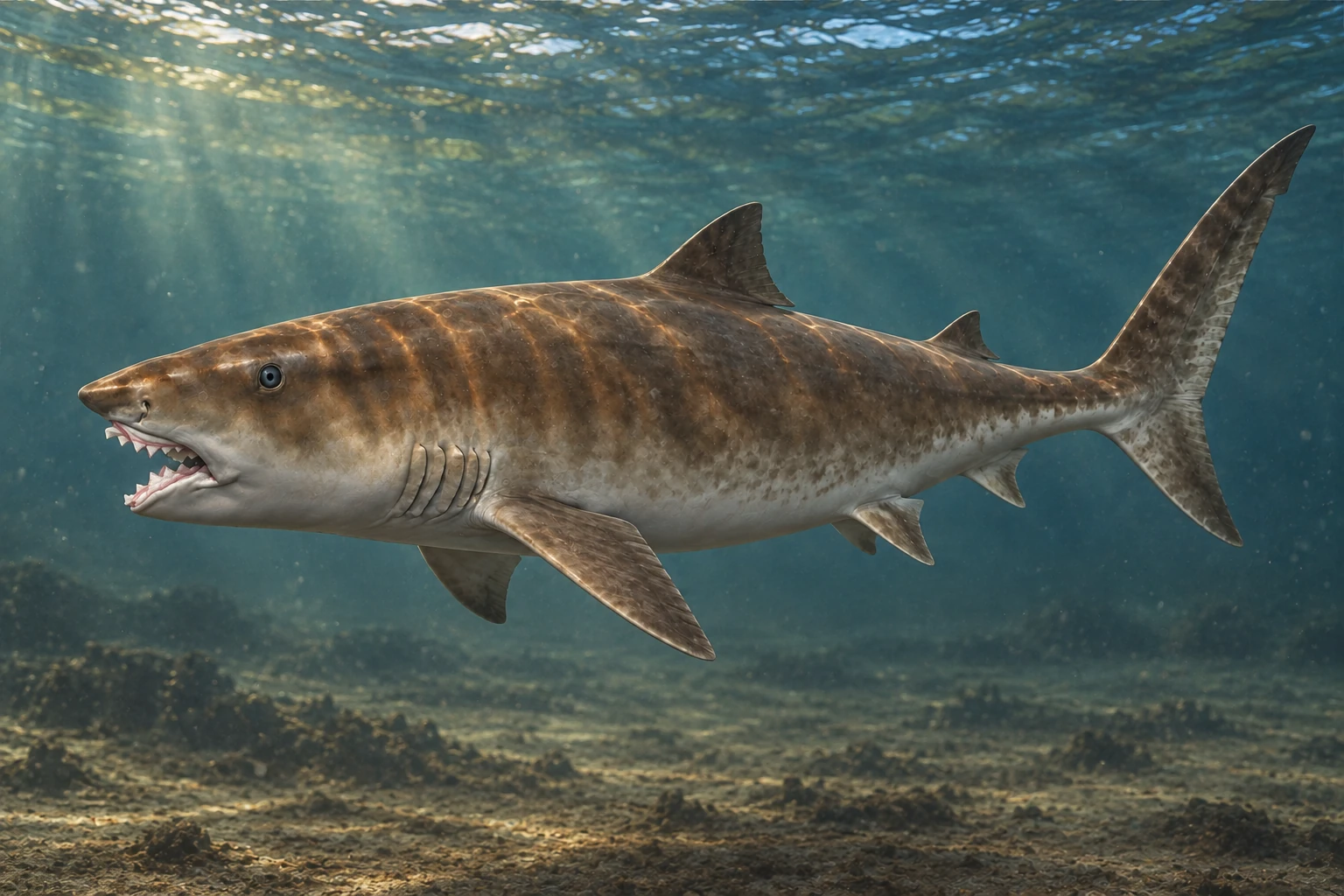
An illustrative reconstruction. Compare its anatomy with the evidence and limitations in the dossier. Lighting, coloration and scenery are artistic choices. This image does not document a fossil locality or behavior.
Original artwork · artistic interpretation.
Scientific view: source-informed reconstruction, credited paleoart or specimen-based imagery. Movie-style view: Original artistic interpretation. Reconstructions involve uncertainty.
MEET THE ANIMAL
Edestus was a prehistoric cartilaginous fish with a blade of teeth along the middle of each jaw. The lower blade curved more strongly than the upper one. As it grew, teeth were lost from the front, giving it a different dental system from the permanent spiral of Helicoprion. [D1]
A museum team studied its jaws in three dimensions. Their reconstruction suggested that closing the lower jaw also pulled its blade backward, helping it slice food between opposing teeth. That explanation comes from modeling the bones and teeth; nobody has watched a living Edestus take a bite. [D2]
Tiny marks offer another clue. Researchers studied scratches on a tooth of Edestus minor and considered a vertical slashing movement. They also explained that other kinds of abrasion could produce wear. A small fossil detail can support an idea while still leaving competing explanations possible. [D3]
The best feeding models favor soft animal prey, but the reviewed evidence does not give us a complete menu or a body-mass estimate. Its strange jaws are much better known than its reproduction or social life. We keep those gaps visible when reconstructing the animal. [D4]
PREHISTORIC ANIMAL DOSSIER
The animal, the evidence, and the questions still open.
Tooth wear and three-dimensional jaw models offer competing tests of how the unusual dental blades worked. [D3] [D2]
Profile scope: Genus-wide exhibit; juvenile E. heinrichi skull FMNH PF2204 informs the head, while larger body estimates use dental scaling. [D1]
Source supported identifies a description documented by the cited source. Inferred marks a reconstruction or functional estimate. Debated marks competing interpretations. Not established means the sources reviewed for this dossier do not support a firm conclusion; it does not mean a behavior never occurred.
A size reference is an estimate, not a population range. Nesting evidence does not by itself establish courtship, mate choice, or lifelong pairing.
Could exceed 6.7 m (model)
E. heinrichi size is scaled from whorls and a juvenile skull; no complete giant body was measured. [D1]
Not established here
The reviewed dental and jaw models do not establish body mass. [D4]
Animal prey
Opposing serrated midline blades support cutting; models favor soft-bodied prey rather than identify a preserved meal. [D4]
Marine coastal and estuarine settings
The 2019 revision places Edestus in Pennsylvanian marine coastal and estuarine deposits. [D1]
Swimming inferred; body incomplete
Feeding interpretations depend on reconstructed motion. The isolated tooth does not preserve a complete swimming animal. [D3]
Opposing midline tooth blades
One blade occupies each jaw. The lower blade curves more strongly; teeth were shed from the front as new teeth developed. [D1]
Not established here
Focused searches and reviewed tooth studies provide no direct pregnancy, egg or birth evidence. [D3]
Not established here
The reviewed tooth evidence cannot establish courtship or mating displays. [D3]
Not established here
The reviewed revision establishes identities, not schooling, pair bonds or parental care. [D1]
Sources and inspection notes for the claims in this profile.
THE STORY IN THE FOSSILS
An isolated tooth can supply evidence at a much smaller scale than a skull. A study of Edestus minor found directional wear scratches and considered how they might form. The proposed vertical slashing motion is one interpretation; abrasion outside feeding is another possibility. Wear therefore tests a hypothesis without turning it into a directly observed movement. [3]
A museum and virtual laboratory partnership examined jaws and tooth blades in three dimensions. The resulting reconstruction instead emphasizes the lower blade moving backward while closing against the upper blade. These approaches ask different questions of different fossils, so the exhibit distinguishes their interpretations rather than presenting one dramatic attack scene as proven. [2]
The dossier identifies the scope of each reference estimate. A mount, an individual fossil and a species-wide adult range are different measurements. Comparison metrics remain unavailable where adult scope has not been established. Unknown does not mean zero.
Sources support the stated claims and scopes. Refer to the evidence notes for uncertainty.
KEEP EXPLORING
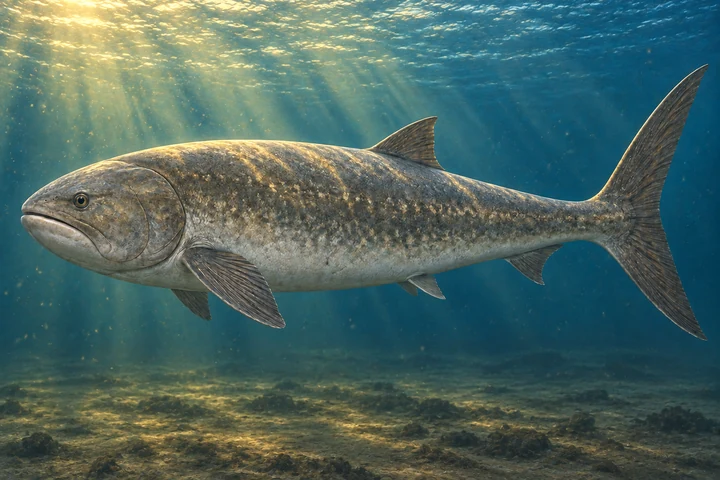
Leedsichthys problematicus
Prehistoric fish
A giant ray-finned fish whose filtering apparatus and incomplete skeleton make size reconstruction a careful puzzle.
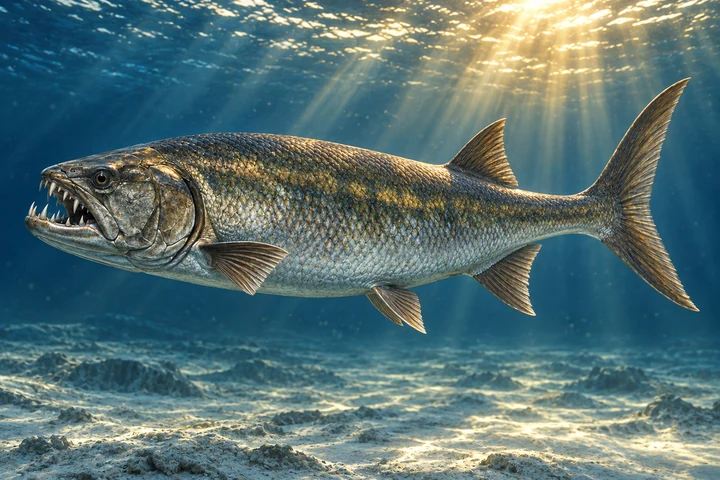
Xiphactinus audax
Prehistoric fish
A large toothed ray-finned fish, with a famous fossil preserving another fish inside it.
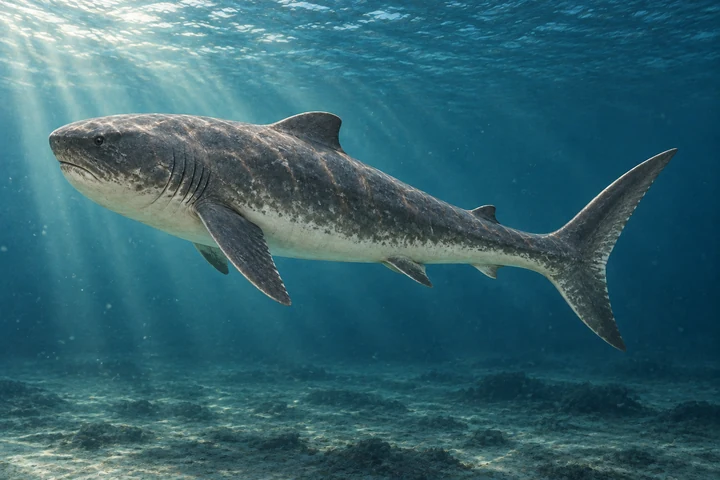
Ptychodus
Prehistoric fish
An extinct crushing-toothed shark whose articulated Mexican fossils reveal a streamlined swimming body.