

Length
InferredLarge genus references around6 m
The2012 paper summarizes large specimens. MUZ3912 is instead modeled at2.761–3.012 m standard length, with no secure maturity assessment. [D2] [D1]
EXHIBIT 233
Xiphactinus audax
Prehistoric fish
A large toothed ray-finned fish, with a famous fossil preserving another fish inside it. [3]
TWO WAYS TO PICTURE THE PAST
Compare the evidence with the familiar movie image. The illustrations are not to a shared scale.
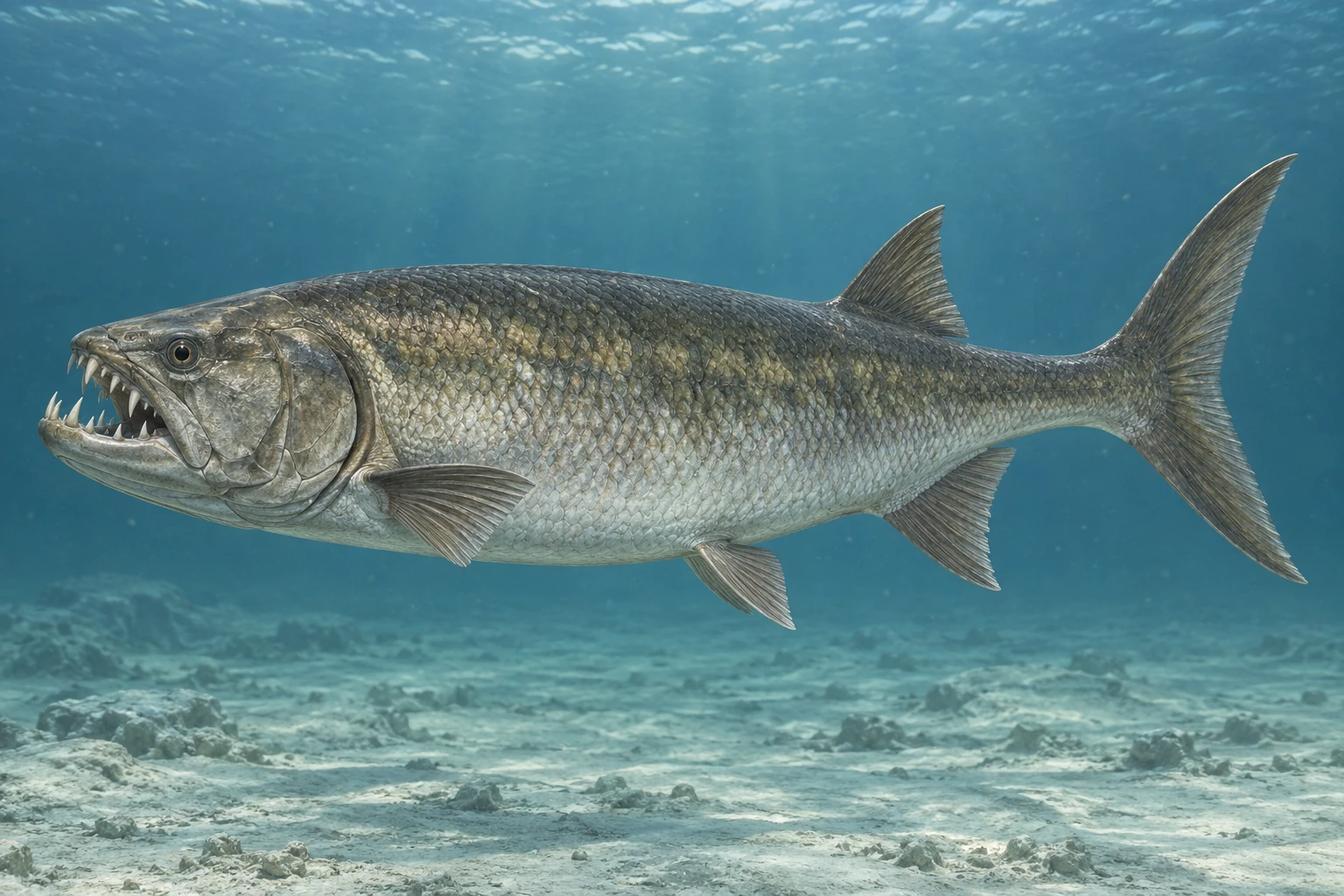
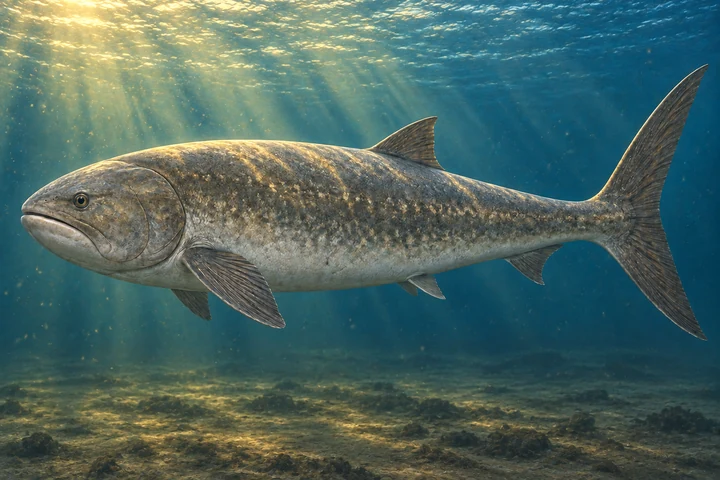
An illustrative reconstruction. Compare its anatomy with the evidence and limitations in the dossier. [1]
Source-informed reconstruction. Appearance evidence [1]. Original illustration; missing anatomy, coloration and scenery include interpretation.
Fossils constrain this life reconstruction. Missing anatomy, coloration and the environmental scene include interpretation; the dossier explains the evidence limits.
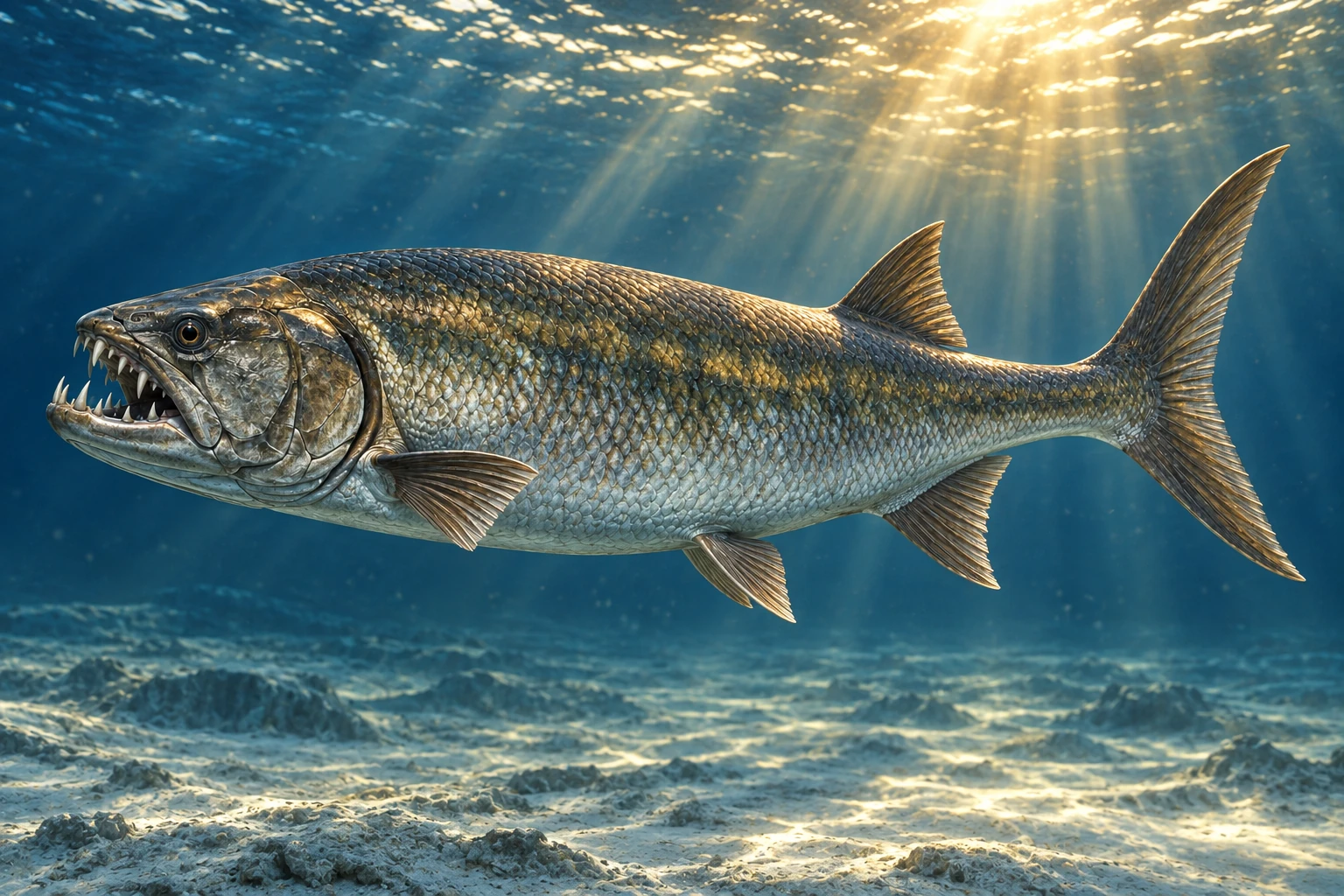
An illustrative reconstruction. Compare its anatomy with the evidence and limitations in the dossier. Lighting, coloration and scenery are artistic choices. This image does not document a fossil locality or behavior.
Original artwork · artistic interpretation.
Scientific view: source-informed reconstruction, credited paleoart or specimen-based imagery. Movie-style view: Original artistic interpretation. Reconstructions involve uncertainty.
MEET THE ANIMAL
Xiphactinus was a ray-finned fish with large teeth, rather than a marine reptile or dinosaur. Mexican specimen MUZ3912 preserves enough head and fin anatomy for identification as X. audax. Other incomplete fossils can belong to the genus without allowing the same precise species identification. [D1]
One famous museum specimen contains a Gillicus fish inside it. This gives direct evidence that Xiphactinus swallowed fish. The fossil does not film the hunt or establish exactly why either animal died, so a dramatic account of a burst stomach should not be mistaken for a directly observed event. [D3]
A Venezuelan specimen comes from Cenomanian marine rocks of the La Luna Formation. Its authors identify only Xiphactinus, keeping the narrower species question open. This is an example of how an incomplete skull and vertebrae can still expand knowledge of a genus without answering every question about it. [D2]
Names also have histories. Museum records describe Portheus molossus as a historical name for X. audax, while older literature discusses a priority problem involving Polygonodon. Keeping those overlapping names together prevents the same animals being counted again as completely separate additions to a collection. [D3] [D5]
PREHISTORIC ANIMAL DOSSIER
The animal, the evidence, and the questions still open.
Teeth and fin rays help identify fragmentary fossils. A detailed comparison can support a name without supplying a complete body or an exact adult life stage. [D1]
Profile scope: Genus exhibit represented by X. audax; Mexican MUZ3912 is specifically identified, whereas Venezuelan MTG070 is referred only to the genus. [D1]
Source supported identifies a description documented by the cited source. Inferred marks a reconstruction or functional estimate. Debated marks competing interpretations. Not established means the sources reviewed for this dossier do not support a firm conclusion; it does not mean a behavior never occurred.
A size reference is an estimate, not a population range. Nesting evidence does not by itself establish courtship, mate choice, or lifelong pairing.
Large genus references around6 m
The2012 paper summarizes large specimens. MUZ3912 is instead modeled at2.761–3.012 m standard length, with no secure maturity assessment. [D2] [D1]
Not established here
The specimen account scales length from a partial head; it does not provide an adopted comparable adult mass estimate. [D1]
Fish eating directly supported
The museum fossil preserves Gillicus inside Xiphactinus. It does not independently establish rupture, choking or the exact cause of death. [D3]
Cretaceous marine waters
MTG070 comes from Cenomanian La Luna marine rocks of Venezuela and is identified only to genus. [D2]
Ray-finned fish swimmer inferred
Preserved pectoral rays and a streamlined fish body support swimming; precise speed is not established here. [D1]
Irregularly sized conical teeth
Smooth, uncarinated teeth help identify Mexican MUZ3912 as X. audax; this is a specimen-based distinction. [D1]
Not established here
The reviewed fossil atlas does not document eggs, embryos or a spawning site for X. audax. [D4]
Not established here
The Venezuelan material preserves anatomy and locality rather than a mating display or breeding pair. [D2]
Not established here
A predator and swallowed prey are not evidence of a school, cooperative hunting or parental association. [D3]
Sources and inspection notes for the claims in this profile.
THE STORY IN THE FOSSILS
The Sternberg fossil contains Gillicus inside Xiphactinus, directly supporting fish feeding while leaving the fatal event unresolved. [3]
A Venezuelan skull-and-vertebra specimen extends the known occurrence of the genus into South America. Its authors identify Xiphactinus without forcing a species name onto incomplete evidence, demonstrating why genus and species records are different. [2]
The dossier identifies the scope of each reference estimate. A mount, an individual fossil and a species-wide adult range are different measurements. Comparison metrics remain unavailable where adult scope has not been established. Unknown does not mean zero.
Sources support the stated claims and scopes. Refer to the evidence notes for uncertainty.
KEEP EXPLORING
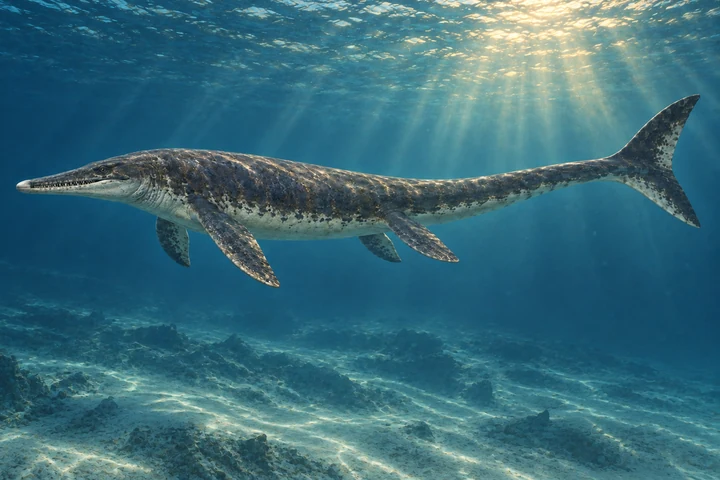
Tylosaurus proriger
Marine reptile
A marine lizard with an elongated adult snout tip, whose fossil identities are still being revised.
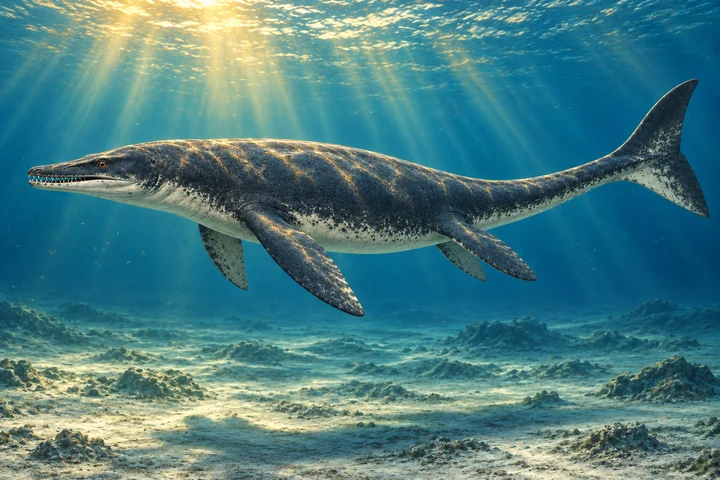
Platecarpus tympaniticus
Marine reptile
A streamlined mosasaur known from an exceptional fossil preserving skin traces and digested fish.
Leedsichthys problematicus
Prehistoric fish
A giant ray-finned fish whose filtering apparatus and incomplete skeleton make size reconstruction a careful puzzle.