
Length
InferredAbout 6 m (museum reference)
Rounded educational reference without specified fossil individual, method or maturity; not a measured adult range. [D1]
EXHIBIT 94
Einiosaurus procurvicornis
Einiosaurus was a Montana horned plant-eater with a distinctive nasal horn curving forward and downward.
TWO WAYS TO PICTURE THE PAST
Compare the evidence with the familiar movie image. The illustrations are not to a shared scale.
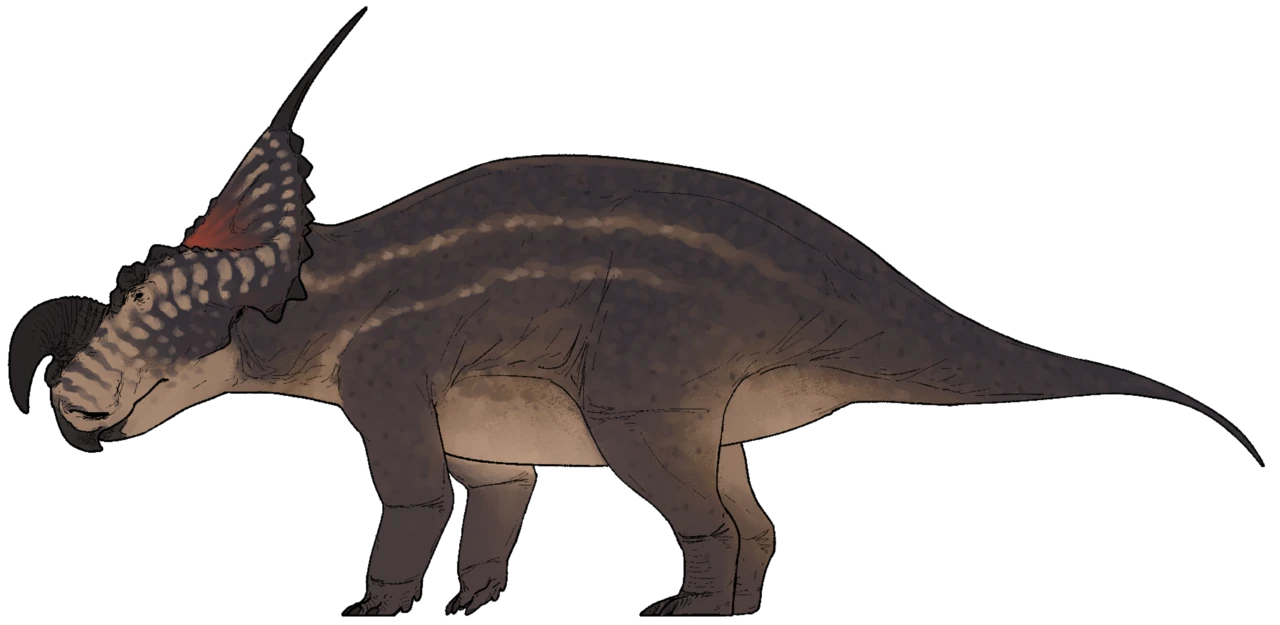
Life reconstruction of Einiosaurus procurvicornis by Connor Ashbridge, using the characteristic adult nasal-horn outline. Colors, patterns and soft tissues are interpretive; ornamentation does not itself establish sex or courtship. [2]
Einiosaurus procurvicornis · Connor Ashbridge. CC BY 4.0. Commons-listed 1280 px preview converted to WebP; smaller responsive copy proportionally resized. Artwork preserved.
Scientific reconstruction is an interpretation; source credit does not certify every anatomical detail.
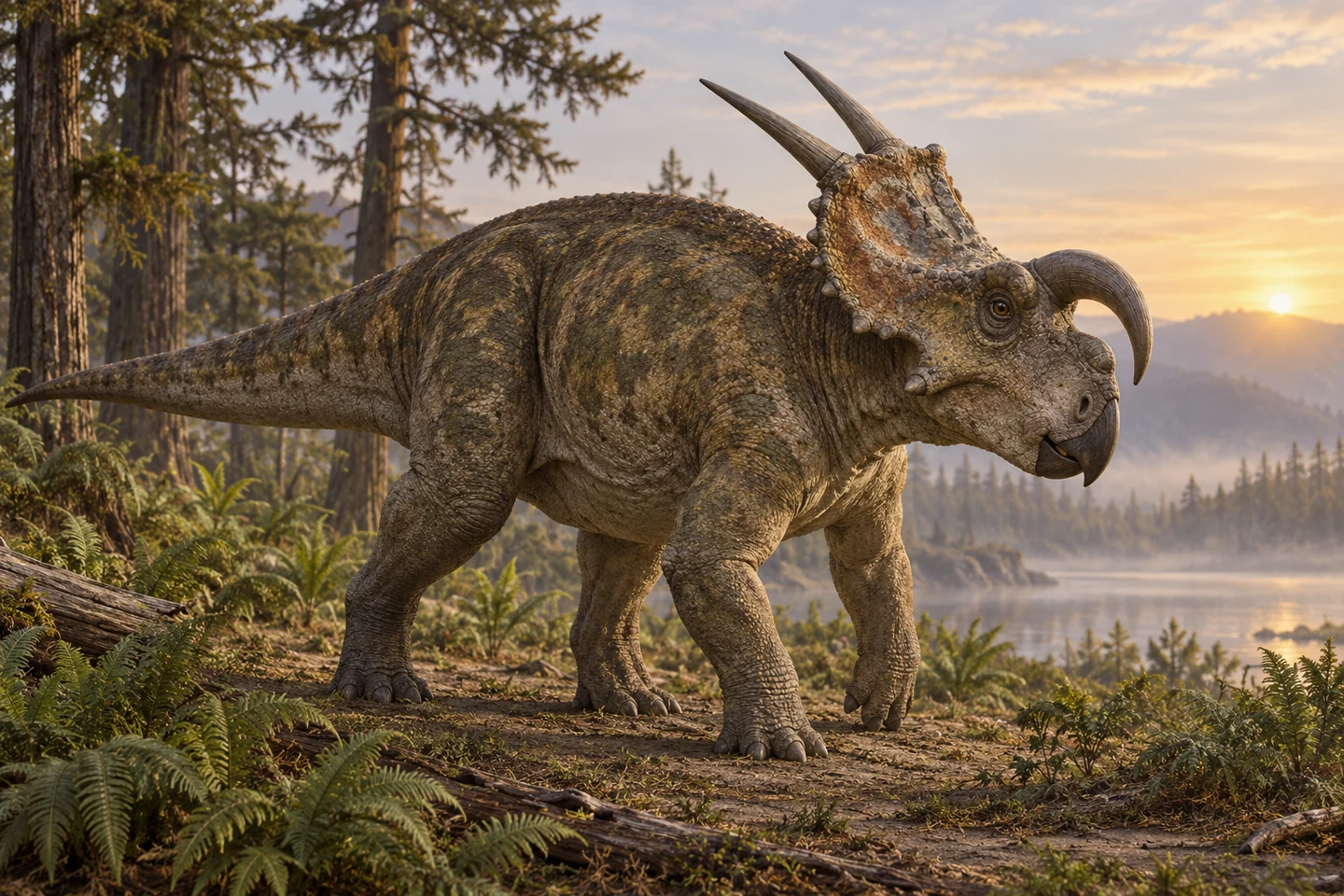
Original cinematic interpretation of Einiosaurus procurvicornis. Coloration, soft tissues and scenery are artistic choices; reconstructed proportions do not establish a measured individual. Lighting, coloration and scenery are artistic choices. This image does not document a fossil locality or behavior.
Original artwork · artistic interpretation.
Scientific view: source-informed reconstruction, credited paleoart or specimen-based imagery. Movie-style view: Original artistic interpretation. Reconstructions involve uncertainty.
MEET THE ANIMAL
Einiosaurus was a plant-eating horned dinosaur from Late Cretaceous Montana. Its most recognizable feature is a nasal horn that curves forward and downward in adult animals. A museum reference of about six metres gives a broad sense of size without identifying a measured adult maximum. Its skull is striking, but recognizing growth stages matters when comparing its ornament. [D1]
Studies of the horn's surface use comparisons with living animals to investigate its covering. The bony horn core supported a hardened outer sheath, so the fossil bone and the complete living horn would not have been identical. This kind of evidence connects a preserved surface with missing soft tissue. It does not reveal an exact display color or a courtship routine. [D4]
Adult skulls also carried paired long frill spikes. Younger individuals differed in ornamentation, meaning that a small horn or a different outline need not identify another species or the opposite sex. Studying those changes helps separate growth from other explanations for variation. Its appearance changed as it matured. [D2]
PREHISTORIC ANIMAL DOSSIER
The animal, the evidence, and the questions still open.
Its fossils let researchers compare changes in skull ornamentation with growth recorded inside limb bones.
Profile scope: Species: E. procurvicornis. Adult skull ornament, subadult development and bonebed tibial histology are kept separate.
Source supported identifies a description documented by the cited source. Inferred marks a reconstruction or functional estimate. Debated marks competing interpretations. Not established means the sources reviewed for this dossier do not support a firm conclusion; it does not mean a behavior never occurred.
A size reference is an estimate, not a population range. Nesting evidence does not by itself establish courtship, mate choice, or lifelong pairing.
About 6 m (museum reference)
Rounded educational reference without specified fossil individual, method or maturity; not a measured adult range. [D1]
Not established here
No independently verified specimen-level mass estimate was established in this review.
Plant-eater
The museum identifies herbivory; exact food plants and seasonal feeding remain unestablished here. [D1]
Montana; Two Medicine Formation
The diagnostic material comes from Late Cretaceous Campanian strata, including the Dino Ridge and Canyon bonebeds. [D2]
Four-legged walking inferred
Limb-bearing bonebed material and the ceratopsid body plan support quadrupedal reconstruction; no speed estimate follows from this review. [D3]
Curved nasal horn; paired long frill spikes
Adult skulls have the forward/downward nasal curve and straight paired frill spikes. Bone-surface comparisons support a cornified horn covering. [D2] [D4]
Possible maturity around 3–5 years
Growth slowdown in 16 bonebed tibiae suggested reproductive maturity. This histological hypothesis does not identify nests, eggs or parental care. [D3]
Not established here
Age-related skull ornamentation and an inferred horn covering do not establish mate choice or a mating system.
Bonebed grouping inferred
Drought-associated assemblages were interpreted as a population. Their juvenile/subadult bias and burial history limit conclusions about lasting herd structure. [D3]
Sources and inspection notes for the claims in this profile.
THE STORY IN THE FOSSILS
Einiosaurus’s nasal horn is especially distinctive in adult skulls. Younger individuals differ in ornamentation, so fossil age must be considered before interpreting every skull difference as a species or sex difference. [2]
Thin sections of limb bones reveal growth lines rather than directly preserved behavior. A proposed maturity age is therefore a life-history inference, while nesting and parental care remain unresolved. [3]
The dossier identifies the scope of each reference estimate. A mount, an individual fossil and a species-wide adult range are different measurements. Comparison metrics remain unavailable where adult scope has not been established. Unknown does not mean zero.
Sources support the stated claims and scopes. Refer to the evidence notes for uncertainty.
KEEP EXPLORING
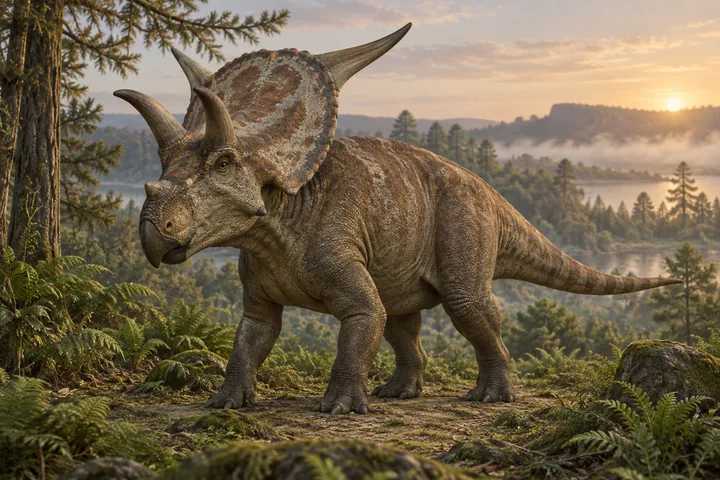
Diabloceratops eatoni
Diabloceratops is known for a horned skull with long brow horns and a pair of prominent rear frill spines.
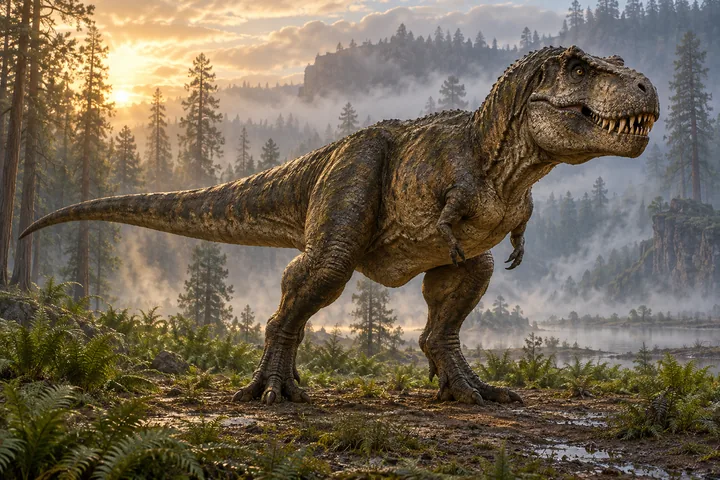
Tyrannosaurus rex
Tyrannosaurus rex was a large meat-eating dinosaur from the final part of the Cretaceous in western North America. Fossil teeth, bite marks and skeletons reveal a powerful animal whose behaviour still invites questions.
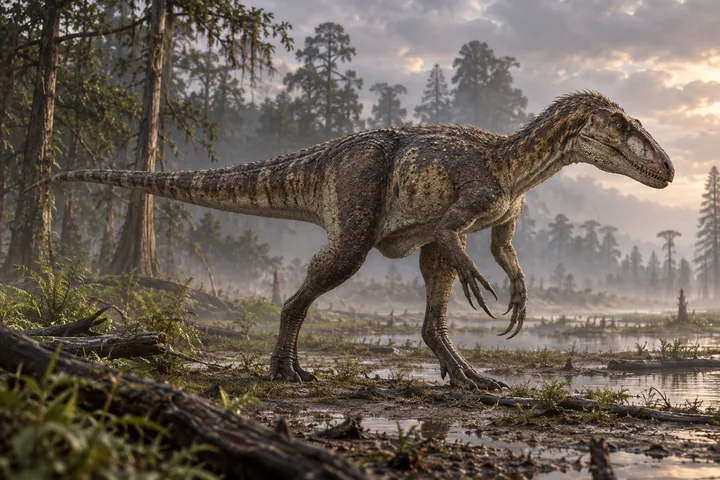
Dryptosaurus aquilunguis
Dryptosaurus was an eastern North American tyrannosauroid with a short upper arm and unusually large hand. Its partial skeleton and changing restorations reveal how evidence and imagination interact.