
Body length
Not establishedNot established here
The type is incomplete and restoration depends on missing parts. Its neck-bone count does not independently measure an intact living animal. [D2]
EXHIBIT 210
Elasmosaurus platyurus
Marine reptile
Elasmosaurus platyurus was a long-necked marine reptile from Kansas. Re-examination of its type skeleton identified seventy-two neck vertebrae. [1]
TWO WAYS TO PICTURE THE PAST
Compare the evidence with the familiar movie image. The illustrations are not to a shared scale.
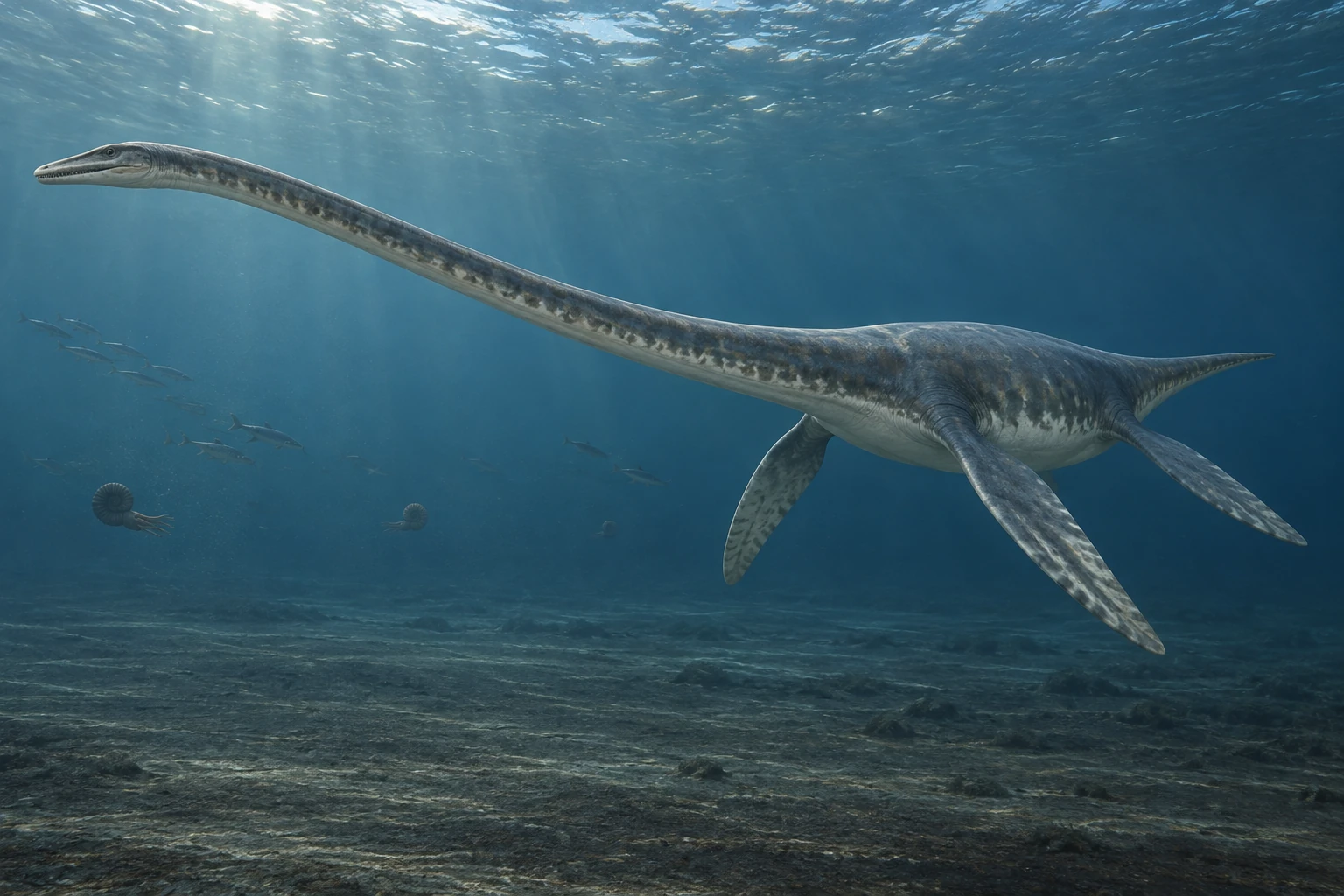
An illustrative reconstruction. Compare its anatomy with the evidence and limitations in the dossier. [1]
Source-informed reconstruction. Appearance evidence [1]. Original illustration; missing anatomy, coloration and scenery include interpretation.
Fossils constrain this life reconstruction. Missing anatomy, coloration and the environmental scene include interpretation; the dossier explains the evidence limits.
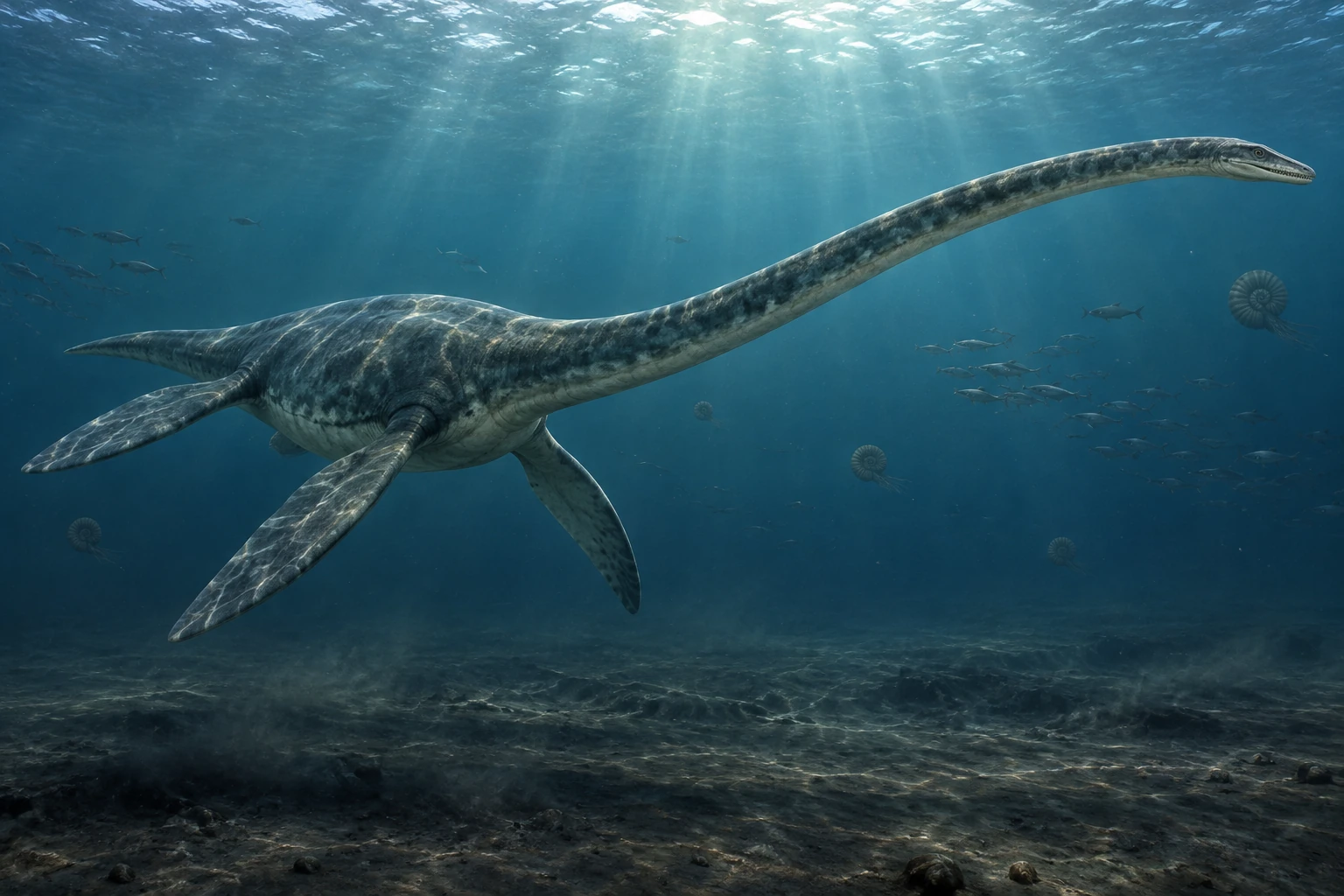
An illustrative reconstruction. Compare its anatomy with the evidence and limitations in the dossier. Lighting, coloration and scenery are artistic choices. This image does not document a fossil locality or behavior.
Original artwork · artistic interpretation.
Scientific view: source-informed reconstruction, credited paleoart or specimen-based imagery. Movie-style view: Original artistic interpretation. Reconstructions involve uncertainty.
MEET THE ANIMAL
Elasmosaurus platyurus lived in the Late Cretaceous sea that covered part of North America. Its famous Kansas skeleton is a marine reptile, not a dinosaur. The standout feature is its extraordinary neck. A careful re-examination counted seventy-two neck vertebrae, or backbone bones. A separated fossil fragment supplied the evidence that corrected an earlier count. [D1]
The type skeleton is incomplete: much of the backbone remains, while only pieces of the skull survive and the originally described limb girdles are lost. Its pointed teeth suggest animal feeding. Those bones help build a reconstruction, but they do not give a complete preserved body, a measured weight, or a record of every meal the animal ate. [D2]
Plesiosaurs had four swimming paddles, and flipper experiments help test how the pairs could work together. Such models are tests of ideas, rather than videos of Elasmosaurus moving. [D3]
A pregnancy fossil in another plesiosaur provides live-birth evidence for the wider group. It does not show this genus nesting, tell us its litter size, or establish how parents treated their young. [D4]
PREHISTORIC ANIMAL DOSSIER
The animal, the evidence, and the questions still open.
The type preserves much of the vertebral column but only parts of the skull, and its originally described limb girdles are now lost. A complete silhouette combines surviving bones and restoration. [D2]
Profile scope: Genus Elasmosaurus; E. platyurus, incomplete holotype ANSP 10081. This genus is not interchangeable with the elasmosaur family or every restored long-necked marine skeleton. [D1]
Source supported identifies a description documented by the cited source. Inferred marks a reconstruction or functional estimate. Debated marks competing interpretations. Not established means the sources reviewed for this dossier do not support a firm conclusion; it does not mean a behavior never occurred.
A size reference is an estimate, not a population range. Nesting evidence does not by itself establish courtship, mate choice, or lifelong pairing.
Not established here
The type is incomplete and restoration depends on missing parts. Its neck-bone count does not independently measure an intact living animal. [D2]
Not established here
Partial cranial material and lost girdles do not supply measured mass. No reproducible individual estimate was adopted. [D2]
Animal feeding inferred from teeth
Jaw fragments bear pointed teeth suited to seizing prey. A specific menu is not established by a meal with this holotype. [D2]
Lower Campanian Western Interior sea
ANSP 10081 came from western Kansas’s marine Sharon Springs Formation. [D1]
Four-paddle swimming reconstructed
Plesiosaur models support propulsion by both pairs, not an Elasmosaurus stroke, speed or habitual neck pose. [D3]
Seventy-two cervical vertebrae
Rediscovered material revised seventy-one to seventy-two; vertebral fusion indicates skeletal maturity, not breeding age. [D1]
Live birth is a broader-group inference
A pregnancy fossil belongs to another plesiosaur. Applying live birth to Elasmosaurus remains comparison, not an observed genus pregnancy. [D4]
Not established here
The plesiosaur synthesis does not establish mating displays or sexual dimorphism for Elasmosaurus. [D5]
Not established here
The synthesis leaves parental care and sociality unresolved; a long neck does not establish schooling or cooperation. [D5]
Sources and inspection notes for the claims in this profile.
THE STORY IN THE FOSSILS
Cope placed the head at the wrong end. The documented correction was Leidy’s, rather than the often repeated attribution to Marsh. [1]
Matching a separated half vertebra to its partner revised the neck count without discovering another animal. [1]
The dossier identifies the scope of each reference estimate. A mount, an individual fossil and a species-wide adult range are different measurements. Comparison metrics remain unavailable where adult scope has not been established. Unknown does not mean zero.
Sources support the stated claims and scopes. Refer to the evidence notes for uncertainty.
KEEP EXPLORING
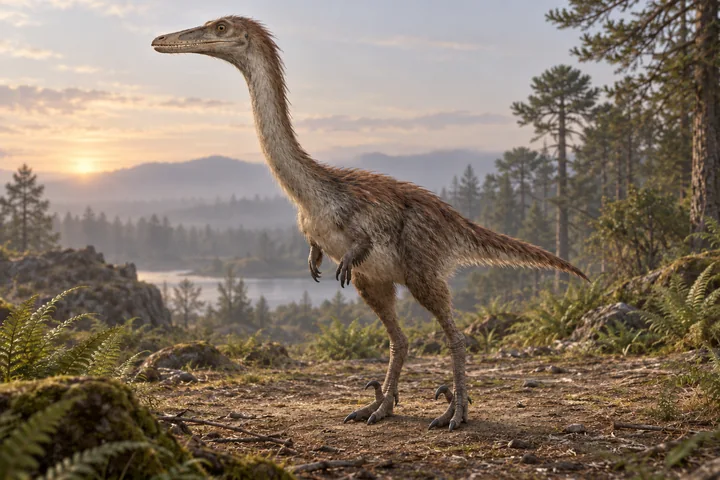
Halszkaraptor escuilliei
Halszkaraptor combines an unusually long neck with short forelimbs and a broad snout.
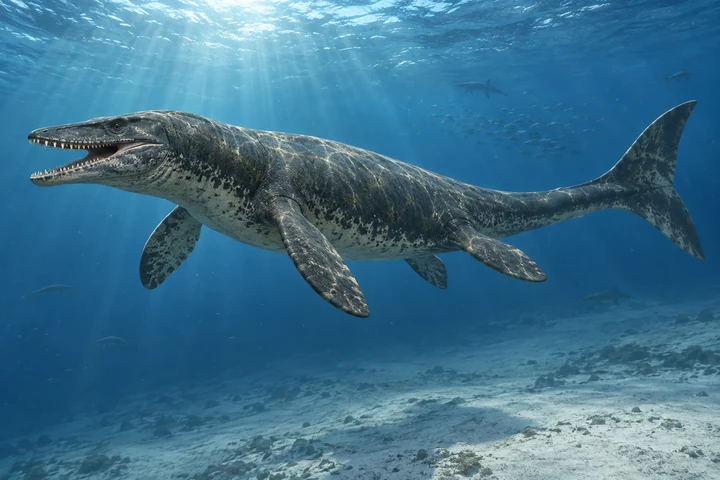
Mosasaurus hoffmanni
Marine reptile
Mosasaurus was a large marine lizard with four flippers, a long tail and toothed jaws. Its size is reconstructed from incomplete fossils.
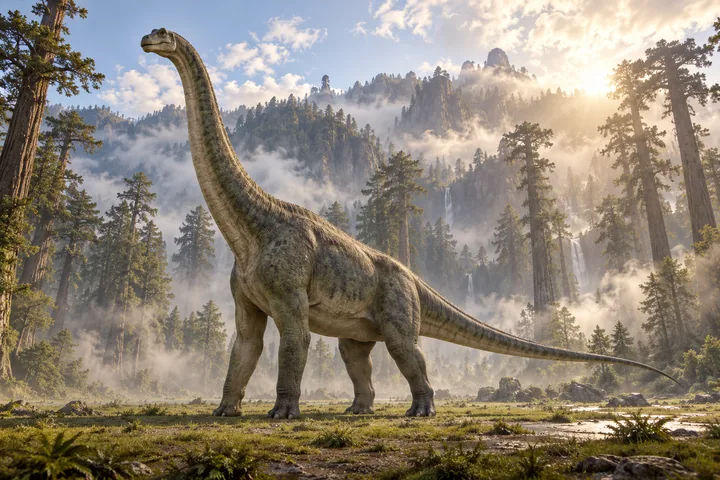
Brachiosaurus altithorax
Brachiosaurus altithorax was a giant sauropod from Late Jurassic North America. Its name-bearing skeleton is incomplete, and many familiar reconstructions borrow details from the separate African dinosaur Giraffatitan.