
Body length
Not establishedNot established here
The studied skull is 67.7 mm long. A checked whole-body adult reference is not supplied by the inspected cranial study. [D4]
EXHIBIT 141
Halszkaraptor escuilliei
Halszkaraptor combines an unusually long neck with short forelimbs and a broad snout. [5]
TWO WAYS TO PICTURE THE PAST
Compare the evidence with the familiar movie image. The illustrations are not to a shared scale.
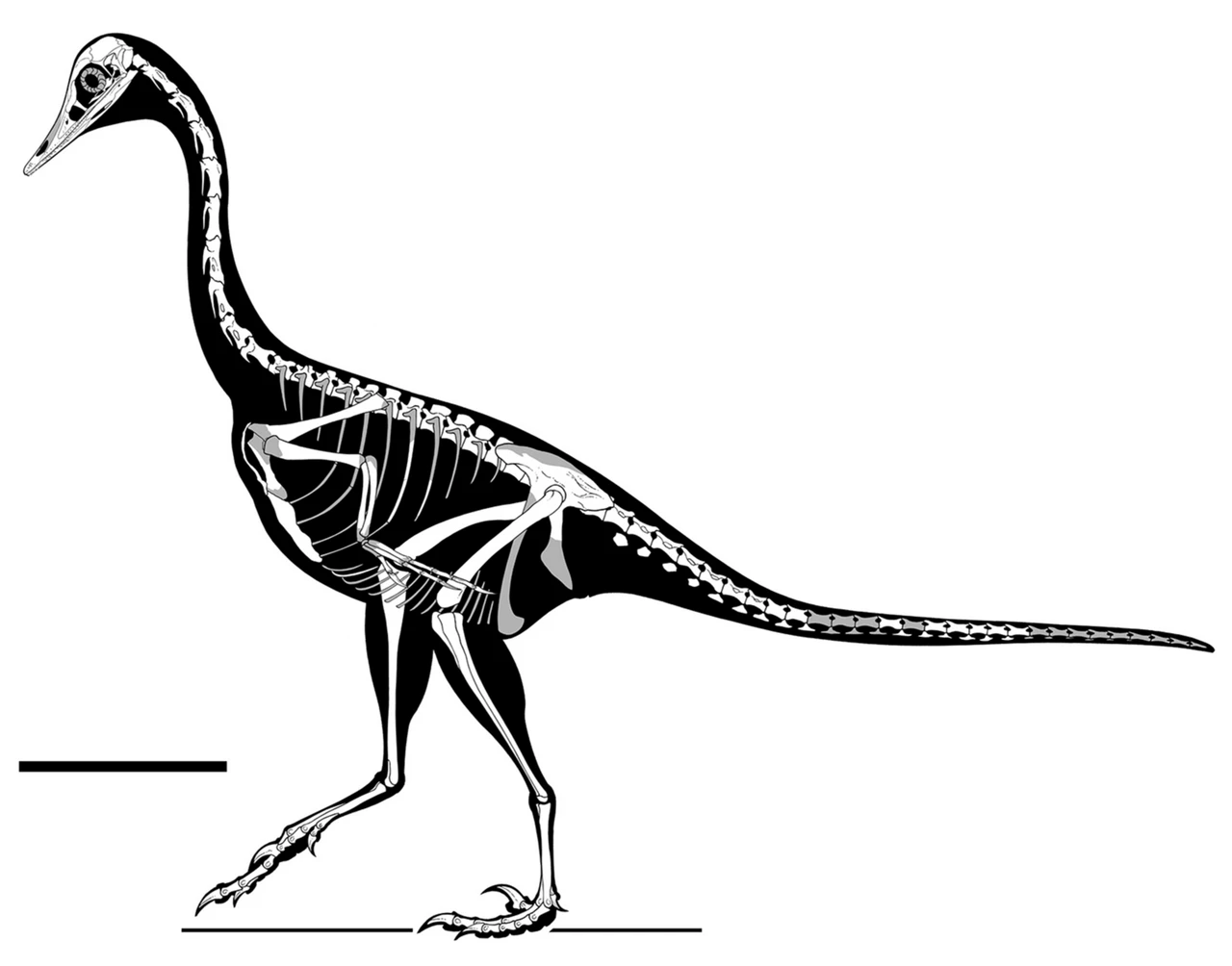
Halszkaraptor escuilliei skeletal reconstruction by M. Auditore, published with Cau and colleagues’ 2021 study of MPC D-102/109. Missing elements are grey; the scale bar is 10 cm. The drawing reconstructs preserved anatomy and missing pieces, while the surrounding outline and posture do not directly establish soft tissues or swimming behavior. [5]
Halszkaraptor escuilliei skeletal.png · M. Auditore. CC BY 4.0. Current Commons 1280 px preview converted to WebP and proportionally reduced for thumbnail use. No cropping, mirroring, anatomical edits or compositing; scale bar and source restoration retained. Source license applies to these versions.
Skeletal mounts and drawings may restore missing parts; the caption identifies the displayed material.
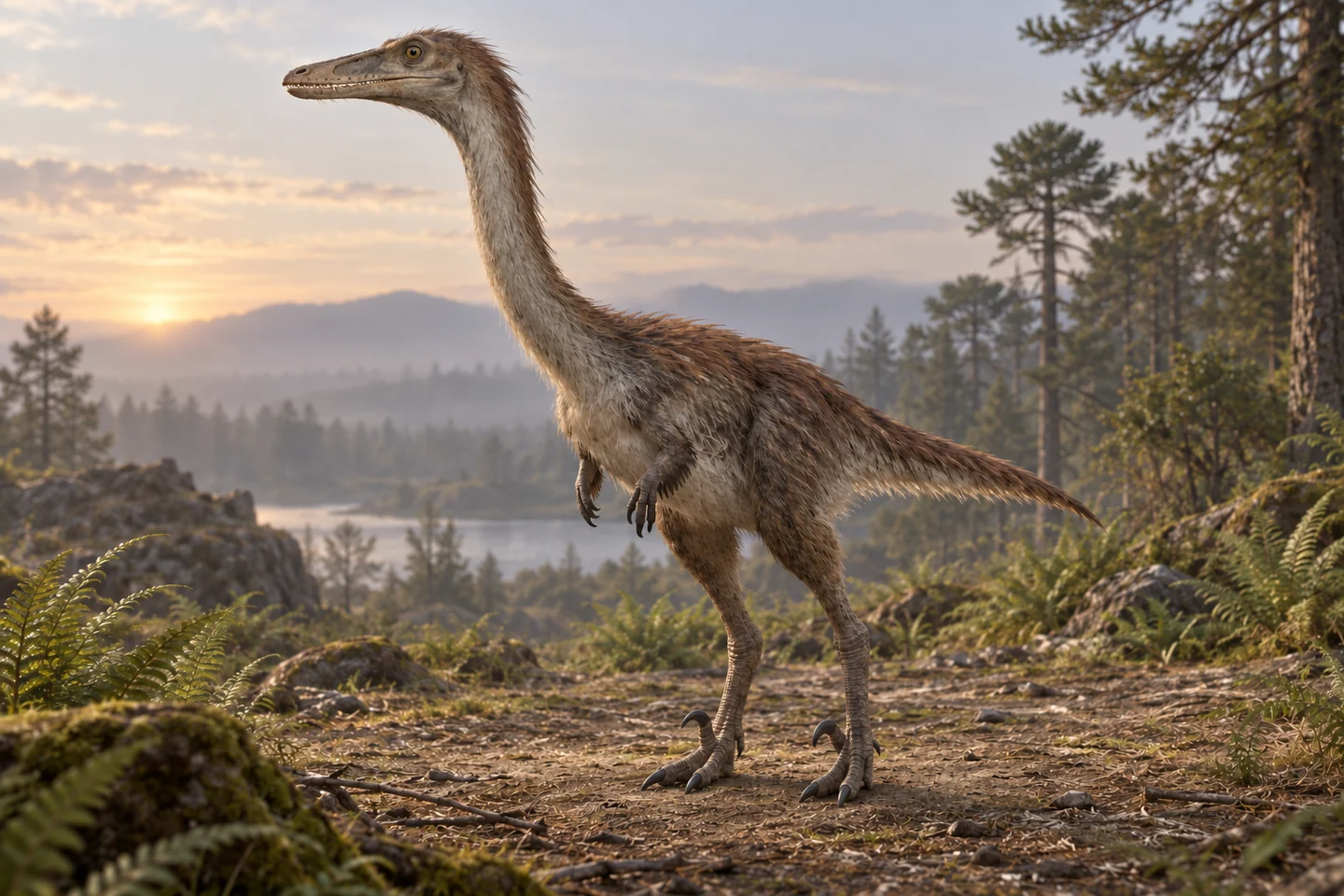
Original cinematic interpretation of Halszkaraptor. Colors, soft tissues, scenery and missing anatomy are reconstructed artistic choices; this is not a directly observed individual or behavior. The animal is shown on land; aquatic habits, webbing and swimming behavior are not established by this illustration. Lighting, coloration and scenery are artistic choices. This image does not document a fossil locality or behavior.
Original artwork · artistic interpretation.
Scientific view: source-informed reconstruction, credited paleoart or specimen-based imagery. Movie-style view: Original artistic interpretation. Reconstructions involve uncertainty.
MEET THE ANIMAL
Halszkaraptor was a Late Cretaceous dinosaur from Mongolia with an unusual combination of features. Its skeleton passed through the fossil trade, so its reported discovery location is less securely documented than a carefully excavated find. Powerful X-ray scans helped researchers check that its surprising bones genuinely belonged to one associated animal, rather than a misleading assembly of different fossils. [D6]
The animal had a broad snout, short forelimbs and an especially long neck. Its neck made up roughly half the distance from the snout to the hips, not half the entire animal including its tail. Details of its fingers and shoulder bones add to this distinctive body plan, while some missing regions still require reconstruction. [D5]
Researchers disagree about whether Halszkaraptor had an amphibious lifestyle, moving between land and water. Comparisons with other dinosaurs have challenged an aquatic interpretation of its features. The debate illustrates a difference between finding an unusual shape and proving what it did. A skeleton can suggest possible abilities without preserving a swimming event or showing exactly how often its owner entered water. [D2]
PREHISTORIC ANIMAL DOSSIER
The animal, the evidence, and the questions still open.
The skeleton is well preserved, while its proposed amphibious lifestyle remains contested. [D6] [D2] [D3]
Profile scope: Genus — Halszkaraptor; H. escuilliei, centered on MPC D-102/109. [D1]
Source supported identifies a description documented by the cited source. Inferred marks a reconstruction or functional estimate. Debated marks competing interpretations. Not established means the sources reviewed for this dossier do not support a firm conclusion; it does not mean a behavior never occurred.
A size reference is an estimate, not a population range. Nesting evidence does not by itself establish courtship, mate choice, or lifelong pairing.
Not established here
The studied skull is 67.7 mm long. A checked whole-body adult reference is not supplied by the inspected cranial study. [D4]
About 1.5 kg (model assumption)
MPC D-102/109, subadult; 2025 metabolic analysis adopts the 2017 estimate. Mass is inferred, not a mature species average. [D7]
Small-prey interpretations debated
Earlier fish-feeding proposals were challenged; 2024 skull models instead favor invertebrate feeding. No directly identified meal establishes its diet. [D3] [D4]
Reported Djadochta Formation provenance
Campanian Mongolia; a traded fossil was reported from Ukhaa Tolgod, so precise excavation context is less secure than an excavated specimen. [D1] [D6]
Bipedal; aquatic capability debated
Walking anatomy is compatible with two-legged movement. Amphibious interpretations and their terrestrial alternatives remain disputed. [D2] [D3]
Long neck; broad snout; short forelimbs
Neck is half the snout-to-sacrum length, not half total length. The third finger exceeds the second; the wishbone contacts the sternum. [D5]
Not established here
A subadult skeleton does not establish egg laying sites, nesting, breeding maturity or parental care. Aquatic hypotheses cannot locate its nests. [D1] [D7]
Not established here
The unusually long neck and shoulder anatomy do not identify a courtship display; reviewed studies establish no sex-specific ornament or mating sequence. [D5]
Not established here
Scans support a genuine single skeleton; its fossil-trade history provides no secure group association or social behavior. [D6]
Sources and inspection notes for the claims in this profile.
THE STORY IN THE FOSSILS
Tomography helped check that the unusual combination of bones belonged to one animal, even where anatomy remained hidden in rock. [6]
Later skull modeling challenged a fish-catching explanation for the broad snout. This does not, by itself, determine whether the animal entered water. [4]
The dossier identifies the scope of each reference estimate. A mount, an individual fossil and a species-wide adult range are different measurements. Comparison metrics remain unavailable where adult scope has not been established. Unknown does not mean zero.
Sources support the stated claims and scopes. Refer to the evidence notes for uncertainty.
KEEP EXPLORING
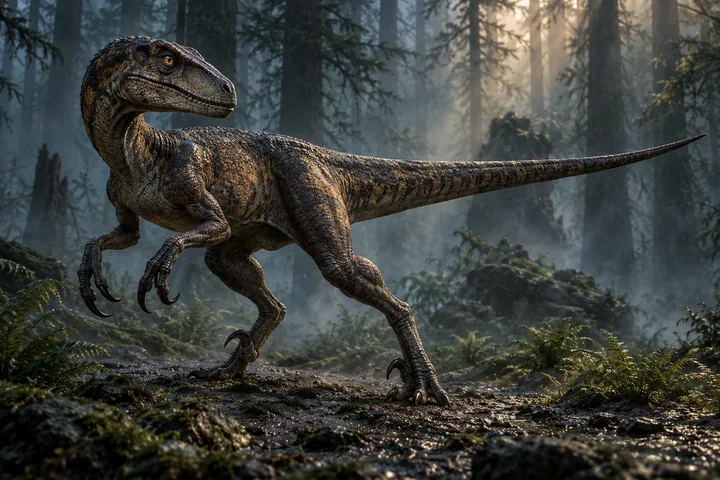
Velociraptor mongoliensis
Velociraptor mongoliensis was a lightly built meat-eater from Late Cretaceous Mongolia. Its long limbs, teeth and enlarged foot claws made it distinctive, while the Fighting Dinosaurs specimen records a remarkable interaction with a horned dinosaur.
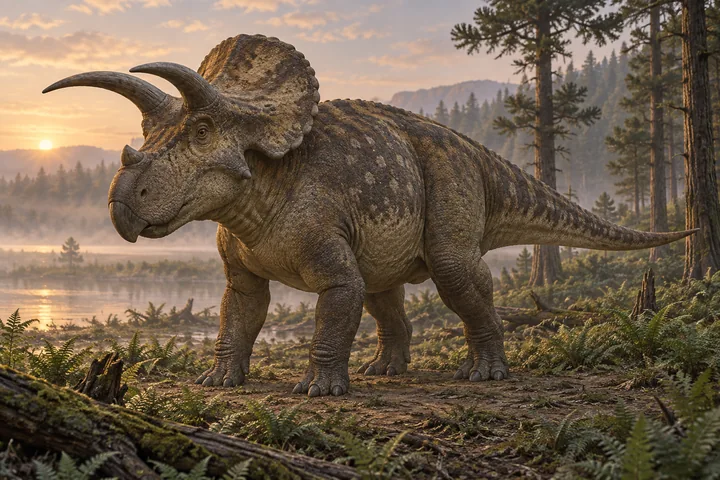
Nasutoceratops titusi
Nasutoceratops was a short-snouted horned dinosaur with a broad nose, forward-curving brow horns and a comparatively simple frill.
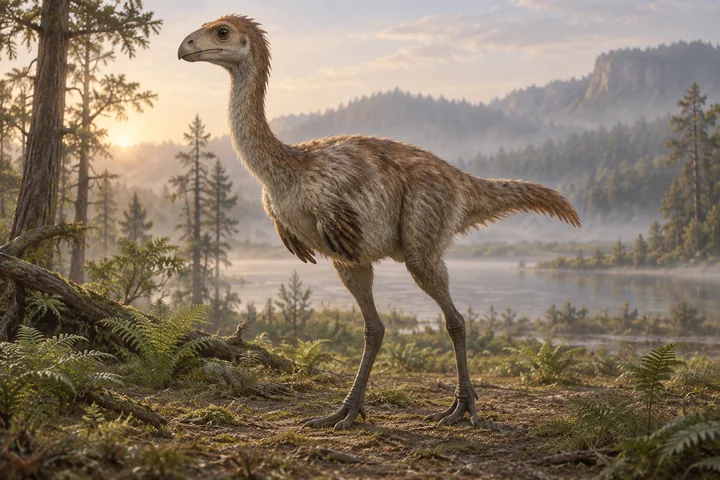
Avimimus portentosus
Avimimus has a compact head and an unusually informative bonebed.