
Length
InferredAbout 5 m (museum reference)
The museum gives a rounded total-body reconstruction without a named size-model specimen or method. It is not an observed adult range. [D1]
EXHIBIT 115
Nasutoceratops titusi
Nasutoceratops was a short-snouted horned dinosaur with a broad nose, forward-curving brow horns and a comparatively simple frill. [2]
TWO WAYS TO PICTURE THE PAST
Compare the evidence with the familiar movie image. The illustrations are not to a shared scale.
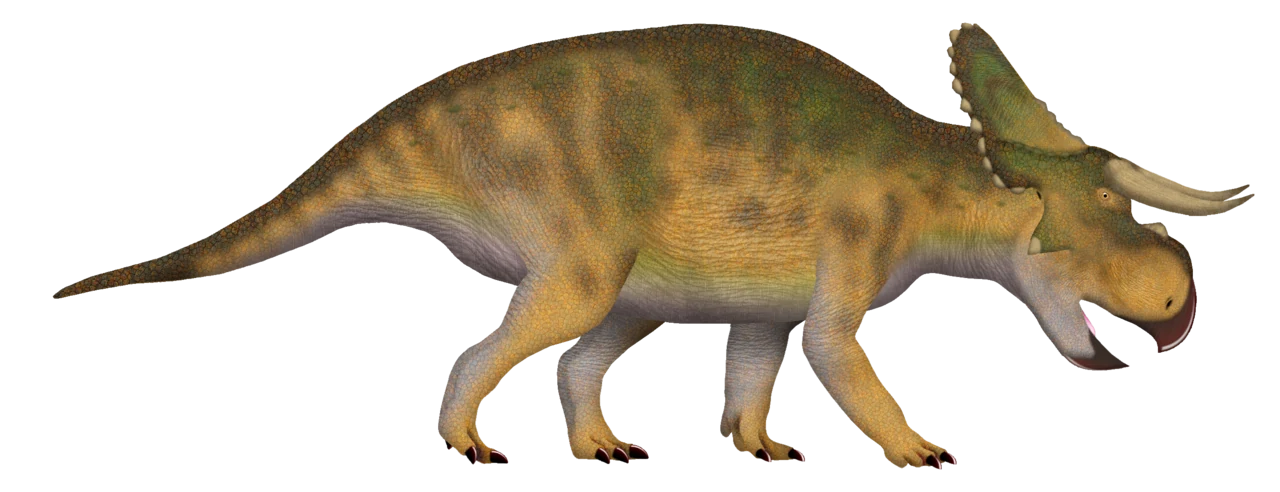
Reconstruction of N. titusi with its broad nose and curved brow horns. Small fossil skin patches inform scale interpretation; full-body skin, color and soft tissues remain uncertain. [2]
Nasutoceratops TD · TotalDino. CC0 1.0. Commons-listed 1280 px preview converted to WebP; smaller responsive copy proportionally resized. Original image preserved without anatomy alterations.
Scientific reconstruction is an interpretation; source credit does not certify every anatomical detail.
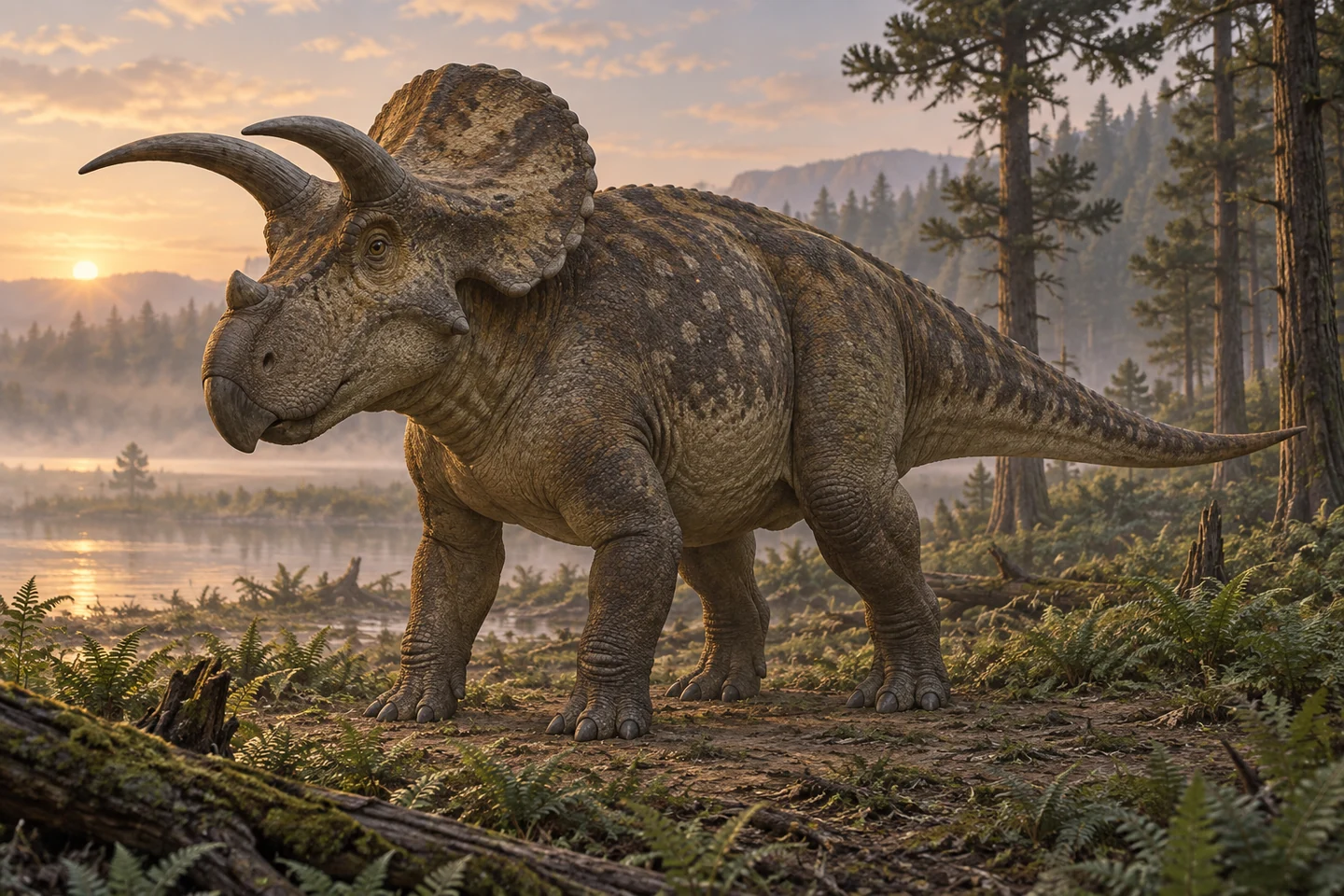
Original cinematic interpretation of Nasutoceratops titusi. Colors, soft tissues, scenery and missing anatomy are reconstructed artistic choices; this is not a directly observed individual or behavior. Lighting, coloration and scenery are artistic choices. This image does not document a fossil locality or behavior.
Original artwork · artistic interpretation.
Scientific view: source-informed reconstruction, credited paleoart or specimen-based imagery. Movie-style view: Original artistic interpretation. Reconstructions involve uncertainty.
MEET THE ANIMAL
Nasutoceratops was a plant-eating horned dinosaur from Late Cretaceous Utah. Its Kaiparowits setting is reconstructed as a wet, forested river plain near the Western Interior Seaway. Those regional conditions help picture the surroundings without proving one exclusive habitat preference. Its four-legged body is reconstructed from horned-dinosaur anatomy and preserved material. [D1]
Its long, sweeping brow horns make the skull especially recognizable. Many close relatives had shorter brow horns and more prominent nasal horns or frill spikes. Nasutoceratops instead combined long brow horns with a modest nasal horn and comparatively simple frill ornament. Those differences show how varied horned dinosaur heads could be, even within the same branch of their family tree. [S1]
A curator's account describes its original fossils in Utah's museum collections and distinguishes one definite skull from more fragmentary material that might belong to the species. That wording keeps firm identification separate from possibility. The Kaiparowits Formation also preserves several other horned dinosaurs. Their shared regional record helps reconstruct diversity without proving that they all gathered in one herd. [S1]
PREHISTORIC ANIMAL DOSSIER
The animal, the evidence, and the questions still open.
Its unusually deep snout and long brow horns make the skull distinctive. Small skin patches add direct evidence about scales, without establishing the color or covering of the entire living animal. [D3]
Profile scope: N. titusi, using the Utah type and referred skulls; wider Nasutoceratopsini records are not a genus-level range. [D2] [D4]
Source supported identifies a description documented by the cited source. Inferred marks a reconstruction or functional estimate. Debated marks competing interpretations. Not established means the sources reviewed for this dossier do not support a firm conclusion; it does not mean a behavior never occurred.
A size reference is an estimate, not a population range. Nesting evidence does not by itself establish courtship, mate choice, or lifelong pairing.
About 5 m (museum reference)
The museum gives a rounded total-body reconstruction without a named size-model specimen or method. It is not an observed adult range. [D1]
About 2.5 tonnes (museum reference)
This educational estimate has no published method or explicit individual basis in the announcement. It is not a measured holotype mass or species-wide adult range. [D1]
Plant-eater with a beak and tooth batteries
The described jaws and dental batteries support plant processing. Particular plant species and feeding height are not established. [D3]
Late Campanian Kaiparowits Formation, Utah
The museum reconstructs the regional setting as a wet, forested river plain near the Western Interior Seaway. Regional conditions do not establish an exclusive habitat preference. [D1]
Four-legged walking inferred
The museum identifies a quadrupedal plant-eater; partial type postcrania support the ceratopsid reconstruction. No running-speed estimate is established. [D1]
Broad snout; curved brow horns; simple frill
The original diagnosis records a deep nasal region, long forward-curving brow horns, low blade-like nasal horn and comparatively plain frill margin. [D2]
Not established here
The later anatomical description identifies the type as subadult, approaching adulthood. This does not establish breeding age, nests or parental care. [D3]
Not established here
Signaling and horn-locking roles have been proposed by comparison with other ceratopsids; neither proposal demonstrates a mating ritual or sexually distinct individuals. [D3]
Not established here
A tribal review discusses rarity and possible habitat/social differences. This does not establish Nasutoceratops herd structure or solitary living. [D4]
Sources and inspection notes for the claims in this profile.
THE STORY IN THE FOSSILS
The skull carries a very large nasal region and unusually long, curved brow horns. The combination distinguishes Nasutoceratops from its relatives without revealing exactly how the horns were used in life. [2]
Skin associated with the type’s shoulder includes round scales and a patch of larger, hexagonal scales. These limited impressions constrain texture locally; they cannot supply a full-body pattern or living color. [3]
The dossier identifies the scope of each reference estimate. A mount, an individual fossil and a species-wide adult range are different measurements. Comparison metrics remain unavailable where adult scope has not been established. Unknown does not mean zero.
Sources support the stated claims and scopes. Refer to the evidence notes for uncertainty.
KEEP EXPLORING
Chasmosaurus
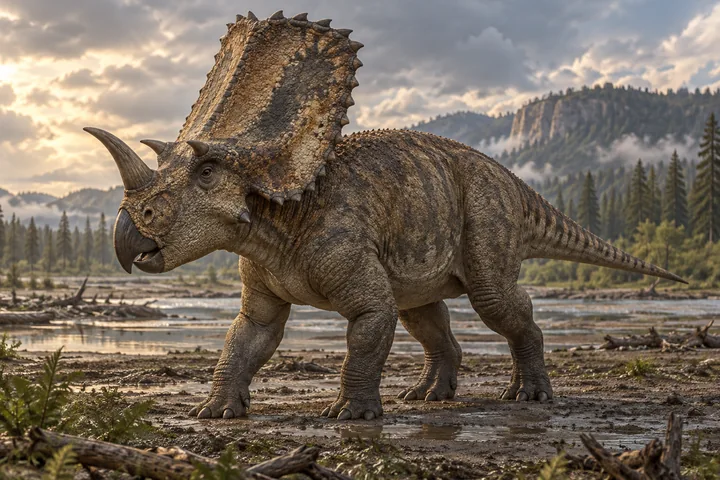
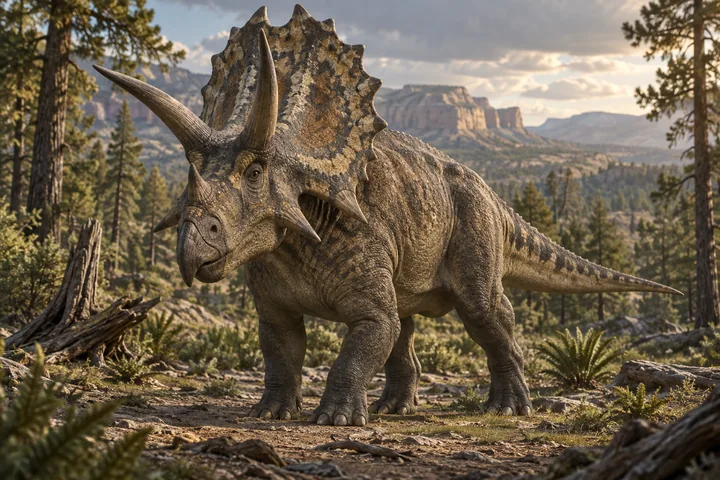
Chasmosaurus was a horned plant eater from Late Cretaceous Canada. A rare juvenile skeleton reveals that its frill changed in shape as well as relative size during growth.
Pentaceratops sternbergii
Pentaceratops was a horned plant eater from Late Cretaceous New Mexico. Its name counts the prominent cheek projections alongside the nasal and brow horns, while disputed giant material requires separate treatment.
Saurolophus angustirostris
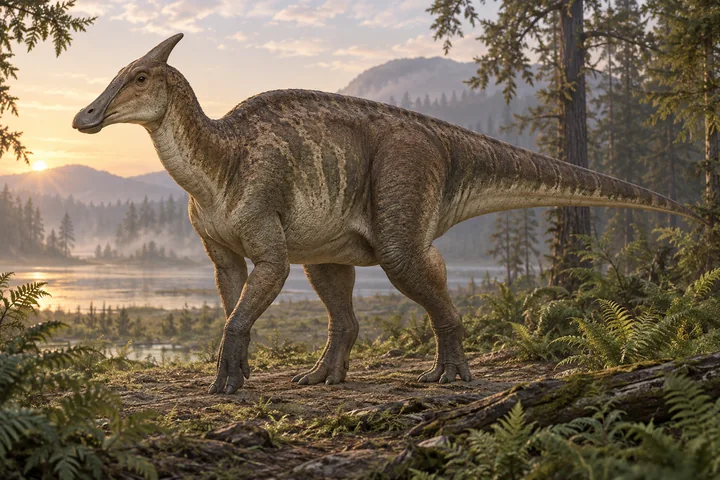
Distinctive crests, skin and perinatal evidence.