
Body length
InferredConflicting skull-based reconstructions
NHM contrasts roughly 11–12 m and 17–18 m reconstructions of large M. hoffmanni. These alternatives are not a measured adult species range. [D2]
EXHIBIT 207
Mosasaurus hoffmanni
Marine reptile
Mosasaurus was a large marine lizard with four flippers, a long tail and toothed jaws. Its size is reconstructed from incomplete fossils. [2]
TWO WAYS TO PICTURE THE PAST
Compare the evidence with the familiar movie image. The illustrations are not to a shared scale.
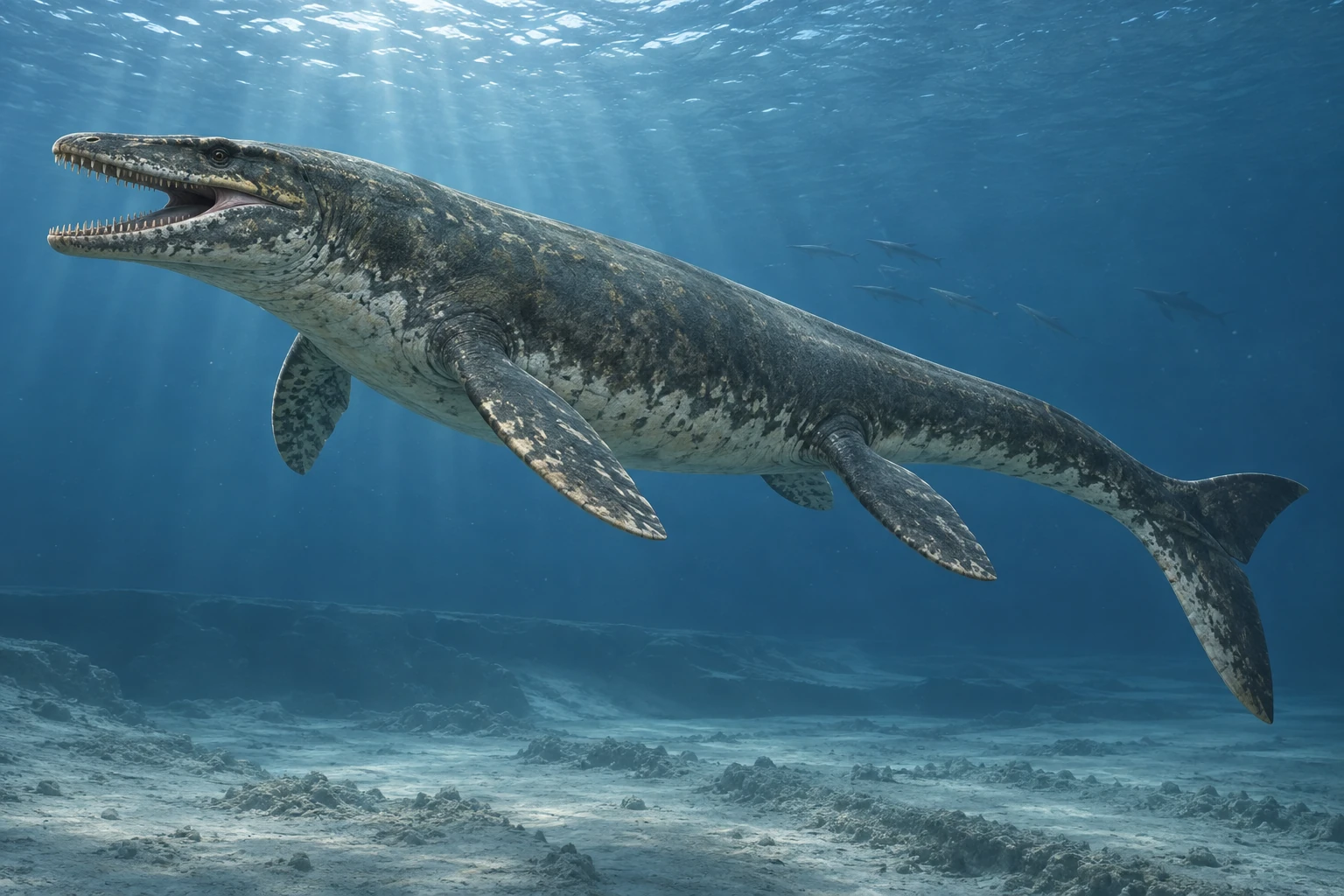
An illustrative reconstruction. Compare its anatomy with the evidence and limitations in the dossier. [2]
Source-informed reconstruction. Appearance evidence [2]. Original illustration; missing anatomy, coloration and scenery include interpretation.
Fossils constrain this life reconstruction. Missing anatomy, coloration and the environmental scene include interpretation; the dossier explains the evidence limits.
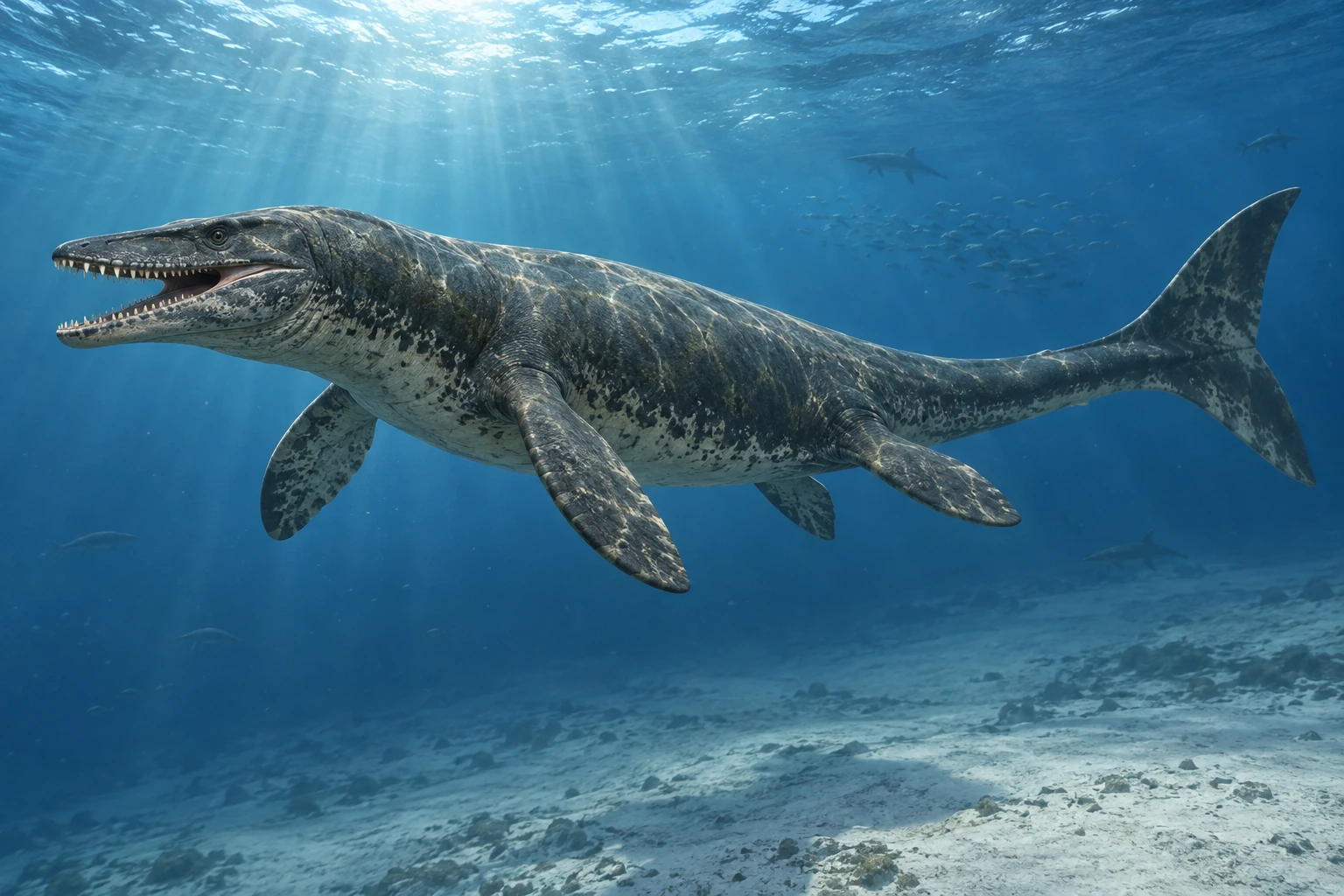
An illustrative reconstruction. Compare its anatomy with the evidence and limitations in the dossier. Lighting, coloration and scenery are artistic choices. This image does not document a fossil locality or behavior.
Original artwork · artistic interpretation.
Scientific view: source-informed reconstruction, credited paleoart or specimen-based imagery. Movie-style view: Original artistic interpretation. Reconstructions involve uncertainty.
MEET THE ANIMAL
Mosasaurus was a marine reptile related to the broad group that includes lizards and snakes. It was not a dinosaur. Four flippers, a long tail and strong jaws gave it a very different outline from a land lizard. Its curved teeth suggest a predator, but a tooth cannot tell us everything the animal ate. [D2]
A surprising detail is the extra set of teeth on the roof of its mouth. Those bones help scientists recognize mosasaurs and compare their relationships. The complete swimming animal still needs reconstruction around the skeleton. Museum researchers study those pieces because an ocean-adapted body alone does not settle which living reptile groups are its closest relatives. [D3]
Other mosasaurs provide evidence that babies could be born in the water: tiny Clidastes fossils were found in open-marine deposits. That supports live birth for the wider group, rather than directly showing a Mosasaurus pregnancy. Injured Mosasaurus jaws add another kind of evidence. They record damage and healing, while leaving the cause, courtship and social life uncertain. [D4] [D5]
PREHISTORIC ANIMAL DOSSIER
The animal, the evidence, and the questions still open.
Mosasaurs were marine squamates, the wider reptile group containing lizards and snakes. Their exact relationship within that group remains debated; a streamlined ocean body does not make them dinosaurs. [D3]
Profile scope: Genus Mosasaurus, with M. hoffmanni as the representative species. The 2024 nomenclatural study recommends this one-i spelling; hoffmannii is a spelling variant, not another animal. [D1]
Source supported identifies a description documented by the cited source. Inferred marks a reconstruction or functional estimate. Debated marks competing interpretations. Not established means the sources reviewed for this dossier do not support a firm conclusion; it does not mean a behavior never occurred.
A size reference is an estimate, not a population range. Nesting evidence does not by itself establish courtship, mate choice, or lifelong pairing.
Conflicting skull-based reconstructions
NHM contrasts roughly 11–12 m and 17–18 m reconstructions of large M. hoffmanni. These alternatives are not a measured adult species range. [D2]
Not established here
The museum’s approximate ten-tonne reference lacks an identified individual calculation; it is not used as a precise adult comparison. [D2]
Predatory diet inferred from teeth
Curved jaw teeth and extra mouth-roof teeth support animal feeding. They do not identify every prey species or a daily menu. [D2]
Latest Cretaceous Maastricht marine deposits
Historic partial skulls came from limestone near Maastricht in the Netherlands. Occurrence records a marine setting, not a preferred hunting depth. [D1]
Four flippers and a propulsive tail
Limb transformation and tail anatomy support a fully marine swimmer. Exact strokes, speed and complete soft-tissue outline are reconstructed. [D3]
Jaw teeth and mouth-roof teeth
Teeth occur in jaws and on pterygoid bones in the mouth roof. Soft-tissue tail outlines known from relatives require comparison. [D2]
Live birth inferred from mosasaur relatives
Neonatal Clidastes supports birth and early swimming in open water, not Mosasaurus litter size, gestation or breeding age. [D4]
Not established here
Healed jaw fractures have possible feeding or fighting explanations; injury alone does not demonstrate mating displays or pair formation. [D5]
Not established here
The pathology study records individual jaw injuries with alternative causes. It does not establish packs, stable pairs or parental care. [D5]
Sources and inspection notes for the claims in this profile.
THE STORY IN THE FOSSILS
The Maastricht finds were partial skulls. Naming and interpreting an extinct marine animal began with pieces of anatomy, rather than a fully preserved swimming silhouette. [1]
Museum researchers compare bones to resolve mosasaur relationships. Familiar flippers and a long tail do not answer every question about ancestry or life appearance. [3]
The dossier identifies the scope of each reference estimate. A mount, an individual fossil and a species-wide adult range are different measurements. Comparison metrics remain unavailable where adult scope has not been established. Unknown does not mean zero.
Sources support the stated claims and scopes. Refer to the evidence notes for uncertainty.
KEEP EXPLORING
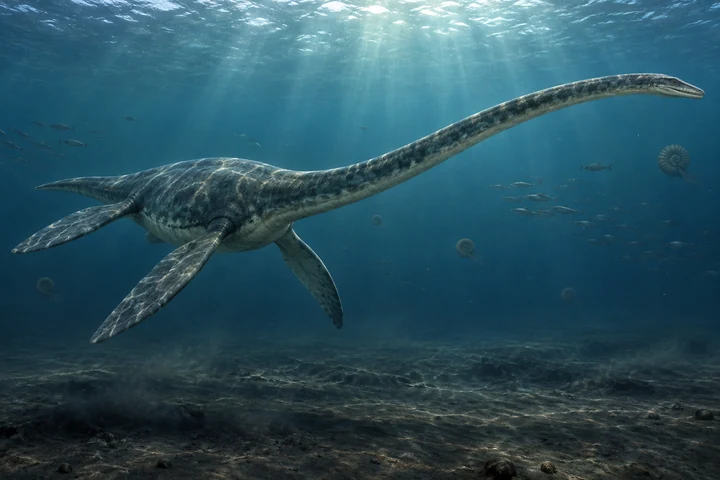
Elasmosaurus platyurus
Marine reptile
Elasmosaurus platyurus was a long-necked marine reptile from Kansas. Re-examination of its type skeleton identified seventy-two neck vertebrae.
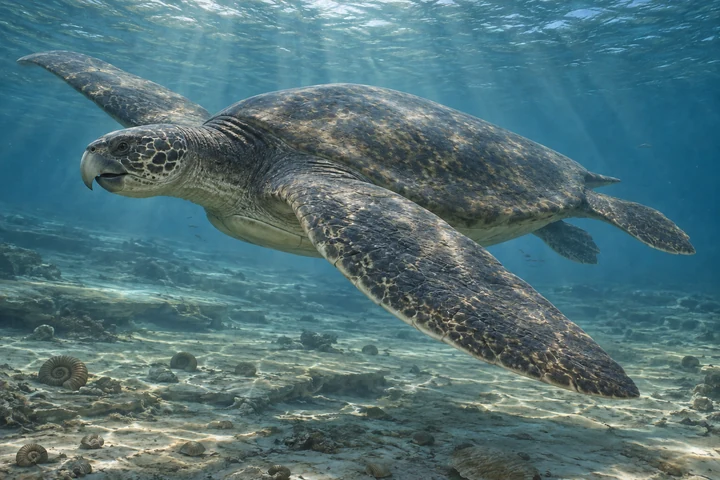
Archelon ischyros
Marine turtle
Archelon ischyros was a giant marine turtle with powerful front flippers and a reduced bony shell. Its exact diet and nesting record remain unresolved.
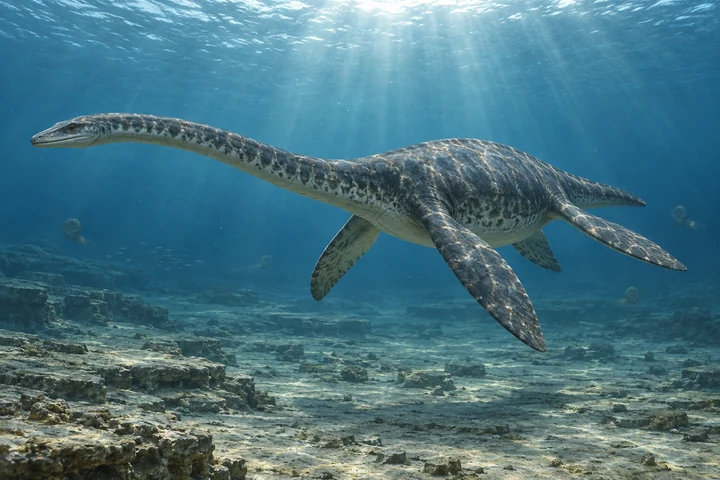
Plesiosaurus dolichodeirus
Marine reptile
Plesiosaurus was an Early Jurassic marine reptile with a small head, a long neck and four flippers. Mary Anning found a nearly complete skeleton.