
Body length
InferredAbout 3.5 m; museum reference
NHM supplies an approximate genus reconstruction, not a measured mature individual or a demonstrated adult population range. [D2]
TWO WAYS TO PICTURE THE PAST
Compare the evidence with the familiar movie image. The illustrations are not to a shared scale.
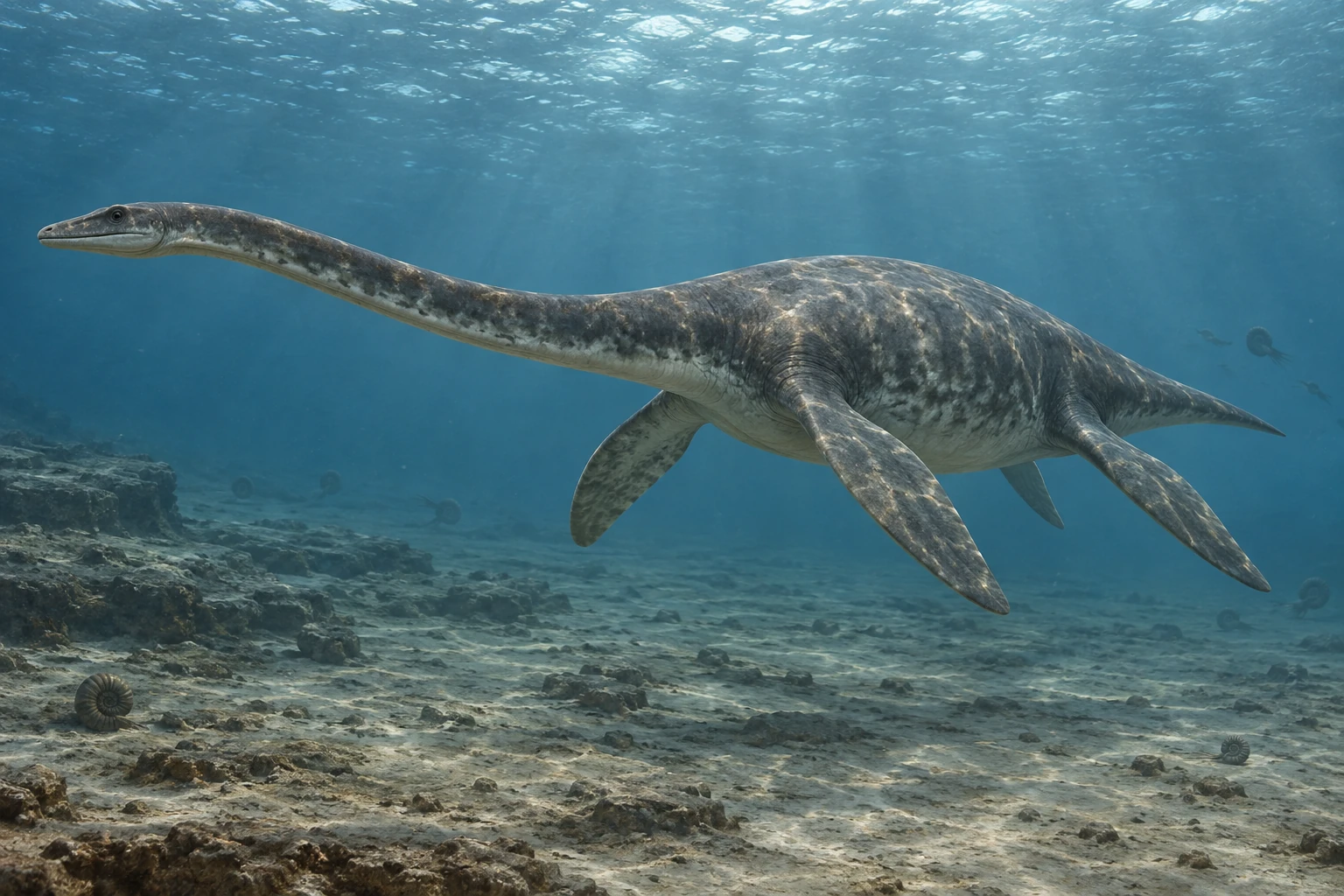
An illustrative reconstruction. Compare its anatomy with the evidence and limitations in the dossier. [4]
Source-informed reconstruction. Appearance evidence [4]. Original illustration; missing anatomy, coloration and scenery include interpretation.
Fossils constrain this life reconstruction. Missing anatomy, coloration and the environmental scene include interpretation; the dossier explains the evidence limits.
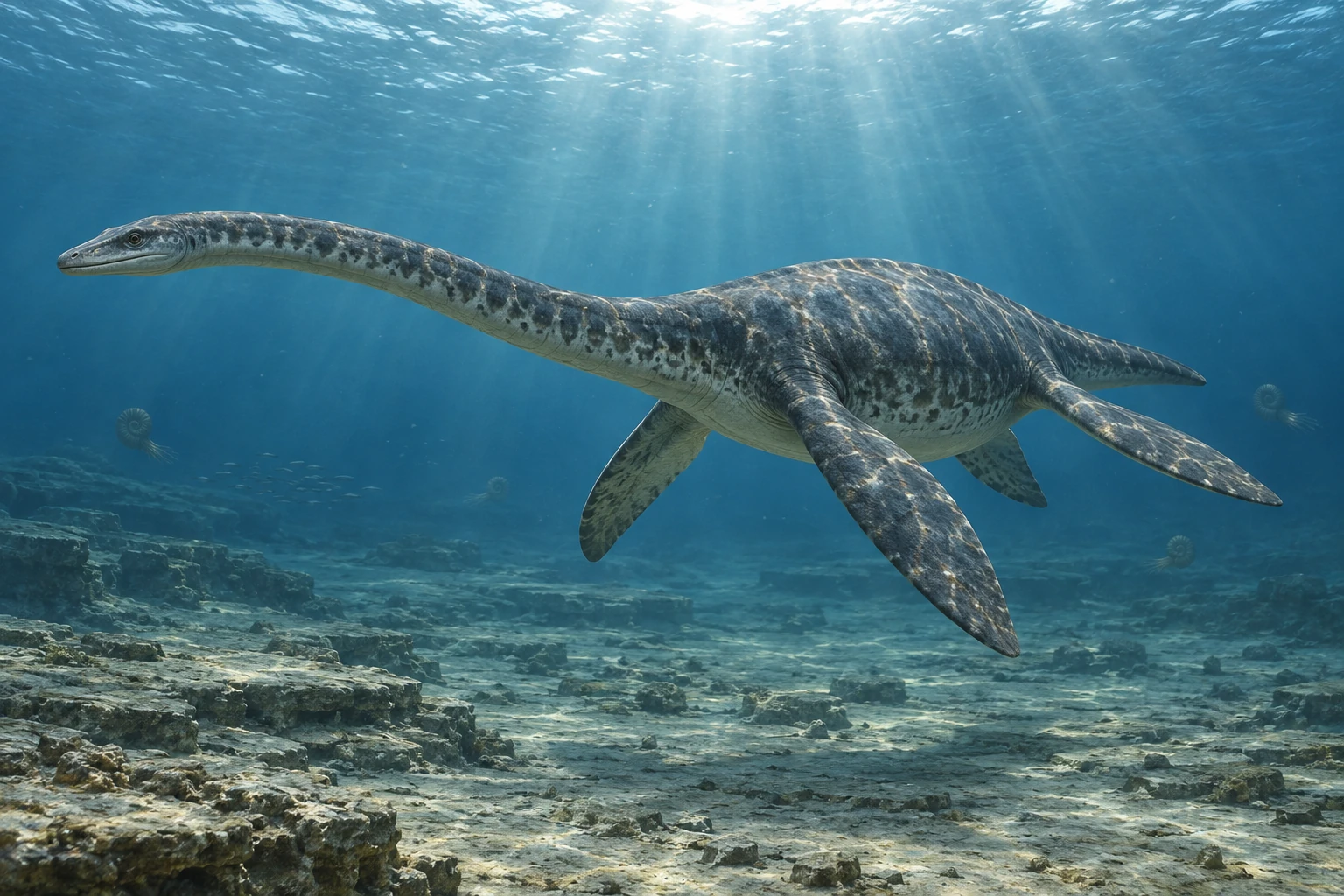
An illustrative reconstruction. Compare its anatomy with the evidence and limitations in the dossier. Lighting, coloration and scenery are artistic choices. This image does not document a fossil locality or behavior.
Original artwork · artistic interpretation.
Scientific view: source-informed reconstruction, credited paleoart or specimen-based imagery. Movie-style view: Original artistic interpretation. Reconstructions involve uncertainty.
MEET THE ANIMAL
Plesiosaurus dolichodeirus swam in an Early Jurassic sea where southern England lies today. It was a marine reptile, not a dinosaur. Picture a small head, a long neck and four broad paddles. The museum’s roughly three-and-a-half-metre length is a useful reconstruction to imagine its size, rather than a rule for every adult of the species. [D2]
Mary Anning found a nearly complete skeleton with many bones still connected. That arrangement matters: it helped show that the unusual body really belonged to one kind of animal. The long neck was not simply a collection of unrelated bones. Fossils can preserve an outline surprisingly well while leaving skin, colors and movements of the living creature open to interpretation. [D3]
Scientists can test swimming ideas with models of plesiosaur flippers. Moving both pairs can produce useful thrust, but experiments do not film an ancient animal swimming. [D5]
A fossil pregnancy in another plesiosaur supports live birth for the wider group. It does not tell us the number of young in a Plesiosaurus family, or whether parents stayed with them. [D6]
PREHISTORIC ANIMAL DOSSIER
The animal, the evidence, and the questions still open.
Anning’s nearly complete specimen preserves connected bones in natural order. Its long neck made the animal unlike familiar living reptiles and helped establish an extinct marine body plan. [D3]
Profile scope: Genus Plesiosaurus, represented by P. dolichodeirus. This genus is narrower than the whole plesiosaur group; many historical species assignments do not belong here. [D4]
Source supported identifies a description documented by the cited source. Inferred marks a reconstruction or functional estimate. Debated marks competing interpretations. Not established means the sources reviewed for this dossier do not support a firm conclusion; it does not mean a behavior never occurred.
A size reference is an estimate, not a population range. Nesting evidence does not by itself establish courtship, mate choice, or lifelong pairing.
About 3.5 m; museum reference
NHM supplies an approximate genus reconstruction, not a measured mature individual or a demonstrated adult population range. [D2]
Not established here
The specimen entry provides identity and display dimensions, not a whole-body mass calculation. No comparison mass is adopted. [D1]
Small-animal feeding inferred
A small skull and pointed teeth fit catching animals such as fish. This interpretation is not a preserved individual meal. [D2]
Early Jurassic sea at Lyme Regis
The Paris specimen comes from Dorset’s marine Jurassic rocks. Occurrence does not establish a favorite water depth or shoreline distance. [D1]
Propulsion with interacting flipper pairs
Water-tank plesiosaur models support thrust from both pairs, not an exact Plesiosaurus stroke or speed. [D5]
Small skull, long neck, four paddles
The genus diagnosis includes about forty neck vertebrae and slightly longer forelimbs than hindlimbs. Soft tissues and colors remain reconstructed. [D4]
Live birth is a broader-group inference
A fetus inside a different Late Cretaceous plesiosaur supports live birth there, not a Plesiosaurus pregnancy or litter size. [D6]
Not established here
The reviewed plesiosaur synthesis does not establish mating displays or sexual dimorphism for this genus. [D7]
Not established here
Sociality proposed from reproductive comparisons is a hypothesis; the synthesis supplies no direct parent-care or group behavior. [D7]
Sources and inspection notes for the claims in this profile.
THE STORY IN THE FOSSILS
Anning’s skeleton kept many bones connected. That made the striking neck-and-paddle arrangement harder to dismiss as pieces from different animals. [3]
Names once placed many marine reptiles in Plesiosaurus. Anatomical revision narrowed the genus, so a historical label needs checking against its bones. [4]
The dossier identifies the scope of each reference estimate. A mount, an individual fossil and a species-wide adult range are different measurements. Comparison metrics remain unavailable where adult scope has not been established. Unknown does not mean zero.
Sources support the stated claims and scopes. Refer to the evidence notes for uncertainty.
KEEP EXPLORING
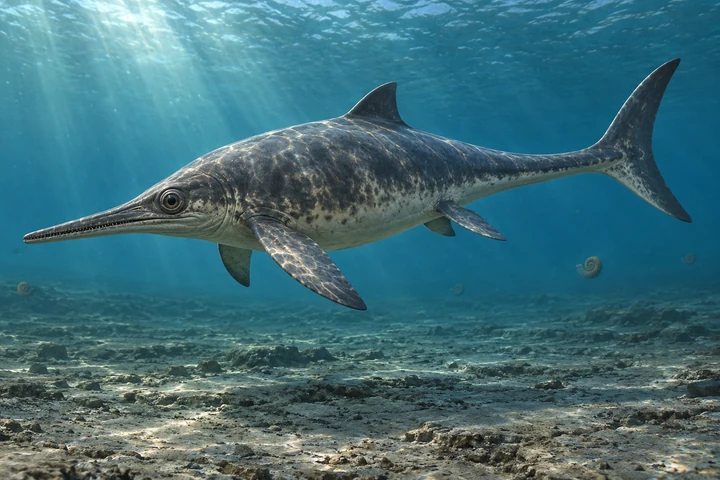
Ichthyosaurus somersetensis
Marine reptile
Ichthyosaurus was a streamlined marine reptile. A Somerset specimen of I. somersetensis preserves an embryo, providing direct evidence of live birth.
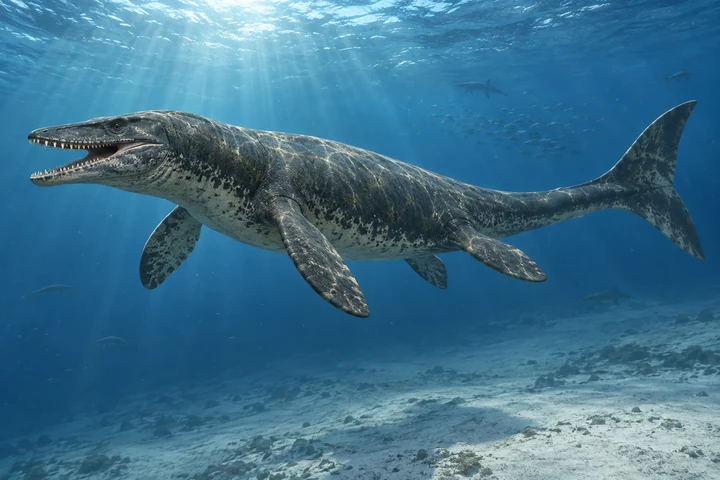
Mosasaurus hoffmanni
Marine reptile
Mosasaurus was a large marine lizard with four flippers, a long tail and toothed jaws. Its size is reconstructed from incomplete fossils.
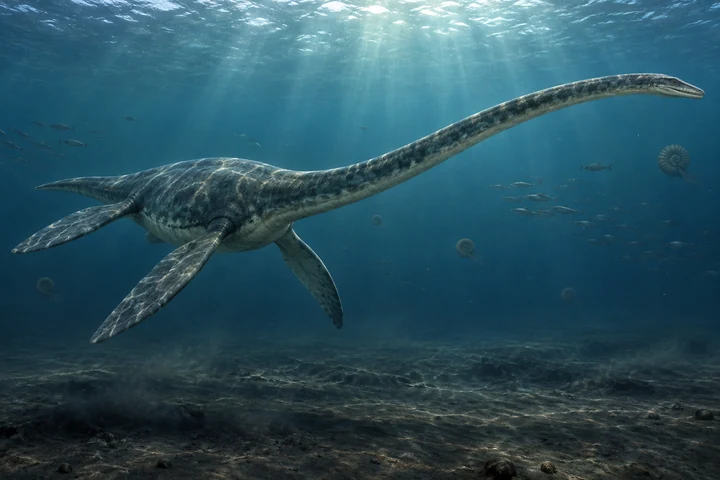
Elasmosaurus platyurus
Marine reptile
Elasmosaurus platyurus was a long-necked marine reptile from Kansas. Re-examination of its type skeleton identified seventy-two neck vertebrae.