
Body length
Inferred3.0–3.3 m for NLMH 106234
The individual was scaled from genuine skull/precaudal proportions. Much of its mounted tail was added; the interval is not an adult species range. [D2]
EXHIBIT 209
Ichthyosaurus somersetensis
Marine reptile
Ichthyosaurus was a streamlined marine reptile. A Somerset specimen of I. somersetensis preserves an embryo, providing direct evidence of live birth. [2]
TWO WAYS TO PICTURE THE PAST
Compare the evidence with the familiar movie image. The illustrations are not to a shared scale.
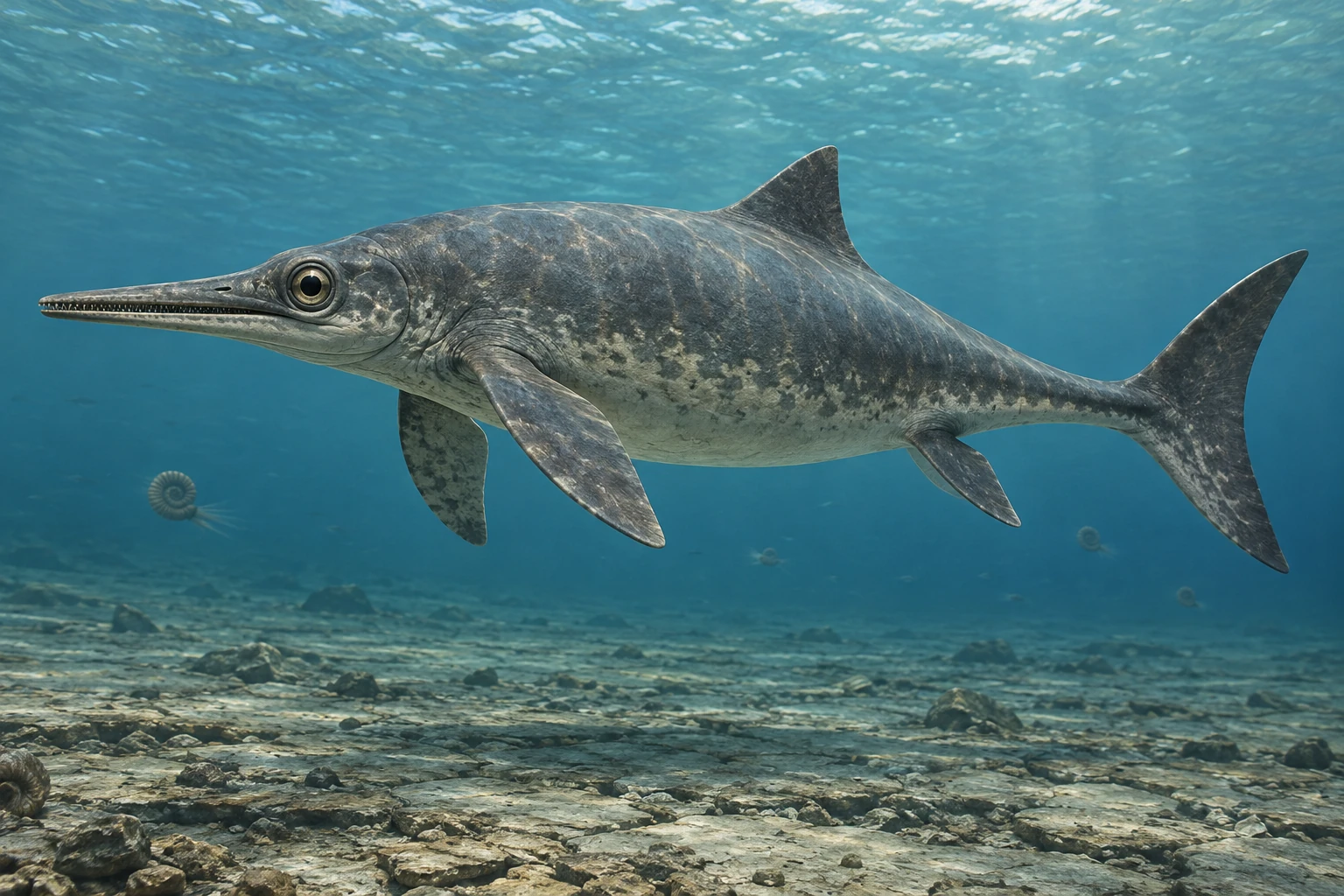
An illustrative reconstruction. Compare its anatomy with the evidence and limitations in the dossier. [1]
Source-informed reconstruction. Appearance evidence [1]. Original illustration; missing anatomy, coloration and scenery include interpretation.
Fossils constrain this life reconstruction. Missing anatomy, coloration and the environmental scene include interpretation; the dossier explains the evidence limits.
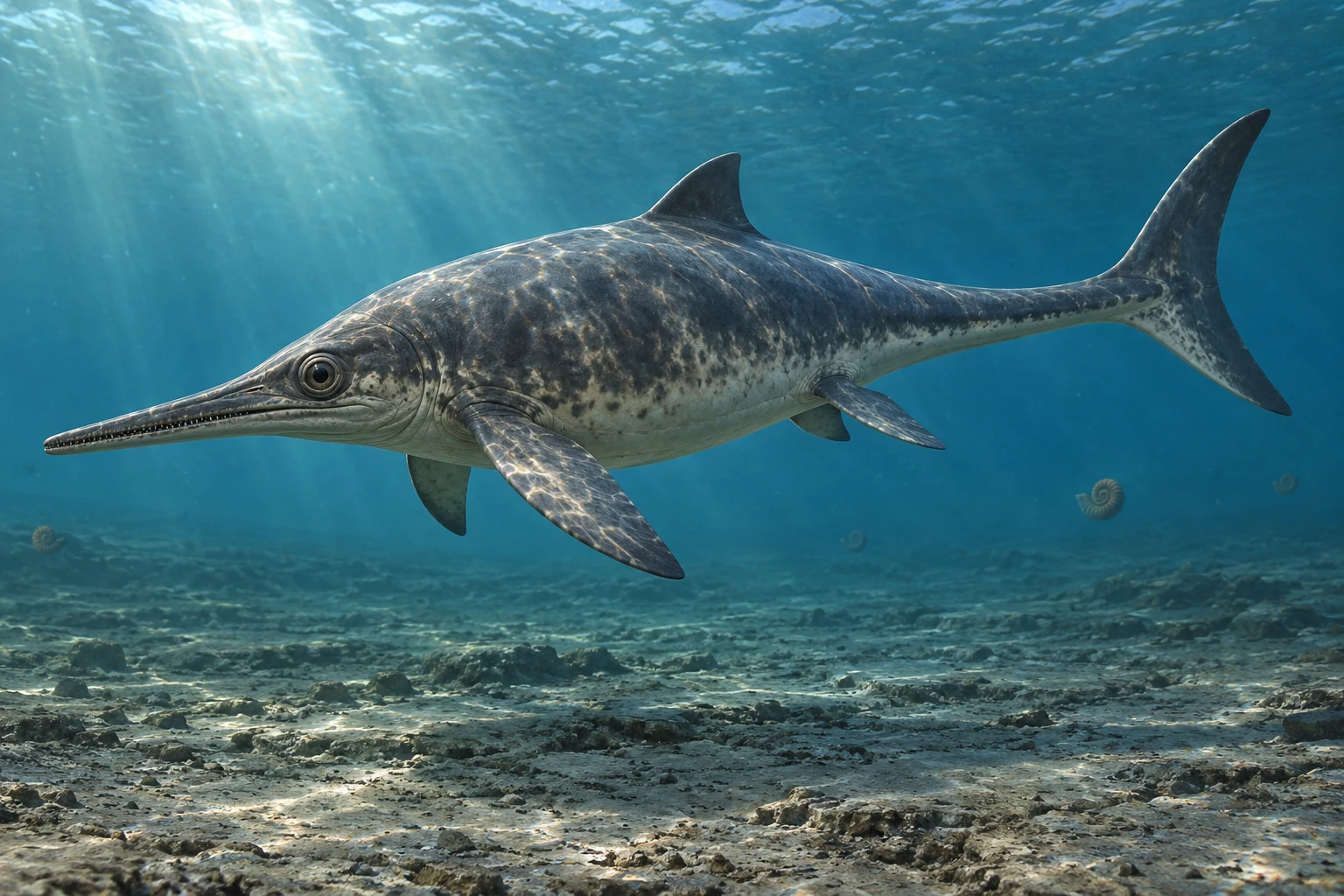
An illustrative reconstruction. Compare its anatomy with the evidence and limitations in the dossier. Lighting, coloration and scenery are artistic choices. This image does not document a fossil locality or behavior.
Original artwork · artistic interpretation.
Scientific view: source-informed reconstruction, credited paleoart or specimen-based imagery. Movie-style view: Original artistic interpretation. Reconstructions involve uncertainty.
MEET THE ANIMAL
Ichthyosaurus somersetensis was an Early Jurassic marine reptile from England. Its genus belonged to the ichthyosaurs, but that broader name includes many different genera. Scientists recognized this species by comparing the shapes of skull bones, limb bones and flippers in Somerset fossils. A similar swimming outline by itself is not enough to identify a fossil to species. [D1]
One individual, NLMH 106234, preserves an embryo within the adult. That gives direct evidence of live birth in this species. The adult was estimated at about three to three-and-a-third metres long from genuine parts of its skeleton. Its displayed tail was partly added, so the museum mount must be checked before treating its length as an untouched fossil. [D2]
Its resemblance to a fish or dolphin shows how different animal groups can evolve useful shapes for swimming. Ichthyosaurs were reptiles, rather than fish or dolphins. Fish and squid-like animals were foods in the wider group, although that does not provide a complete menu for this species. The fossil body plan leaves its exact colors and everyday social life uncertain. [D3]
PREHISTORIC ANIMAL DOSSIER
The animal, the evidence, and the questions still open.
A fishlike outline evolved in a reptile lineage. Similarity to a dolphin reflects adaptation to water rather than dolphin ancestry; older Ichthyosaurus assignments include animals now separated into other genera. [D3]
Profile scope: Genus Ichthyosaurus, highlighting I. somersetensis. Diagnostic skull and limb characters distinguish it from other species; this exhibit does not cover every ichthyosaur genus. [D1]
Source supported identifies a description documented by the cited source. Inferred marks a reconstruction or functional estimate. Debated marks competing interpretations. Not established means the sources reviewed for this dossier do not support a firm conclusion; it does not mean a behavior never occurred.
A size reference is an estimate, not a population range. Nesting evidence does not by itself establish courtship, mate choice, or lifelong pairing.
3.0–3.3 m for NLMH 106234
The individual was scaled from genuine skull/precaudal proportions. Much of its mounted tail was added; the interval is not an adult species range. [D2]
Not established here
The species diagnosis describes bones and relationships, not a reproducible individual body-mass estimate. [D1]
Animal feeding; species menu unresolved
The museum describes ichthyosaurs eating fish and cephalopods. This is broader-group evidence, not stomach contents assigned to I. somersetensis. [D3]
Lower Hettangian marine Blue Lias
The embryo-bearing specimen came from Doniford Bay, Somerset. Its fossil setting does not establish preferred depth or seasonal movement. [D2]
Streamlined body with fins and a tail
The ichthyosaur body plan supports marine swimming. Detailed fin outline and performance for this species require comparative reconstruction. [D3]
Diagnostic skull and limb-bone characters
The description separates I. somersetensis using cheek-bone, humerus, forefin and pelvic morphology, rather than a fishlike silhouette alone. [D1]
An embryo within I. somersetensis
NLMH 106234 preserves embryonic bones inside an adult. One preserved embryo does not establish litter size or birth sequence. [D2]
Not established here
Possible forefin and pubic differences do not establish displays, mating positions or external sex colors. [D2]
Not established here
The museum synthesis does not establish packs or sustained parental care. A marine body plan does not demonstrate a living social group. [D3]
Sources and inspection notes for the claims in this profile.
THE STORY IN THE FOSSILS
Embryo bones survive in the specimen; an added tail warns against measuring a mount as untouched anatomy. [2]
Historical names need anatomical checking. Tooth-shape differences can vary with growth and within one animal, complicating old species labels. [4]
The dossier identifies the scope of each reference estimate. A mount, an individual fossil and a species-wide adult range are different measurements. Comparison metrics remain unavailable where adult scope has not been established. Unknown does not mean zero.
Sources support the stated claims and scopes. Refer to the evidence notes for uncertainty.
KEEP EXPLORING
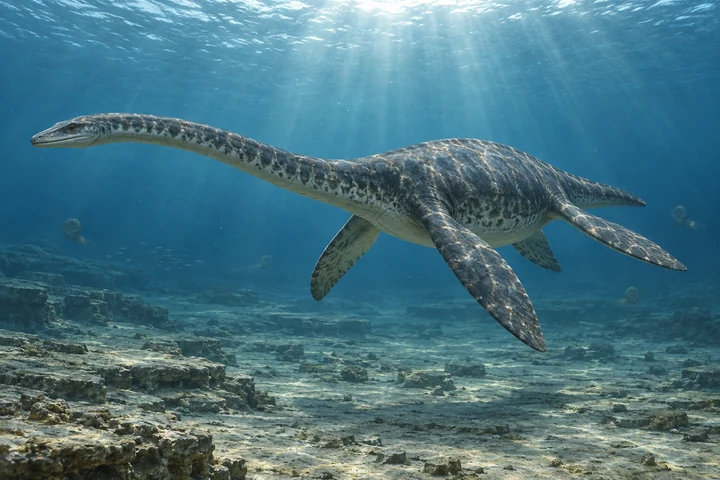
Plesiosaurus dolichodeirus
Marine reptile
Plesiosaurus was an Early Jurassic marine reptile with a small head, a long neck and four flippers. Mary Anning found a nearly complete skeleton.
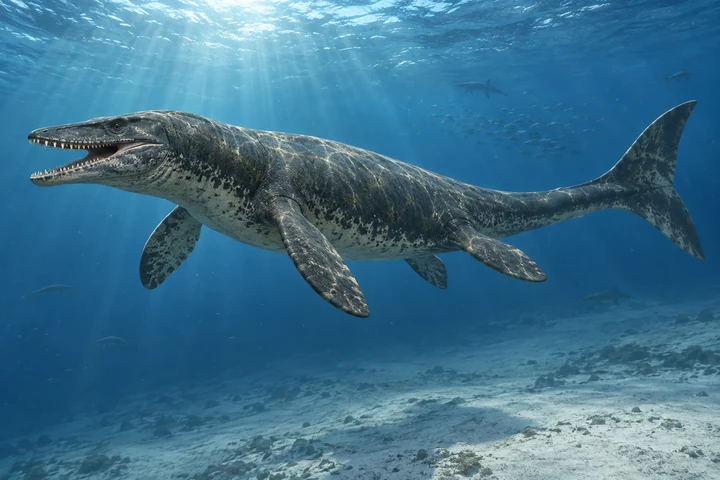
Mosasaurus hoffmanni
Marine reptile
Mosasaurus was a large marine lizard with four flippers, a long tail and toothed jaws. Its size is reconstructed from incomplete fossils.
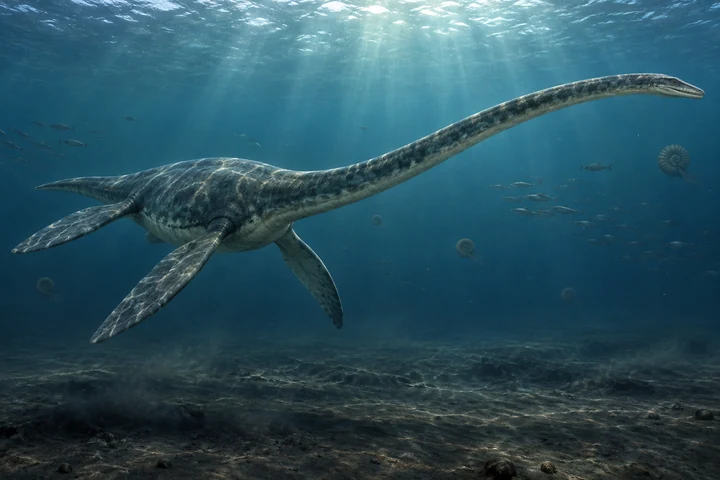
Elasmosaurus platyurus
Marine reptile
Elasmosaurus platyurus was a long-necked marine reptile from Kansas. Re-examination of its type skeleton identified seventy-two neck vertebrae.