
Length
InferredAbout 4.5–6 m (museum reference)
AMNH gives this educational interval for G. burgei, without specimen ages or a measured adult range. Reconstructed mounts need separate interpretation. [D1]
EXHIBIT 91
Gastonia
Gastonia was an armored plant-eater from Utah.
TWO WAYS TO PICTURE THE PAST
Compare the evidence with the familiar movie image. The illustrations are not to a shared scale.
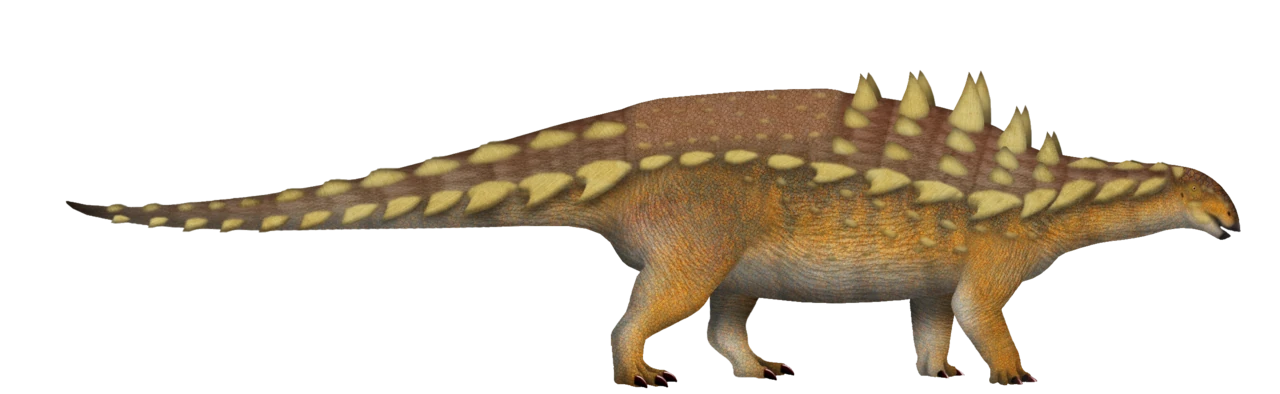
Life reconstruction of Gastonia burgei by TotalDino. Colors, patterns and soft tissues are interpretive; its armor arrangement does not establish a courtship display. [1]
Gastonia TD · TotalDino. CC BY 4.0. Commons-listed 1280 px preview converted to WebP; smaller responsive copy proportionally resized. Artwork preserved.
Scientific reconstruction is an interpretation; source credit does not certify every anatomical detail.
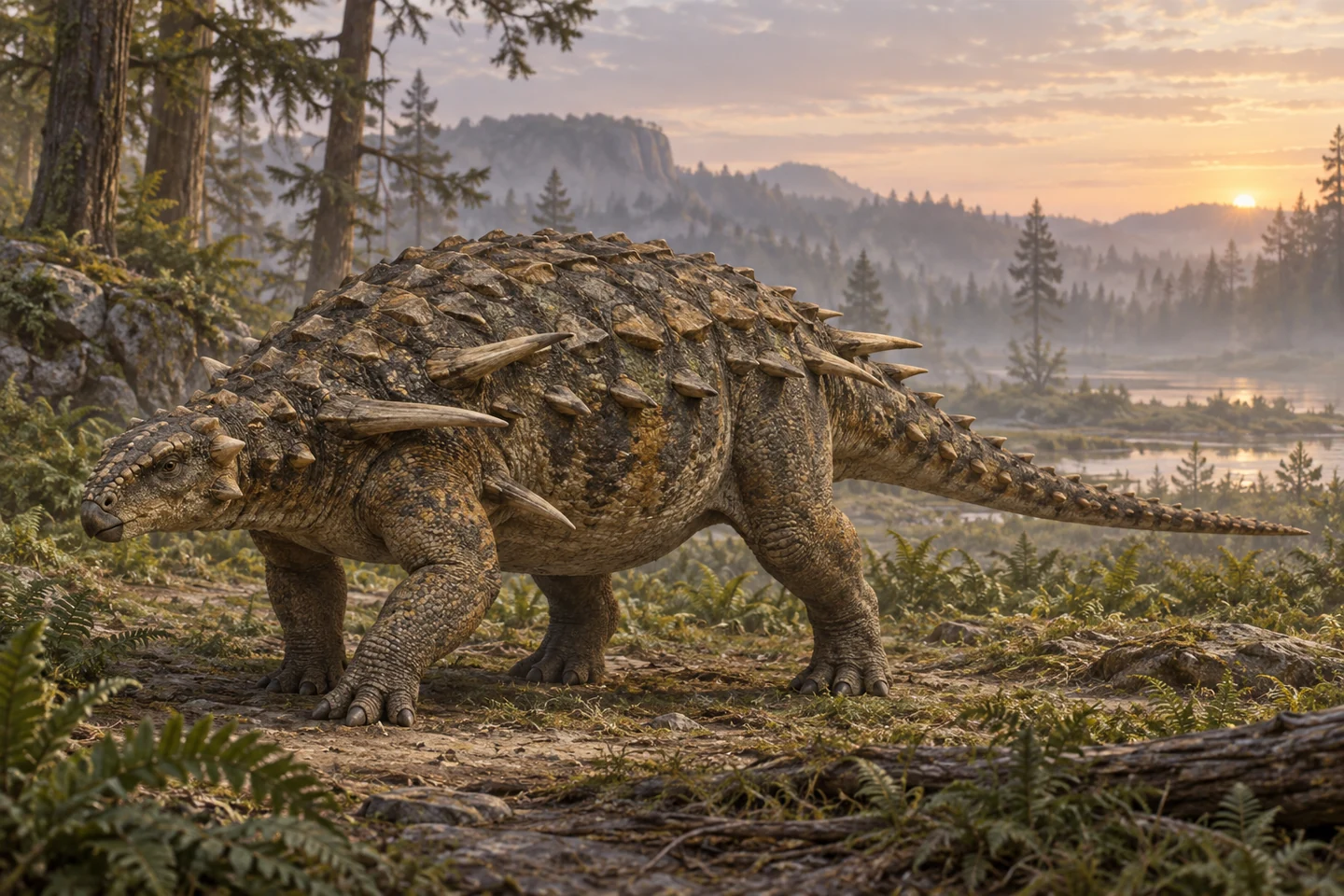
Original cinematic interpretation of Gastonia burgei. Coloration, soft tissues and scenery are artistic choices; reconstructed proportions do not establish a measured individual. Lighting, coloration and scenery are artistic choices. This image does not document a fossil locality or behavior.
Original artwork · artistic interpretation.
Scientific view: source-informed reconstruction, credited paleoart or specimen-based imagery. Movie-style view: Original artistic interpretation. Reconstructions involve uncertainty.
MEET THE ANIMAL
Gastonia was an armored plant-eating dinosaur from Early Cretaceous Utah. Gastonia burgei had prominent shoulder spikes and a broad armored outline, but lacked the large tail club familiar from some later ankylosaurs. A museum size reference introduces its scale without describing a measured adult population. Its own fossil anatomy should guide the picture. [D1]
Its fossils occur in the Cedar Mountain Formation. Geological work places Gastonia burgei in the Yellow Cat Member and the second named species, Gastonia lorriemcwhinneyae, in the overlying Poison Strip Member. Members are subdivisions of a rock formation. Keeping those layers separate helps distinguish the fossil occurrences rather than turning all Gastonia discoveries into one time and place. [D3]
The second species was described from a large collection of disarticulated bones, meaning bones that no longer lay together as connected skeletons. Drought or drowning was suggested as a possible cause of death. A mass-death collection does not automatically show permanent herd behavior, and an interpretation for one species cannot simply be copied to another. Its bones preserve a death assemblage that researchers must explain. [D2]
PREHISTORIC ANIMAL DOSSIER
The animal, the evidence, and the questions still open.
With pelvic armor.
Profile scope: Genus; size references concern G. burgei.
Source supported identifies a description documented by the cited source. Inferred marks a reconstruction or functional estimate. Debated marks competing interpretations. Not established means the sources reviewed for this dossier do not support a firm conclusion; it does not mean a behavior never occurred.
A size reference is an estimate, not a population range. Nesting evidence does not by itself establish courtship, mate choice, or lifelong pairing.
About 4.5–6 m (museum reference)
AMNH gives this educational interval for G. burgei, without specimen ages or a measured adult range. Reconstructed mounts need separate interpretation. [D1]
About 1.4 tonnes (limb model)
CEUM3646 bonebed reconstruction; dataset mature label is not independent confirmation of a complete mature individual or population average. [D5]
Plant-eater
The museum identifies herbivory; particular plant species and feeding height remain unresolved here. [D1]
Utah; Cedar Mountain Formation
G. burgei is recorded in the Yellow Cat Member; UGS places G. lorriemcwhinneyae in the overlying Poison Strip Member. [D4] [D3]
Four-legged walking inferred
The low armored body and ankylosaur limb plan support quadrupedal reconstruction; no speed estimate is established. [D4]
Shoulder spikes; pelvic shield; no tail club
G. burgei combines large spikes with plates and a fused pelvic shield. Its tail lacks an ankylosaurid-style club. [D1] [D2]
Not established here
Focused review found no securely assigned nests, eggs, incubation pattern or parental care for these species.
Not established here
Armor alone does not establish mate choice, sexual dimorphism or a courtship sequence.
G. lorriemcwhinneyae mass-death assemblage
Drought or drowning was proposed for its bonebed. A death assemblage does not establish permanent herds for either species. [D2]
Sources and inspection notes for the claims in this profile.
THE STORY IN THE FOSSILS
Gastonia burgei illustrates an armored dinosaur without a tail club. Its conspicuous shoulder spikes and broad armor distinguish its silhouette from later club-tailed ankylosaurs. [1]
A second named species, G. lorriemcwhinneyae, was described from a large disarticulated bonebed. Proposed causes of death remain hypotheses, and its assemblage cannot simply be applied to G. burgei behavior. [2]
The dossier identifies the scope of each reference estimate. A mount, an individual fossil and a species-wide adult range are different measurements. Comparison metrics remain unavailable where adult scope has not been established. Unknown does not mean zero.
Sources support the stated claims and scopes. Refer to the evidence notes for uncertainty.
KEEP EXPLORING
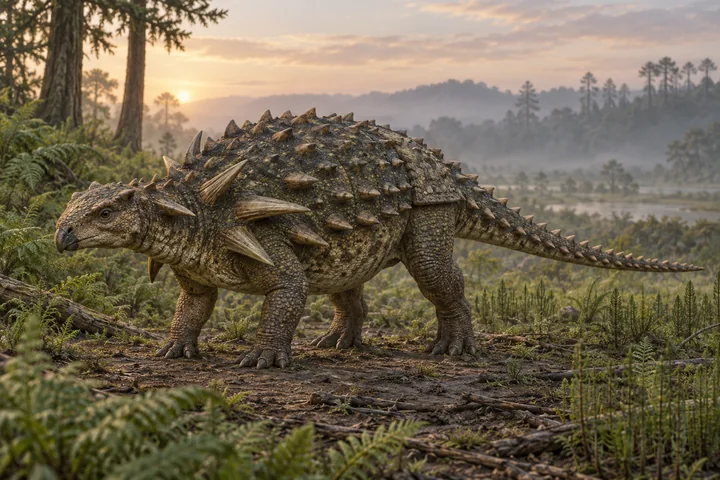
Polacanthus foxii
Polacanthus was an armored plant-eater from England, recognized especially by the bony shield covering its hips.
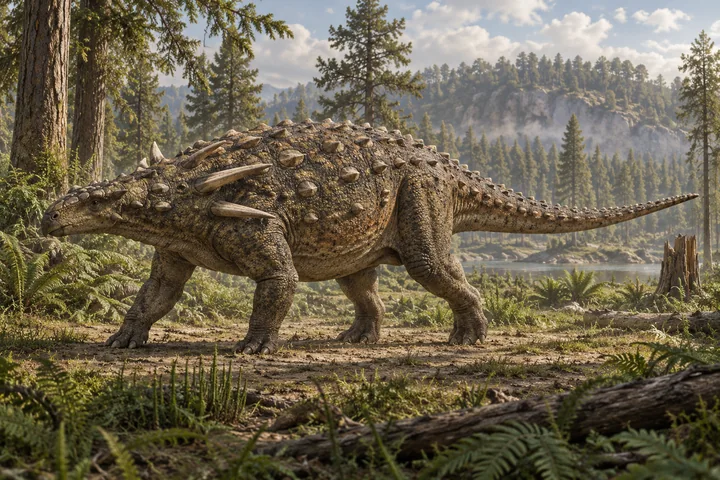
Sauropelta edwardsorum
Sauropelta was an armored plant eater from Early Cretaceous North America. Several partial skeletons preserve armor in place, helping researchers work out how its bony covering fitted around the body.
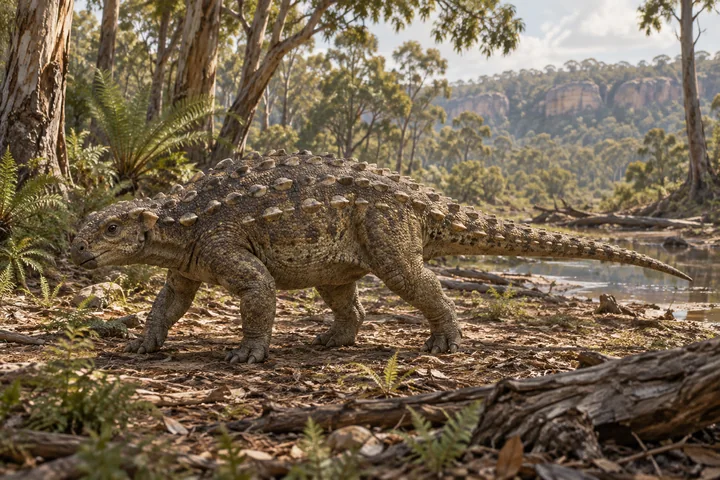
Minmi paravertebra
Minmi is an Australian ankylosaur known from incomplete type material. The more complete skeleton renamed Kunbarrasaurus belongs in a separate profile.