
Length
InferredAbout 3 m (museum reference)
The Australian Museum gives a rounded 3 m reference. Its page does not specify a complete individual, estimation method or life stage, so this is not a measured adult range. [D2]
EXHIBIT 73
Minmi paravertebra
Minmi is an Australian ankylosaur known from incomplete type material. The more complete skeleton renamed Kunbarrasaurus belongs in a separate profile.
TWO WAYS TO PICTURE THE PAST
Compare the evidence with the familiar movie image. The illustrations are not to a shared scale.
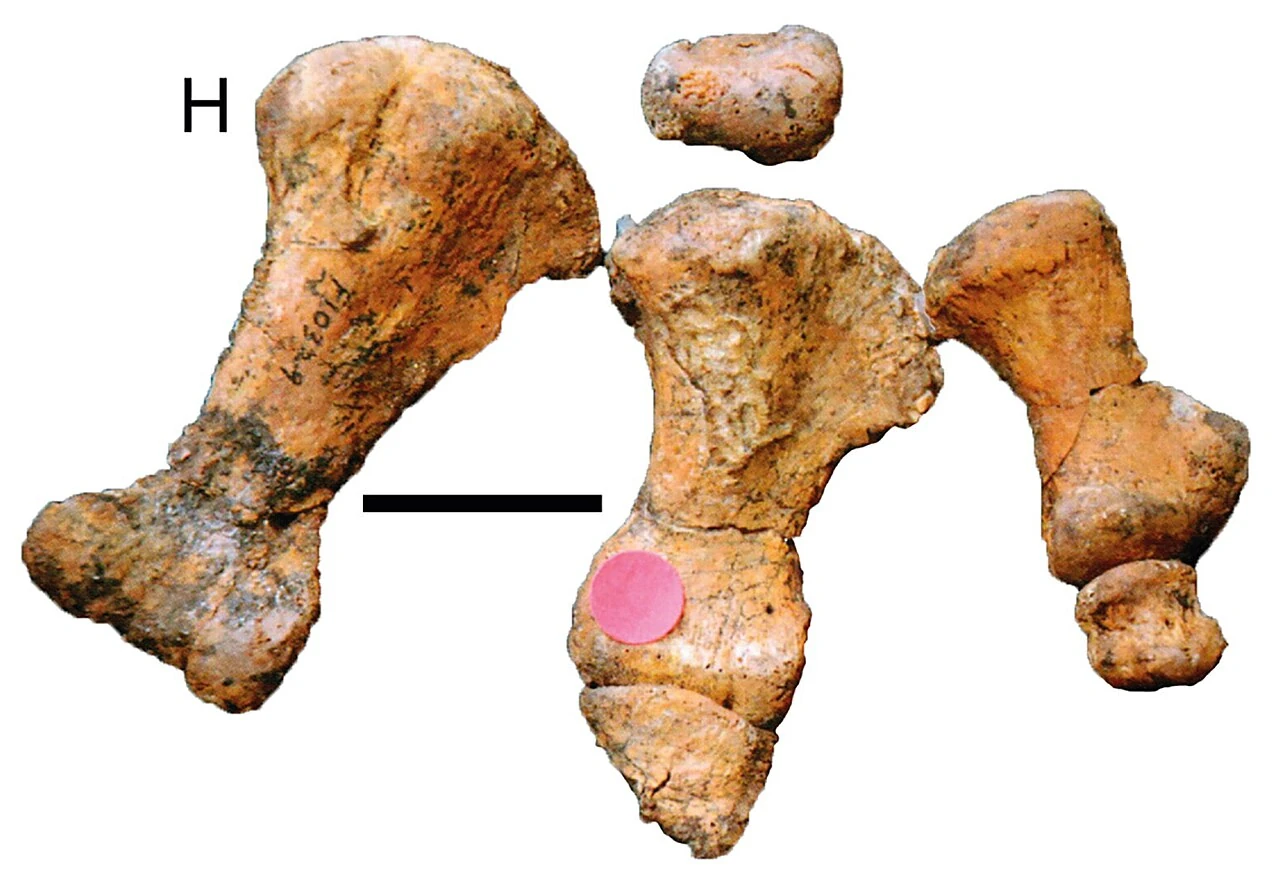
Left foot of the Minmi paravertebra holotype, QM F10329, viewed from below. This is Minmi type material, rather than the skeleton renamed Kunbarrasaurus. The scale bar represents 2 cm; fossil color does not establish living skin color. [1]
Minmi left foot · Stephen F. Poropat, Phil R. Bell, Lachlan J. Hart, Steven W. Salisbury and Benjamin P. Kear. CC BY-SA 4.0. Commons-listed 1280 px preview converted to WebP; smaller responsive copy resized. No crop, color changes or anatomical alterations; these copies remain CC BY-SA 4.0.
The photograph or figure shows the credited fossil material; displayed mounts and labels can include interpretation.
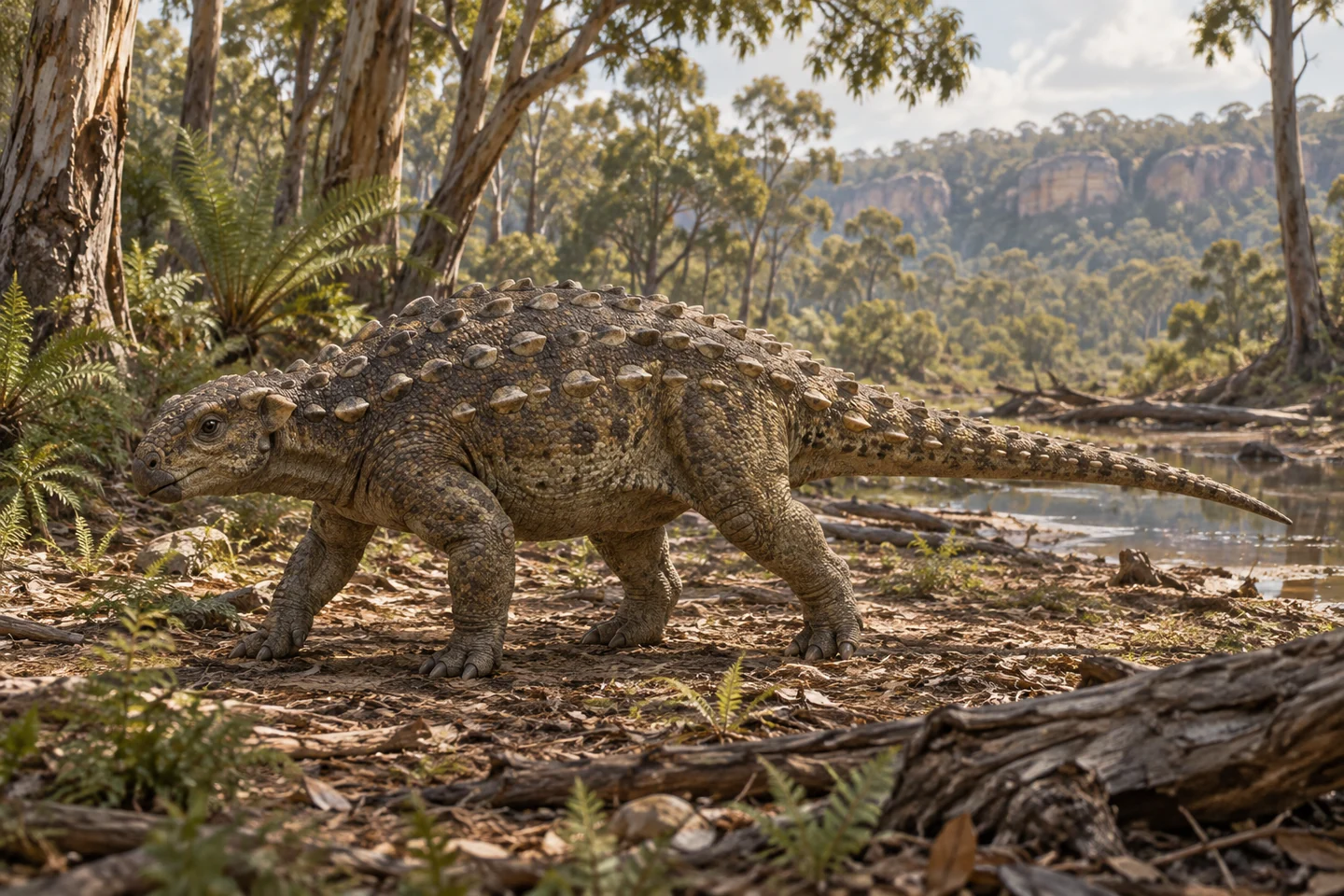
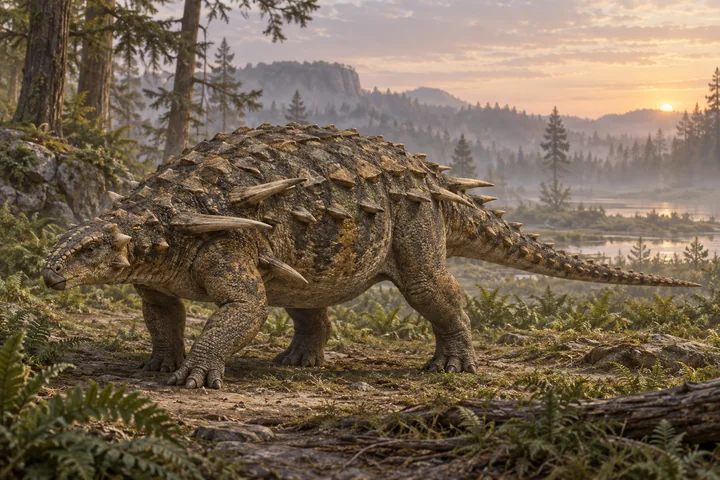
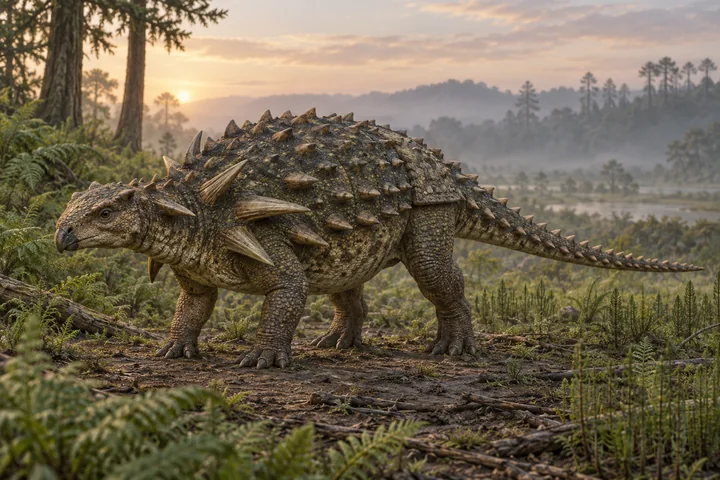
Original cinematic interpretation of Minmi. Anatomy, soft tissues and colors are reconstructed choices. Lighting, coloration and scenery are artistic choices. This image does not document a fossil locality or behavior.
Original artwork · artistic interpretation.
Scientific view: source-informed reconstruction, credited paleoart or specimen-based imagery. Movie-style view: Original artistic interpretation. Reconstructions involve uncertainty.
MEET THE ANIMAL
Minmi is an Australian armored dinosaur known from bones near Roma in southwestern Queensland. The museum reference of about three metres supplies a rough idea of scale rather than the measured length of a complete adult. Its original material is incomplete, so a detailed living outline needs to be treated with care. [D2]
A Queensland skeleton was once placed in Minmi, but a research team recognized it as a different dinosaur in 2015: Kunbarrasaurus ieversi. The revised identification matters because its unusual skull and inner ear belong to that separate animal. They should not simply fill missing parts of a Minmi profile. [S1]
The wider ankylosaur group had armor made from bone embedded in the skin, and its teeth support plant eating. This broader evidence helps interpret Minmi without borrowing the other skeleton's details. Armor can be preserved after its outer covering decays. A restored silhouette therefore combines actual fossil pieces with comparisons, while the original Roma material remains the anchor for Minmi's identity. [S2]
PREHISTORIC ANIMAL DOSSIER
The animal, the evidence, and the questions still open.
Minmi is known from incomplete postcranial fossils. A reassigned skeleton cannot supply its missing skull or species-specific feeding details.
Profile scope: Species: Minmi paravertebra, centered on postcranial holotype QM F10329. Excludes QM F18101, renamed Kunbarrasaurus ieversi in 2015. Minmi's diagnosability is debated.
Source supported identifies a description documented by the cited source. Inferred marks a reconstruction or functional estimate. Debated marks competing interpretations. Not established means the sources reviewed for this dossier do not support a firm conclusion; it does not mean a behavior never occurred.
A size reference is an estimate, not a population range. Nesting evidence does not by itself establish courtship, mate choice, or lifelong pairing.
About 3 m (museum reference)
The Australian Museum gives a rounded 3 m reference. Its page does not specify a complete individual, estimation method or life stage, so this is not a measured adult range. [D2]
Not established here
No adequately scoped mass estimate for Minmi's type material was established in the reviewed sources.
Herbivory inferred from ankylosaur affinity
Ankylosaurs are plant eaters. Gut contents from formerly referred material cannot automatically be transferred to Minmi's holotype. [D1]
Lower Aptian Bungil Formation, Queensland
The reviewed regional study places Minmi in the Bungil Formation of Queensland. Its type locality is near Roma; a particular preferred terrestrial habitat remains unresolved. [D3] [D1]
Quadrupedal ankylosaur
Four-legged movement follows its ankylosaur anatomy. Claims that it outran predators are not treated as measured performance. [D1] [D2]
Postcranial bones and paravertebral elements
QM F10329 preserves postcranial material. Its paravertebral elements concern ossified tissues along the back; the skull of Kunbarrasaurus is not Minmi's skull. [D1]
Not established here
Minmi nest structure, incubation and parental care are not established by the reviewed type-material sources.
Not established here
The reviewed sources do not establish Minmi mating behavior, sexual differences or display colors.
Not established here
The incomplete type specimen does not establish herd structure, group defense or solitary living.
Sources and inspection notes for the claims in this profile.
THE STORY IN THE FOSSILS
Minmi's type material belongs to the Early Cretaceous Bungil Formation of Queensland. Its taxonomic validity is debated: some researchers regard it as insufficiently diagnostic, while others consider it distinguishable from Australia's other ankylosaurs. [3]
A much more complete Queensland skeleton once called Minmi sp. was named Kunbarrasaurus ieversi in 2015. That reassignment matters: its skull and feeding evidence cannot simply fill the gaps in a profile of Minmi paravertebra. [1]
The dossier identifies the scope of each reference estimate. A mount, an individual fossil and a species-wide adult range are different measurements. Comparison metrics remain unavailable where adult scope has not been established. Unknown does not mean zero.
Sources support the stated claims and scopes. Refer to the evidence notes for uncertainty.
KEEP EXPLORING
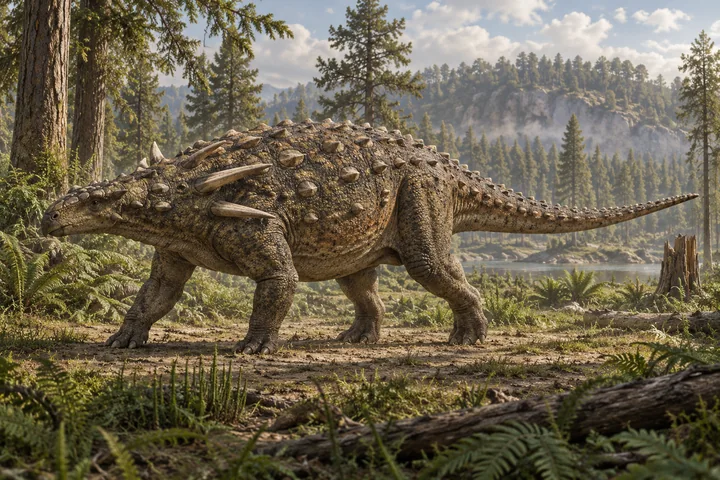
Sauropelta edwardsorum
Sauropelta was an armored plant eater from Early Cretaceous North America. Several partial skeletons preserve armor in place, helping researchers work out how its bony covering fitted around the body.
Polacanthus foxii
Polacanthus was an armored plant-eater from England, recognized especially by the bony shield covering its hips.