
Length
InferredAbout 5.2 m (AMNH 3036 reconstruction)
Carpenter's reconstruction estimate applies to AMNH 3036. NHM separately gives 6.5 m without specimen or life stage; these are not endpoints of a biological range. [D2] [D1]
EXHIBIT 72
Sauropelta edwardsorum
Sauropelta was an armored plant eater from Early Cretaceous North America. Several partial skeletons preserve armor in place, helping researchers work out how its bony covering fitted around the body.
TWO WAYS TO PICTURE THE PAST
Compare the evidence with the familiar movie image. The illustrations are not to a shared scale.
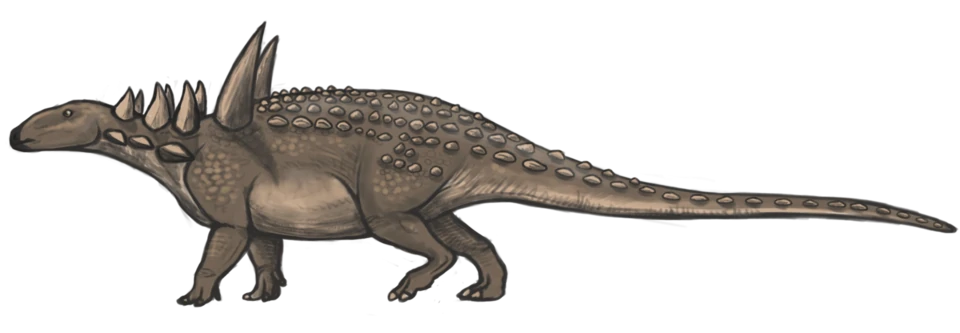
Life reconstruction of Sauropelta edwardsorum by Emily Willoughby. The armor is based on fossil anatomy; living color, pattern and surrounding soft tissues remain interpretive. [1]
Sauropelta reconstruction · Emily Willoughby (Ferahgo the Assassin). CC BY-SA 3.0. Commons-listed 960 px preview converted to WebP; smaller responsive copy resized. Artwork and transparency preserved; these copies remain CC BY-SA 3.0.
Scientific reconstruction is an interpretation; source credit does not certify every anatomical detail.
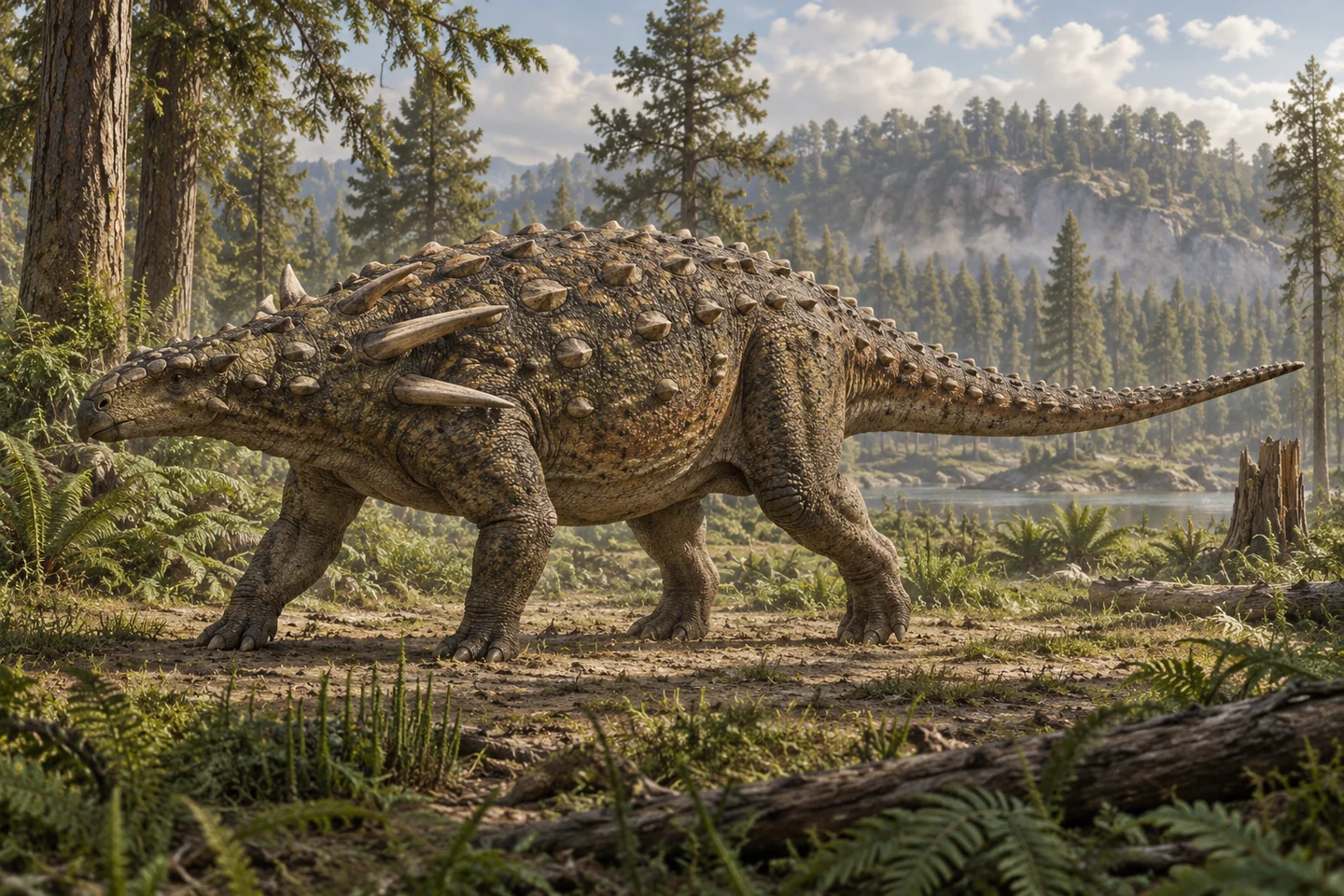
Original cinematic interpretation of Sauropelta. Anatomy, soft tissues and colors are reconstructed choices. Lighting, coloration and scenery are artistic choices. This image does not document a fossil locality or behavior.
Original artwork · artistic interpretation.
Scientific view: source-informed reconstruction, credited paleoart or specimen-based imagery. Movie-style view: Original artistic interpretation. Reconstructions involve uncertainty.
MEET THE ANIMAL
Sauropelta was an armored plant eater from Early Cretaceous North America. Its large shoulder spines gave this nodosaur a distinctive outline. [D1]
Its wider ankylosaur group had armor made from bone embedded in the skin. Such bones are called osteoderms. Researchers infer that many carried an outer covering of keratin, the material in fingernails, although that covering usually decays. Understanding this broader evidence helps distinguish preserved bony armor from the complete covering restored around it. [S1]
One museum specimen preserves skull and jaw material, backbone bones, limbs, feet, and armor from Montana's Cloverly Formation. Those identified parts anchor a reconstruction; missing pieces still need to be restored through comparison. [D3]
The armor of ankylosaurs probably helped protect them, but researchers consider several possible functions. That uncertainty matters when imagining Sauropelta. Shoulder spines are recognizable anatomy; a particular defensive action or mating display needs further evidence. An armored outline can be reconstructed more confidently than a daily routine, and broad comparisons should not become observations of this species. [S1]
PREHISTORIC ANIMAL DOSSIER
The animal, the evidence, and the questions still open.
Fossils preserve Sauropelta shoulder spines and body armor, informing its reconstruction.
Profile scope: Species: Sauropelta edwardsorum, published in older sources as S. edwardsi. The 1984 size estimates concern reconstructed AMNH 3036, not a measured adult population range.
Source supported identifies a description documented by the cited source. Inferred marks a reconstruction or functional estimate. Debated marks competing interpretations. Not established means the sources reviewed for this dossier do not support a firm conclusion; it does not mean a behavior never occurred.
A size reference is an estimate, not a population range. Nesting evidence does not by itself establish courtship, mate choice, or lifelong pairing.
About 5.2 m (AMNH 3036 reconstruction)
Carpenter's reconstruction estimate applies to AMNH 3036. NHM separately gives 6.5 m without specimen or life stage; these are not endpoints of a biological range. [D2] [D1]
About 1,500 kg (reconstruction model)
Carpenter estimated reconstructed AMNH 3036's living mass using a clay model. The estimate is method-dependent; reviewed excerpts do not establish maturity or uncertainty bounds. [D2]
Plant eater
NHM identifies herbivory. Particular plants, seasonal diet and feeding preferences are not established by this profile. [D1]
Cloverly Formation, western USA
The restoration paper uses material from Wyoming and Montana. AMNH FR 3035 has a recorded Montana Cloverly locality; fossil provenance does not alone establish habitat preference. [D2] [D3]
Four-legged walking reconstructed
The skeletal and foot restoration supports quadrupedal walking. A proposed match to Tetrapodosaurus tracks is an attribution hypothesis, not a skeleton found beside its footprints. [D2]
Body armor and large shoulder spines
NHM identifies the shoulder spines. AMNH FR 3035 includes dermal plates and body armor among its preserved components. [D1] [D3]
Not established here
The reviewed Sauropelta sources do not establish nesting arrangements, incubation or parental care.
Not established here
Shoulder spines do not by themselves reveal sexual differences or a mating display. No courtship sequence is established in this review.
Not established here
Material combined from several skeletons does not demonstrate herd behavior or cooperative defense.
Sources and inspection notes for the claims in this profile.
THE STORY IN THE FOSSILS
Sauropelta was a nodosaurid armored dinosaur and plant eater. Large shoulder spines formed an especially conspicuous part of its body plan, although their presence does not reveal a courtship ritual. [1]
An AMNH collection record for FR 3035 lists skull and jaw material, vertebrae, limb and foot bones, dermal plates and body armor from Montana's Cloverly Formation. Such fossils anchor reconstructions in real anatomy, even when missing parts still require interpretation. [3]
The dossier identifies the scope of each reference estimate. A mount, an individual fossil and a species-wide adult range are different measurements. Comparison metrics remain unavailable where adult scope has not been established. Unknown does not mean zero.
Sources support the stated claims and scopes. Refer to the evidence notes for uncertainty.
KEEP EXPLORING
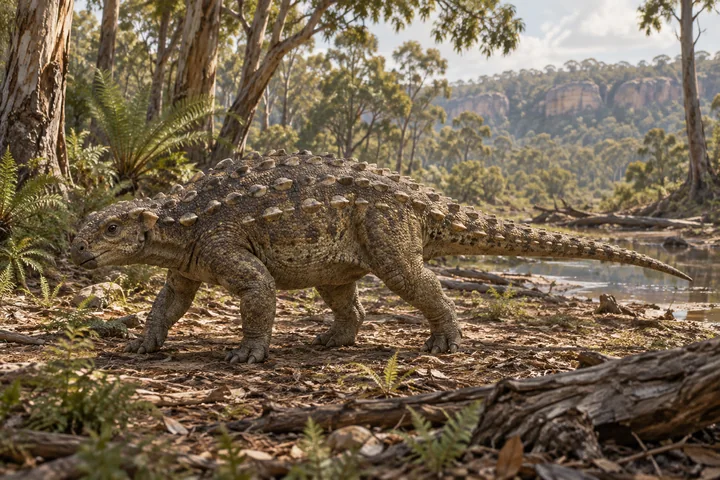
Minmi paravertebra
Minmi is an Australian ankylosaur known from incomplete type material. The more complete skeleton renamed Kunbarrasaurus belongs in a separate profile.
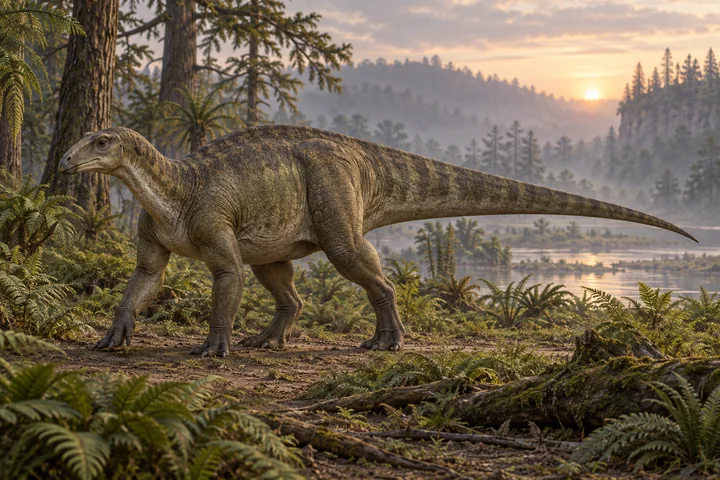
Tenontosaurus tilletti
Tenontosaurus offers evidence of growth, juvenile associations and reproduction before full skeletal maturity.
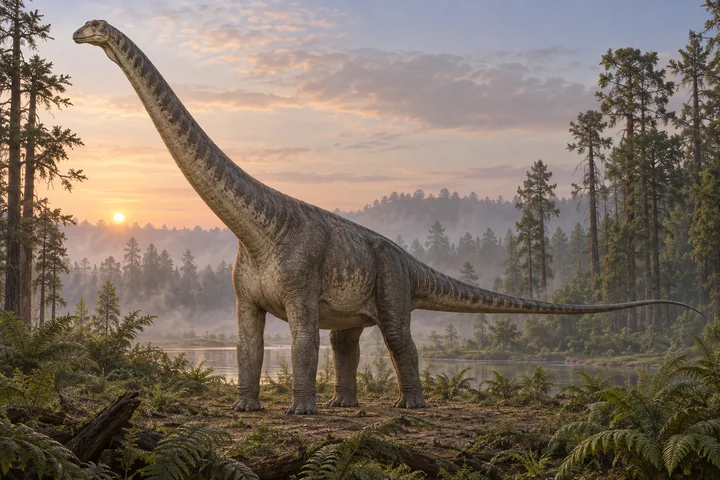
Sauroposeidon proteles
Sauroposeidon was an Early Cretaceous North American sauropod distinguished by extremely elongated, air-filled neck vertebrae.