
Body length
Not establishedNot established here
The 2000 paper extrapolated an 11.25–12 m neck from a Giraffatitan composite comparison. This is neither an observed neck nor total body length. [D1]
EXHIBIT 88
Sauroposeidon proteles
Sauroposeidon was an Early Cretaceous North American sauropod distinguished by extremely elongated, air-filled neck vertebrae.
TWO WAYS TO PICTURE THE PAST
Compare the evidence with the familiar movie image. The illustrations are not to a shared scale.
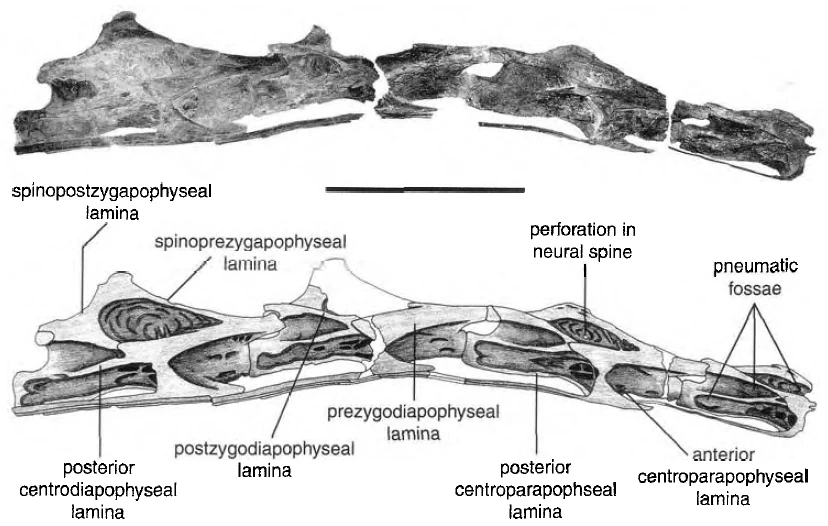
Sauroposeidon type neck vertebrae OMNH 53062, illustrated by Wedel, Cifelli and Sanders (2000). The lower outline includes restored ribs; the original metre scale is retained. This is a partial neck, not a complete animal. [1]
Sauroposeidon.jpg · Mathew J. Wedel; Richard L. Cifelli; R. Kent Sanders. CC BY 2.0. Resized proportionally and converted to WebP; no anatomical edits. Same source license applies.
The photograph or figure shows the credited fossil material; displayed mounts and labels can include interpretation.
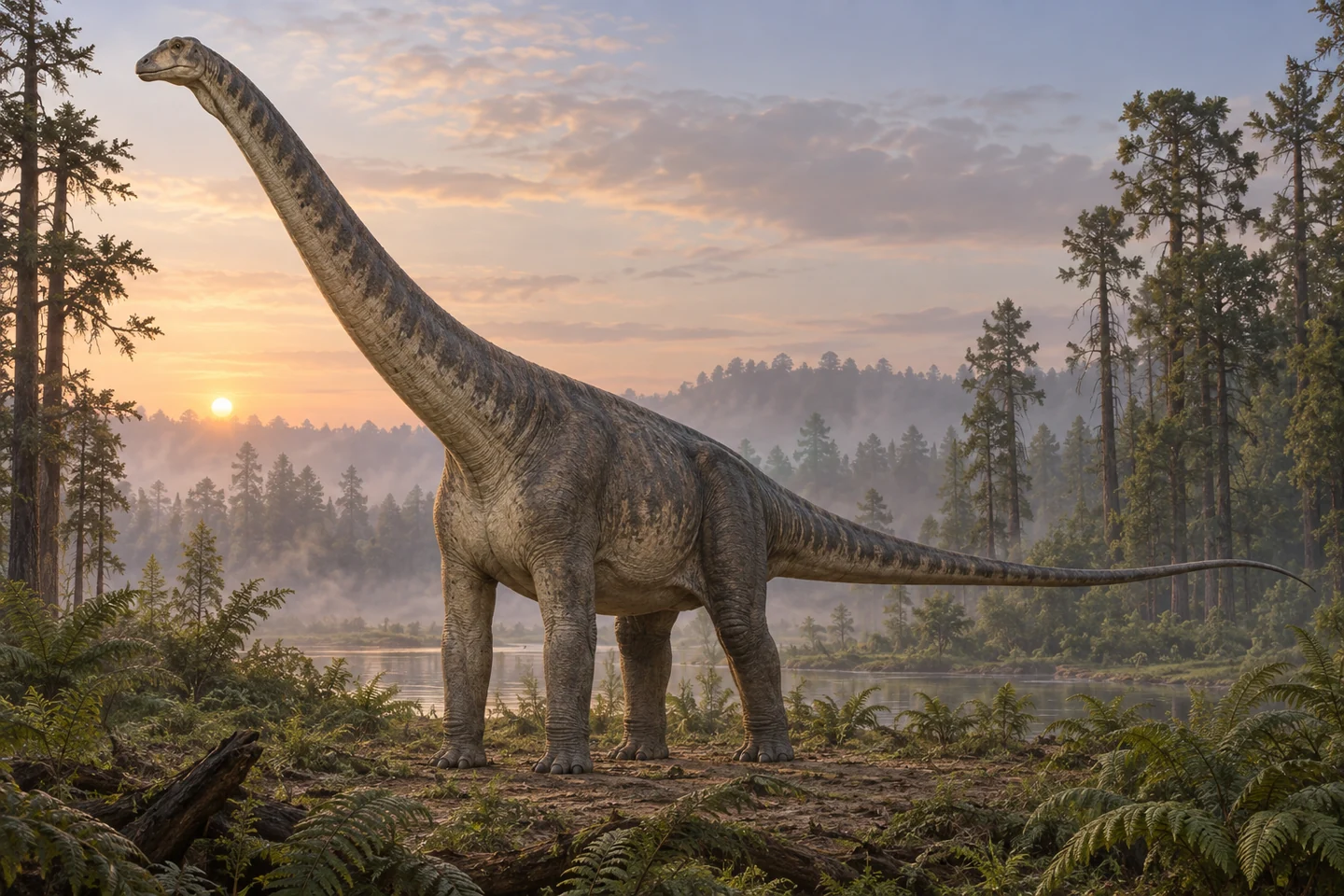
Original cinematic interpretation of Sauroposeidon proteles. Coloration, soft tissues and scenery are artistic choices; reconstructed proportions do not establish a measured individual. Whole-body proportions and neck posture are reconstructed. Lighting, coloration and scenery are artistic choices. This image does not document a fossil locality or behavior.
Original artwork · artistic interpretation.
Scientific view: source-informed reconstruction, credited paleoart or specimen-based imagery. Movie-style view: Original artistic interpretation. Reconstructions involve uncertainty.
MEET THE ANIMAL
Sauroposeidon was a sauropod from Early Cretaceous central North America. Revisions have brought material from different localities under this name, including Texas fossils once called Paluxysaurus. That history matters when comparing the discoveries: a renamed dinosaur does not become another animal, and different-sized specimens need not belong to different genera. [D2] [D3]
The Texas material adds limbs to the picture. Forelimb and hindlimb bones support a reconstruction moving on four legs. At least four individuals occurred in the river-related deposits at Jones Ranch. Their shared burial allows questions about gathering, but it does not by itself demonstrate a permanent herd. A quarry records preservation as well as the lives of its animals. [D4]
The original Oklahoma material preserves exceptionally elongated neck bones with internal air spaces. Their striking proportions help explain its familiar long-necked reconstruction, although most of the original animal is missing. [D1]
Sauropod-wide studies have considered whether necks could have had roles in mate attraction. Such discussions do not establish Sauroposeidon's courtship. Its remarkable neck is evidence of anatomy, while the behavior of a living animal requires a different kind of support. [D5]
PREHISTORIC ANIMAL DOSSIER
The animal, the evidence, and the questions still open.
Four remarkable neck vertebrae anchored its original description.
Profile scope: Genus profile centered on Sauroposeidon proteles, including material historically named Paluxysaurus; complete body dimensions remain uncertain.
Source supported identifies a description documented by the cited source. Inferred marks a reconstruction or functional estimate. Debated marks competing interpretations. Not established means the sources reviewed for this dossier do not support a firm conclusion; it does not mean a behavior never occurred.
A size reference is an estimate, not a population range. Nesting evidence does not by itself establish courtship, mate choice, or lifelong pairing.
Not established here
The 2000 paper extrapolated an 11.25–12 m neck from a Giraffatitan composite comparison. This is neither an observed neck nor total body length. [D1]
Not established here
The original 50–60-tonne suggestion depended on an assumed brachiosaur-like body. Reviewed evidence does not establish a reliable complete-individual mass. [D1]
Plant-eater; feeding height uncertain
Sauropod affinity supports herbivory. The original paper models possible feeding envelopes; actual posture and a specific plant menu remain uncertain. [D1]
Early Cretaceous central North America
Oklahoma’s Antlers and Texas’s Trinity material are included by revision; separate Cloverly specimens extend referrals into Wyoming. [D2] [D3]
Four-legged terrestrial walker
Texas material preserves forelimb and hindlimb bones supporting a quadrupedal reconstruction after its referral to Sauroposeidon. [D4] [D2]
Extremely elongated, pneumatic neck vertebrae
OMNH 53062 preserves four neck vertebrae with extensive internal air spaces. A complete living neck and body outline require reconstruction. [D1]
Not established here
Focused searches and reviewed anatomical studies do not establish Sauroposeidon clutches, nesting sites or parental care.
Not established here
A long neck alone does not establish sexual display. The reviewed sauropod study finds existing evidence insufficient to reconstruct courtship. [D5]
Multiple individuals; herd structure unresolved
Jones Ranch contains at least four individuals in fluvial deposits. Shared burial is compatible with aggregation but does not by itself establish persistent herds. [D4]
Sources and inspection notes for the claims in this profile.
THE STORY IN THE FOSSILS
The Oklahoma type consists of four extraordinarily elongated neck vertebrae. Their internal structure supports extensive pneumaticity, while total-body estimates require assumptions about missing parts. [1]
Texas fossils originally named Paluxysaurus are included here following D’Emic’s revision. Their smaller size and immaturity do not justify counting them as a second genus in the catalog. [2]
The dossier identifies the scope of each reference estimate. A mount, an individual fossil and a species-wide adult range are different measurements. Comparison metrics remain unavailable where adult scope has not been established. Unknown does not mean zero.
Sources support the stated claims and scopes. Refer to the evidence notes for uncertainty.
KEEP EXPLORING
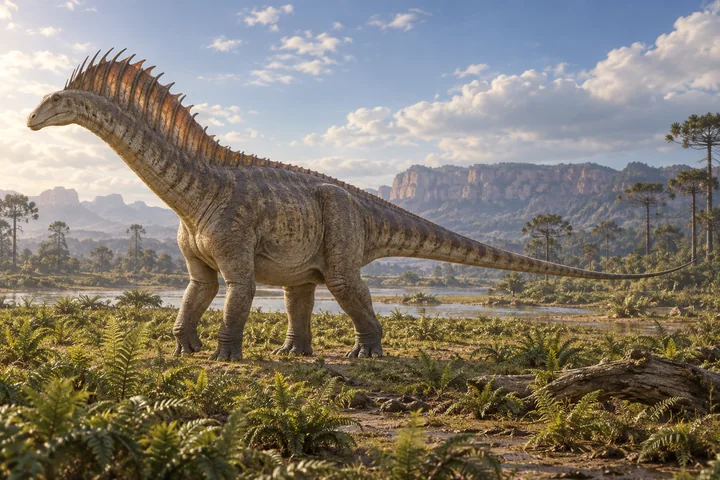
Amargasaurus cazaui
Amargasaurus cazaui was an Early Cretaceous sauropod from Argentina with paired elongated neck spines. Bone histology supports connected soft tissue rather than separate horn sheaths.
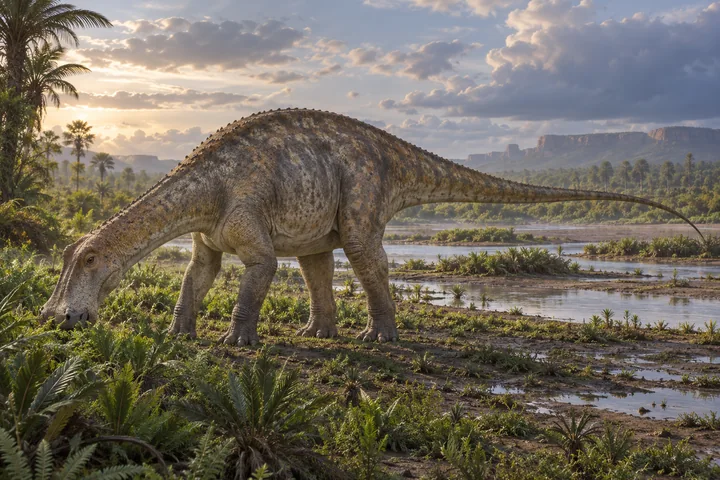
Nigersaurus taqueti
Nigersaurus was a plant-eating sauropod from Niger with an unusually broad muzzle and tightly packed tooth batteries. Its skull offers a detailed window into feeding close to the ground.
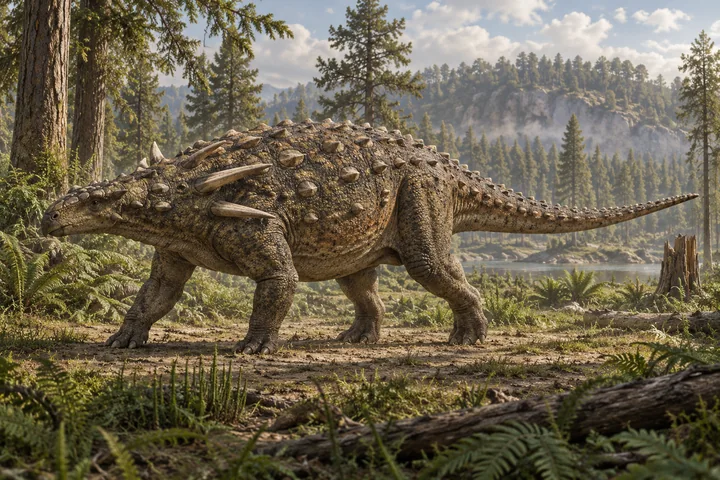
Sauropelta edwardsorum
Sauropelta was an armored plant eater from Early Cretaceous North America. Several partial skeletons preserve armor in place, helping researchers work out how its bony covering fitted around the body.