
Length
InferredAbout 9 m (composite skeleton)
The 2007 reconstruction combines and rescales multiple partial skeletons. It is not a measured individual or an adult population interval. [D1]
EXHIBIT 71
Nigersaurus taqueti
Nigersaurus was a plant-eating sauropod from Niger with an unusually broad muzzle and tightly packed tooth batteries. Its skull offers a detailed window into feeding close to the ground.
TWO WAYS TO PICTURE THE PAST
Compare the evidence with the familiar movie image. The illustrations are not to a shared scale.
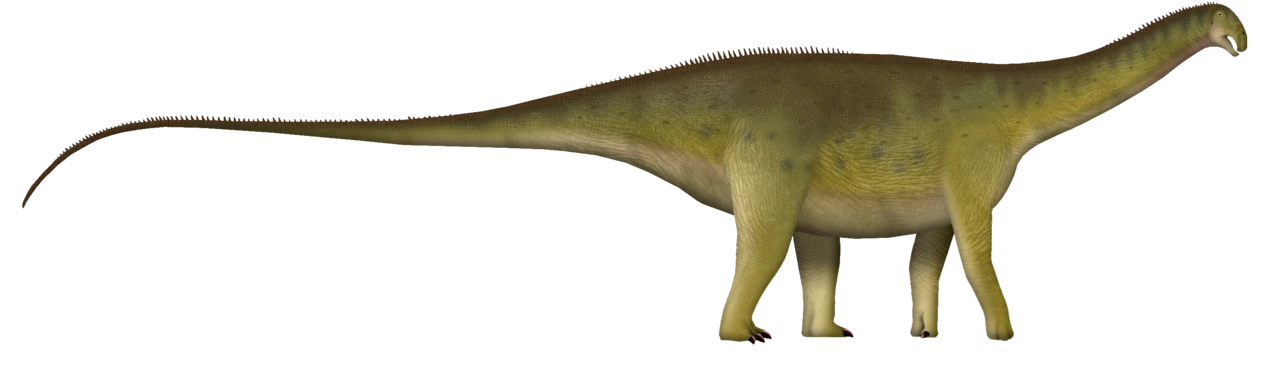
Life reconstruction of Nigersaurus taqueti by TotalDino. Color, pattern and soft-tissue details are interpretive, and the pose does not establish a habitual neck position. [2]
Nigersaurus TD · TotalDino. CC BY 4.0. Commons-listed 1280 px preview converted to WebP; smaller responsive copy resized. Artwork and transparency preserved.
Scientific reconstruction is an interpretation; source credit does not certify every anatomical detail.
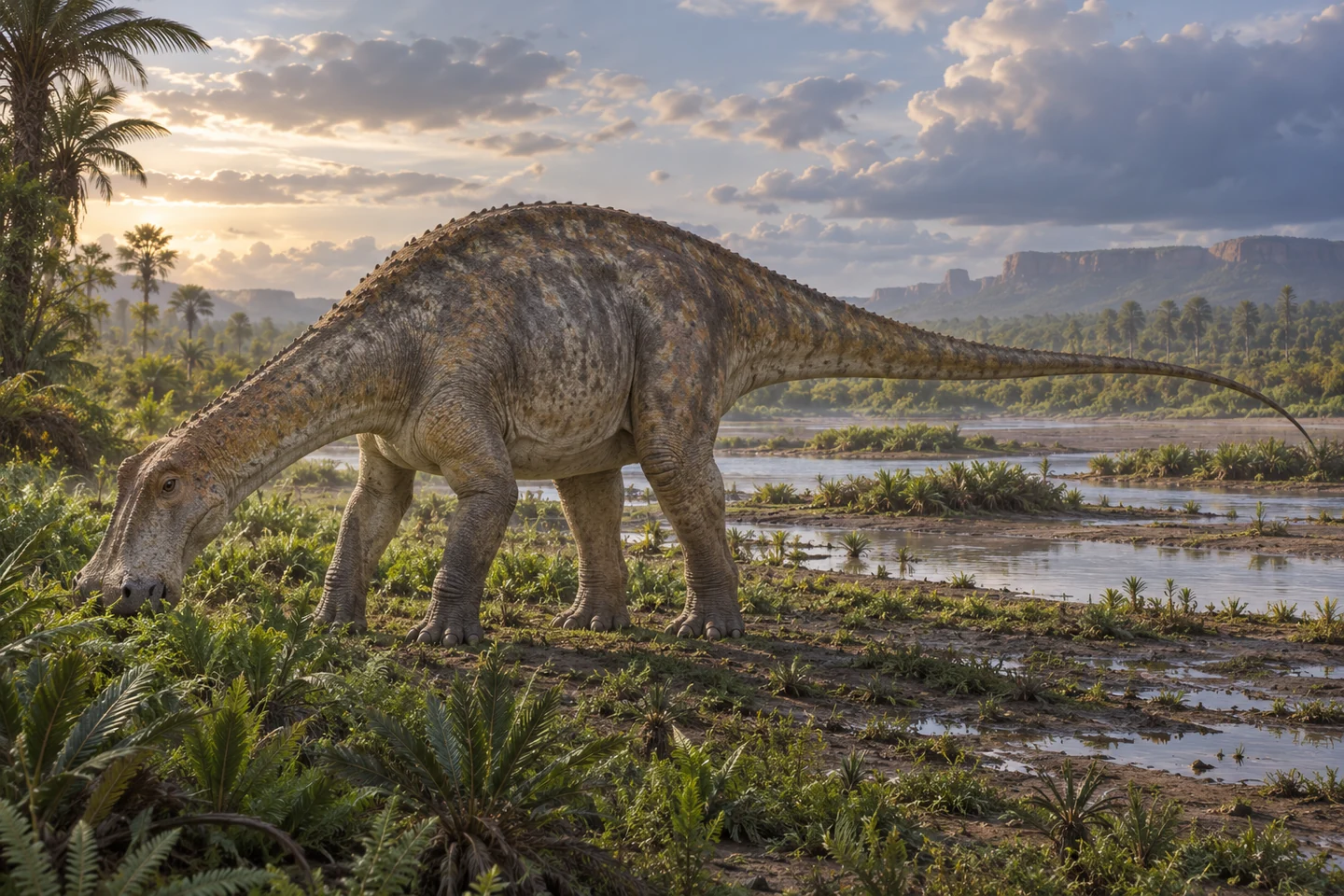
Original cinematic interpretation of Nigersaurus. Anatomy, soft tissues and colors are reconstructed choices. Lighting, coloration and scenery are artistic choices. This image does not document a fossil locality or behavior.
Original artwork · artistic interpretation.
Scientific view: source-informed reconstruction, credited paleoart or specimen-based imagery. Movie-style view: Original artistic interpretation. Reconstructions involve uncertainty.
MEET THE ANIMAL
Nigersaurus was a plant-eating dinosaur from what is now Niger. The researcher's account places it around 110 million years ago and describes a lush environment, quite different from the modern Sahara Desert. Its unusually wide mouth was adapted for gathering plants close to the ground, making the skull a particularly informative part of its body. [S1]
The broad, straight-edged muzzle carried more than 500 replaceable teeth. New teeth could take over as working teeth wore down. Its delicate skull was among the early dinosaur skulls reconstructed digitally with CT scans, letting researchers examine structures that were difficult to study as an intact physical object. The feeding system is supported more clearly than any exact list of plants eaten. [S1]
The field account also describes uncovering a partial skeleton and a tiny upper jaw attributed to a hatchling. These finds show how discoveries can expand the picture from a distinctive adult outline to early growth. The jaw's small size does not reveal a nest arrangement or parental feeding. Nigersaurus offers a fossil-based portrait of unusual feeding equipment while leaving much of its family life uncertain. [S1]
PREHISTORIC ANIMAL DOSSIER
The animal, the evidence, and the questions still open.
Nigersaurus had a remarkably delicate skull with its teeth concentrated across the front of broad jaws. Tooth wear and replacement helped researchers reconstruct a specialized plant-feeding system.
Profile scope: Species: Nigersaurus taqueti. The published 9 m skeleton is a composite of size-adjusted individuals; it is not one complete individual or a species size range.
Source supported identifies a description documented by the cited source. Inferred marks a reconstruction or functional estimate. Debated marks competing interpretations. Not established means the sources reviewed for this dossier do not support a firm conclusion; it does not mean a behavior never occurred.
A size reference is an estimate, not a population range. Nesting evidence does not by itself establish courtship, mate choice, or lifelong pairing.
About 9 m (composite skeleton)
The 2007 reconstruction combines and rescales multiple partial skeletons. It is not a measured individual or an adult population interval. [D1]
About 4 tonnes (2007 approximation)
The paper gives an approximate elephant-scale mass, without an uncertainty interval or demonstrated species maximum. This is separate from a directly weighed fossil animal. [D1]
Cropping low-growing plants
Jaw form and dental wear support low browsing. Ferns and horsetails are proposed foods; the reviewed account does not identify a preserved meal. [D2]
Early Cretaceous Niger
The research-team account places the bones in roughly 110-million-year-old rocks of today's Ténéré Desert. A modern desert locality does not establish a desert lifestyle. [D3]
Four-legged support
The reconstructed sauropod skeleton supports quadrupedal movement. The reviewed study does not establish running speed. [D1]
Broad muzzle and dental batteries
CT work revealed more than 500 working and replacement teeth at the front of the jaws. Replacement crowns sustained rapid tooth turnover. [D2]
Not established here
The reviewed sources do not establish Nigersaurus nest construction, incubation or parental care.
Not established here
The reviewed sources do not identify a Nigersaurus courtship sequence, mating system or sex-specific display.
Not established here
Combining individuals into a museum reconstruction does not show that they formed a living herd. Social organization is unresolved in this review.
Sources and inspection notes for the claims in this profile.
THE STORY IN THE FOSSILS
Nigersaurus taqueti comes from the Early Cretaceous of Niger. Research on fossils from the Ténéré region used CT scanning and physical modeling to study a skull whose delicate bones made conventional reconstruction difficult. [3]
Its tooth-bearing jaws were broad and square. Researchers interpreted this apparatus as a way to crop plants near the ground, with replacement teeth taking over as the working crowns wore down. That feeding reconstruction does not reveal the animal's courtship or family life. [2]
The dossier identifies the scope of each reference estimate. A mount, an individual fossil and a species-wide adult range are different measurements. Comparison metrics remain unavailable where adult scope has not been established. Unknown does not mean zero.
Sources support the stated claims and scopes. Refer to the evidence notes for uncertainty.
KEEP EXPLORING
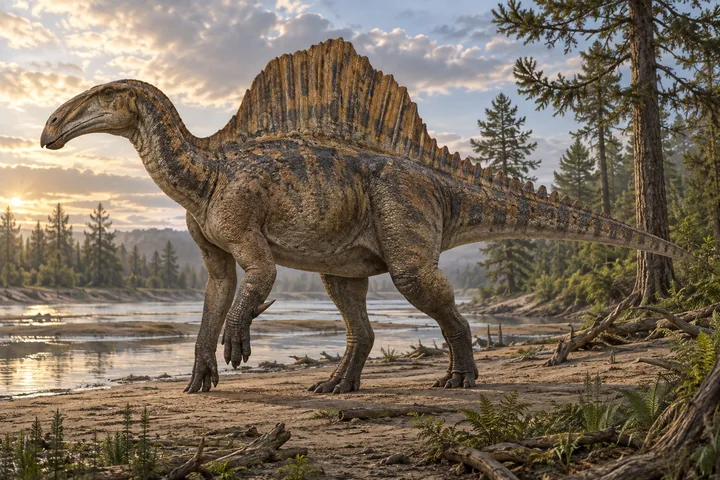
Ouranosaurus nigeriensis
Ouranosaurus nigeriensis was a plant-eating ornithopod from Niger with tall vertebral spines. Studies investigate their possible roles and skeleton growth stages.
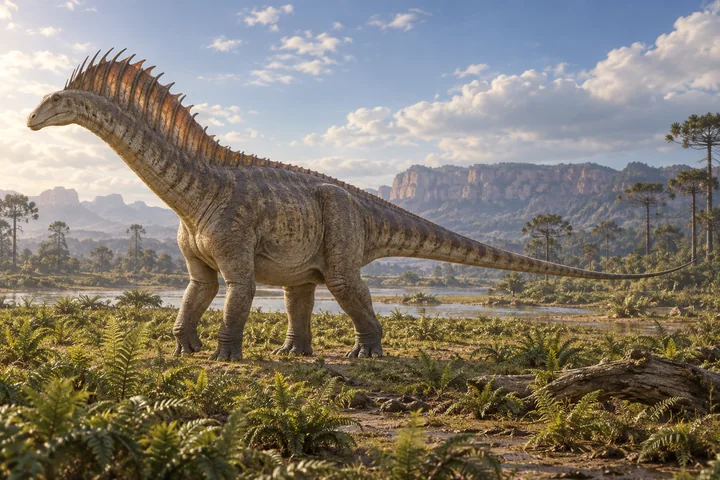
Amargasaurus cazaui
Amargasaurus cazaui was an Early Cretaceous sauropod from Argentina with paired elongated neck spines. Bone histology supports connected soft tissue rather than separate horn sheaths.
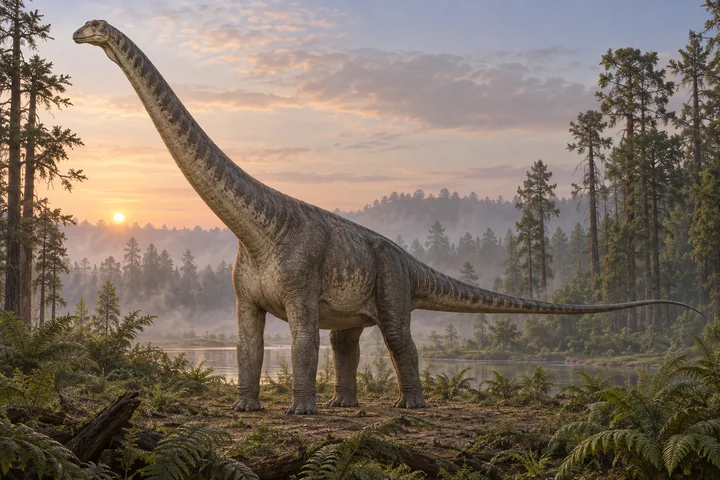
Sauroposeidon proteles
Sauroposeidon was an Early Cretaceous North American sauropod distinguished by extremely elongated, air-filled neck vertebrae.