
Body length
InferredAbout 6.5 m; incomplete Venice mount
The 2017 study reports a mount about 6.5 m long, with the tail tip missing. Histology identifies a subadult, so this is not a full-grown maximum. [D2]
EXHIBIT 67
Ouranosaurus nigeriensis
Ouranosaurus nigeriensis was a plant-eating ornithopod from Niger with tall vertebral spines. Studies investigate their possible roles and skeleton growth stages.
TWO WAYS TO PICTURE THE PAST
Compare the evidence with the familiar movie image. The illustrations are not to a shared scale.
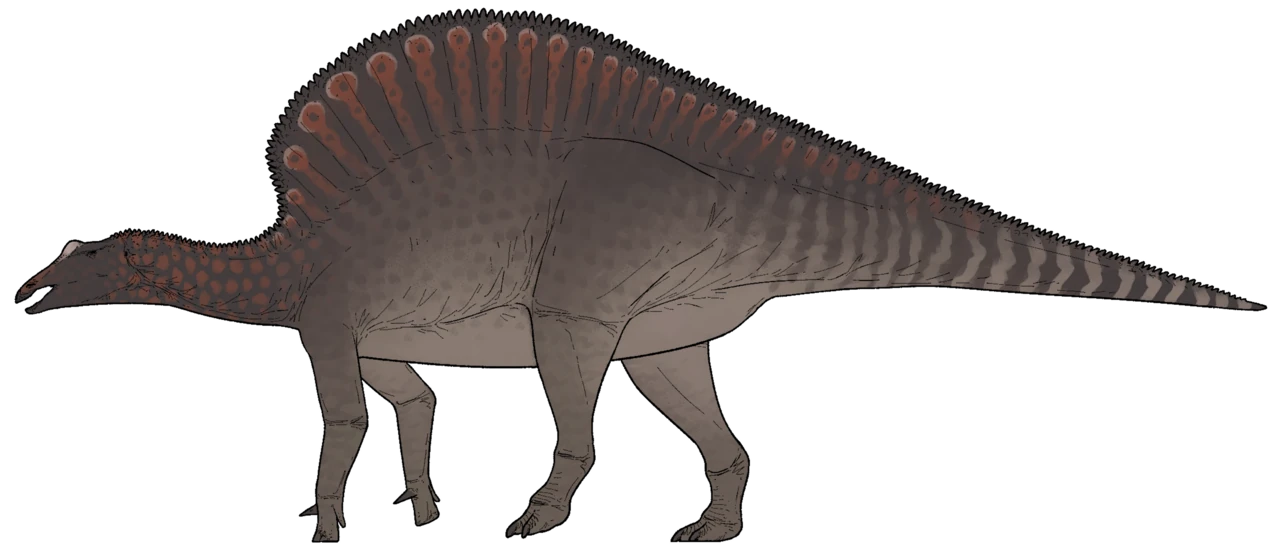
Artist reconstruction of Ouranosaurus nigeriensis. Sail outline, colours and other soft tissues are interpretive; display or mating behavior is not demonstrated. [2]
Ouranosaurus nigeriensis.png · Connor Ashbridge (Ddinodan). CC BY 4.0. Resized proportionally and converted to WebP; no anatomical edits. Same source license applies.
Scientific reconstruction is an interpretation; source credit does not certify every anatomical detail.
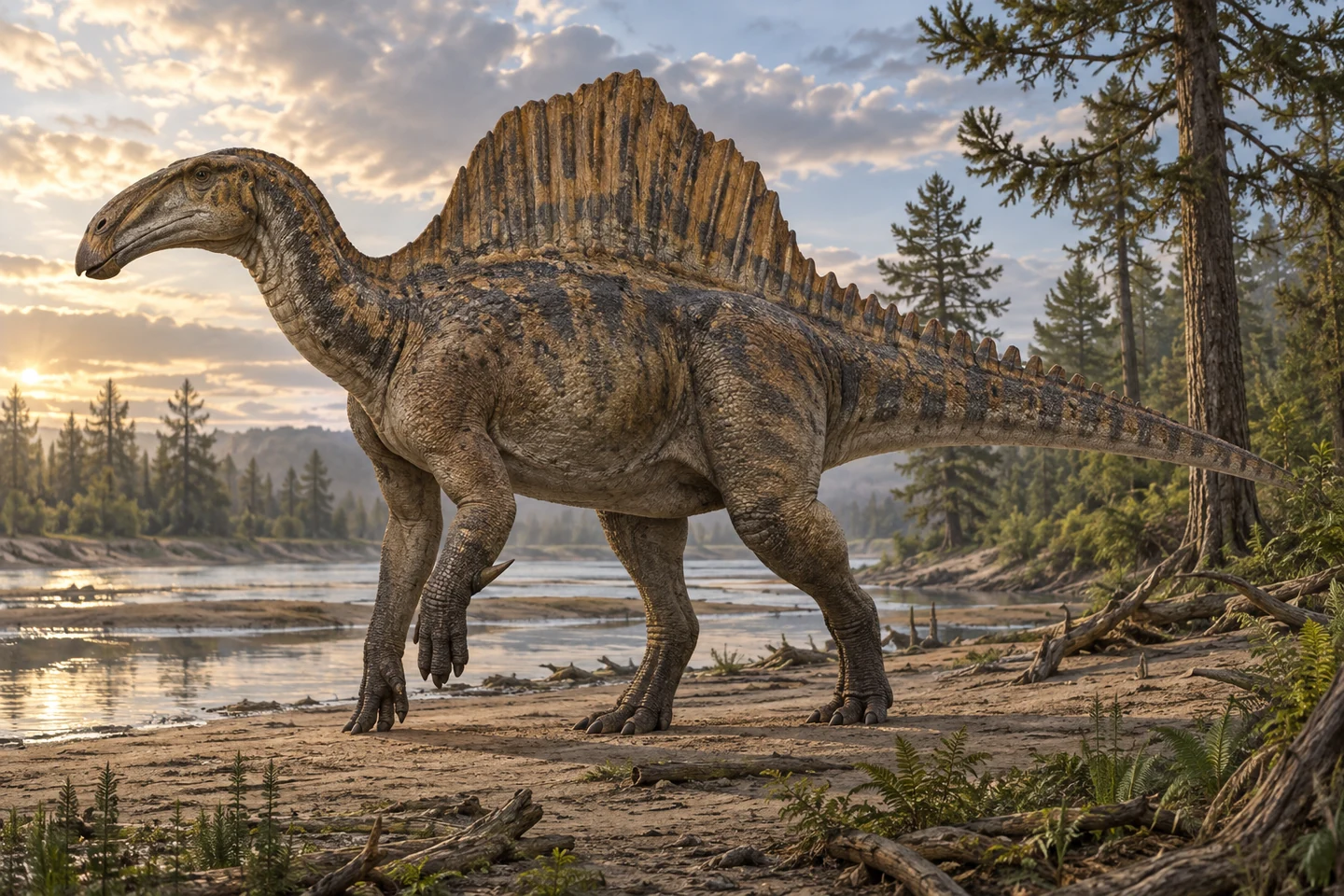
Original cinematic interpretation of Ouranosaurus. Anatomy, soft tissues and colors are reconstructed choices. Lighting, coloration and scenery are artistic choices. This image does not document a fossil locality or behavior.
Original artwork · artistic interpretation.
Scientific view: source-informed reconstruction, credited paleoart or specimen-based imagery. Movie-style view: Original artistic interpretation. Reconstructions involve uncertainty.
MEET THE ANIMAL
Ouranosaurus nigeriensis was a plant-eating dinosaur from Early Cretaceous Niger. The Natural History Museum places it among the large ornithopods. Ornithopods are a broad dinosaur group that includes the familiar duck-billed dinosaurs as well as their relatives. [D1]
A cropping beak and teeth farther back in the mouth provided feeding equipment. The Venice museum describes a usual four-legged gait with an ability to adopt a more upright posture. These are reconstructions from anatomy, rather than observations of a living walk. [D3]
The most striking outline is the raised back crest supported by long bones. A museum booklet discusses possible functions, including changing apparent size, exchanging heat or supporting a different external form. These remain proposals. The bones establish the tall supporting structures more securely than their precise soft-tissue shape or their job in the animal's daily life. [S1]
The Venice collection has its roots in a 1972–73 scientific expedition to Gadoufaoua. Fossils recovered there included Ouranosaurus and other animals. Today's desert locality describes where the remains were collected; it should not be read as proof that the dinosaur lived in the same environment now found there. [S2]
PREHISTORIC ANIMAL DOSSIER
The animal, the evidence, and the questions still open.
Ouranosaurus's tall spines and subadult Venice material require careful reconstruction.
Profile scope: Species: Ouranosaurus nigeriensis. Composite Venice mount MSNVE 3714 largely uses the paratype; studied bones indicate a subadult. Mount length is not an adult maximum.
Source supported identifies a description documented by the cited source. Inferred marks a reconstruction or functional estimate. Debated marks competing interpretations. Not established means the sources reviewed for this dossier do not support a firm conclusion; it does not mean a behavior never occurred.
A size reference is an estimate, not a population range. Nesting evidence does not by itself establish courtship, mate choice, or lifelong pairing.
About 6.5 m; incomplete Venice mount
The 2017 study reports a mount about 6.5 m long, with the tail tip missing. Histology identifies a subadult, so this is not a full-grown maximum. [D2]
About two tons; museum reference
Venice's educational account gives two tons but does not specify the ton unit, estimation method or maturity. It is excluded from numerical comparison. [D3]
Plant-eater
The museum profiles identify herbivory; Venice describes a plant-cropping beak and small rear teeth. [D1] [D3]
Early Cretaceous Gadoufaoua, Niger
The studied skeletons come from the Gadoufaoua locality in the Ténéré desert. A present-day desert location does not establish the animal's ancient habitat. [D2] [D1]
Quadrupedal walking reconstruction
Venice describes a usual four-legged gait with the ability to adopt an upright posture. This is a skeletal reconstruction; speed and gait proportions remain unquantified here. [D3]
Tall vertebral spines; thumb spike
The paper documents tall spines over the back and proximal tail and a spike-like first manual digit. The external contour includes reconstruction uncertainty. [D2]
Not established here
The reviewed sources do not establish species-specific nests, clutch size or parental care.
Display proposed; mating behavior unknown
The 2017 study proposes a speculative display role; this does not demonstrate sexual dimorphism, mate choice or courtship. [D2]
Not established here
The reviewed sources do not establish persistent groups or cooperative behavior.
Sources and inspection notes for the claims in this profile.
THE STORY IN THE FOSSILS
Ouranosaurus was an Early Cretaceous plant-eater from Niger. Its dorsal crest was supported by tall backbone spines, making it conspicuous among large ornithopods. [1] [3]
The Venice mount combines multiple individuals and reconstructed parts; studied bones indicate a subadult. Its dorsal structure may have served in display, but mating behavior remains unknown. [2]
The dossier identifies the scope of each reference estimate. A mount, an individual fossil and a species-wide adult range are different measurements. Comparison metrics remain unavailable where adult scope has not been established. Unknown does not mean zero.
Sources support the stated claims and scopes. Refer to the evidence notes for uncertainty.
KEEP EXPLORING
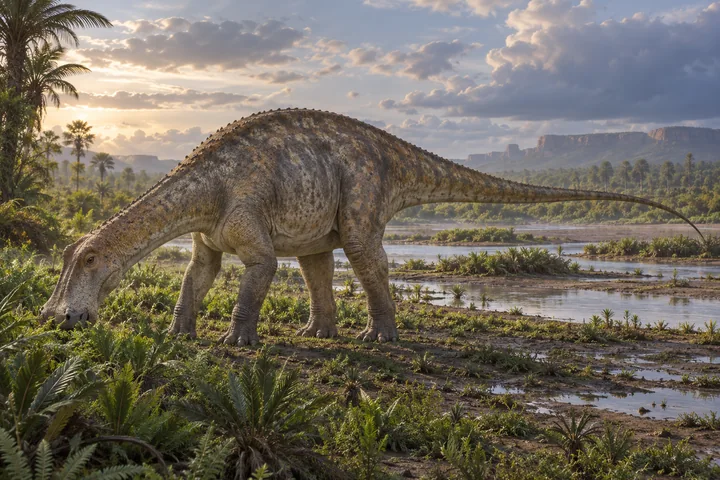
Nigersaurus taqueti
Nigersaurus was a plant-eating sauropod from Niger with an unusually broad muzzle and tightly packed tooth batteries. Its skull offers a detailed window into feeding close to the ground.
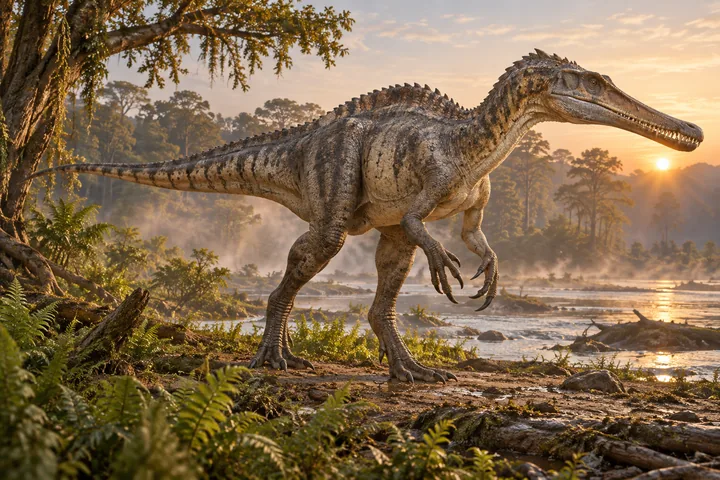
Suchomimus
This Niger spinosaur was closely similar to Baryonyx. Its hooked, rounded teeth suggest a role catching fish in ancient river environments.
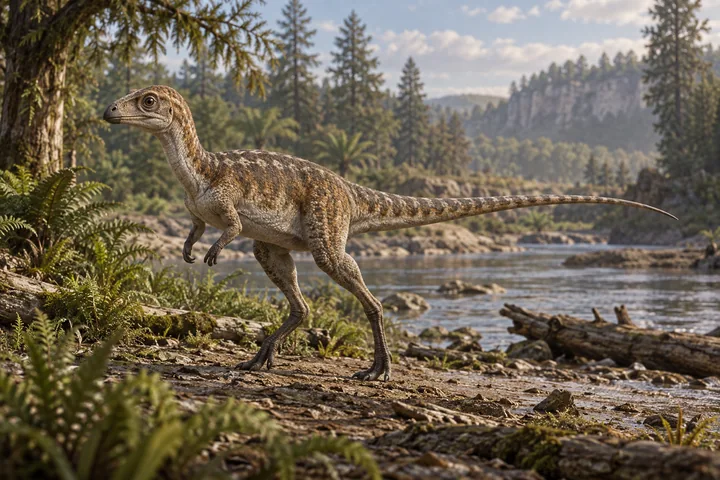
Hypsilophodon foxii
Hypsilophodon foxii was a small, ground-dwelling plant-eater from the Isle of Wight. Its lightly built skeleton and long hind limbs are consistent with agile running.