
Body length
InferredAbout 9 m; museum reference
The current museum profile gives 9 m. It is a rounded body reconstruction, with no life stage or biological range specified. [D1]
EXHIBIT 68
Amargasaurus cazaui
Amargasaurus cazaui was an Early Cretaceous sauropod from Argentina with paired elongated neck spines. Bone histology supports connected soft tissue rather than separate horn sheaths.
TWO WAYS TO PICTURE THE PAST
Compare the evidence with the familiar movie image. The illustrations are not to a shared scale.
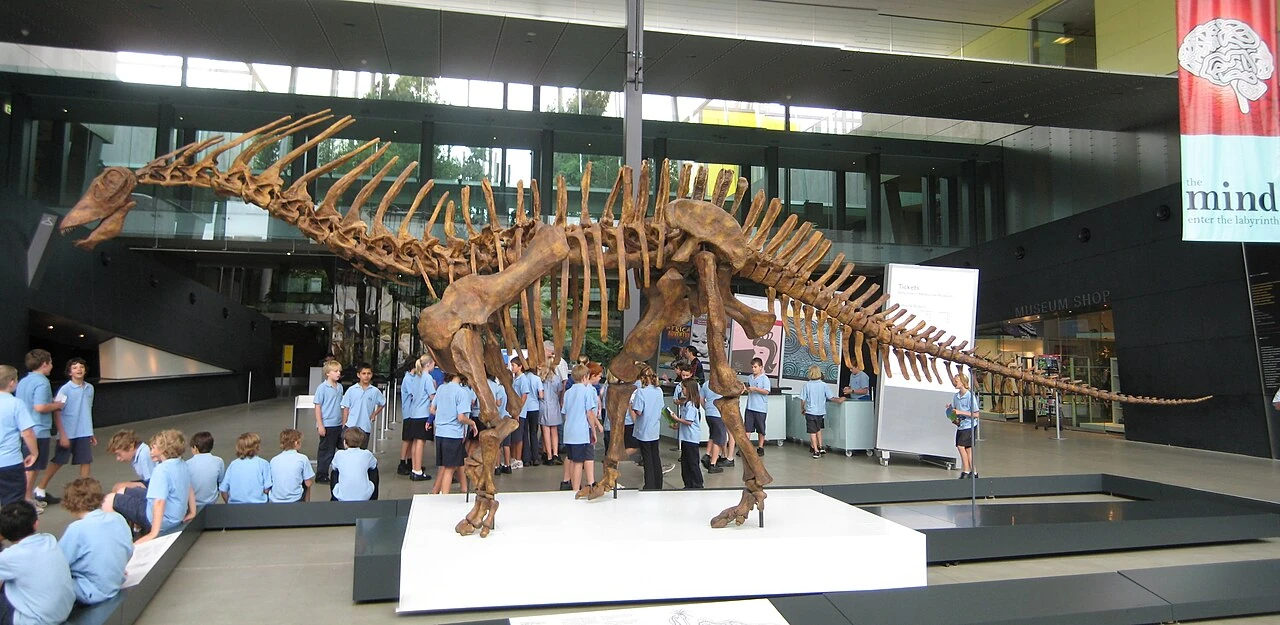
Photograph of a reconstructed Amargasaurus cazaui skeletal mount. Mounts include restored parts and do not preserve living colours or soft tissues; the bare bones do not establish separate horn sheaths. [2]
Amargasaurus skeleton.jpg · Jeffrey. CC BY-SA 2.0. Resized proportionally and converted to WebP; no anatomical edits. Same source license applies.
Skeletal mounts and drawings may restore missing parts; the caption identifies the displayed material.
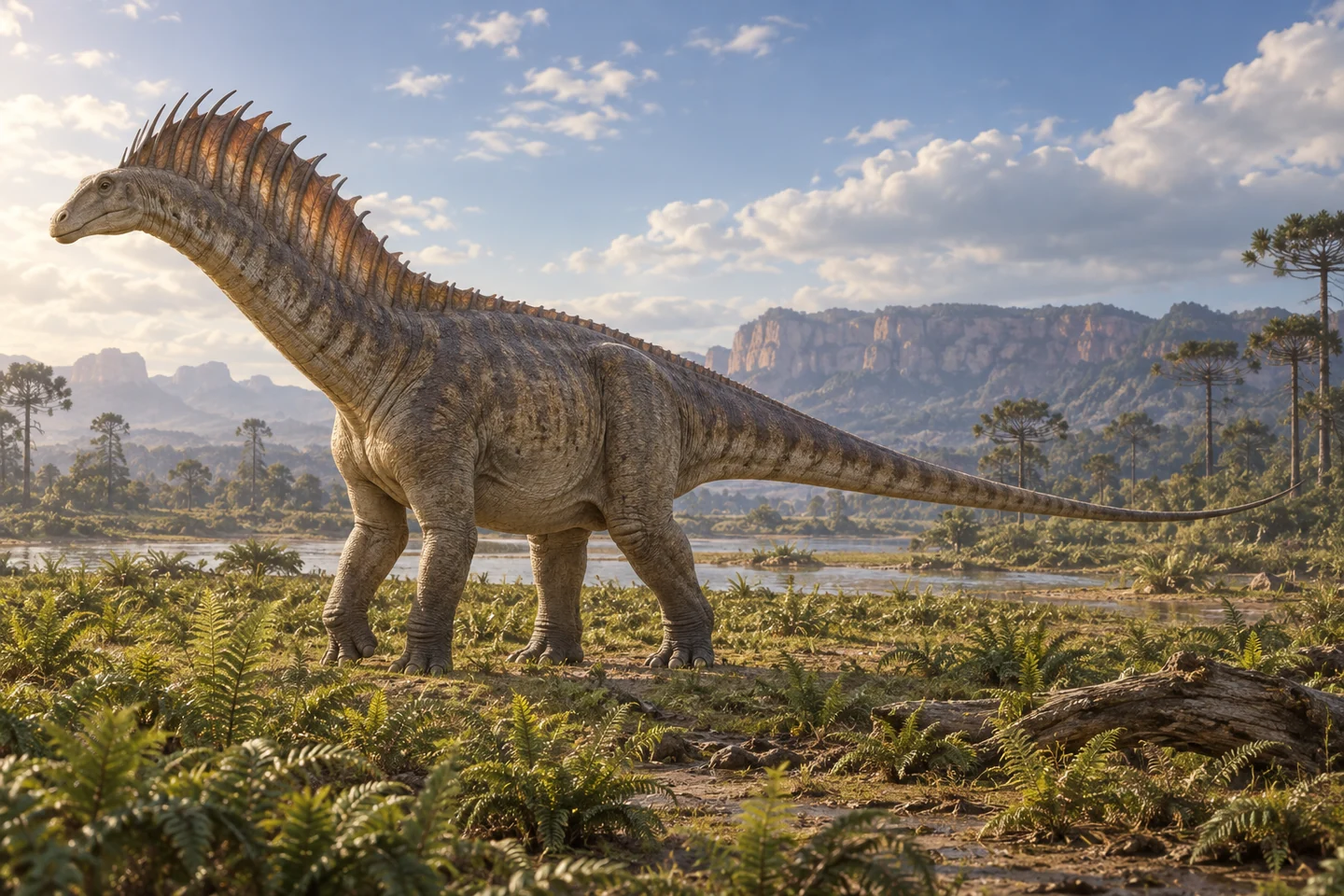
Original cinematic interpretation of Amargasaurus. Anatomy, soft tissues and colors are reconstructed choices. Lighting, coloration and scenery are artistic choices. This image does not document a fossil locality or behavior.
Original artwork · artistic interpretation.
Scientific view: source-informed reconstruction, credited paleoart or specimen-based imagery. Movie-style view: Original artistic interpretation. Reconstructions involve uncertainty.
MEET THE ANIMAL
Amargasaurus cazaui was a plant-eating sauropod from Early Cretaceous Argentina. Sauropods are the long-necked dinosaurs familiar from many giant skeletons, but this animal had a particularly unusual neck outline. Its double row of bony spines makes it recognizable within that wider group, rather than just another dinosaur with a long neck. [S1]
The spines rose from the vertebrae, the bones of the backbone, and were especially elongated along the neck. A twin sail of skin has been proposed as a covering. That proposal is a reconstruction of missing tissues, while the bony structures supply the physical evidence. Picturing a complete living animal therefore involves more than simply drawing the bones. [S1]
Its classification places it in the dicraeosaurid branch of sauropods, and the named type species is cazaui. Those labels help organize comparisons with relatives. They do not record its exact colors or show how its striking neck was used during daily life. An unusual outline can identify a dinosaur clearly while leaving the purpose and complete appearance of its outer covering open to investigation. [S1]
PREHISTORIC ANIMAL DOSSIER
The animal, the evidence, and the questions still open.
Amargasaurus is a relatively small sauropod distinguished by paired, tall neural spines. Their preserved bone structure helps evaluate alternative reconstructions of the neck's soft tissues.
Profile scope: Species: Amargasaurus cazaui. Rounded museum size and mass figures are educational reconstructions; they do not specify an adult population range.
Source supported identifies a description documented by the cited source. Inferred marks a reconstruction or functional estimate. Debated marks competing interpretations. Not established means the sources reviewed for this dossier do not support a firm conclusion; it does not mean a behavior never occurred.
A size reference is an estimate, not a population range. Nesting evidence does not by itself establish courtship, mate choice, or lifelong pairing.
About 9 m; museum reference
The current museum profile gives 9 m. It is a rounded body reconstruction, with no life stage or biological range specified. [D1]
Roughly 2.5 tonnes; museum reference
The museum's facts list roughly 2.5 tonnes without naming a method or life stage. This is not a measured fossil individual's live weight. [D1]
Plant-eating sauropod
The museum identifies herbivory. The reviewed evidence does not establish a preferred plant species. [D1]
La Amarga Formation, Neuquén, Argentina
The original description places the holotype in the lower La Amarga Formation. The museum identifies an Early Cretaceous northern Patagonian setting. [D2] [D1]
Quadrupedal sauropod
The holotype's forelimbs and hind limbs support a four-legged reconstruction. Exact running speed is not inferred from its short limb proportions here. [D2]
Paired tall neck spines; sail favored
The spines are preserved bone. A 2022 histological study supports interspinous ligaments and a cervical sail, and finds no support for separate keratin horn sheaths. [D2] [D3]
Not established here
The reviewed sources do not establish species-specific nests, clutch size or parental care.
Not established here
Spine and sail reconstructions do not establish a courtship sequence or mating system. A display interpretation is a hypothesis, not direct behavior. [D3]
Not established here
The reviewed sources do not establish herd structure, pair bonds or cooperative behavior.
Sources and inspection notes for the claims in this profile.
THE STORY IN THE FOSSILS
Amargasaurus came from Early Cretaceous Patagonia. Its comparatively compact sauropod body carried remarkable paired spines extending from the neck vertebrae. [1] [2]
Artists have given those spines several different soft-tissue coverings. A 2022 study examined their internal structure and favored ligaments connecting neighboring spines within a cervical sail. It did not support separate keratin horn sheaths. The animal's living appearance remains a reconstruction. [3]
The dossier identifies the scope of each reference estimate. A mount, an individual fossil and a species-wide adult range are different measurements. Comparison metrics remain unavailable where adult scope has not been established. Unknown does not mean zero.
Sources support the stated claims and scopes. Refer to the evidence notes for uncertainty.
KEEP EXPLORING
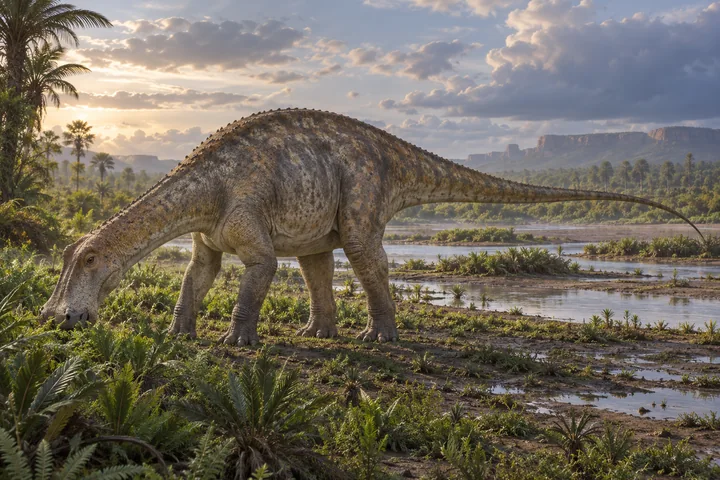
Nigersaurus taqueti
Nigersaurus was a plant-eating sauropod from Niger with an unusually broad muzzle and tightly packed tooth batteries. Its skull offers a detailed window into feeding close to the ground.
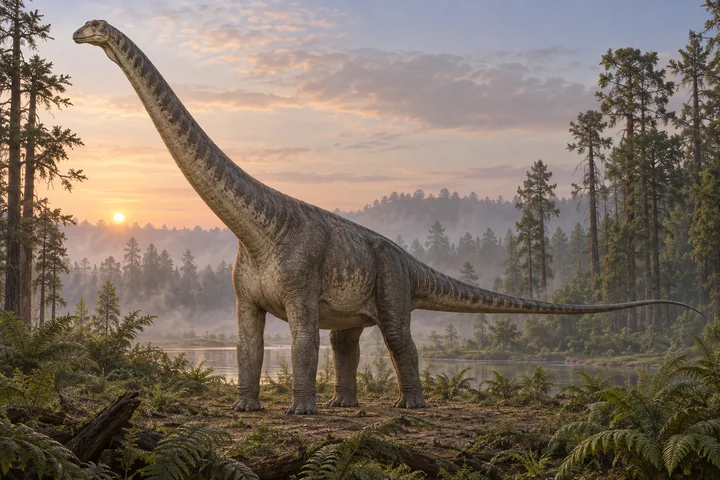
Sauroposeidon proteles
Sauroposeidon was an Early Cretaceous North American sauropod distinguished by extremely elongated, air-filled neck vertebrae.
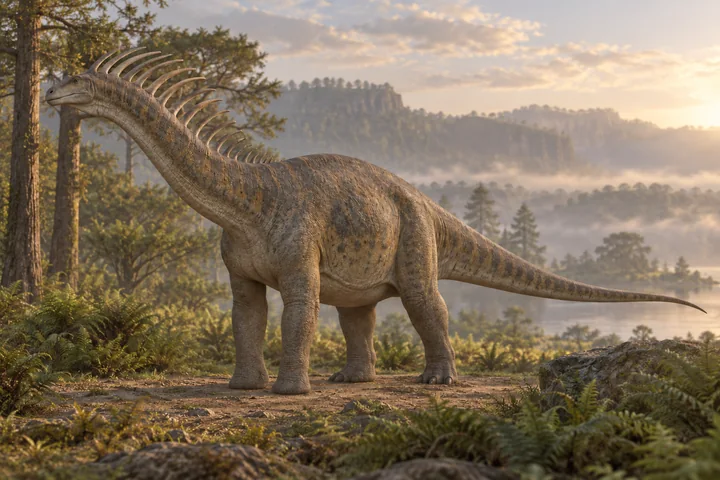
Bajadasaurus pronuspinax
Bajadasaurus was an Argentine sauropod with striking forward-directed neck spines. Its informative skull contrasts with a largely unknown body.