EXPLORE PREHISTORY 220 prehistoric animal profiles · Scientific & movie-style image galleries

EXHIBIT 166

Bajadasaurus

Bajadasaurus pronuspinax

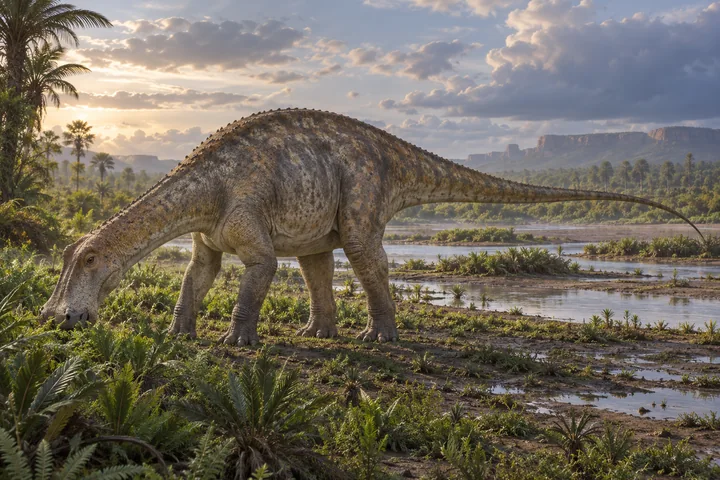
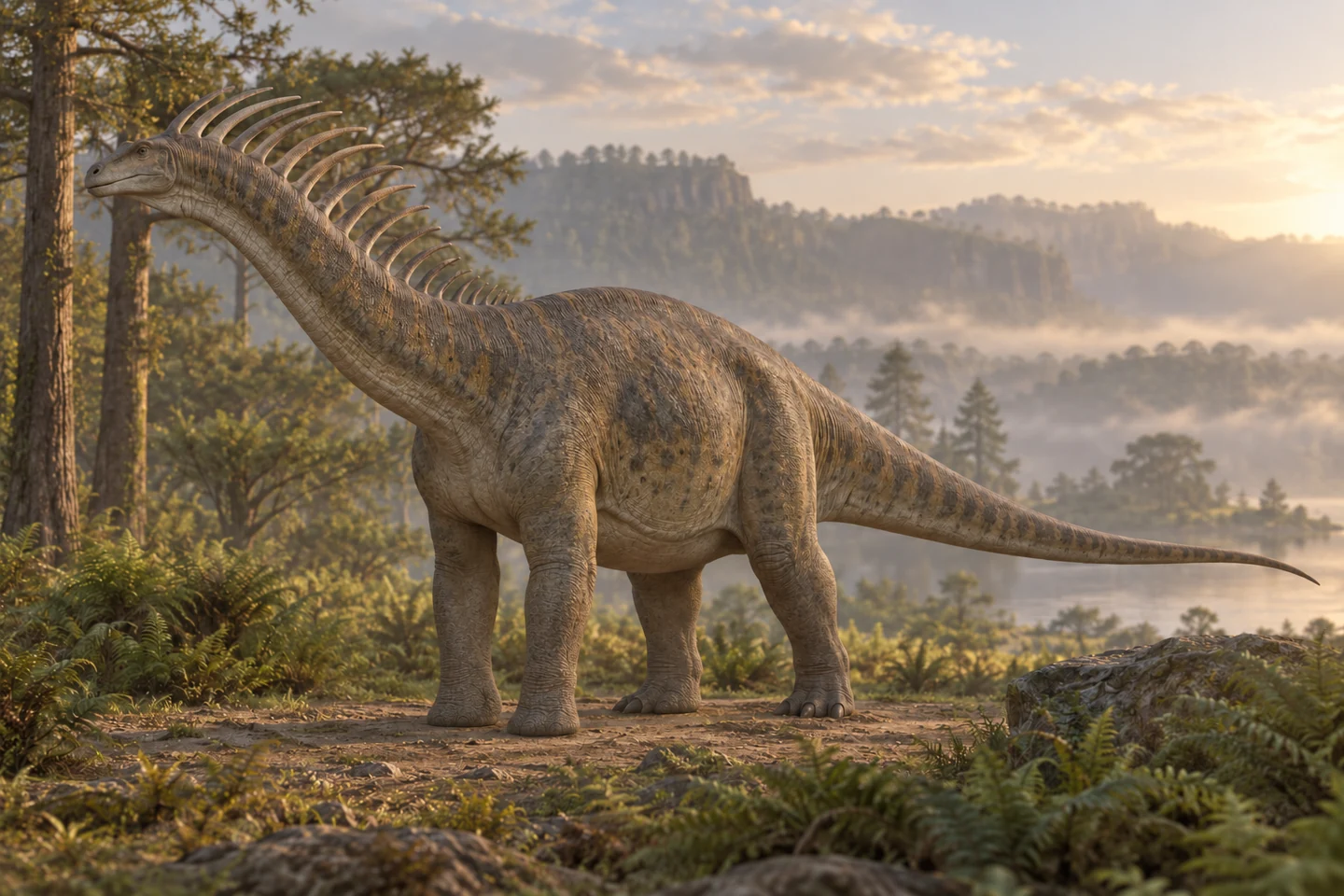
Bajadasaurus was an Argentine sauropod with striking forward-directed neck spines. Its informative skull contrasts with a largely unknown body. [1] [2]

Evidence profile
PERIODEarly Cretaceous[1]
DIETHerbivoreEvidence and uncertainty in the dossier
TOTAL LENGTHSee the dossierEstimate scope matters
FOSSILS FOUNDArgentina[1]
CompareRead the dossierView the sources

MEET THE ANIMAL

Meet Bajadasaurus

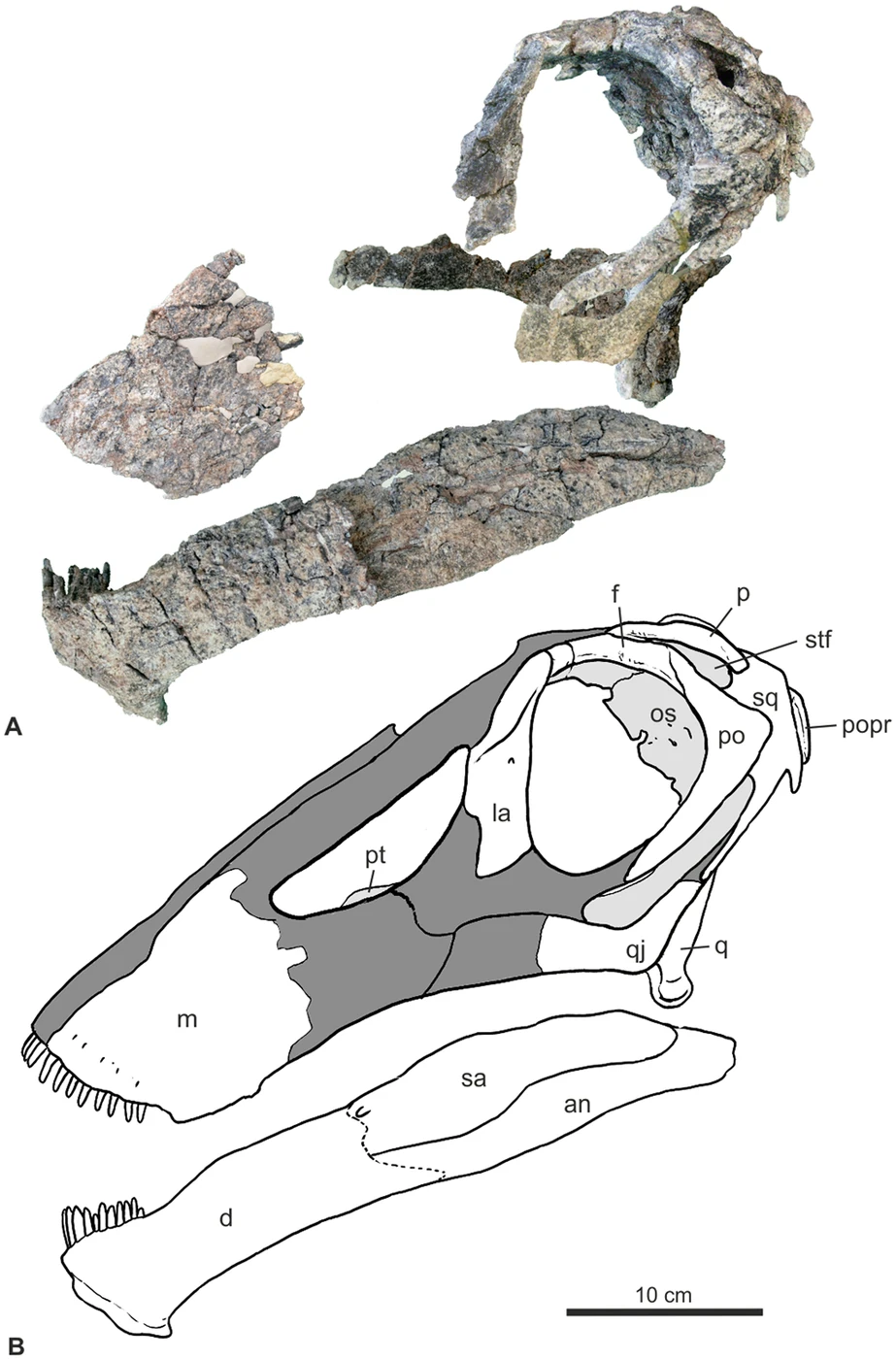
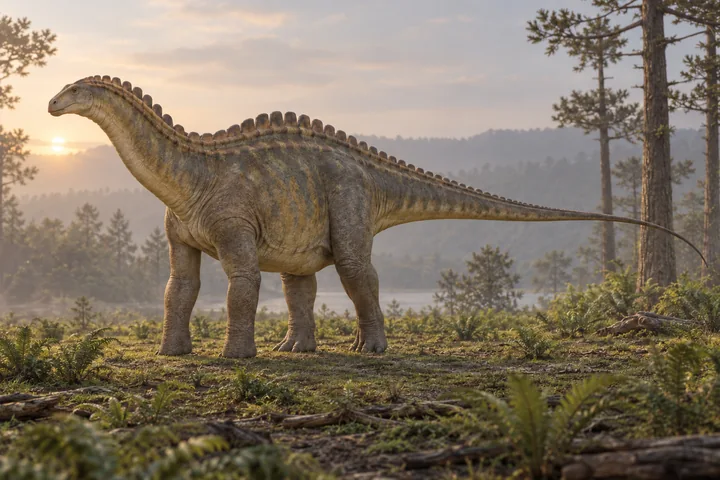
Bajadasaurus was a sauropod from Early Cretaceous northern Patagonia in Argentina. Its discovery preserves a skull and some neck bones, rather than the complete trunk and limbs. Those missing regions matter when drawing a full animal. The institutional discovery account provides no transparent whole-body size calculation, so a dramatic neck spine cannot be converted directly into a total length. [D6]

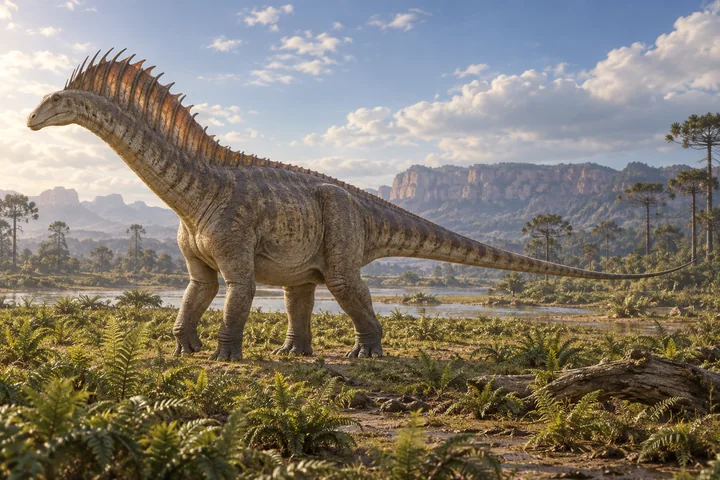
A preserved neck vertebra has paired, elongated spines pointing forward. Researchers tentatively identify it as the fifth cervical vertebra, one of the bones between the head and torso. Repeating that shape across an entire neck and adding long hornlike coverings require reconstruction. The fossil establishes the bony spines, while the complete outline and a particular defensive function remain hypotheses. [D1]

Recent work on its teeth proposes specialized feeding close to the ground. Tooth shape, wear and estimated replacement patterns provide clues about how its mouth processed vegetation. These are useful tests of feeding ability, not an actual meal or a rule that it always ate at one height. Its distinctive neck and feeding apparatus still leave important parts of its lifestyle unknown. [D3]

PREHISTORIC ANIMAL DOSSIER

A life in profile.

The animal, the evidence, and the questions still open.

Recent dental work proposes specialized low browsing. The dramatic spine covering and its defensive or display function remain hypotheses requiring evidence beyond the preserved bones. [D3] [D5]

Profile scope: Genus profile centered on Bajadasaurus pronuspinax holotype MMCh-PV 75. Preserved skull and cervical elements do not supply a complete neck, trunk or limbs, or an established adult size. [D2]

Time
Early Cretaceous
Fossil locations in this exhibit
Argentina
How to read the evidence

Source supported identifies a description documented by the cited source. Inferred marks a reconstruction or functional estimate. Debated marks competing interpretations. Not established means the sources reviewed for this dossier do not support a firm conclusion; it does not mean a behavior never occurred.

A size reference is an estimate, not a population range. Nesting evidence does not by itself establish courtship, mate choice, or lifelong pairing.

Body length

Not established

Not established here

The reviewed type description and institutional account do not provide a transparent whole-body estimate tied to this incomplete individual. A preserved long neck spine is a bone dimension, not its total length. [D1] [D6]
Body mass

Not established

Not established here

A genus-specific mass calculation tied to reviewed material was not established. The unknown trunk and limbs prevent silently importing a different dicraeosaurid’s mass or adult range. [D2]

Diet

Inferred

Specialized low browsing proposed

Dental shape, wear and replacement patterns support a low-level specialist feeding hypothesis. The dental model estimates a mean replacement time of 40.7 days; neither result identifies actual meals or a rigid feeding height. [D3]

Habitat & fossil setting

Source supported

Berriasian–Valanginian northern Patagonia

The type came from the Bajada Colorada Formation, Neuquén, Argentina. The original account assigns the deposits to the early Early Cretaceous; exact numerical ages are not directly established for this individual. [D1]

Movement

Inferred

Quadrupedal body restored comparatively

A sauropod body is inferred from relationships, because the type lacks trunk and limb bones. Muscle reconstruction explores sideways head motion; it does not measure living movement or establish cranial kinesis as observed feeding. [D2] [D4]

Distinctive anatomy

Source supported

Paired, forward-directed cervical spines

One elongated-spined vertebra is tentatively identified as the fifth cervical. Repeating its shape across an entire neck and adding long keratin sheaths are reconstructions, not preserved complete anatomy. [D1]

Reproduction & life together

Reproduction & nesting

Not established

Not established here

Focused searches did not establish securely identified eggs, nests, embryos, reproductive maturity or parental care. Tooth development documents replacement, not reproductive development. [D3]

Courtship & mating

Not established

Not established here

Defense and display have been proposed for dicraeosaurid spines. The comparative histological study sampled other taxa, so it does not establish Bajadasaurus sexes, courtship displays or its external spine covering. [D5]

Social behavior

Not established

Not established here

The described skull and cervical elements belong to the type assemblage. They do not establish an organized herd, family relationships, cooperative defense or social recognition. [D6]

Dossier research & sources

Sources and inspection notes for the claims in this profile.

  1. A new long-spined dinosaur from Patagonia sheds light on sauropod defense systemScientific Reports; Gallina, Apesteguía, Canale & Haluza (2019) · Accessed 2026-10-02Original ten-page PDF and full XML inspected: MMCh-PV 75 skull and limited cervicals, tentatively fifth cervical with forward spines, early Cretaceous formation and proposed defensive covering. · Inspected: page
  2. Cranial osteology of Bajadasaurus pronuspinax (Sauropoda, Dicraeosauridae)Historical Biology; Garderes, Gallina, Whitlock & Toledo (2023 online; 2024 issue) · Accessed 2026-10-02Publisher abstract inspected: skull and preserved jaw scope, detailed cranial revision and hypothetical cornified rostral covering; full article not obtained. · Inspected: abstract
  3. Morphology, development and ecological implications of the dentition of Bajadasaurus pronuspinaxHistorical Biology; Garderes (2025 online; 2026 issue) · Accessed 2026-10-02Publisher abstract and data description inspected: MMCh-PV 75 dentition, tooth replacement mean 40.7 days and inferred low-level specialist feeding. Full paper not obtained. · Inspected: abstract
  4. Head, skull–neck and extrinsic eye musculature of the dicraeosaurid sauropod Bajadasaurus pronuspinaxPublicación Electrónica de la Asociación Paleontológica Argentina; Garderes, Toledo, Whitlock, Militello & Gallina (2026) · Accessed 2026-10-02Original 34-page published PDF inspected: muscle reconstruction from osteological correlates, hypothetical cranial kinesis and sideways head movement leverage; soft tissues and motions are inferred. · Inspected: page
  5. Osteohistology of the hyperelongate hemispinous processes of Amargasaurus cazaui (Dinosauria: Sauropoda) and implications for soft tissue reconstructions and functionJournal of Anatomy; Cerda and colleagues (2022) · Accessed 2026-10-02Original full text inspected: direct samples are Amargasaurus and an indeterminate La Amarga dicraeosaurid, not Bajadasaurus. Its soft-tissue comparison and display discussion are conditional. · Inspected: page
  6. Encuentran en Neuquén una nueva especie de dinosaurio saurópodoCONICET, Argentina (2019) · Accessed 2026-10-02Institutional discovery page inspected: locality, research team, discovery and preserved skull/neck scope. No transparent whole-body size estimate was supplied. · Inspected: page

THE STORY IN THE FOSSILS

Meet Bajadasaurus.

The newest muscle study reconstructs a head that could move effectively sideways. Its suggested internal skull motion remains explicitly conditional, with no preserved muscles proving the proposed feeding mechanism. [4]

The spine-covering debate illustrates the difference between comparison and direct evidence: Amargasaurus bone tissues can test its own covering, while Bajadasaurus still requires equivalent sampling. [5]

A note on scale and time

The dossier identifies the scope of each reference estimate. A mount, an individual fossil and a species-wide adult range are different measurements. Comparison metrics remain unavailable where adult scope has not been established. Unknown does not mean zero.

Sources & editorial notes

Sources support the stated claims and scopes. Refer to the evidence notes for uncertainty.

  1. A new long-spined dinosaur from Patagonia sheds light on sauropod defense systemScientific Reports; Gallina, Apesteguía, Canale & Haluza (2019) · Accessed 2026-10-02Original ten-page PDF and full XML inspected: MMCh-PV 75 skull and limited cervicals, tentatively fifth cervical with forward spines, early Cretaceous formation and proposed defensive covering. · Inspected: page
  2. Cranial osteology of Bajadasaurus pronuspinax (Sauropoda, Dicraeosauridae)Historical Biology; Garderes, Gallina, Whitlock & Toledo (2023 online; 2024 issue) · Accessed 2026-10-02Publisher abstract inspected: skull and preserved jaw scope, detailed cranial revision and hypothetical cornified rostral covering; full article not obtained. · Inspected: abstract
  3. Morphology, development and ecological implications of the dentition of Bajadasaurus pronuspinaxHistorical Biology; Garderes (2025 online; 2026 issue) · Accessed 2026-10-02Publisher abstract and data description inspected: MMCh-PV 75 dentition, tooth replacement mean 40.7 days and inferred low-level specialist feeding. Full paper not obtained. · Inspected: abstract
  4. Head, skull–neck and extrinsic eye musculature of the dicraeosaurid sauropod Bajadasaurus pronuspinaxPublicación Electrónica de la Asociación Paleontológica Argentina; Garderes, Toledo, Whitlock, Militello & Gallina (2026) · Accessed 2026-10-02Original 34-page published PDF inspected: muscle reconstruction from osteological correlates, hypothetical cranial kinesis and sideways head movement leverage; soft tissues and motions are inferred. · Inspected: page
  5. Osteohistology of the hyperelongate hemispinous processes of Amargasaurus cazaui (Dinosauria: Sauropoda) and implications for soft tissue reconstructions and functionJournal of Anatomy; Cerda and colleagues (2022) · Accessed 2026-10-02Original full text inspected: direct samples are Amargasaurus and an indeterminate La Amarga dicraeosaurid, not Bajadasaurus. Its soft-tissue comparison and display discussion are conditional. · Inspected: page
  6. Encuentran en Neuquén una nueva especie de dinosaurio saurópodoCONICET, Argentina (2019) · Accessed 2026-10-02Institutional discovery page inspected: locality, research team, discovery and preserved skull/neck scope. No transparent whole-body size estimate was supplied. · Inspected: page

FOLLOW YOUR CURIOSITY

Who will you meet next?

KEEP EXPLORING

More from the collection