
Length
InferredAbout 7 m; institutional reference
Holtz’s educational estimate lacks specimen, life-stage and method details; it is not a measured adult or species range. [D5]
TWO WAYS TO PICTURE THE PAST
Compare the evidence with the familiar movie image. The illustrations are not to a shared scale.
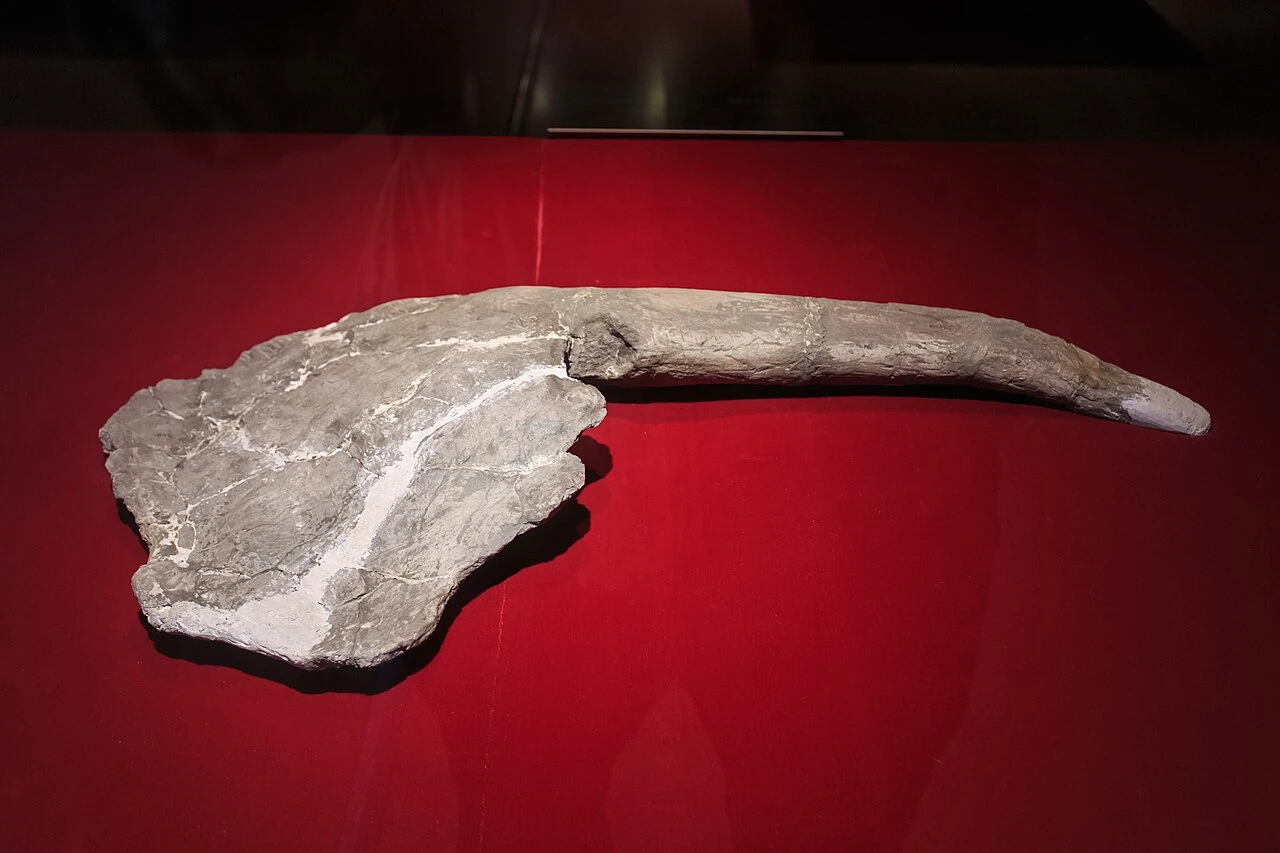
A displayed Gigantspinosaurus shoulder spine shows its broad base and curved projection. This isolated exhibit view does not fix its exact living angle, keratin covering or the complete armor sequence; living colors and soft tissues are unknown. [1]
Zigong Dinosaur Museum Gigantspinosaurus spine.jpg · Zhangzhugang. CC BY 4.0. Proportional resizing and WebP conversion; no anatomy edits.
The photograph or figure shows the credited fossil material; displayed mounts and labels can include interpretation.
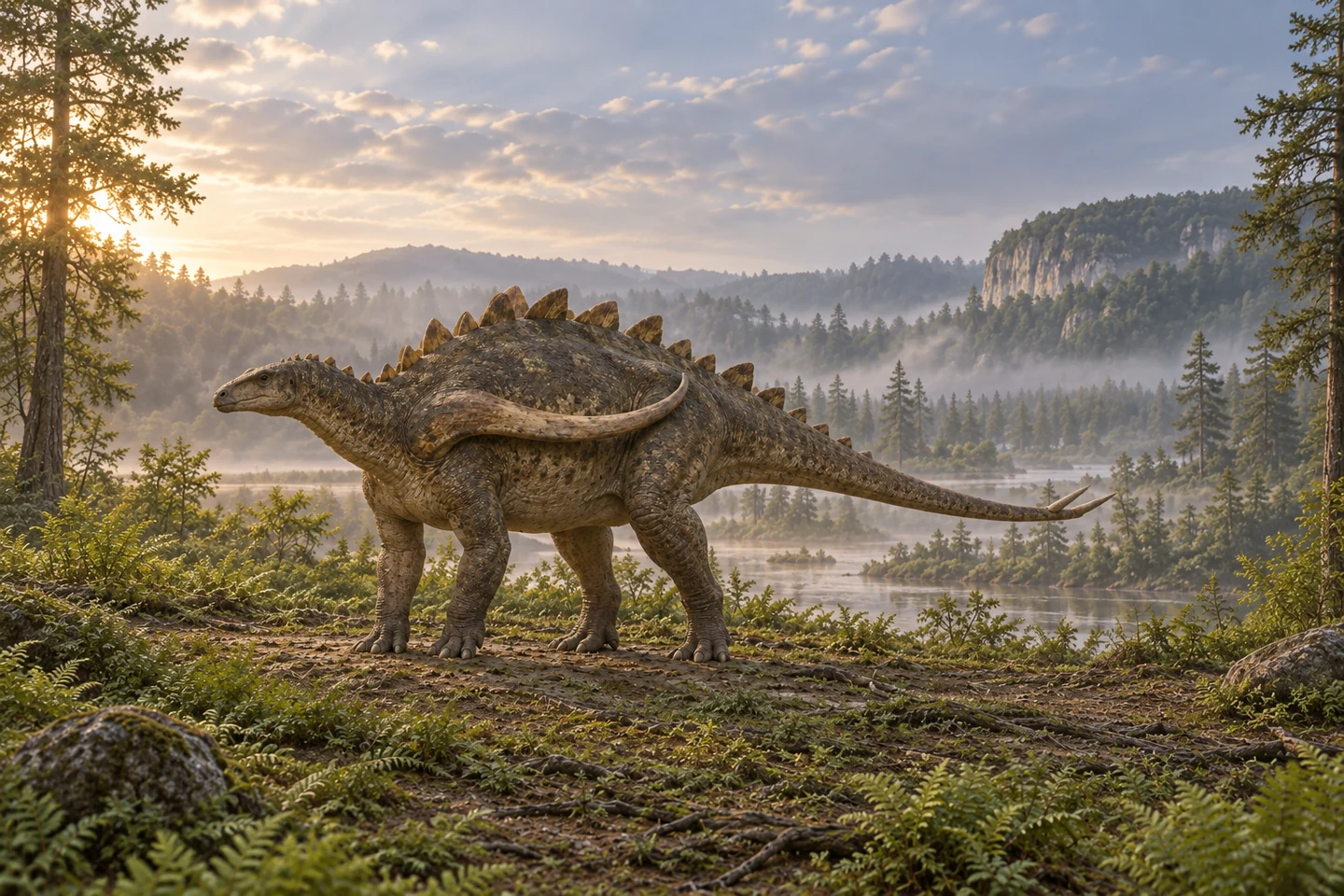
Original cinematic interpretation of Gigantspinosaurus. The paired comma-shaped shoulder spines and relatively small plates guide this restoration. Complete spine orientation, head, missing tail and plate arrangement remain reconstructed scenarios. Colors, lighting and scenery are artistic choices; this is not directly observed behavior. Lighting, coloration and scenery are artistic choices. This image does not document a fossil locality or behavior.
Original artwork · artistic interpretation.
Scientific view: source-informed reconstruction, credited paleoart or specimen-based imagery. Movie-style view: Original artistic interpretation. Reconstructions involve uncertainty.
MEET THE ANIMAL
Gigantspinosaurus was a stegosaur from Late Jurassic Sichuan in China. Skin preserved near its shoulder and forelimb records a pattern of larger scales surrounded by smaller polygonal scales. These rosettes provide a rare clue to the animal's surface texture. A skin impression records shape, however, without automatically establishing the colors of the living animal or a complete body covering. [D2]
Its most striking armor consisted of paired, comma-shaped spines near the shoulders. They were preserved in place, making their position more secure than an ornament reconstructed from isolated, unidentified pieces. [D1]
A CT study examined lesions inside the left thighbone and interpreted them as probably a bone tumor. That remains a diagnosis based on fossil structures, not a direct medical examination of a living animal. It concerns one individual's condition and does not demonstrate a fighting injury, assistance from companions or a pattern of social protection. [D3]
Its four-legged, plant-eating reconstruction follows the broader stegosaur body plan. That comparison helps build a general life profile, while leaving its particular foods, daily movements and feeding preferences unresolved. [D5]
PREHISTORIC ANIMAL DOSSIER
The animal, the evidence, and the questions still open.
Paired shoulder spines were comma-shaped. Skin impressions record rosettes of small polygonal scales, adding surface detail beyond the bones. [D1] [D2]
Profile scope: G. sichuanensis, chiefly holotype ZDM 0019; shoulder armor is preserved in place, while whole-body reconstructions restore missing anatomy. [D1]
Source supported identifies a description documented by the cited source. Inferred marks a reconstruction or functional estimate. Debated marks competing interpretations. Not established means the sources reviewed for this dossier do not support a firm conclusion; it does not mean a behavior never occurred.
A size reference is an estimate, not a population range. Nesting evidence does not by itself establish courtship, mate choice, or lifelong pairing.
About 7 m; institutional reference
Holtz’s educational estimate lacks specimen, life-stage and method details; it is not a measured adult or species range. [D5]
About 2.2 t; ZDM 0019 model
Benson’s measured-limb-circumference estimate. Tooth wear suggests adulthood separately; femoral pathology and model uncertainty preclude a precise adult comparison. [D6] [D1] [D3]
Plant eater
Herbivory is a comparative stegosaur interpretation; a species-specific menu or preserved meal is not established here. [D5]
Upper Shaximiao succession, Sichuan
The skin-bearing fossil comes from the Upper Jurassic Shangshaximiao Formation near Zigong; burial does not establish all habitat preferences. [D2]
Four-legged stegosaur
Reconstruction follows the stegosaur body plan; reviewed material provides no genus-identified tracks, speed or gait measurements. [D5]
Giant comma-shaped shoulder spines
The paired parascapular spines were found in place. Their distinctive form separates this animal from a generic tall-plated reconstruction. [D1]
Not established here
Tooth wear supports an adult assessment, but does not identify sex, breeding age, nests or clutch size. [D1]
Not established here
Large shoulder ornaments alone do not demonstrate display behavior, mate choice or sexual dimorphism. [D1]
Not established here
A probable femoral tumor concerns one animal; illness or survival does not demonstrate herd protection or social care. [D3]
Sources and inspection notes for the claims in this profile.
THE STORY IN THE FOSSILS
Preserved skin near the shoulder and forelimb contains larger scales encircled by smaller polygonal scales. These impressions constrain texture, while living pigmentation remains unknown. [2]
CT study interpreted lesions in the left femur as probably a bone tumor. This uncertain diagnosis is not direct evidence of injury from fighting or cooperative behavior. [3]
The dossier identifies the scope of each reference estimate. A mount, an individual fossil and a species-wide adult range are different measurements. Comparison metrics remain unavailable where adult scope has not been established. Unknown does not mean zero.
Sources support the stated claims and scopes. Refer to the evidence notes for uncertainty.
KEEP EXPLORING
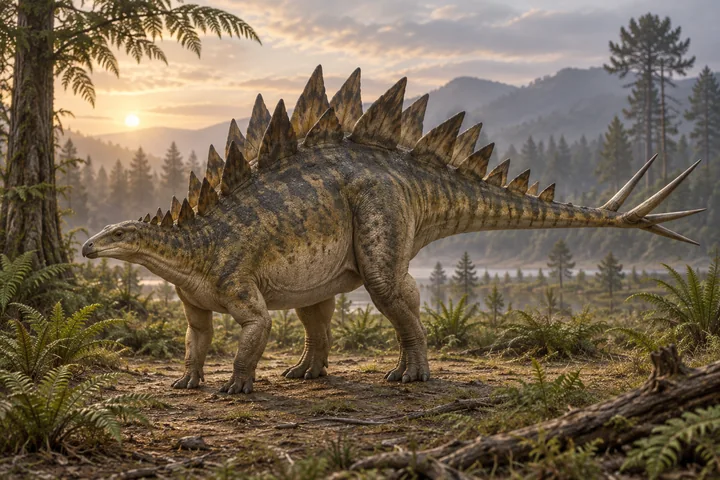
Tuojiangosaurus multispinus
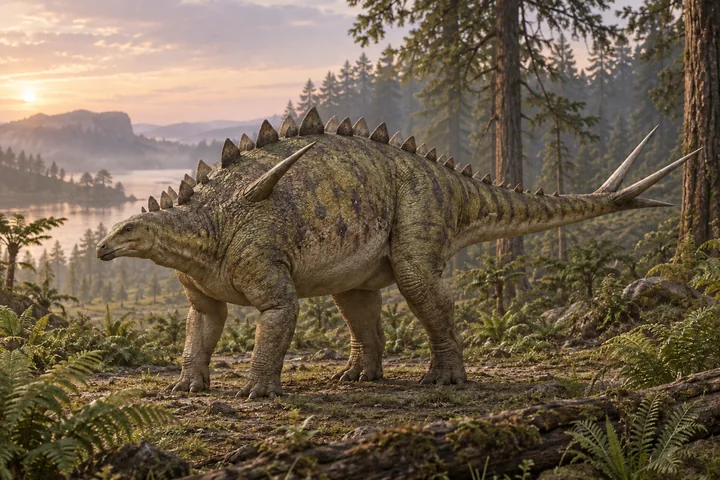
Tuojiangosaurus was a Late Jurassic Chinese plant-eating stegosaur with varied bony plates along its body.
Dacentrurus armatus
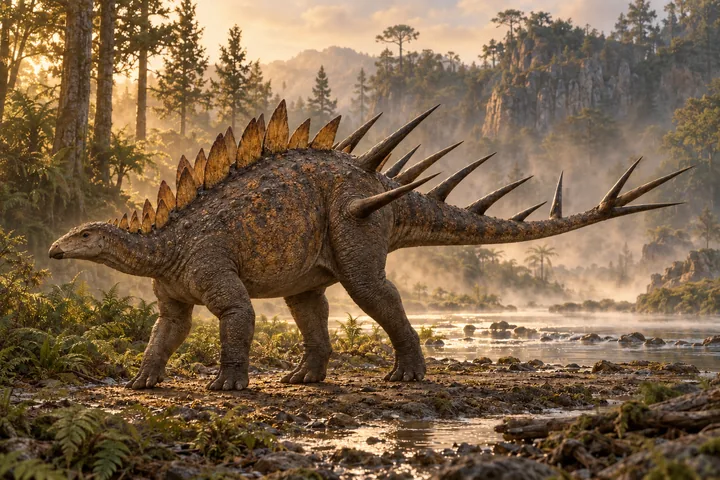
Dacentrurus was a heavily built European stegosaur, combining bony armor with a substantial pelvis and limbs.
Kentrosaurus
Kentrosaurus was a plant-eating Late Jurassic stegosaur from Tanzania. Its armour is distinctive, but the position of its large lateral spikes has been debated.