
Size reference
Source supported22.2 mm body length excluding antennae and proboscis
Female L. prochorista holotype reference, not L. gloriae or a genus size range. [D1]
EXHIBIT 246
Lichnomesopsyche
Prehistoric insect
Lichnomesopsyche was a Jurassic scorpionfly with a long fluid-feeding proboscis, associated by inference with gymnosperm plants. [3]
TWO WAYS TO PICTURE THE PAST
Compare the evidence with the familiar movie image. The illustrations are not to a shared scale.
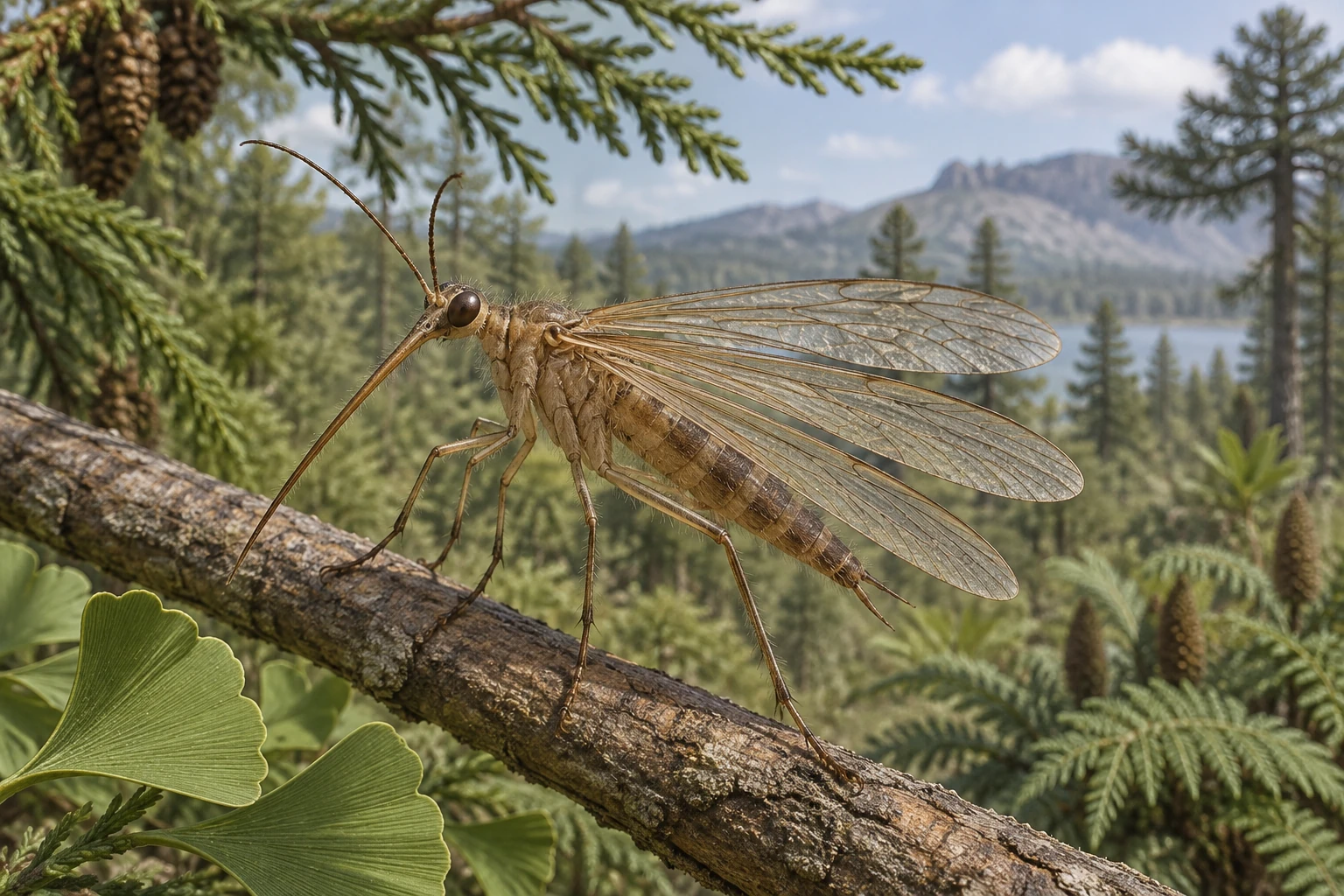
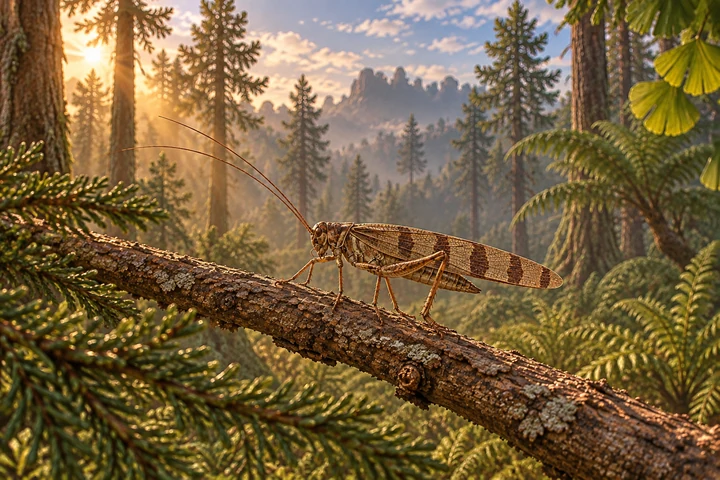
An illustrative reconstruction. Compare its anatomy with the evidence and limitations in the dossier. [2]
Source-informed reconstruction. Appearance evidence [2]. Original illustration; missing anatomy, coloration and scenery include interpretation.
Fossils constrain this life reconstruction. Missing anatomy, coloration and the environmental scene include interpretation; the dossier explains the evidence limits.
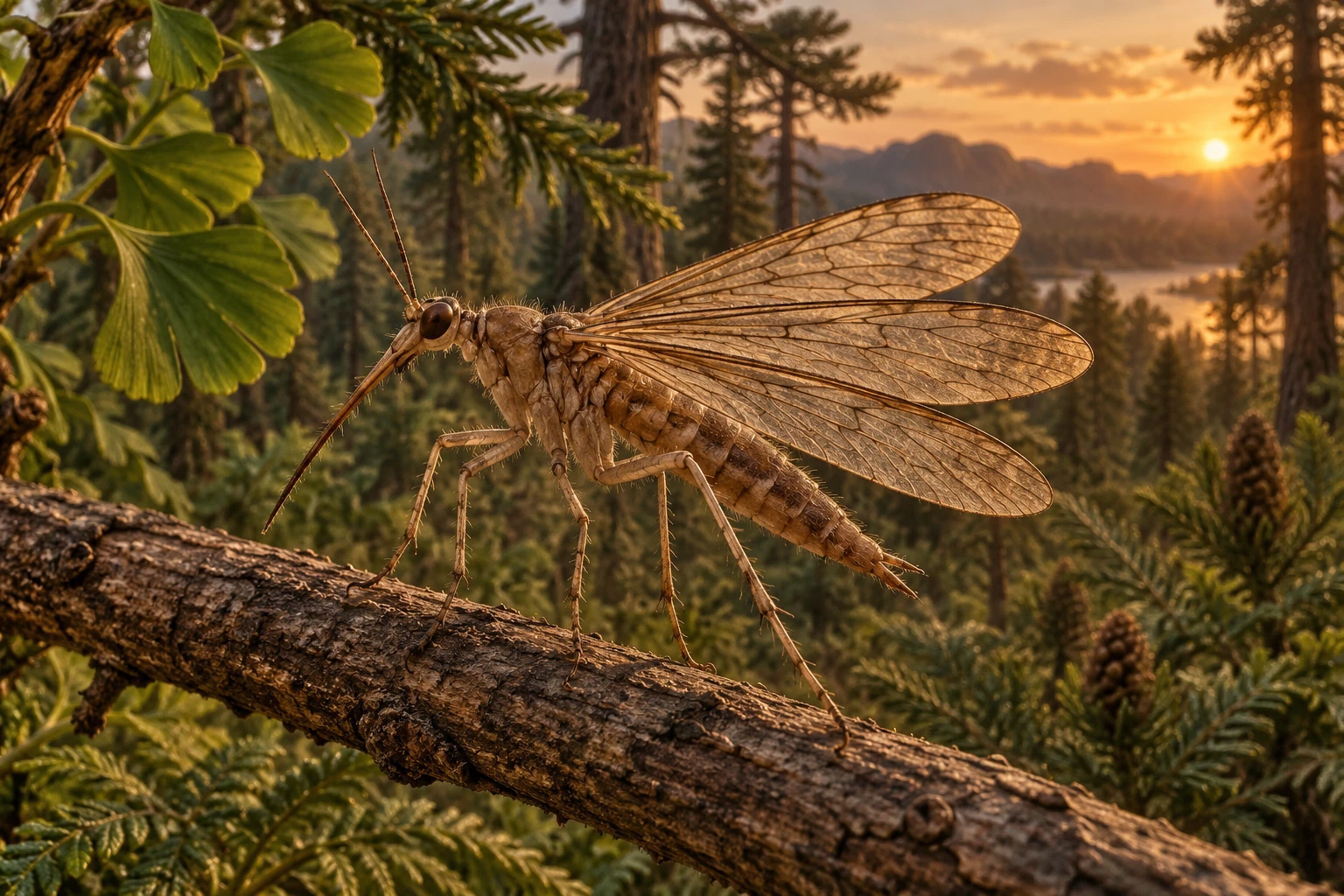
An illustrative reconstruction. Compare its anatomy with the evidence and limitations in the dossier. Lighting, coloration and scenery are artistic choices. This image does not document a fossil locality or behavior.
Original artwork · artistic interpretation.
Scientific view: source-informed reconstruction, credited paleoart or specimen-based imagery. Movie-style view: Original artistic interpretation. Reconstructions involve uncertainty.
MEET THE ANIMAL
Lichnomesopsyche was a Jurassic insect called a scorpionfly. That name does not mean it was a scorpion, or that it carried a venomous stinger. A later revision describes its long mouthparts, slender legs and narrow wings. The scientists also compared male genital structures to distinguish three species within the genus. Similar-looking wing veins alone were not always enough to identify which species a fossil represented. [D2]
Its long mouthparts were shaped like a drinking tube. Smithsonian researchers compared such tubes with channels in the reproductive structures of gymnosperms, the seed plants that include conifers and cycads. The channels could contain nectar-like pollen drops. This makes feeding on plant fluids a supported interpretation of the broader fossil evidence. It does not preserve an actual visit by this insect to one identified plant, or prove exactly how efficiently it transferred pollen. [D3]
Measurements need careful labels. A 2016 study reported a 22.2-millimeter body for a female L. prochorista fossil, leaving antennae and proboscis out of that number. Its proboscis was at least 9.7 millimeters long. Those are measurements of that specimen and species. This gallery instead reconstructs L. gloriae using its described anatomy. Comparing related fossils is helpful, but their measurements should not silently become a single supposedly universal size. [D1]
PREHISTORIC ANIMAL DOSSIER
The animal, the evidence, and the questions still open.
Its narrow veined wings and elongated mouthparts reveal an extinct feeding design; direct pollination behavior is not preserved. [D4] [D2]
Profile scope: Genus — Lichnomesopsyche; galleries use L. gloriae anatomy. The size reference is explicitly a different species, L. prochorista. [D1]
Source supported identifies a description documented by the cited source. Inferred marks a reconstruction or functional estimate. Debated marks competing interpretations. Not established means the sources reviewed for this dossier do not support a firm conclusion; it does not mean a behavior never occurred.
A size reference is an estimate, not a population range. Nesting evidence does not by itself establish courtship, mate choice, or lifelong pairing.
22.2 mm body length excluding antennae and proboscis
Female L. prochorista holotype reference, not L. gloriae or a genus size range. [D1]
Not established here
No body-mass estimate is supplied in the reviewed specimen descriptions. [D1]
Gymnosperm fluids inferred
Long mouthparts fit proposed pollen-drop channels; a particular observed feeding visit is not preserved. [D3]
Jurassic gymnosperm vegetation inferred
Reviewed comparisons concern seed-plant reproductive structures; fossil burial sediments do not identify an exact perch. [D3]
Walking and flight inferred
Six legs and two pairs of membranous wings support these capabilities; speeds remain unknown. [D1]
Long proboscis and four narrow wings
L. gloriae has slender legs, short filiform antennae and an elongate segmented abdomen; no scorpion stinger. [D2]
Male and female adults documented
Genital structures distinguish sexes and species; attributable eggs, larvae and nesting remain unestablished in the reviewed revision. [D2]
Not established here
The reviewed revision describes adult reproductive anatomy without a courtship sequence. [D2]
Not established here
The reviewed original specimens do not establish colonies or cooperation. [D1]
Sources and inspection notes for the claims in this profile.
THE STORY IN THE FOSSILS
The research-team caption identifies a long, hairy proboscis about ten millimeters long in L. gloriae. This is a mouthpart reference, separate from the body measurement of L. prochorista. [4]
The dossier identifies the scope of each reference estimate. A mount, an individual fossil and a species-wide adult range are different measurements. Comparison metrics remain unavailable where adult scope has not been established. Unknown does not mean zero.
Sources support the stated claims and scopes. Refer to the evidence notes for uncertainty.
KEEP EXPLORING
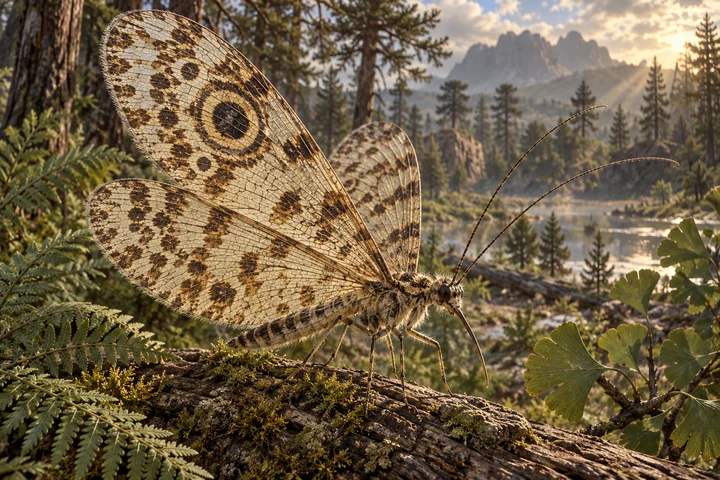
Kalligramma
Prehistoric insect
Kalligramma was a large lacewing whose patterned wings recall butterflies, despite its different ancestry.
Archaboilus
Prehistoric insect
Archaboilus was a Jurassic katydid relative whose fossil wings preserve clues to ancient insect calls.
Ophthalmosaurus icenicus
Marine reptile
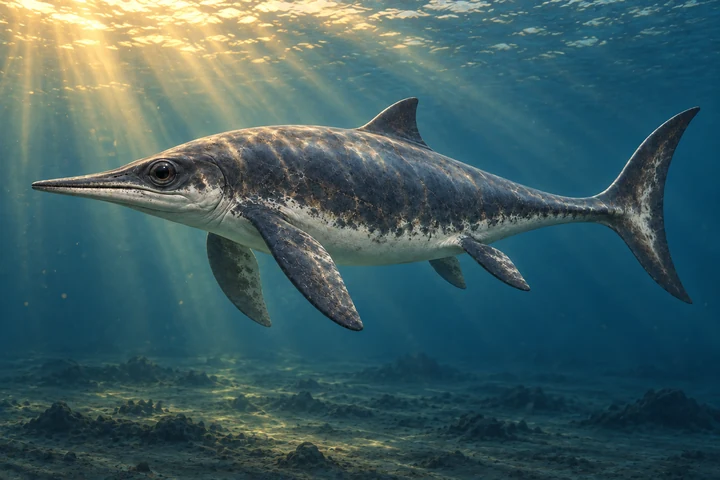
A large-eyed ichthyosaur whose British fossils must be separated from debated North American relatives.