
Size reference
Source supportedAbout72 mm estimated forewing
Estimate for the incomplete A. musicus male type; not body length, wingspan or a genus range. [D1]
EXHIBIT 221
Archaboilus
Prehistoric insect
Archaboilus was a Jurassic katydid relative whose fossil wings preserve clues to ancient insect calls. [3]
TWO WAYS TO PICTURE THE PAST
Compare the evidence with the familiar movie image. The illustrations are not to a shared scale.
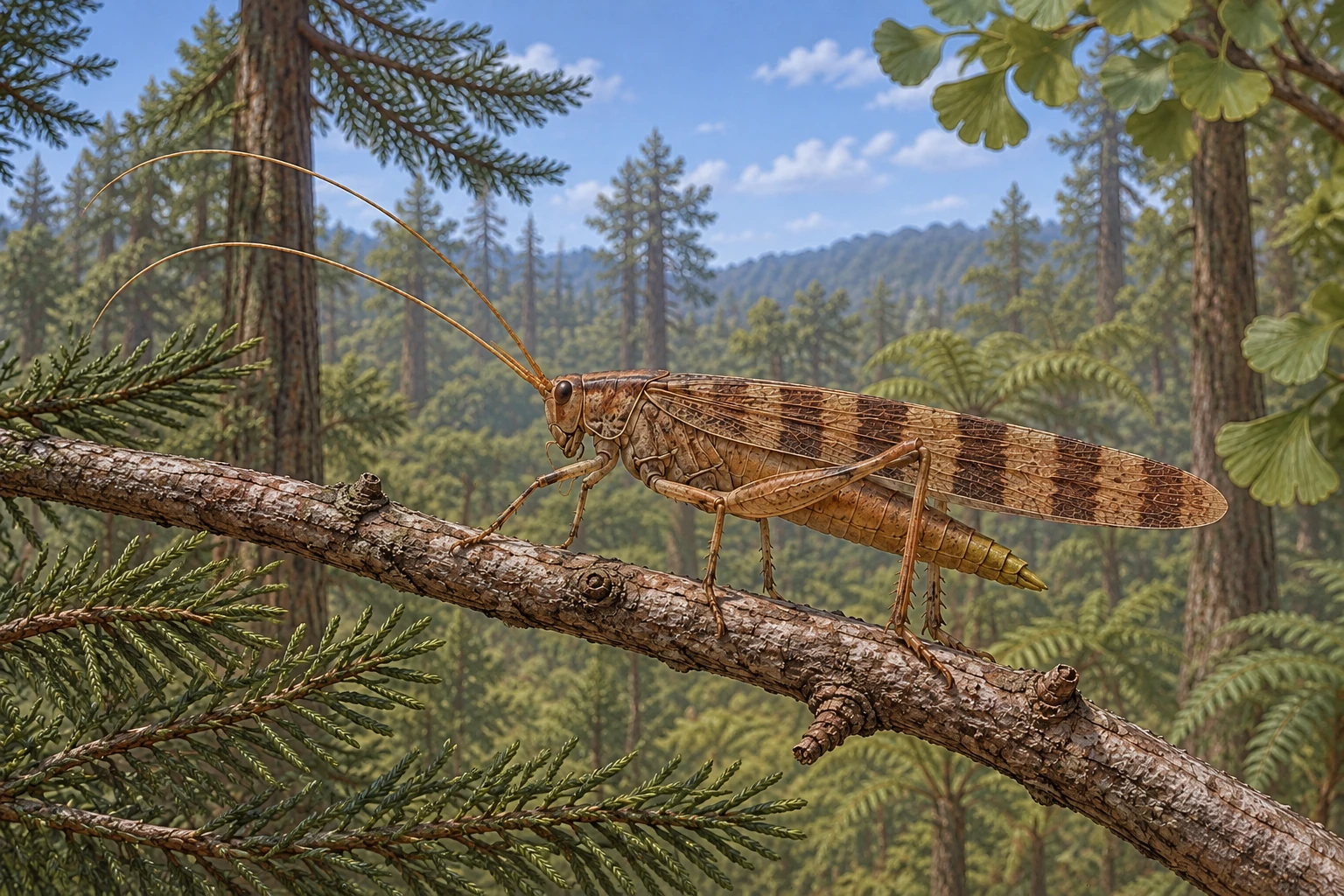
An illustrative reconstruction. Compare its anatomy with the evidence and limitations in the dossier. [1]
Source-informed reconstruction. Appearance evidence [1]. Original illustration; missing anatomy, coloration and scenery include interpretation.
Fossils constrain this life reconstruction. Missing anatomy, coloration and the environmental scene include interpretation; the dossier explains the evidence limits.
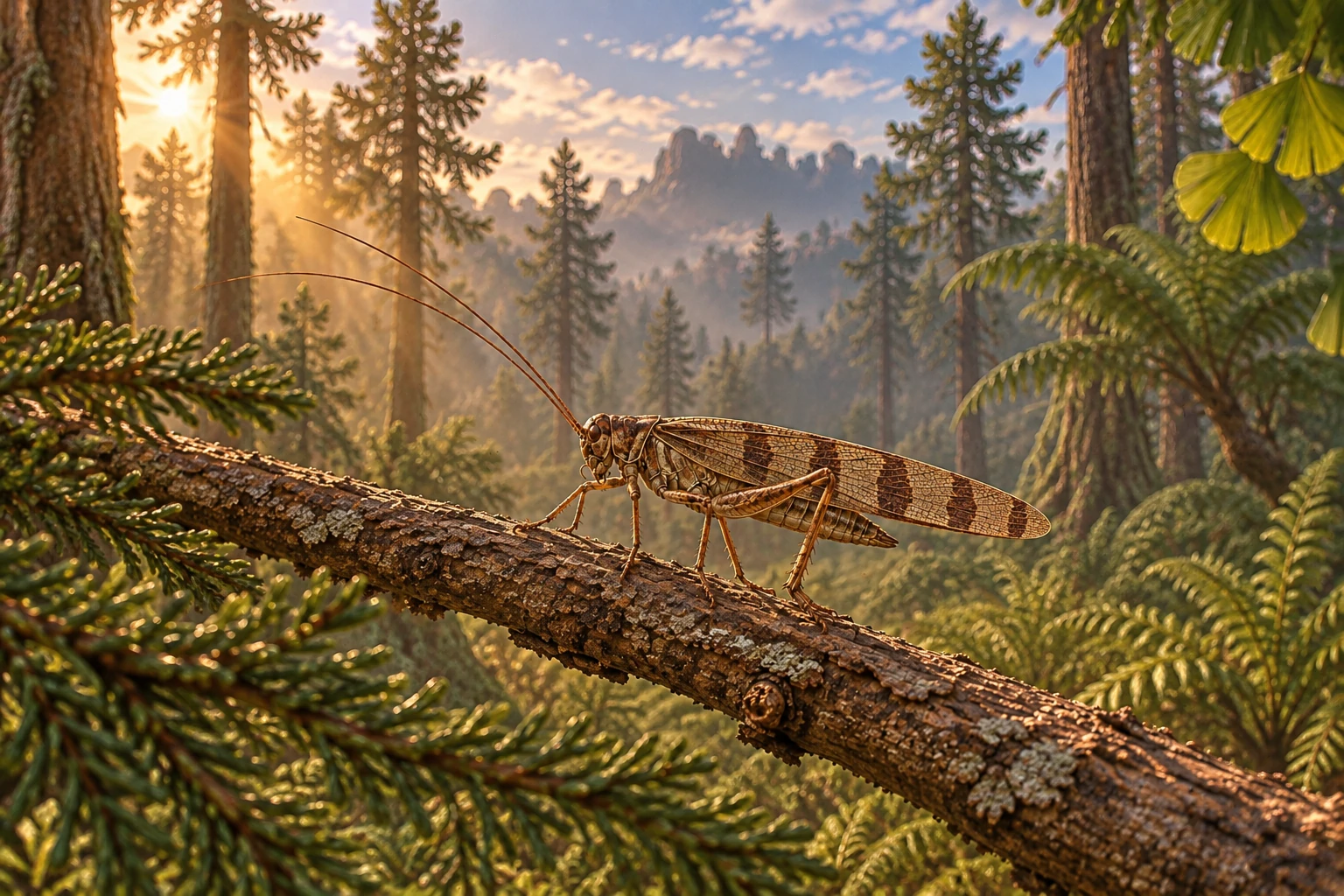
An illustrative reconstruction. Compare its anatomy with the evidence and limitations in the dossier. Lighting, coloration and scenery are artistic choices. This image does not document a fossil locality or behavior.
Original artwork · artistic interpretation.
Scientific view: source-informed reconstruction, credited paleoart or specimen-based imagery. Movie-style view: Original artistic interpretation. Reconstructions involve uncertainty.
MEET THE ANIMAL
Archaboilus was an insect relative of katydids, living long before modern gardens and lawns. A species called Archaboilus musicus came from Middle Jurassic rocks at Daohugou in China. Its best-known fossil is an incomplete pair of male forewings. Researchers estimated a forewing length of about 72 millimeters. That measures one reconstructed wing, not the length of the whole insect. [D1]
Tiny features on those wings helped researchers work out how the animal might have made a call. A row of teeth could rub against a structure on the other wing. Comparisons with living insects produced a model of a musical tone. The researchers interpreted singing as a way to attract a mate, but no fossil records the insect actually singing or meeting a partner. [D3]
A2026 study compared several Jurassic insects and found more than one kind of sound-making arrangement. Another species referred to Archaboilus, A. polyneurus, had tooth-spacing patterns consistent with changing its call. A. musicus remains a low-frequency example; findings about ultrasonic calls in other insects do not turn every member of this genus into an ultrasonic singer. Fossil anatomy supplies clues, while the sound itself remains a reconstruction. [D2]
PREHISTORIC ANIMAL DOSSIER
The animal, the evidence, and the questions still open.
Sound estimates come from wing mechanics and living comparisons; no Jurassic sound recording survives. [D2]
Profile scope: Genus — Archaboilus; gallery outline anchored to A. musicus, an incomplete male forewing pair from Daohugou, China. [D1]
Source supported identifies a description documented by the cited source. Inferred marks a reconstruction or functional estimate. Debated marks competing interpretations. Not established means the sources reviewed for this dossier do not support a firm conclusion; it does not mean a behavior never occurred.
A size reference is an estimate, not a population range. Nesting evidence does not by itself establish courtship, mate choice, or lifelong pairing.
About72 mm estimated forewing
Estimate for the incomplete A. musicus male type; not body length, wingspan or a genus range. [D1]
Not established here
Reviewed wing-based taxonomy provides no fossil-individual body-mass estimate. [D4]
Not established here
The focal wing pair preserves no mouthparts or meal establishing diet. [D1]
Jurassic woodland inferred
Forest and possible nocturnal activity are acoustic comparisons; burial does not identify its exact perch. [D3]
Flight inferred
Forewings indicate a winged insect; flight speed and jumping performance remain unmeasured. [D3]
Veined sound-making forewings
A toothed file supports stridulation; the focal type lacks the complete head, legs and body. [D1]
Not established here
The reviewed adult-wing descriptions identify no attributable eggs or juvenile series. [D4]
Mate-attraction call inferred
The2012 model estimates a 6.4 kHz tone for A. musicus; comparison suggests mate attraction, not a preserved mating sequence. [D3]
Not established here
Modeled species calls do not demonstrate a cooperative group or an observed chorus. [D2]
Sources and inspection notes for the claims in this profile.
THE STORY IN THE FOSSILS
Different tooth spacing can suggest different sound patterns. The2026 study treated A. polyneurus separately from the familiar A. musicus reconstruction, rather than assigning one pitch to every Archaboilus species. [2]
The dossier identifies the scope of each reference estimate. A mount, an individual fossil and a species-wide adult range are different measurements. Comparison metrics remain unavailable where adult scope has not been established. Unknown does not mean zero.
Sources support the stated claims and scopes. Refer to the evidence notes for uncertainty.
KEEP EXPLORING
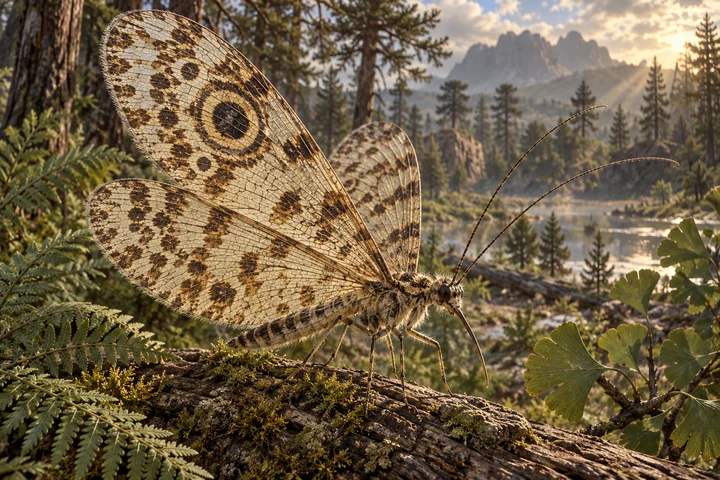
Kalligramma
Prehistoric insect
Kalligramma was a large lacewing whose patterned wings recall butterflies, despite its different ancestry.
Mamenchisaurus
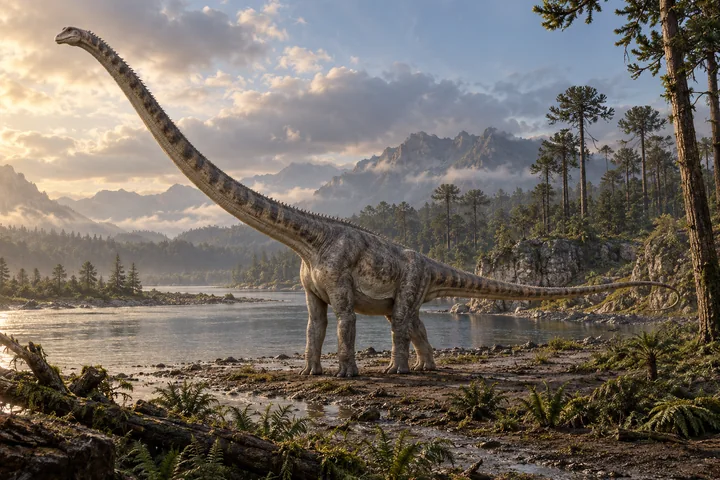
Mamenchisaurus includes long-necked Chinese sauropods. Differing species and recent research require revision of the traditional genus.
Shunosaurus lii
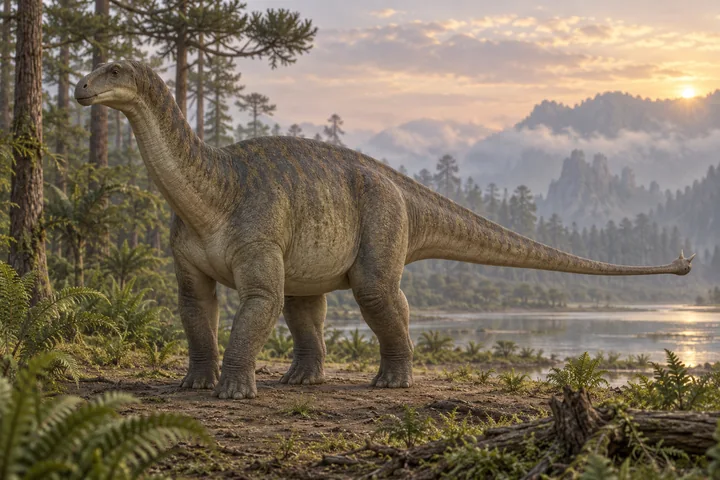
Shunosaurus was a Chinese plant-eater with a comparatively short neck, stout teeth and a small bony tail club.