
Body length
InferredAbout 22 m; legacy genus reference
The directory's body-length reference has no identified species or life stage. The over-14 m estimate in the 2023 paper concerns only the neck of M. sinocanadorum. [D1] [D2]
EXHIBIT 70
Mamenchisaurus
Mamenchisaurus includes long-necked Chinese sauropods. Differing species and recent research require revision of the traditional genus.
TWO WAYS TO PICTURE THE PAST
Compare the evidence with the familiar movie image. The illustrations are not to a shared scale.
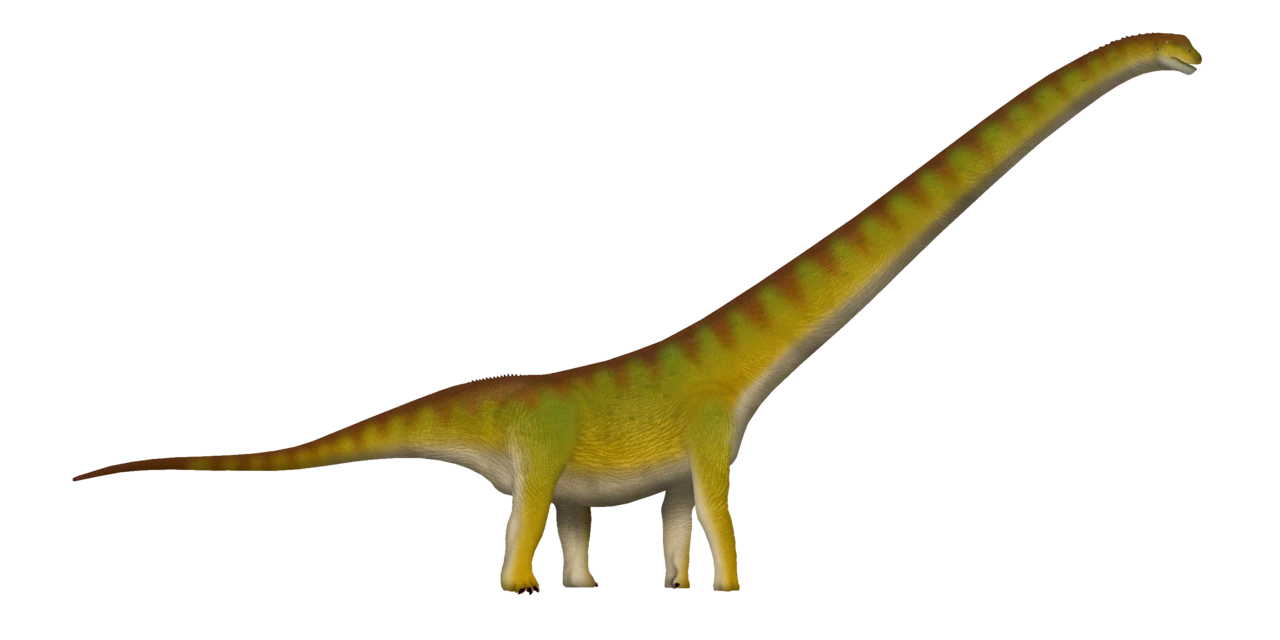
Artist reconstruction captioned as Mamenchisaurus youngi. It does not portray the giant M. sinocanadorum neck estimate or every traditionally assigned species; colours and soft tissues are interpretive. [2]
Mamenchisaurus TD.png · TotalDino. CC BY-SA 4.0. Resized proportionally and converted to WebP; no anatomical edits. Same source license applies.
Scientific reconstruction is an interpretation; source credit does not certify every anatomical detail.
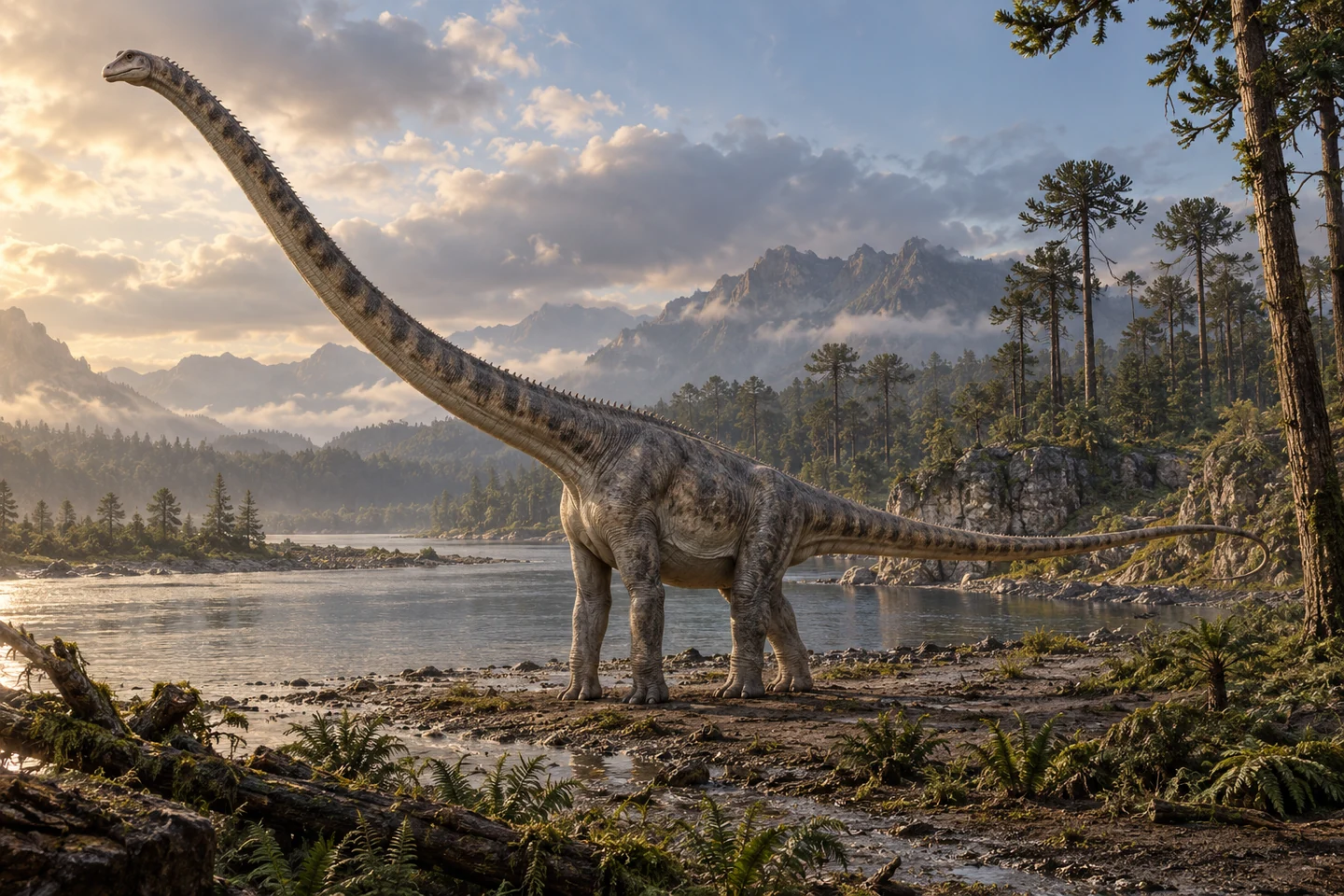
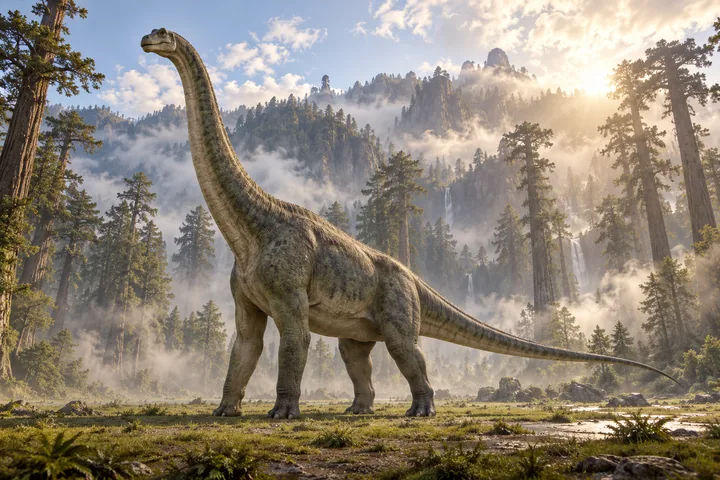
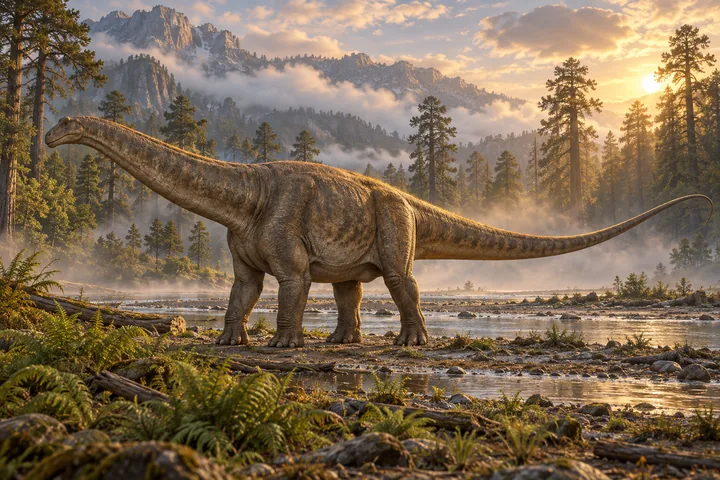
Original cinematic interpretation of Mamenchisaurus. Anatomy, soft tissues and colors are reconstructed choices. Lighting, coloration and scenery are artistic choices. This image does not document a fossil locality or behavior.
Original artwork · artistic interpretation.
Scientific view: source-informed reconstruction, credited paleoart or specimen-based imagery. Movie-style view: Original artistic interpretation. Reconstructions involve uncertainty.
MEET THE ANIMAL
Mamenchisaurus is a name applied to long-necked sauropods from China. The museum account of Mamenchisaurus hochuanensis describes a plant eater with spoon-shaped teeth and a body supported on four legs. That species offers one view of the group, rather than making all traditionally named Mamenchisaurus animals identical in size and anatomy. [D3]
A different species, Mamenchisaurus sinocanadorum, is known from only a handful of skull and neck bones in Jurassic rocks of northwest China. Researchers compared those remains with more complete relatives to estimate a neck longer than fourteen metres. That figure concerns a reconstructed neck, not a complete body measured from nose to tail. [S1]
CT scans revealed extensive air spaces in its neck vertebrae. Long, rod-like neck ribs would have helped stabilize that lightweight structure. These findings offer clues to how such an exceptional neck could be supported, while the original skeleton remains incomplete. A striking reconstruction can therefore be grounded in real anatomy without making every missing part equally certain. The extreme neck estimate also should not be transferred to every species in the genus. [S1]
PREHISTORIC ANIMAL DOSSIER
The animal, the evidence, and the questions still open.
Long-necked Mamenchisaurus requires separate species treatment.
Profile scope: Genus: Mamenchisaurus; species are non-monophyletic in a 2023 analysis. M. hochuanensis and M. sinocanadorum evidence is labeled separately; exceptional neck length is not genus body size.
Source supported identifies a description documented by the cited source. Inferred marks a reconstruction or functional estimate. Debated marks competing interpretations. Not established means the sources reviewed for this dossier do not support a firm conclusion; it does not mean a behavior never occurred.
A size reference is an estimate, not a population range. Nesting evidence does not by itself establish courtship, mate choice, or lifelong pairing.
About 22 m; legacy genus reference
The directory's body-length reference has no identified species or life stage. The over-14 m estimate in the 2023 paper concerns only the neck of M. sinocanadorum. [D1] [D2]
Not established here
No defensible single genus mass is established from the reviewed sources; species and specimen differences prevent a universal value.
Plant-eating sauropods
The museum identifies herbivory; its M. hochuanensis account describes spoon-shaped teeth for stripping plant material. [D1] [D3]
Jurassic East Asia; Chinese fossil sites
The 2023 abstract places traditionally assigned species in an East Asian sauropod radiation. A single habitat or exact age is not applied to every species. [D2]
Four-legged terrestrial sauropods
The M. hochuanensis museum reconstruction is quadrupedal. That anatomical interpretation does not establish speeds or movements of every traditionally assigned species. [D3]
Very long necks; pneumatic vertebrae
CT data reveal extensive air spaces in M. sinocanadorum neck bones. Its exceptional neck length is a scaling estimate from incomplete remains, not a complete measured neck. [D2] [D4]
Not established here
The reviewed sources do not establish species-specific nests, clutch sizes or parental care.
Not established here
The research-team report explicitly calls proposed mating display and neck-butting roles speculative. It does not establish mate choice or combat behavior. [D4]
Not established here
The reviewed sources do not establish a genus-wide herd structure or cooperative behavior.
Sources and inspection notes for the claims in this profile.
THE STORY IN THE FOSSILS
Mamenchisaurus covers substantial variation among Chinese sauropods. A 2023 analysis found that its species do not form one exclusive evolutionary group, requiring taxonomic revision. [2]
Researchers estimated the incomplete M. sinocanadorum neck using more complete relatives, obtaining over 14 metres for the neck alone. That estimate cannot be generalized to every species. [2] [4]
The dossier identifies the scope of each reference estimate. A mount, an individual fossil and a species-wide adult range are different measurements. Comparison metrics remain unavailable where adult scope has not been established. Unknown does not mean zero.
Sources support the stated claims and scopes. Refer to the evidence notes for uncertainty.
KEEP EXPLORING
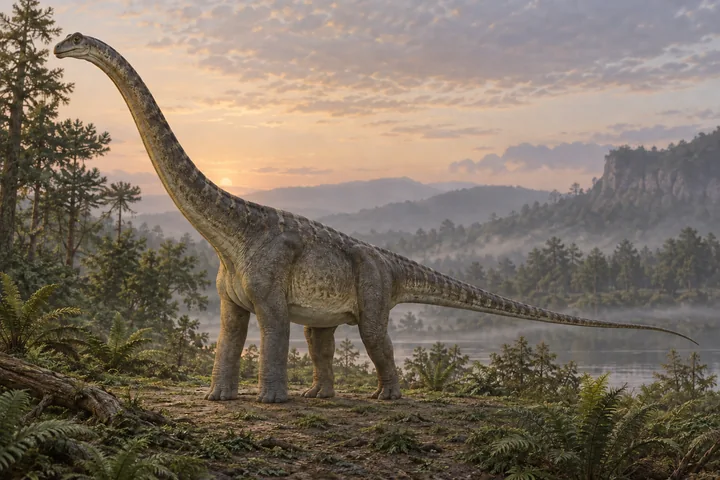
Omeisaurus junghsiensis
Omeisaurus is a Chinese sauropod genus represented by several named species whose fossils and size references must be kept separate.
Brachiosaurus altithorax
Brachiosaurus altithorax was a giant sauropod from Late Jurassic North America. Its name-bearing skeleton is incomplete, and many familiar reconstructions borrow details from the separate African dinosaur Giraffatitan.
Apatosaurus
Apatosaurus was a plant-eating sauropod from the Late Jurassic of North America. Its discovery history includes a famous skeleton displayed with a Camarasaurus head before a narrow Apatosaurus skull was restored.